Rated 5 star on

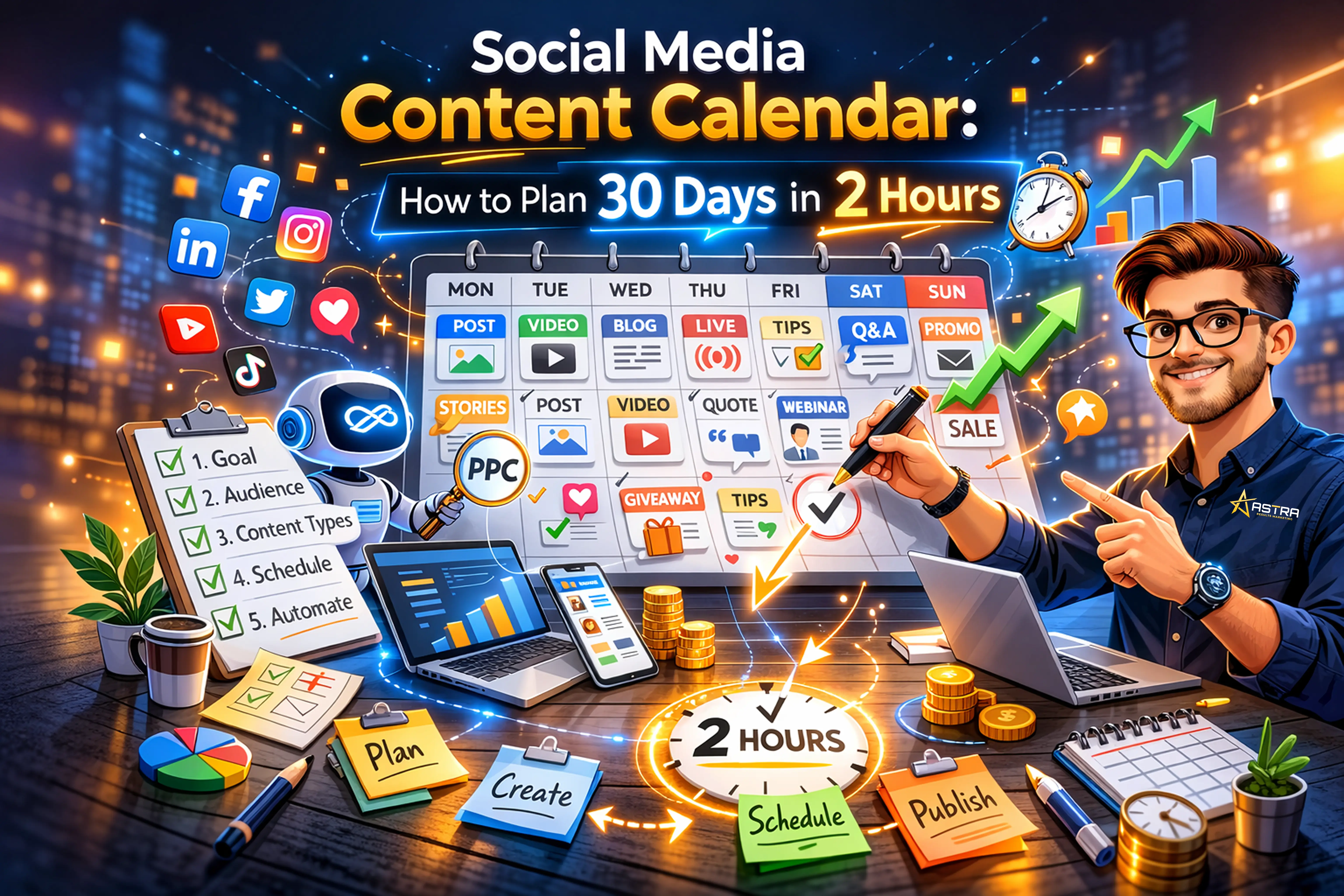
Social Media Content Calendar: How to Plan 30 Days in 2 Hours
A step-by-step system for building a full month of strategic social media content in a single focused session—from content pillars and platform strategy to batching, scheduling, and performance tracking.
Published: February 2026 | Reading Time: ~10 minutes | Category: Social Media & Content Planning
If your social media strategy consists of staring at a blank screen every morning and wondering what to post, you are not alone—and you are wasting hours every week. The most common pain points marketing teams report are inconsistent posting schedules, last-minute content scrambles, and difficulty measuring what is actually working (Ordinal, 2025). The solution is not posting more content. It is planning better content.
A social media content calendar transforms chaotic daily posting into a strategic, repeatable system. Consistent brands see 3x follower growth on LinkedIn (PostZio). Businesses with content calendars report an 8% profit increase through optimized posting schedules (PostZio). And small businesses using calendar automation save an average of 10 hours per week (PostZio). This guide gives you the exact process to plan a full 30 days of content in a single two-hour session—then execute it efficiently throughout the month.
Why Random Posting Is Killing Your Results
Without a content calendar, social media becomes reactive instead of strategic. Here is what goes wrong:
- Inconsistent posting erodes audience trust. Followers expect regular content. When you post three times one week and disappear the next, algorithms deprioritize your content and audiences disengage. Consistency beats volume—choose a schedule your team can maintain without burning out (Ingeniom/Hootsuite).
- Last-minute content is mediocre content. Posts created under time pressure lack the strategic thinking, quality visuals, and compelling copy that drive engagement. When you plan ahead, you have time to create content that is genuinely valuable—not just space-filling.
- No alignment with business goals. Without a plan, social media activity floats independently of your marketing strategy. A content calendar connects every post to a specific business objective: brand awareness, lead generation, customer education, or sales activation.
- Missed opportunities compound. Industry events, seasonal trends, product launches, and cultural moments require advance planning. Without a calendar, you discover these opportunities after they have passed—or scramble to produce low-quality reactive content.
Before You Build: The 5 Strategic Foundations
Your content calendar is a tool to execute your strategy. Without a strategy, you are just scheduling randomness. Define these five foundations before creating any content:
1. Platform Selection
You do not need to be on every platform. Identify which social networks your target audience actually uses, then set a specific goal for each. LinkedIn might be for lead generation, Instagram for brand awareness, and Facebook for community engagement. Spreading yourself across seven platforms with mediocre content on each is worse than dominating two or three with excellent content.
2. Content Pillars
Content pillars are the three to five core themes you will consistently create content around. They should align with your expertise, your audience’s interests, and your business objectives. For example, a digital marketing agency might use these pillars: industry insights, client results, educational how-tos, behind-the-scenes culture, and thought leadership. Every piece of content you create should fit within one of your defined pillars—if it does not, it is off-strategy.
3. Posting Frequency
Determine how often you will post on each platform. A good plan executed consistently beats a perfect plan that fails after two weeks (Ingeniom). Start with a sustainable cadence:
| Platform | Minimum Frequency | Ideal Frequency | Content Type |
|---|---|---|---|
| 3x/week | 5x/week | Thought leadership, case studies, industry insights | |
| 3–4 feed posts/week + daily Stories | 5 feed posts + daily Stories + 2 Reels | Visual content, behind-the-scenes, Reels, carousels | |
| 3x/week | 5x/week | Community posts, videos, event promotion, local content | |
| X (Twitter) | 1x/day | 2–3x/day | News commentary, quick tips, engagement threads |
| TikTok | 3x/week | 1x/day | Short-form video, trends, educational clips |
4. Approval Workflow
Establish a simple process for who creates, reviews, and approves content before it is published. A clear workflow prevents delays, mistakes, and the back-and-forth that slows teams down. Even solopreneurs benefit from a self-review step where they check content against brand guidelines before scheduling.
5. Analytics Cadence
Decide when you will review your social media analytics. Weekly check-ins help you understand what is working and make quick adjustments, while monthly reviews provide the deeper analysis needed for strategic pivots. Regular performance reviews are what separate strategic social media from posting into the void (Ingeniom).
The 2-Hour Calendar Build: Step by Step
Here is the exact process for creating a full 30-day content calendar in a single focused session:
Hour 1: Research and Ideation (60 minutes)
- Review last month’s analytics (15 min): Pull your performance data from each platform. Identify your top 5 performing posts: what content type, topic, format, and posting time produced the best engagement? Also note your lowest performers—patterns in what fails are as valuable as patterns in what succeeds.
- Gather content inputs (15 min): Check your company calendar for product launches, events, promotions, and milestones. Review industry news for trending topics. Scan competitor accounts for content ideas and gaps you can fill. Note relevant holidays and cultural moments (Buffer provides comprehensive social media holiday calendars for each year).
- Generate 30+ content ideas (20 min): Using your content pillars as a framework, brainstorm post ideas for the month. Aim for at least 30 ideas—more than you need—so you can select the strongest ones. Use these idea sources: repurpose blog posts and long-form content into social snippets, turn client FAQs into educational posts, create quote graphics from team expertise, develop behind-the-scenes content from recent projects, and plan user-generated content prompts.
- Map ideas to calendar slots (10 min): Assign each idea to a specific date and platform. Balance your content pillars across the month—do not cluster all your promotional content in week one and all your educational content in week four. Ensure variety in both topic and format (text, image, video, carousel, poll).
Hour 2: Content Creation and Scheduling (60 minutes)
- Write captions in batches (25 min): Write all your captions in one sitting rather than one at a time throughout the month. Batching is significantly more efficient because you stay in writing mode without the context-switching cost of shifting between tasks. AI tools can accelerate this step—use them to generate first drafts based on your topic and platform, then edit for your brand voice. Remember: 91% of marketers stress human involvement in AI-generated content (PostZio).
- Prepare or source visuals (20 min): Gather, create, or assign the images, videos, and graphics needed for each post. Use templates for recurring content formats (weekly tips, client spotlights, stat graphics) to maintain visual consistency while reducing production time. Tools like Canva provide social media templates you can customize to your brand.
- Schedule everything (15 min): Load all content into your scheduling tool with the correct date, time, platform, and media attachments. Double-check that links work, hashtags are appropriate, and mentions are correct. Post at times when your audience is most active—weekdays from 11 AM to 1 PM and 6 PM to 8 PM are generally strong engagement windows (Stackby), but your own analytics should guide your specific timing.
The 80/20 Rule for Content: Plan 80% of your content in advance through your calendar. Leave 20% of your posting slots flexible for trending topics, timely responses, and real-time engagement opportunities. This balance ensures consistency without rigidity.
The Content Mix Formula
Not every post should sell. The most effective social media accounts follow a content mix that balances value with promotion:
| % of Posts | Content Type | Purpose | Examples |
|---|---|---|---|
| 40% | Educational / Value | Build authority, earn saves and shares, attract new followers | How-to tips, industry insights, data-driven posts, tutorials |
| 25% | Engagement / Community | Build relationships, increase algorithmic reach, generate comments | Polls, questions, behind-the-scenes, user-generated content, stories |
| 20% | Brand / Culture | Humanize your brand, attract talent, build trust | Team spotlights, company milestones, values-driven content, testimonials |
| 15% | Promotional / Sales | Drive leads, conversions, and direct revenue | Product features, case studies with CTAs, offers, event promotion |
This mix ensures your audience receives consistent value rather than feeling marketed to constantly. Accounts that lead with value build larger, more engaged audiences that respond better when promotional content does appear.
The Content Repurposing Engine
You do not need 30 completely original ideas every month. One substantial piece of content can fuel an entire week of social posts across multiple platforms. Here is how to turn a single blog post into 8–10 social media posts:
- Pull the key statistic and create a bold visual graphic for Instagram and LinkedIn.
- Extract a controversial or surprising point as a text-based LinkedIn thought leadership post.
- Create a carousel breaking down the blog’s main framework or step-by-step process for Instagram.
- Record a 60-second video summarizing the key takeaway for TikTok, Instagram Reels, and LinkedIn.
- Write a Twitter/X thread expanding on one section of the blog with your personal perspective.
- Create a poll asking your audience about the topic before sharing the blog’s insights.
- Design a quote graphic from the most impactful sentence in the article.
- Write a Story sequence teasing the content with a swipe-up or link sticker to the full post.
This approach means one hour of content creation produces a full week of posts. Video remains particularly impactful: YouTube drives 68% of business impact (PostZio), and 87% of consumers have been influenced to purchase after watching a video (Shopify/Wyzowl). Prioritize video repurposing when possible.
Tools That Streamline Your Calendar
The right tools transform a manual process into a streamlined system. Choose based on your team size and complexity:
| Tool | Best For | Key Feature |
|---|---|---|
| Google Sheets / Excel | Solo operators and small teams starting out | Free, customizable, real-time collaboration; many free templates available |
| Hootsuite | Multi-platform scheduling with analytics | Bulk scheduling, custom approval workflows, platform-specific optimization |
| Buffer | Simple scheduling with clean interface | Instagram, X, Facebook, LinkedIn, TikTok, YouTube, Threads scheduling |
| Later | Visual-first planning (Instagram focused) | Visual content calendar, link in bio tools, Instagram grid preview |
| Sprout Social | Teams needing analytics integration | Strategic content planner connecting past performance to future goals |
| Monday.com | Teams integrating social with broader operations | Cross-department collaboration, automation, real-time visibility |
Start simple. A Google Sheets template is perfectly functional for planning, and you can move to a dedicated tool once your volume and team size justify the investment. The goal is to have a single source of truth where every post, deadline, and asset is visible to everyone who needs it.
The Weekly Execution Rhythm
Hootsuite’s social media team plans and schedules their upcoming content every Friday (Ingeniom). This weekly cadence provides the ideal balance between structure and agility—you can map out campaigns without losing the ability to jump on emerging trends. Here is a recommended weekly rhythm:
- Monday: Review last week’s performance. Which posts performed above or below expectations? Any content gaps this week?
- Tuesday–Wednesday: Create and finalize content for the following week. Write captions, prepare visuals, get approvals.
- Thursday: Schedule the following week’s content. Load everything into your scheduling tool with correct timing and platform settings.
- Friday: Plan and brainstorm. Review the calendar for the next 2–3 weeks, note upcoming events or trends, and generate fresh ideas.
- Daily (15 min): Monitor engagement, respond to comments and messages, and capture any real-time opportunities for reactive content. Community management is not optional—social media is a two-way conversation.
Measuring What Matters
Track these metrics monthly to evaluate and improve your content calendar performance:
- Engagement rate: Likes, comments, shares, and saves divided by reach. This measures content quality—are people actually interacting with your posts?
- Reach and impressions: How many people see your content? Growing reach indicates algorithmic favor and audience expansion.
- Link clicks and traffic: How many people move from social media to your website? This measures your ability to convert social attention into business interest.
- Follower growth rate: Net new followers per month. Consistent brands see 3x faster growth (PostZio).
- Content pillar performance: Which of your pillars generates the most engagement? This data should inform how you weight your content mix going forward.
- Time saved: Track how many hours your team spends on social media content creation and scheduling. A well-maintained calendar should reduce this over time as you build templates, processes, and a library of reusable content.
From Scramble to System
A social media content calendar is not about removing spontaneity from your social presence—it is about creating the structure that makes spontaneity possible. When your core content is planned, created, and scheduled in advance, you have the mental bandwidth and schedule flexibility to jump on trends, respond to news, and engage authentically with your community.
Two hours of focused planning per month replaces 30 days of daily scrambling. That is the trade-off, and it is not close. Start with the process outlined here: define your foundations, batch your ideation and creation, schedule everything, then execute your weekly rhythm of review and optimization. The businesses that treat social media as a planned, measured discipline—rather than an afterthought or a chore—are the ones building audiences that translate into revenue.
References
The following sources informed this article:
- Buffer (2025). “180+ Social Media Calendar for Every Holiday of 2026.”
- Hootsuite (2025). “Social Media Calendar: Top Tools and Templates for 2025.”
- Ingeniom (2025). “Build Your 2025 Social Media Calendar Now.”
- Monday.com (2026). “Social Media Calendar Template: Guide, Tips and Strategies for 2026.”
- Ordinal (2025). “Social Media Content Planning Guide.”
- PostZio (2026). “Social Media Content Calendar Guide for 2026.”
- SocialBee (2025). “2026 Social Media Calendar Template with Ideas.”