Rated 5 star on

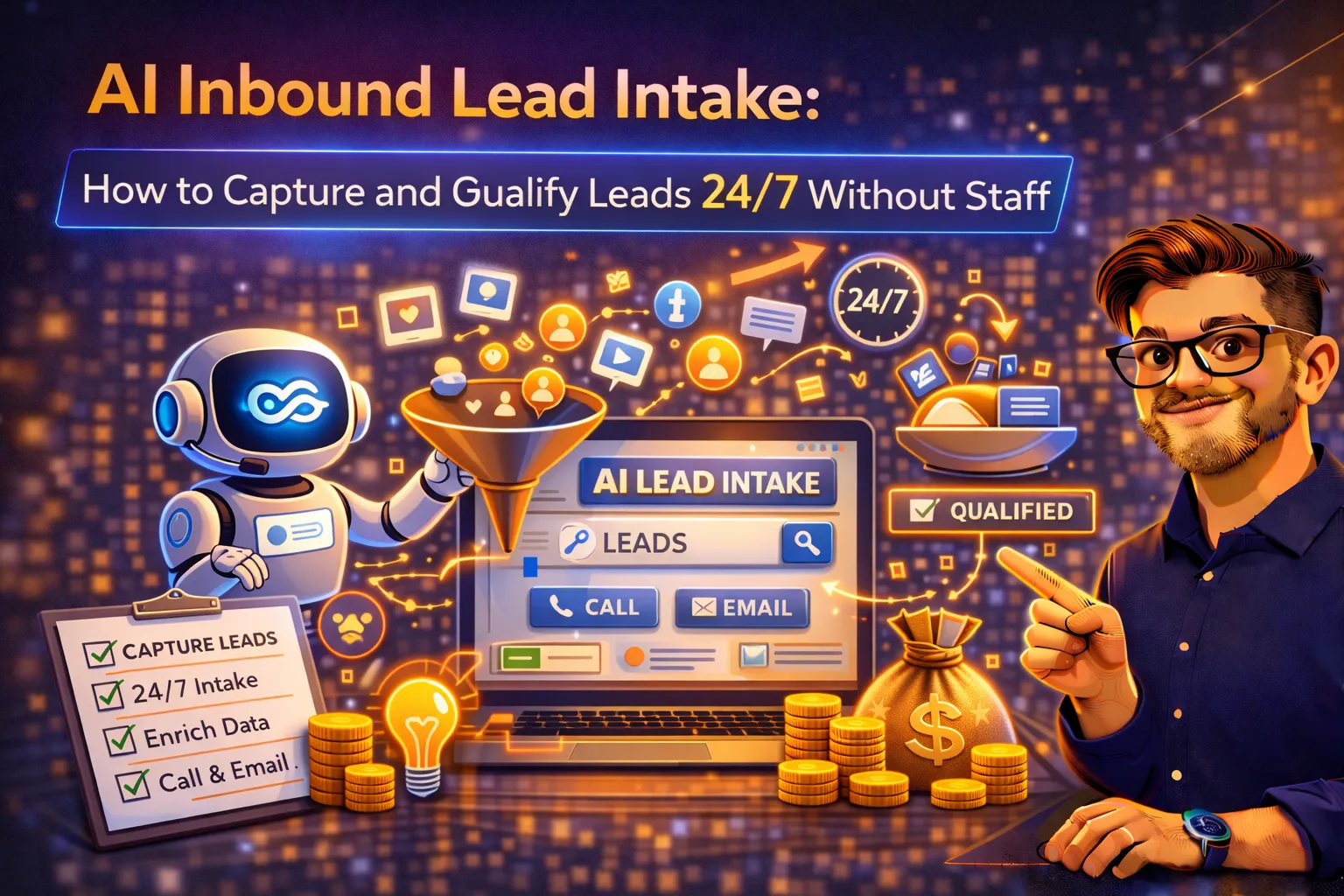
AI Inbound Lead Intake: How to Capture and Qualify Leads 24/7 Without Staff
The speed-to-lead data that proves why every minute matters, how AI-powered lead intake works, and a practical framework for service businesses ready to stop losing after-hours inquiries.
Published: March 4, 2026 | Reading Time: ~10 minutes | Category: AI Services
A potential customer visits your website at 9:47 p.m. on a Tuesday. They need an HVAC repair, a dental appointment, a legal consultation, or an estimate for new flooring. They fill out your contact form—or worse, they call and reach voicemail. By the time your team follows up at 9 a.m. the next morning, that lead has already contacted two competitors and booked with the one who answered first.
This scenario plays out thousands of times every day across service businesses in the United States. The data is unforgiving: (Harvard Business Review/Prospeo), and a staggering 63% of companies never respond at all (RevenueHero). Meanwhile, than those contacted after 30 minutes (Lead Response Management). That gap between when your leads arrive and when your team responds is not a minor inefficiency—it is a revenue hemorrhage.
AI inbound lead intake eliminates that gap entirely. It captures every inquiry instantly, qualifies the lead in real time, gathers the information your sales team needs, and routes qualified prospects to the right person—all without a human needing to be available. For service businesses that depend on inbound leads, it is the single highest-ROI investment available in 2026.
The Speed-to-Lead Crisis: What the Data Shows
Speed to lead—the time between when a prospect shows interest and when your business makes first contact—is the most underappreciated metric in sales. The research is unambiguous: response time does not just influence conversions; it determines them.
| Response Time | Impact on Conversion | Source |
|---|---|---|
| Within 1 minute | 391% higher conversion rate | Velocify |
| Within 5 minutes | 21x more likely to qualify; 100x more likely to connect | Lead Response Management / Forbes |
| 5 to 10 minutes | 400% decrease in qualification odds | Harvard Business Review |
| After 30 minutes | Conversion probability drops dramatically | InsideSales / LeanData |
| Industry average: 42–47 hours | 73% of leads never contacted at all | HBR / Prospeo / Rep.ai |
The numbers get worse for service businesses specifically. Nearly half of all inbound leads arrive during evenings, weekends, and off-hours when most teams are unavailable (LeadAngel). Only 7% of companies manage to respond within the critical five-minute window (Outreach Bloom). And between 35% and 78% of sales go to whichever vendor responds first (Setter AI/Voiso).
The Revenue Impact: A home improvement company receiving 50 inbound leads per week that takes an average of 12 hours to respond is losing roughly 60–70% of those opportunities before the first conversation ever happens. At a $5,000 average project value, that is $87,500–$175,000 in lost monthly revenue—not from a marketing problem, but from a response-time problem.
What AI Inbound Lead Intake Actually Does
AI inbound lead intake is not a simple autoresponder or a chatbot that says “Thanks for contacting us!” and disappears. It is an intelligent system that performs the same functions as a trained intake specialist—but instantly, 24 hours a day, across every channel simultaneously.
Here is what happens when a lead comes in through an AI-powered intake system:
Step 1: Instant Engagement
The moment a prospect submits a form, sends a text, calls your phone line, or messages through your website chat, the AI responds within seconds. It greets the prospect by name (when available), acknowledges their inquiry, and begins a natural, conversational interaction. There is no hold music, no voicemail, no “we will get back to you within 24 hours.”
Step 2: Intelligent Qualification
The AI asks targeted questions to determine whether the lead is a good fit for your business. For a dental practice, this might mean asking about insurance, the type of appointment needed, and scheduling preferences. For a law firm, it could involve gathering details about the incident type, timeline, and whether the caller has representation. For an HVAC company, the AI identifies whether the call is an emergency repair, a maintenance request, or a new installation estimate—and routes accordingly.
Step 3: Information Capture
During the conversation, the AI collects all the data your team needs: contact information, service requested, location, timeline, budget indicators, and any special circumstances. This information is structured and organized—not buried in a voicemail that someone has to transcribe later.
Step 4: Routing and Scheduling
Qualified leads are routed instantly. Depending on your setup, the AI can book an appointment directly on your calendar, send a notification to the right team member with the full conversation transcript, trigger a CRM entry with all captured data, or escalate urgent matters (like emergency plumbing or accident intake) to an on-call human immediately.
Step 5: Follow-Up Sequences
If a lead does not convert on the first interaction, the AI initiates follow-up—via text, email, or both—at optimized intervals. Research shows that 80% of sales require five or more follow-up attempts to close (Voiso), yet most businesses quit after one or two attempts. AI never forgets to follow up.
Why Traditional Lead Intake Fails Service Businesses
Most service businesses rely on one of three intake methods, all of which have critical weaknesses:
| Method | How It Works | Where It Fails |
|---|---|---|
| Front-desk staff / receptionist | Answers calls and emails during business hours; handles walk-ins and scheduling simultaneously | Unavailable after hours, during lunch, when on another call, or on sick/vacation days; quality varies with workload |
| Voicemail / contact forms | Captures messages when no one is available; team follows up during business hours | Average 42–47 hour response time; 63% of leads never get a callback; zero qualification happens at point of contact |
| Answering service / call center | Third-party operators answer calls using scripts; messages are relayed to your team | No real qualification; operators cannot answer business-specific questions; customer experience feels impersonal; costs $500–$2,000+/month |
The fundamental problem with all three methods is the same: they create a delay between the moment a lead shows intent and the moment your business delivers value. Every minute of that delay erodes conversion probability. AI eliminates the delay entirely.
The Qualification Advantage: Why Lead Quality Matters More Than Volume
Generating leads is expensive. The average cost per lead across industries sits around $198, with some service verticals running significantly higher (DesignRush). Yet (SPOTIO), and 67% of lost deals happen because leads were not qualified properly (SalesSo). The problem is not lead generation—it is lead qualification.
AI-powered lead intake addresses this directly. By qualifying every lead at the point of first contact, AI ensures your team spends time exclusively on prospects who are a genuine fit. The data supports the impact: organizations implementing AI-driven lead scoring achieve a 40% improvement in qualification accuracy compared to manual or rule-based systems (Landbase/SPOTIO). Companies using AI-driven workflows report 35% higher conversion rates overall (GTM 80/20). And businesses with robust lead nurturing programs generate 50% more sales-ready leads while reducing costs by 33% (Forrester/Salesgenie).
For service businesses, qualification at intake means asking the right questions immediately: Is the prospect within your service area? Do they need a service you actually offer? What is their timeline? Do they have the budget or insurance? Is this an emergency or routine request? When AI handles these questions upfront, your team receives only leads that are pre-qualified, pre-informed, and ready to book.
AI Lead Intake by Service Industry
The intake process varies by vertical, but the advantages are consistent:
HVAC and Plumbing
Emergency calls at 2 a.m. go to AI instead of voicemail. The AI determines whether it is an emergency (burst pipe, no heat in winter, gas leak) or a routine request (maintenance, filter replacement, estimate). Emergencies are escalated to the on-call technician with full details. Routine requests are qualified and scheduled for the next available slot. No lead is lost; no emergency goes unresponded.
Dental Practices
The AI handles appointment requests, answers insurance questions, provides office hours and location information, and fills cancellation gaps by texting patients on the waitlist when a slot opens. It pre-qualifies new patients with the information the front desk typically gathers—saving 10 to 15 minutes per patient and reducing no-shows through automated confirmation sequences.
Personal Injury Law Firms
Legal intake is uniquely time-sensitive. Accident victims search for representation immediately after an incident—often late at night or on weekends. AI intake captures the critical details: type of accident, date, injuries sustained, whether another attorney is involved, and contact information. Qualified cases are flagged and routed to an attorney for same-day follow-up, even on weekends.
Home Improvement and Roofing
Seasonal spikes—storm damage inquiries, spring renovation season, end-of-year projects—overwhelm small teams. AI handles the surge without temporary staff, qualifying leads by project type, scope, timeline, and property details. Hot leads (large projects, immediate timeline) are prioritized; informational inquiries receive automated nurturing sequences that keep them engaged until they are ready to move forward.
Measuring the ROI of AI Lead Intake
Track these five metrics to measure your AI lead intake performance:
| Metric | What It Measures | Target Benchmark |
|---|---|---|
| First response time | Time from inquiry to AI’s first response | Under 30 seconds |
| Lead capture rate | Percentage of inquiries that result in captured contact info | 85%+ (vs. 30–40% for forms/voicemail) |
| Qualification accuracy | Percentage of AI-qualified leads that convert to appointments | 40%+ (vs. 11% for unqualified leads) |
| After-hours capture | Leads captured outside business hours that would have been missed | Track as net-new revenue opportunity |
| Cost per qualified lead | Total AI cost divided by number of qualified leads delivered | Compare to cost of front-desk staff + missed-lead revenue |
The ROI calculation for most service businesses is straightforward. If AI captures even 10 additional qualified leads per month that would have been lost to voicemail or slow follow-up, and your average customer lifetime value is $3,000–10,000, the annual revenue impact is $360,000 to $1.2 million—from a system that costs a fraction of a single full-time employee.
Implementation: Getting Started in 30 Days
Week 1: Audit and Baseline
- Document your current lead sources: phone, website forms, chat, email, social media.
- Measure your current average response time. Check your CRM timestamps or simply test yourself—submit a form on your own site and see how long it takes to get a response.
- Calculate your after-hours lead volume. How many inquiries arrive when no one is available?
- Identify your top three to five qualification questions—the information your team absolutely needs before booking an appointment or consultation.
Week 2: Platform Selection and Setup
- Choose an AI lead intake solution that supports your primary channels (phone, chat, SMS, email).
- Configure the AI with your business information: services, pricing ranges, service areas, hours, and booking availability.
- Build your qualification flow—the sequence of questions the AI asks and the criteria that determine whether a lead is qualified, needs nurturing, or should be disqualified.
- Connect to your CRM and calendar for automated lead entry and appointment booking.
Week 3: Testing and Refinement
- Run internal tests across all channels. Have team members pose as different types of prospects—emergency calls, tire-kickers, qualified buyers, out-of-area inquiries.
- Review AI conversation transcripts and refine responses where the AI struggles or provides incomplete information.
- Set up notification rules so your team is alerted instantly when a high-priority lead is captured.
Week 4: Launch and Monitor
- Go live across all configured channels.
- Monitor conversations daily for the first two weeks. Identify patterns in what leads ask and how the AI responds.
- Compare your first-week metrics (response time, capture rate, qualification rate) to your pre-AI baseline.
- Adjust and optimize based on real data. The AI improves with feedback, so invest time early in refining its performance.
Stop Losing Leads You Already Paid For
Every dollar you spend on SEO, PPC, social media, and referral marketing is designed to generate inbound interest. The tragedy for most service businesses is that a significant percentage of that interest is wasted—not because the marketing failed, but because no one was there to answer when the prospect reached out.
AI inbound lead intake solves the most expensive problem most service businesses do not realize they have: the gap between lead generation and lead conversion. It responds in seconds, not hours. It qualifies intelligently, not generically. It works at 2 a.m. on a Saturday with the same precision as 10 a.m. on a Tuesday. And it never forgets to follow up.
(Outreach Bloom). (Setter AI). The businesses that win are not necessarily generating more leads—they are capturing and qualifying a higher percentage of the leads they already have. AI inbound lead intake is how you become the first responder, every time, without adding headcount.
References
The following sources informed this article:
- Chili Piper (2026). "What Is Lead Response Time and How It Wins You More Deals."
- DesignRush (2025). "2026 Lead Generation Statistics: Benchmarks, AI Trends & Revenue Growth."
- Forrester Research / Salesgenie (2025). Lead Nurturing Performance Data.
- GTM 80/20 (2026). "39 B2B Lead Generation Statistics Every Growth Team Needs in 2026."
- Harvard Business Review. Lead Response Time Study (100,000 call attempts).
- Kixie (2025). "Speed to Lead Response Time Statistics That Drive Conversions."
- Landbase (2026). "35 Lead Qualification Statistics: Essential Data for B2B Sales Success."
- LeadAngel (2025). "What Is Speed to Lead? Statistics, Strategies, and Software."
- Martal Group (2026). "Lead Generation Statistics 2026: Trends, Benchmarks & Insights."
- Optifai (2026). "Lead Response Time Benchmark Study (N=939 B2B SaaS companies)."
- Outreach Bloom / Setter AI (2026). "Sales Response Time Statistics: 20 Stats for 2026."
- Prospeo / RevenueHero (2026). "Average Lead Response Time in 2026: Data & Benchmarks."
- SalesSo (2025). "SDR Lead Qualification Statistics That Drive Revenue."
- SPOTIO (2025). Sales Statistics and Lead Qualification Benchmarks.
- Velocify (2016/2025). Lead Response Time Conversion Study.
- Verse.ai (2025). "25 Eye-Opening Speed to Lead Statistics."
- Voiso (2025). "How Faster Lead Response Times Can Skyrocket Conversions."