Rated 5 star on

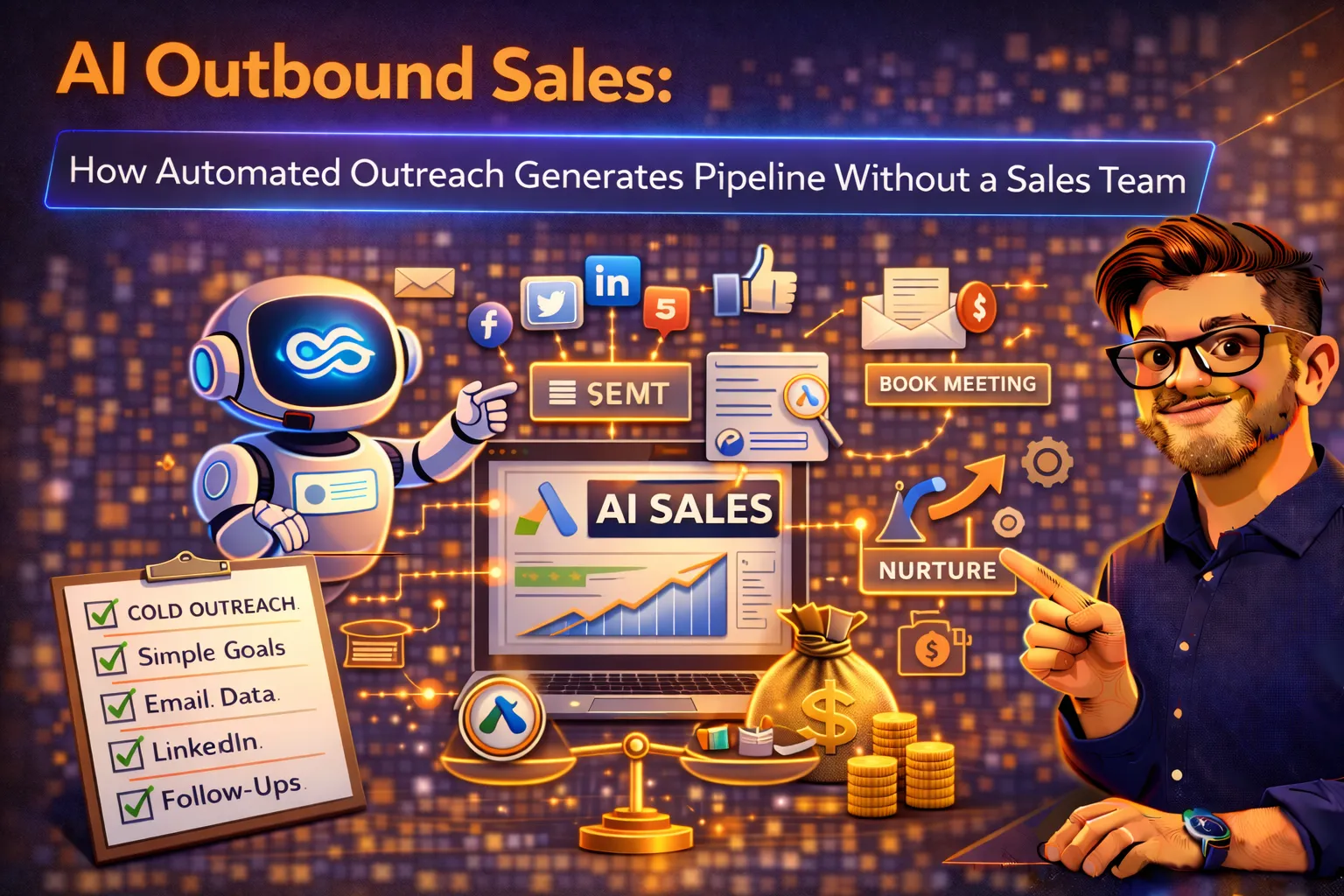
AI Outbound Sales: How Automated Outreach Generates Pipeline Without a Sales Team
How AI-powered outbound prospecting, multichannel sequencing, and autonomous SDR agents are transforming pipeline generation for service businesses—and where the technology still needs a human hand.
Published: March 9, 2026 | Reading Time: ~11 minutes | Category: AI & Sales Automation
Outbound sales has become brutally harder. Cold email reply rates have dropped to around 5%, down from approximately 7% a year prior (Martal Group/SalesSo). It now takes an average of 18 touches to book a meeting—up from five to seven touches just a few years ago (SalesSo). Cold call connect rates sit between 3% and 10%. And the average SDR spends a staggering 70% of their workday on non-selling activities: researching prospects, updating CRMs, drafting emails, and managing follow-ups (MarketsandMarkets).
For service businesses—HVAC companies, dental practices, law firms, home improvement contractors—hiring a full-time sales team to run outbound prospecting is often financially impractical. A single SDR costs $55,000–85,000+ per year in salary alone, books an average of 12–15 completed meetings per month (Operatix), and spends most of their time on tasks a machine can now do faster and more consistently.
AI outbound sales automation changes that equation entirely. Companies investing in AI and automation report a 2.5x higher meeting booking rate (HubSpot), with teams using AI-powered workflows experiencing up to a 30% increase in lead conversion rates and responding to prospects 60% faster (Salesforce/11x.ai). AI is projected to direct 70% of all outbound activity by 2026 (Koncert/ProfileSpider). The businesses winning at outbound are not sending more emails—they are deploying AI to identify better prospects, personalize at scale, and coordinate multichannel sequences that would be impossible for human teams alone.
The Outbound Problem: Why Manual Prospecting Is Failing
The traditional outbound model—hire SDRs, give them lists, have them send emails and make calls—is breaking down for three reasons:
| Challenge | The Data | Impact |
|---|---|---|
| Declining response rates | Cold email reply rates ~5%; cold call connect rates 3–10%; 18 touches needed per meeting | Dramatically more effort required per booked appointment; ROI on manual SDR time declining |
| SDR time allocation | 70% of SDR time spent on non-selling activities (research, CRM updates, email drafting) | Only 30% of expensive human labor is spent on actual revenue-generating conversations |
| Personalization gap | Only ~5% of outbound senders personalize each email effectively; personalized emails get 142% higher reply rates | Most outbound feels generic; the few who personalize well dominate reply rates |
Sources: SalesSo, Martal Group, MarketsandMarkets, LevelUp Leads, Woodpecker/Smartlead (2025–2026).
The fundamental problem is one of scale and precision. Effective outbound requires identifying the right prospects, crafting messages that resonate with each individual, reaching out at the right time through the right channel, and following up persistently across 10–18+ touches—all while maintaining quality. No human SDR can do all of this at scale. AI can.
How AI Outbound Sales Automation Works
Modern AI outbound platforms handle the entire sales development motion—from prospect identification through meeting booked—using four core capabilities:
1. AI-Powered Prospecting and Lead Identification
Instead of working from static purchased lists, AI prospecting tools analyze your existing customer data to build a dynamic ideal customer profile (ICP). They then scan data sources—company databases, technographic data, hiring signals, funding announcements, website visitor behavior, and social media activity—to identify prospects who match your ICP and are showing buying intent signals. The result is a continuously refreshed list of high-probability prospects, not a stale spreadsheet. AI-powered enrichment also eliminates manual research: what used to take an SDR two hours of research per prospect now takes two to three minutes (Cubeo AI).
2. Hyper-Personalized Outreach at Scale
This is where AI transforms outbound from spray-and-pray into precision targeting. AI outbound tools analyze each prospect’s company, role, recent activity, technology stack, and publicly available information to generate personalized emails, LinkedIn messages, and call scripts—each tailored to the specific person. Highly personalized cold emails increase reply rates by up to 142% (Woodpecker/Smartlead). Personalized subject lines alone boost replies by 30% (RemoteReps247). AI makes this level of personalization possible at a volume that no human team can match.
3. Multichannel Sequencing and Optimal Timing
Effective outbound in 2026 is not email-only. AI platforms coordinate sequences across email, LinkedIn, phone, and SMS—automatically adjusting the channel and timing based on each prospect’s engagement patterns. The AI determines the optimal time to send an email to a specific prospect, when to follow up, whether to switch channels, and when to escalate to a phone call. This multichannel orchestration is what drives the 18-touch cadences that modern outbound requires—without any manual scheduling or tracking.
4. Autonomous Follow-Up and Qualification
The AI handles the persistent follow-up that human SDRs consistently fail to execute. When a prospect opens an email but does not reply, the AI sends a follow-up at the optimal interval. When a prospect clicks a link, the AI can trigger a higher-priority sequence. When a prospect replies with interest, the AI can qualify them with targeted questions and route them to a human closer. When a prospect asks to be removed, the AI handles the opt-out immediately. This autonomous follow-up capability alone represents one of the highest-value applications of AI in sales—80% of sales require five or more follow-ups, yet most teams stop after one or two attempts (Voiso).
AI Outbound for Service Businesses: Practical Applications
While AI outbound is often discussed in B2B SaaS contexts, it applies directly to service businesses that need to proactively generate pipeline:
Home Improvement and Contracting
AI identifies homeowners in your service area who are likely in the market for renovations—based on home age, recent permit activity, neighborhood renovation trends, and online behavior signals. It then sends personalized outreach offering a free estimate or seasonal promotion. For companies targeting commercial projects, AI can identify property managers, real estate developers, and facility managers showing intent signals and run multichannel campaigns automatically.
Dental and Healthcare Practices
AI outbound can target residents who have recently moved into your service area (high probability of needing a new dentist), families with children approaching certain age milestones, or patients who have not visited in a defined period. The AI sends personalized re-engagement messages, new patient offers, and recall reminders through email and SMS sequences—keeping your schedule full without adding front-desk staff.
Legal Services
For law firms targeting commercial clients (business formation, employment law, real estate transactions), AI outbound identifies businesses matching your ICP—new business filings, companies reaching employee count thresholds, or businesses in specific industries—and runs outreach campaigns offering consultations. For personal injury firms, AI can automate referral partner outreach to chiropractors, medical offices, and body shops, maintaining relationships at scale.
B2B Service Providers
Marketing agencies, IT service providers, accounting firms, and consulting businesses use AI outbound to replace or augment cold calling and manual email campaigns. AI identifies companies matching your ICP, personalizes outreach based on the prospect’s specific situation (tech stack, team size, recent growth), and books discovery calls directly on your calendar. The result is a predictable pipeline without a full-time SDR team.
The Real Benchmarks: What to Expect
Setting realistic expectations is critical. AI outbound improves upon manual performance, but it does not produce miracles overnight:
| Metric | Manual Outbound Benchmark | AI-Powered Benchmark |
|---|---|---|
| Cold email reply rate | ~5% average | 8–15% with AI personalization (top performers) |
| Touches to book a meeting | 18+ average | Same cadence length, but automated and consistent |
| SDR time on non-selling tasks | 70% of workday | Reduced to 20–30% (research, CRM updates automated) |
| Lead conversion rate improvement | Baseline | Up to 30% increase (Salesforce) |
| Response speed to prospects | Hours to days | 60% faster (Salesforce/11x.ai) |
| ROI timeline | N/A | 30–60 days: deliverability and time savings; 90–120 days: pipeline impact; 6–12 months: full SDR cost savings (Zintlr) |
The Cost Comparison: A full-time SDR costs $55,000–$85,000+ per year (salary only), books an average of 12–15 meetings per month, and requires management, training, and tools. AI outbound platforms typically cost $500–$3,000 per month, run 24/7, never take sick days, and can manage outreach to thousands of prospects simultaneously. Even at the higher end of AI tooling costs ($36,000/year), the savings compared to a single SDR—plus the scale advantage—make the ROI case compelling for any service business generating $500,000+ in annual revenue.
Where AI Outbound Still Needs Humans
AI outbound is powerful, but it has clear limitations. The businesses that get the best results use AI for the repetitive, data-intensive work while keeping humans in the loop for the moments that matter:
Strategy and Messaging Direction
AI can generate personalized variations of your messaging, but it cannot define your value proposition, your positioning, or your competitive differentiation. A human must determine what to say—AI determines how to say it at scale and when to deliver it.
Complex and High-Stakes Conversations
When a prospect replies with detailed questions, objections, or negotiation requests, a human should take over. AI handles the opening sequence and qualification; humans handle the relationship-building and closing. The hybrid model—AI for volume, humans for depth—consistently outperforms both full automation and fully manual approaches.
Domain Reputation and Deliverability
Sending large volumes of automated email without proper infrastructure can destroy your domain reputation and land you in spam folders. AI outbound requires proper domain warming, SPF/DKIM/DMARC authentication, dedicated sending domains (separate from your primary business domain), and careful volume management. This is a technical foundation that must be set up correctly before scaling—and monitored continuously.
Brand Voice and Compliance
Every automated message represents your brand. AI-generated outreach must be reviewed regularly to ensure it matches your tone, accurately represents your services, and complies with CAN-SPAM, TCPA, and any industry-specific regulations. Set up human review checkpoints—especially in the first 30 days—before allowing the system to run fully autonomously.
Implementation Roadmap: 90 Days to AI-Powered Outbound
Days 1–30: Foundation
- Define your ideal customer profile (ICP): industry, company size, geography, job titles, and buying triggers.
- Build or refine your core messaging: value proposition, pain points you solve, proof points, and differentiation.
- Set up technical infrastructure: dedicated sending domain, email authentication (SPF, DKIM, DMARC), domain warming over 2–4 weeks.
- Select your AI outbound platform based on your channels (email, LinkedIn, phone), volume needs, and budget.
- Integrate with your CRM so all prospect data, activity, and responses flow into a single system of record.
Days 31–60: Launch and Learn
- Start with a controlled campaign: 200–500 prospects matching your ICP, with 3–5 email touches per sequence.
- Test messaging variations: two to three different angles, subject lines, and call-to-action approaches.
- Monitor key metrics daily: open rates, reply rates, bounce rates, and unsubscribe rates. Adjust messaging based on early data.
- Review AI-generated messages weekly for brand voice accuracy and factual correctness.
- Set up human handoff protocols: when a prospect replies with interest, how quickly does a human engage?
Days 61–90: Optimize and Scale
- Analyze which messaging angles, subject lines, and sequences produce the highest reply and meeting rates.
- Expand to multichannel: add LinkedIn outreach and phone touchpoints to your sequences based on what your audience responds to.
- Increase volume to 1,000–5,000+ prospects per month as deliverability and conversion metrics stabilize.
- Implement lead scoring: prioritize prospects who engage (open multiple emails, click links, visit your website) for immediate human follow-up.
- Establish a monthly review cadence: pipeline generated, cost per meeting booked, conversion from meeting to customer, and ROI versus manual outbound costs.
Measuring ROI: The Metrics That Matter
| Metric | What It Measures | Target |
|---|---|---|
| Reply rate | Percentage of prospects who respond to your outreach | 8–15% for well-targeted, personalized campaigns |
| Meeting booking rate | Percentage of replies that convert to scheduled meetings | 25–40% of positive replies |
| Cost per meeting booked | Total AI platform cost divided by meetings booked | Compare to SDR fully loaded cost / meetings per month |
| Pipeline generated | Total dollar value of opportunities created from outbound | Track monthly; expect ramp at 90–120 days |
| Meeting-to-customer conversion | Percentage of booked meetings that become paying customers | 20–35% for well-qualified outbound leads |
| Domain health | Email deliverability, spam complaint rate, sender reputation score | Deliverability >95%; spam complaints <0.1% |
AI Outbound as a Pipeline Engine
The businesses generating predictable pipeline in 2026 are not hiring armies of SDRs—they are deploying AI to handle the 70% of outbound work that does not require human judgment while focusing their human talent on the 30% that does: strategy, relationship building, and closing.
Companies using this approach report a 2.5x higher meeting booking rate (HubSpot). They respond to prospects 60% faster (Salesforce). And AI will direct 70% of all outbound activity by the end of the year (Koncert/ProfileSpider). The technology is not replacing salespeople—it is replacing the manual, repetitive work that prevents salespeople from selling.
Start with the foundation: define your ICP, build your messaging, set up your technical infrastructure. Launch a controlled campaign, measure the results, and scale what works. AI outbound is not a magic bullet—it is a system that rewards good inputs with compounding outputs. The businesses that build this system now will have a significant and growing advantage over those still relying on manual outbound in an environment where response rates are declining and the cost of human SDRs keeps rising.
References
The following sources informed this article:
- Artisan (2026). "How AI Is Changing Outbound Sales Automation in 2026."
- Cirrus Insight (2026). "Top 12 AI Outbound Sales Tools + Benefits & Strategies for 2026."
- Cubeo AI (2026). "Lead Qualification: The Complete Guide to Identifying High-Value Prospects."
- Ema (2026). "7 Best Outbound Sales Automation Tools for 2026."
- HubSpot (2025–2026). Sales Automation and ROI Research.
- Koncert / ProfileSpider (2026). AI Outbound Activity Projections.
- LevelUp Leads (2025). "Cold Email Benchmarks 2025."
- MarketsandMarkets (2025). "How Agentic AI in Sales Is Redefining SDR Productivity."
- Martal Group (2025). "2025 Cold Email Statistics: B2B Benchmarks."
- Operatix (2025). SDR Meeting Booking Benchmarks.
- RemoteReps247 (2025). Personalized Subject Line Performance Data.
- Salesforce / 11x.ai (2025). State of Sales Report—AI Automation Impact.
- SalesSo (2025). "SDR Lead Qualification Statistics That Drive Revenue."
- Utmost Agency (2026). "50+ Powerful Sales Automation Statistics That Guarantee ROI in 2026."
- Woodpecker / Smartlead (2025). Personalized Cold Email Reply Rate Study.
- Zintlr (2026). AI Outbound ROI Timeline Benchmarks.