Rated 5 star on

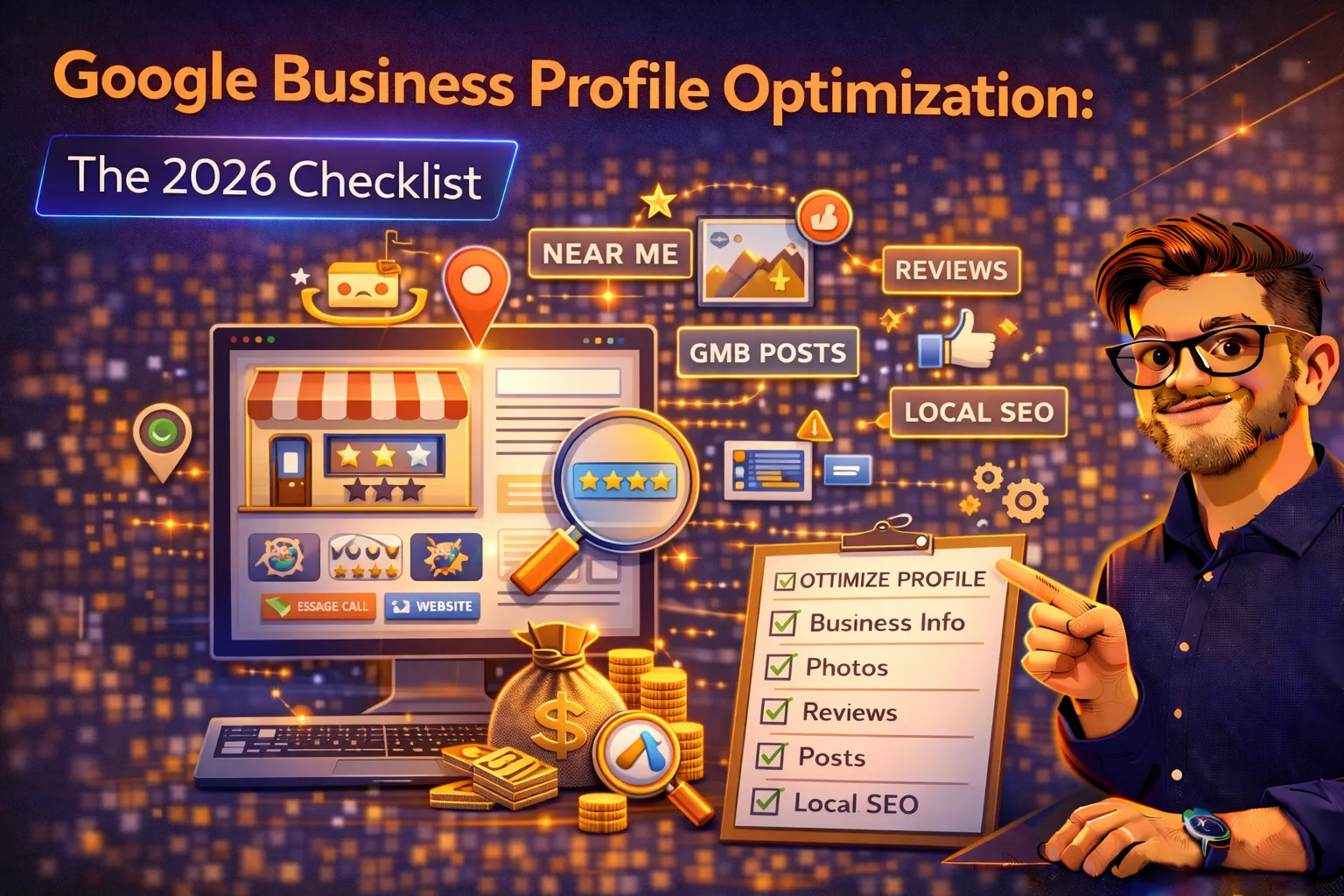
Google Business Profile Optimization: The 2026 Checklist
Every optimization that matters for your Google Business Profile in 2026—from foundational setup and category strategy to photos, reviews, posts, AI readiness, and the weekly maintenance routine that keeps your profile ranking.
Published: March 10, 2026 | Reading Time: ~11 minutes | Category: SEO & Local
Your Google Business Profile is often the first—and sometimes the only—thing a potential customer sees before deciding to call, visit, or move on to a competitor. Nearly (BrightLocal), and (Google). In 2026, Google Business Profiles appear before organic listings across Search, Maps, and AI Overviews—making your profile the most important piece of digital real estate your business owns.
The businesses that treat their GBP as a living, actively managed asset dominate local search. Those that set it up and forget it disappear. Businesses with complete, optimized profiles are 2.7 times more likely to be considered reputable by customers (BrightLocal), receive 42% more direction requests, and get 35% more website clicks compared to incomplete profiles (Branding Marketing Agency). Google now monitors posting frequency, photo freshness, review cadence, and engagement signals—and profiles that go inactive for 30+ days have seen measurable drops in impressions (Agency Jet).
This is the complete 2026 optimization checklist—organized by priority, with the foundational elements first and advanced strategies following.
Part 1: Foundation—Get These Right First
1. Claim, Verify, and Secure Your Profile
If you have not claimed your Google Business Profile, nothing else in this checklist matters. Visit google.com/business, sign in with a business email (not personal Gmail), and claim or create your listing. Complete verification through mail (postcard with code, 5–14 days), phone, email, or video verification—Google expanded video verification in 2025 as an expedited option. Once verified, ensure the correct team members have access. Access issues are one of the most common causes of lost listings during suspensions or team changes (OneCom Media).
2. Business Name—Exact Match Only
Your business name must match your real-world signage, legal documents, and all online listings. Google now enforces much stricter business name policies in 2026—adding keywords, city names, or descriptors like “best” or “#1” to your name will get you flagged and potentially suspended (Dyad Marketing). No exceptions. Your name should be identical on your website, signage, invoices, business cards, and every directory listing.
3. NAP Consistency—Identical Everywhere
Your Name, Address, and Phone Number (NAP) must be identical across your GBP, website, and every online directory. Even minor inconsistencies—“St.” versus “Street,” different suite numbers, inconsistent phone formats—confuse Google’s entity verification and lower your trust score. If your GBP says “24/7” but your website footer says “Closed Sundays,” Google reduces your credibility. Audit and fix every discrepancy before moving to advanced optimizations.
4. Primary and Secondary Categories
Your primary category is the single most impactful element you control. According to BrightLocal, for service relevance—the most influential GBP ranking factor. Be as specific as possible: “Pediatric Dentist” beats “Dentist” for “kids’ dentist near me” searches. “Emergency Plumber” beats “Plumber” for after-hours queries. Add all relevant secondary categories, but only for services you actively provide. Review competitor primary categories using search tools to ensure you are not missing a better match.
5. Service Areas
Set your service areas realistically—not aggressively. Claiming every zip code in your metro area dilutes your visibility. Focus on the areas where you can actually serve customers quickly. For service-area businesses without a storefront, Google needs to understand exactly which neighborhoods you serve to show your profile to the right searchers. You can expand as your business grows, but starting tight and relevant outperforms starting broad and diluted.
Part 2: Profile Content—Tell Google and Customers What You Do
6. Business Description
Write a clear, natural-language description that states what your business does, who you serve, and where you operate. No emojis, no promotional fluff, no keyword stuffing. In 2026, high-performing profiles use descriptions that address customer pain points and highlight unique selling propositions with naturally placed keywords (LocalMighty). Update your description at least once per year to reflect any changes in services or positioning.
7. Services—Complete and Detailed
Every service you offer must be added to your GBP with a clear, human-readable description. Do not leave services empty or generic. Google cross-references your GBP services with your website’s service pages to verify expertise (Agency Jet)—alignment between the two strengthens your ranking for relevant queries. (Branding Marketing Agency). Write each service description as if a customer is reading it—because they are.
8. Attributes
Attributes—such as “Women-led,” “24/7 service,” “Free estimates,” “Accessible entrance,” “Veteran-owned”—are now critical ranking factors because they directly answer AI search queries. When someone asks “plumber with 24/7 service near me,” Google matches that query against your attributes. Check your GBP dashboard regularly—Google frequently adds new attributes based on evolving search trends, and missing them means missing visibility for emerging queries.
Part 3: Photos and Visual Content
9. Photo Strategy—Weekly Uploads
Photos are no longer cosmetic—they are ranking and trust signals. Upload a mix of real photos weekly: team photos, completed work, vehicles, office interior and exterior, and before-and-after project shots. (Branding Marketing Agency). No stock images—Google’s Vision AI now scans photo content to understand your expertise. A plumber who uploads a photo of a tankless water heater installation becomes more likely to rank for “water heater repair” even without that keyword in text (Agency Jet).
10. Geotagging
Geotag your photos to connect visual content to your physical location, boosting relevance for “near me” searches. Many photo management tools offer geotagging capabilities. This is a simple step that strengthens the geographic signals Google uses to determine your relevance to local searchers.
11. Video Content
Short, branded video clips—30 to 60 seconds of a completed project, a team introduction, or a service explanation—provide additional engagement and make your listing more trustworthy. Google displays video prominently on mobile profiles, and video content increases the time users spend on your listing—a behavioral signal that reinforces your ranking.
Part 4: Reviews—Your Most Powerful Trust Signal
12. Build a Systematic Review Process
- Ask every customer for a Google review immediately after service delivery. Provide a direct review link via text or email to reduce friction.
- Aim for consistent flow: one to two new reviews per week outperforms a burst followed by silence. Google values recency and cadence.
- Target a minimum 4.5-star average with at least 20 recent reviews for competitive placement. A perfect 5.0 with zero negative feedback can actually be flagged as suspicious by AI filters (Agency Jet).
13. Respond to Every Review Within 24 Hours
This is non-negotiable. (BrightLocal). Personalized responses—not templates—show Google and future customers that the business is actively managed. For negative reviews, respond professionally, acknowledge the concern, and offer to resolve the issue. Google’s AI now summarizes reviews for users, so addressing specific complaints (like “long wait times”) helps the AI see that you are actively improving.
14. Encourage Detailed, Service-Specific Reviews
Reviews that mention specific services, locations, and outcomes provide more SEO value than generic praise. A review saying “They replaced our roof in Coral Gables in two days and the crew was professional” is far more valuable than “Great job!” Google’s AI reads review text to validate what your business does—keyword-rich reviews strengthen your relevance for specific queries.
Part 5: Posts, Q&A, and Ongoing Activity
15. Post Weekly Updates
GBP posts signal freshness and engagement. Publish at least one post per week: service highlights, completed project photos, seasonal promotions, team updates, community involvement, or educational tips. Profiles that go 30+ days without a post have seen drops in impressions (Agency Jet). Treat your GBP like a social media channel—consistent posting keeps your profile “alive” in Google’s eyes and provides fresh data points for AI systems.
16. Seed and Monitor Q&A
Google’s Q&A feature often influences what searchers see before clicking through. Proactively seed your Q&A with the 10–20 most common questions customers ask—and provide detailed, helpful answers using natural customer language. Monitor Q&A regularly and upvote the most important questions. Unanswered questions from searchers look like neglect and can hurt your profile’s perceived quality.
17. Enable Booking and Appointment Links
If you offer appointments or services, integrate booking systems directly into your GBP. Profiles with direct booking links or messaging options see up to 45% more conversions (Branding Marketing Agency). This allows customers to take action without ever leaving the search results—reducing friction and increasing your conversion rate from profile views to booked appointments.
Part 6: AI Readiness—Preparing for AI Overviews and AI Search
In 2026, over 40% of local business queries trigger Google’s AI Overview (SeoProfy). Your GBP data directly feeds these AI-generated answers. Businesses that are not optimized for AI discovery risk becoming invisible even with strong traditional rankings.
18. Ensure Entity Consistency Across Platforms
AI systems verify business information across multiple platforms before displaying results. Your GBP, website, Apple Maps, Bing Places, Yelp, Facebook, and industry directories must all present identical, consistent information. Inconsistencies trigger verification failures that reduce your visibility in AI-generated results.
19. Implement LocalBusiness Schema on Your Website
Structured data markup tells search engines and AI systems exactly who you are, what you offer, and where you serve—in a machine-readable format. Implement LocalBusiness schema on your website with your exact NAP, services, hours, and geographic coverage. Google cross-references your schema with your GBP to verify accuracy.
20. Write for AI Readability
AI systems favor clear, declarative information. Your GBP description, service listings, and Q&A answers should be written in natural, conversational language that directly answers questions a customer might ask. Avoid jargon, vague marketing language, and keyword repetition. The clearer and more specific your information, the more likely AI systems will surface your business as a recommendation.
The Weekly and Monthly Maintenance Routine
| Frequency | Tasks |
|---|---|
| Weekly | Upload 3–5 new photos (real work, team, projects). Publish one GBP post (service highlight, promotion, tip, or update). Respond to all new reviews within 24 hours. Check and answer any new Q&A submissions. Verify hours are accurate (especially for holidays or schedule changes). |
| Monthly | Review GBP Insights: track search queries, calls, direction requests, and website clicks. Audit NAP consistency across top 10 directories. Review and update service descriptions if offerings have changed. Check for new attribute options in your GBP dashboard. Compare your profile to top three competitors—identify gaps in reviews, photos, or services. |
| Quarterly | Full category audit—review primary and secondary categories against competitor profiles and search trends. Service and description refresh—update language to reflect seasonal services or new offerings. Citation audit—verify consistency across all directories and data aggregators. Website alignment check—ensure service pages, schema markup, and NAP match GBP exactly. |
The Compound Effect: GBP optimization is not a one-time project—it is a compounding system. Every new review, every photo upload, every weekly post, and every answered question builds on the last. Businesses that maintain this routine for six to twelve months create a visibility advantage that competitors cannot replicate with a single optimization sprint. The profiles that dominate local search in 2026 are the ones that never stop improving.
Common Mistakes That Kill GBP Rankings
Keyword Stuffing Your Business Name
Google’s enforcement has become significantly stricter in 2026. Adding “Best,” “#1,” city names, or service keywords to your business name risks suspension. Use your legal business name only—no exceptions.
Inconsistent Information Across Platforms
If your GBP hours, address, or phone number differ from your website, Yelp, or any other directory, Google lowers your trust score. This single issue undermines every other optimization on this checklist.
Inactive Profile
A profile with no new photos, no posts, and no recent reviews signals to Google that the business may be inactive or poorly managed. The visibility decay rate in 2026 is faster than ever—businesses that stop engaging see ranking drops within weeks, not months.
Ignoring Negative Reviews
Unresponded negative reviews hurt twice: they damage customer perception and signal to Google that the business is not actively managed. A professional, solution-oriented response to a negative review can actually improve your trust score with both AI systems and future customers.
Fake Reviews
Google’s AI is now highly effective at detecting inauthentic reviews. Purchasing reviews, incentivizing fake positive reviews, or using review exchange schemes risks profile penalties or suspension. Build reviews organically through consistently great service and systematic post-service requests.
Your GBP Is Your Most Valuable Local Marketing Asset
In 2026, your Google Business Profile is not a directory listing—it is your primary discovery layer across Google Search, Maps, and AI Overviews. It is often the first and last impression before a customer decides to call you or your competitor. The businesses that treat their profile as a dynamic, actively managed marketing channel—not a set-and-forget form—are the ones capturing the majority of local leads.
. . . . Every element in this checklist contributes to a profile that ranks higher, converts more searchers into customers, and builds a compounding local visibility advantage that grows stronger every month you maintain it.
Start at the top of the checklist: verify your profile, fix your NAP, set your categories, and build from there. Establish the weekly and monthly routine. And never stop—because the businesses that dominate local search are the ones that never stop optimizing.
References
The following sources informed this article:
- Agency Jet (2026). "Google Business Profile: The Updated Guide to the 2026 AI Evolution."
- Branding Marketing Agency (2026). "Optimize Google Business Profile 2026: Complete Local Guide."
- BrightLocal (2025–2026). Local Consumer Survey and GBP Ranking Factor Data.
- Dyad Marketing (2026). "Google Business Profile Optimization Checklist for 2026."
- Google (2026). Local Consumer Search Behavior Data.
- Koanthic (2026). "Google Business Profile Optimization: Complete 2026 Guide."
- LocalMighty (2026). "Google Business Profile Optimization Checklist for 2026."
- OneCom Media (2026). "Google Business Profile Optimization Checklist for 2026."
- ReviewPoint (2026). "The Ultimate Google Business Profile Optimization Checklist (2026)."
- SeoProfy (2026). "75 Local SEO Statistics for 2026."
- TrueFuture Media (2025). "Google Business Profile Optimization Checklist (2026)."
- Whitespark (2026). "Official 2026 Local Search Ranking Factors Report."