Rated 5 star on

High-Converting Landing Page Design
Quick answer
Up to eighty percent of visitors read only the headline before deciding whether to stay, which is why the headline carries the page. Ten elements separate landing pages that generate leads from pages that waste ad spend. A homepage cannot substitute, because it serves multiple audiences and purposes while a landing page serves exactly one.
The data-backed design elements, copywriting principles, and conversion optimization strategies that separate landing pages that generate leads from pages that waste ad spend—with specific guidance for service businesses.
Key Takeaways
- The data-backed design elements, copywriting principles, and conversion optimization strategies that separate landing pages that generate leads from pages that waste ad spend—with specific guidance for service businesses.
- Up to 80% of visitors only read the headline before deciding whether to stay or leave (Superside).
- Your homepage serves multiple audiences and purposes.
- Every dollar you invest in SEO, Google Ads, social media, and content marketing ultimately funnels through a landing page.
Published: March 16, 2026 | Reading Time: ~11 minutes | Category: Web & UX Design
Nearly half of the traffic you pay for through Google Ads, Facebook campaigns, and email marketing bounces before taking a single action (Backlinko/Shopify). For service businesses spending $2,000–10,000+ per month on advertising, that is thousands of dollars walking out the door every month—not because the ads are wrong, but because the landing page fails to convert.
The median landing page conversion rate across all industries is approximately 6.6% (Involve.me/Backlinko), which means roughly 93 out of every 100 visitors do not convert. But top-performing pages consistently achieve 10–20% conversion rates, and the gap between average and exceptional comes down to specific, testable design elements (Forbes/Hostinger). That is not a redesign—it is the difference between having the right elements in the right places and not.
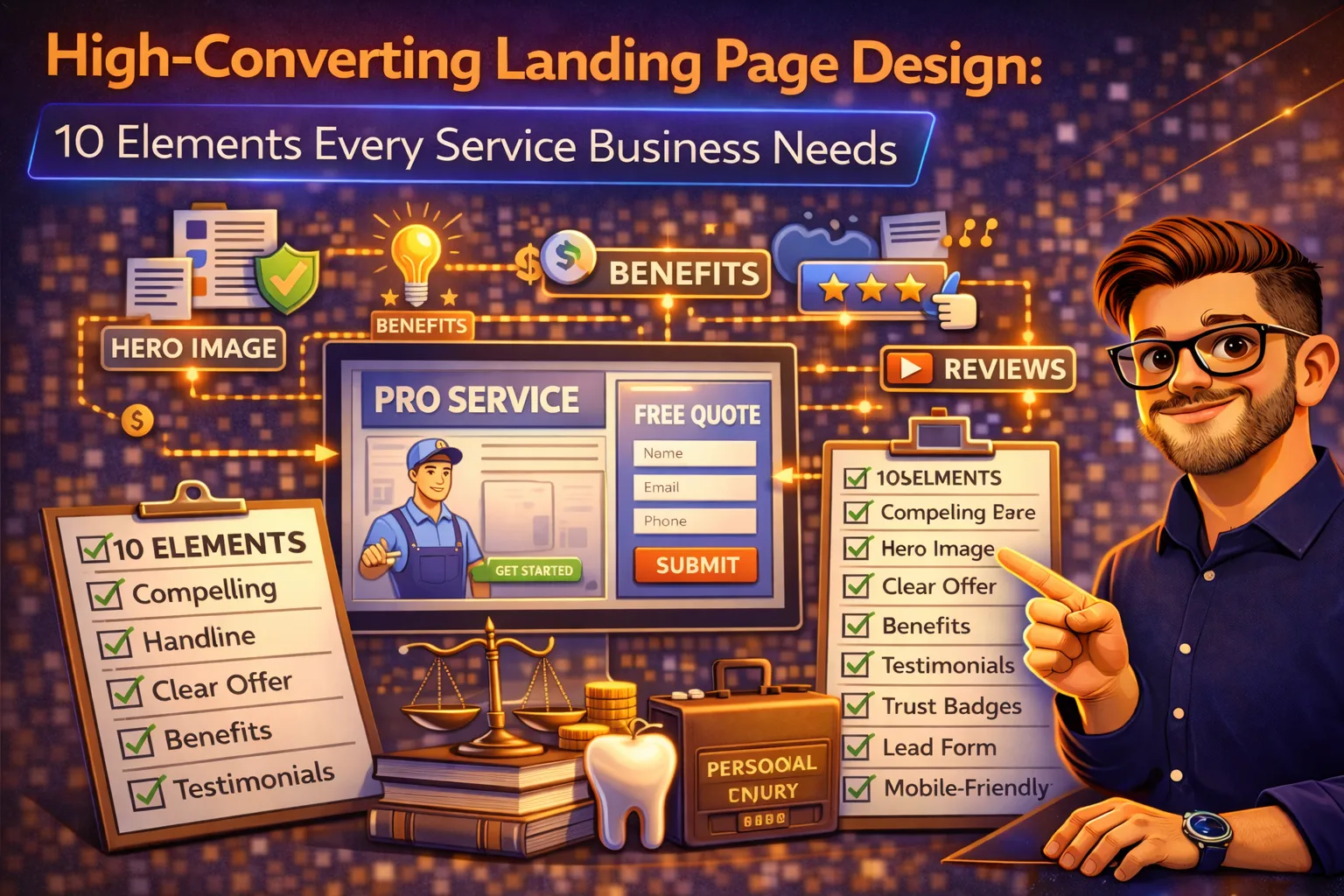
This guide covers the 10 elements that high-converting landing pages share—each backed by data, each tailored to how service business customers actually behave, and each actionable enough to implement this week.
The 10 Elements of a High-Converting Service Business Landing Page
How many visitors read past the headline?
Up to 80% of visitors only read the headline before deciding whether to stay or leave (Superside). Your headline is the single most important piece of copy on the page—it must communicate what you offer, who it is for, and what the visitor gains in under five seconds. A well-crafted headline can deliver a three times higher conversion rate compared to a weak one (Hostinger).
For service businesses, the headline should match the ad or search query that brought the visitor to the page. If someone clicked a Google Ad for “emergency plumber Miami,” the headline should say “24/7 Emergency Plumbing in Miami – Fast Response, Licensed & Insured”—not “Welcome to Our Plumbing Company.” Message match between ad and headline is one of the fastest ways to reduce bounce rates and increase conversions.
How much does adding links cost you?
Landing pages with one link average a 13.5% conversion rate, while pages with five or more links drop to 10.5% (Superside). Every additional link, navigation menu, or competing action on your page creates a decision point that reduces conversion. High-converting landing pages have one clear objective and one clear action: call now, book a free estimate, schedule a consultation, or get a quote.
For service businesses, the CTA should appear above the fold (visible without scrolling), be repeated at logical points as the visitor scrolls down the page, use action-oriented language (“Get My Free Estimate” outperforms “Submit”), and be visually distinct—a contrasting color button that stands out from the rest of the page design. Remove your site’s main navigation menu on dedicated landing pages to eliminate exit paths and keep the visitor focused on the one action you want them to take.
How much do testimonials lift conversion?
Including customer testimonials can increase conversions by 34% (Keywords Everywhere/Genesys Growth), and displaying reviews can boost conversions by up to 270% (Genesys Growth). Yet nearly 77% of marketers fail to include social proof on their landing pages (Shopify). This is one of the easiest, highest-impact improvements you can make.
For service businesses, social proof should appear within the first viewport the visitor sees—before they scroll. Include your Google review rating and count (“4.9 stars – 320+ reviews”), one to two short testimonials from real customers mentioning the specific service the page promotes, and any trust badges (Google Verified, BBB accredited, industry certifications, years in business). Social proof answers the visitor’s unspoken question: “Can I trust this company?” The earlier you answer it, the more likely they are to convert.
How much does one second of load time cost?
Speed is not a design nicety—it is a conversion lever. Pages that load in one second convert three times higher than pages that take five seconds (Portent/Genesys Growth). A one-second delay reduces conversions by 7% (Genesys Growth), and about 30% of users will abandon a page that takes longer than six to ten seconds to load (Kissmetrics/Hostinger). For a service business generating $50,000 per month through landing pages, every additional second of load time costs approximately $3,500 in lost revenue.
Optimize by compressing all images (WebP format), enabling lazy loading for below-the-fold content, minifying CSS and JavaScript, using a CDN, and eliminating unnecessary third-party scripts. Test your page with Google PageSpeed Insights and target a Largest Contentful Paint under 2.5 seconds.
How much landing page traffic is mobile?
Mobile devices account for 82.9% of all landing page traffic (Backlinko), yet there is an 8% conversion gap between mobile and desktop users (Genesys Growth). Mobile visitors often research on-the-go with lower immediate purchase intent, then return on desktop to convert. This means your mobile landing page must accomplish two goals: capture the visitor’s information (or prompt a call) on the first visit, and make a strong enough impression that they return.
Mobile-first design priorities for service businesses: thumb-friendly tap targets (minimum 44x44 pixels), a sticky click-to-call button that remains visible while scrolling, single-column layout with no horizontal scrolling, simplified forms (the fewer fields on mobile, the better), and fast load times—even more critical on mobile networks. Dynamic landing pages that adapt to mobile convert 25.2% more mobile users (KlientBoost/Hostinger).
How many form fields is too many?
Pages with three to five form fields convert 120% better than pages with more fields (Cobloom/Genesys Growth). Each additional field beyond five creates a 20–30% conversion penalty. And 81% of people who start filling out a form abandon it before submitting, with 67% never returning (Insiteful/Genesys Growth).
For service businesses, capture only what you need at this stage of the customer journey. A landing page for a free estimate request needs: name, phone number, service needed, and zip code—four fields. You can collect additional details during the follow-up call. Reducing form friction is one of the highest-ROI changes you can make to any landing page. If your form has more than five fields and you are not selling a $50,000+ service, you are leaving conversions on the table.
7. Video Content
Embedding video on a landing page can increase conversions by up to 86% (Hostinger), and nearly 40% of marketers credit video as the element that most positively impacts their landing page performance (Shopify). Video builds trust faster than text because visitors can see your team, your work, and your customers in a way that static images and copy cannot replicate.
For service businesses, the most effective landing page videos are: customer testimonials (30–60 seconds of a real client describing their experience), before-and-after project walkthroughs (especially powerful for home improvement, dental, and cosmetic services), and short team introductions that put a face to the business. Keep videos under 90 seconds, do not autoplay with sound (which Google penalizes and visitors hate), and place the video prominently on the page without making it the sole focus—visitors should be able to convert without watching it.
What reading level converts best?
Landing pages written at a 5th- to 7th-grade reading level have an average conversion rate of 11.1%, compared to just 5.3% for college-level copy (Backlinko/Shopify). Simpler language more than doubles conversion rates—not because your customers are not intelligent, but because clear, direct communication reduces cognitive load and makes the path to action effortless.
Write the way your customers speak. Replace “comprehensive residential plumbing solutions” with “we fix your plumbing fast.” Replace “cutting-edge dental restorative procedures” with “get a natural-looking smile in one visit.” Focus on benefits (what the customer gets), not features (what you do). Address the visitor’s pain point in the first sentence, present your solution immediately, and make the CTA the obvious next step. Pages with fewer than 100 words convert 50% better than those with more than 500 words (Shopify)—brevity wins.
9. Trust Signals and Credentials
Beyond reviews and testimonials, service business landing pages should display every trust signal available: licensing and insurance information (critical for contractors, HVAC, plumbing, electrical), industry certifications and awards, years in business, number of customers served or projects completed, Better Business Bureau rating, Google Verified or Google Guaranteed badge, payment security icons (if collecting payment information), and association memberships. These signals reduce the perceived risk of contacting a business the visitor may be encountering for the first time. Each trust signal you add reinforces the decision to convert.
10. A/B Testing as a Continuous Process
Systematic A/B testing of landing page elements leads to approximately a 30% increase in conversions (Involve.me). Yet only one out of every eight A/B tests achieves statistically significant results (Hostinger)—which means you need to test consistently to find the winners. The most impactful elements to test, in order of typical impact: headline copy and angle, CTA text and button color, form length and field order, social proof placement and type, and page layout (long-form vs. short-form).
Test one variable at a time. Run each test until you reach statistical significance (typically 100+ conversions per variation). Document every test—hypothesis, variation, result—so you build institutional knowledge about what works for your audience. The businesses with the highest-converting landing pages are not the ones that designed the perfect page on the first try; they are the ones that test relentlessly.
Quick Reference: The 10 Elements at a Glance
| # | Element | Key Stat | Service Business Application |
|---|---|---|---|
| 1 | Benefit-focused headline | 3x higher conversion with strong headlines | Match headline to ad/search query exactly |
| 2 | Single CTA | 13.5% CVR with 1 link vs. 10.5% with 5+ | Remove nav menu; one clear action per page |
| 3 | Social proof above fold | 34% conversion lift from testimonials; 270% from reviews | Google rating + review count + 1–2 testimonials visible immediately |
| 4 | Page speed <2 seconds | 3x higher CVR at 1s vs. 5s load; 7% loss per second | Compress images, CDN, minify code, lazy loading |
| 5 | Mobile-first design | 82.9% of traffic is mobile; 25.2% lift from dynamic mobile pages | Sticky call button, single column, simplified forms |
| 6 | Minimal forms (≤5 fields) | 120% better CVR with ≤5 fields; 81% abandon started forms | Name, phone, service needed, zip code—capture the rest on the call |
| 7 | Video content | 86% conversion increase from embedded video | Testimonials, before/after, team intros; under 90 seconds |
| 8 | Simple copy (5th–7th grade level) | 11.1% CVR at simple level vs. 5.3% at college level | Write how customers speak; benefits over features; brevity wins |
| 9 | Trust signals & credentials | Reduces perceived risk; reinforces conversion decision | Licenses, insurance, certifications, BBB, Google badges, years in business |
| 10 | Continuous A/B testing | ~30% avg. improvement from systematic testing | Test headlines, CTAs, forms, social proof; one variable at a time |
The Five Mistakes That Kill Service Business Landing Pages
Sending Ad Traffic to Your Homepage
Your homepage serves multiple audiences and purposes. A landing page serves one. When you send a Google Ad click for “kitchen remodeling Miami” to your homepage, the visitor has to search for the relevant information—and most will not bother. Create a dedicated landing page for every major service and campaign. Businesses with 10–15 landing pages generate 55% more leads than those with fewer than 10 (HubSpot/Hostinger). Companies with 40+ landing pages see 500% more conversions (Invesp/Genesys Growth).
Too Many Competing Actions
Navigation menus, footer links, sidebar CTAs, social media icons, multiple offers—every additional action competes with your primary conversion goal. Strip the page down to one offer and one action. Remove global navigation. Remove footer links. The only way off the page should be converting or closing the tab.
Generic Stock Photography
Visitors can spot stock photos instantly, and they erode trust. Use real photos of your team, your work, and your customers. Authentic imagery builds credibility that no purchased image can replicate. Google’s Vision AI also indexes real photos more favorably for local search visibility.
Ignoring Mobile Experience
With 83% of landing page traffic coming from mobile, a page that looks good on desktop but is frustrating on a phone is a page that loses the majority of its visitors. Design mobile-first, then adapt for desktop—not the other way around.
Never Testing
The biggest mistake is treating your landing page as finished. The best landing pages in any industry are the result of dozens of tests over months. Start testing headline variations this week. The data will tell you what your audience responds to—and the improvements compound with every winning test.
The Revenue Impact: A service business spending $5,000/month on Google Ads with a landing page converting at 3% generates 45 leads from 1,500 clicks. Improving that page to 6%—the industry median—doubles leads to 90 without a single dollar increase in ad spend. At a $2,000 average customer value, that is $90,000 in additional monthly revenue from landing page optimization alone. Every percentage point of conversion rate improvement translates directly into revenue.
Your Landing Page Is Where Ad Spend Becomes Revenue
Every dollar you invest in SEO, Google Ads, social media, and content marketing ultimately funnels through a landing page. That page is the moment of truth—where a visitor either becomes a lead or becomes a statistic. The 10 elements in this guide are not theoretical design principles; they are the specific, data-backed factors that determine whether your marketing investment produces revenue or waste.
The gap between average and exceptional is not a mystery—it is a headline, a CTA, social proof, page speed, mobile optimization, a simple form, video, clear copy, trust signals, and relentless testing. Implement these 10 elements, test continuously, and your landing pages will convert more of the traffic you are already paying for into the customers your business needs to grow.
References
The following sources informed this article:
- Backlinko/Semrush (2026). "12 Essential Landing Page Statistics for 2026."
- Branded Agency (2026). "High-Converting Landing Pages: 2026 Essential Elements."
- Genesys Growth (2026). "Landing Page Conversion Rates — 40 Statistics for 2026."
- Hostinger (2026). "2026 Landing Page Statistics: Boost Your Conversion Rates."
- Involve.me (2026). "100+ Landing Page Statistics You Should Know (2026)."
- Involve.me (2025). "Landing Page Design Trends by Industry (2026 Guide)."
- Landingi (2026). "15 Best Landing Page Statistics for Digital Marketers in 2026."
- Shopify (2026). "20 Landing Page Statistics To Know in 2026."
- Superside (2026). "20 Landing Page Examples That Actually Convert in 2026."