Rated 5 star on

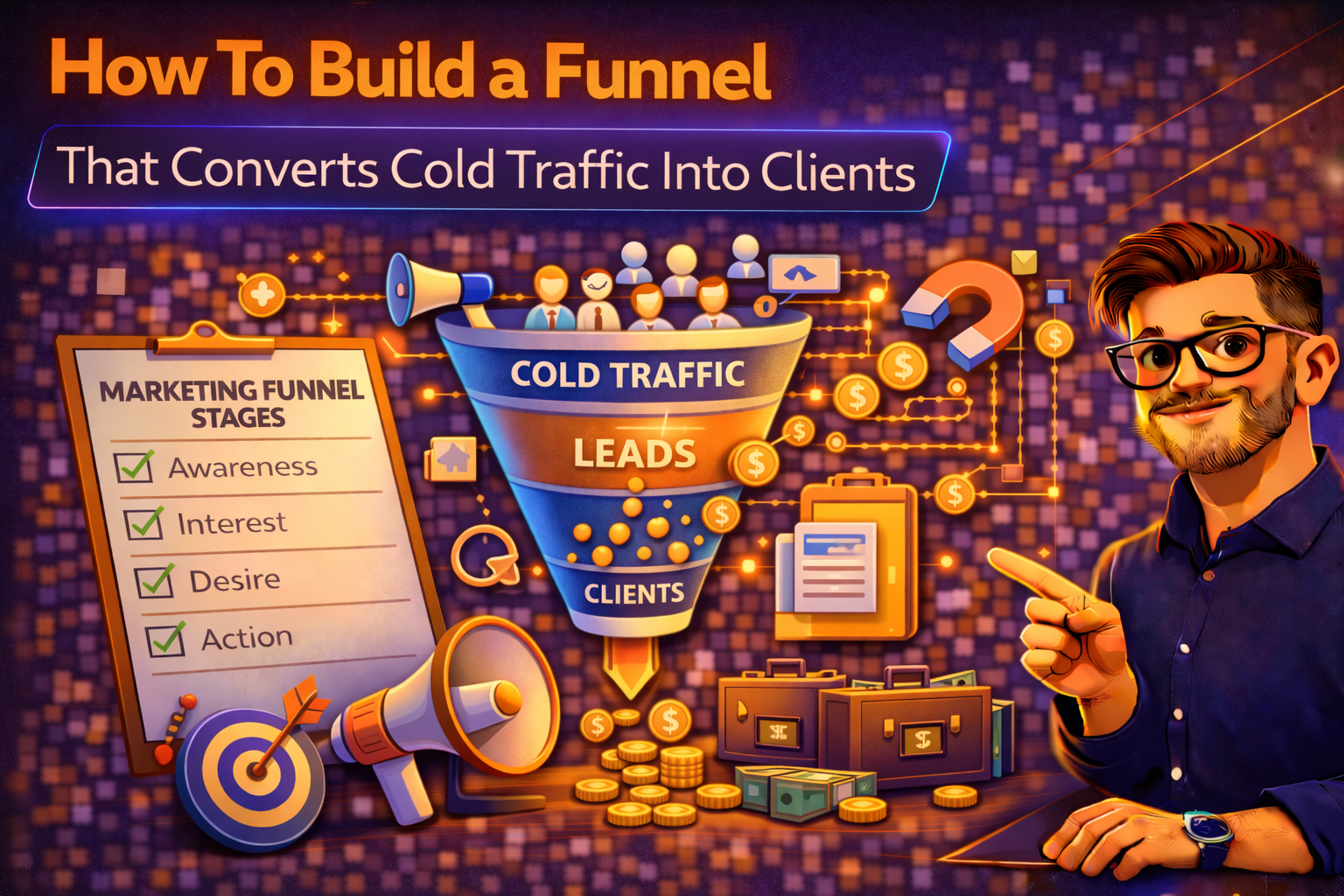
How to Build a Marketing Funnel That Converts Cold Traffic Into Clients
The complete framework for turning strangers into leads and leads into paying customers—with the stage-by-stage strategy, conversion benchmarks, and optimization tactics that make every marketing dollar work harder.
Published: March 24, 2026 | Reading Time: ~12 minutes | Category: Strategy
Most businesses do not have a marketing problem. They have a funnel problem. They drive traffic—through ads, SEO, social media, and referrals—but have no systematic process for converting that traffic into customers. The result: high bounce rates (Leeline Sourcing), wasted ad spend (Passive Secrets), and unpredictable revenue (Passive Secrets).
The average sales funnel converts between 3% and 10% depending on industry (VWO), with the cross-industry average sitting around 2.35% (Amra and Elma). Top-performing companies push above 10–15%. The difference is not more traffic—it is a better funnel. A well-structured marketing funnel turns cold traffic—people who have never heard of you—into warm leads, then into customers, then into repeat buyers and referral sources.
This guide walks through the complete funnel framework for service businesses: what each stage does, the specific tactics that work at each stage, the conversion benchmarks to aim for, and how to diagnose and fix leaks that waste your marketing budget.
Why Most Marketing Fails Without a Funnel
The fundamental mistake most businesses make is trying to sell directly to cold traffic. A stranger who sees your ad or lands on your website for the first time is not ready to buy. They do not know you, do not trust you, and have not decided they need your service badly enough to take action.
(Inbound Agency). Trying to compress that journey into a single ad or landing page is why so many campaigns produce clicks but not customers. A funnel respects the psychology of the buying process: first the customer becomes aware of a problem, then they research solutions, then they evaluate options, then they decide to buy.
The Core Problem: Trying to sell immediately to cold traffic.
The Fix: Build a funnel that earns the right to sell by delivering value at each stage—awareness, consideration, decision—before asking for the commitment (Inbound Agency).
Without a funnel, every marketing dollar is a one-shot gamble. With a funnel, each dollar enters a system that nurtures prospects through stages, each with measurable conversion rates that can be optimized. The result: predictable revenue from the same traffic.
The Three-Stage Funnel Framework
A marketing funnel is not complicated. It has three stages, each with a specific purpose, specific content, and specific metrics:
| Stage | Purpose | Content Type | Key Metric |
|---|---|---|---|
| Top of Funnel (TOFU) Awareness |
Attract cold traffic; make prospects aware of the problem you solve and that your business exists | Blog posts, social media, videos, paid ads, SEO content, podcasts, infographics | Traffic volume, impressions, engagement rate, bounce rate, time on page |
| Middle of Funnel (MOFU) Consideration |
Capture contact information; nurture leads with value; build trust and demonstrate expertise | Lead magnets, email sequences, webinars, case studies, guides, free consultations, calculators | Lead conversion rate, email opt-in rate, lead quality, email open/click rates |
| Bottom of Funnel (BOFU) Decision |
Convert qualified leads into paying customers through direct offers and sales conversations | Proposals, testimonials, pricing pages, consultation calls, limited-time offers, case studies | Close rate, cost per acquisition, revenue per customer, proposal-to-close ratio |
Each stage has a different job. TOFU brings people in. MOFU builds relationships and qualifies interest. BOFU closes the sale. Most businesses invest heavily in TOFU (driving traffic) and skip directly to BOFU (asking for the sale)—completely missing the middle of the funnel where trust is built and leads are nurtured. This gap is where most marketing budgets go to waste.
Stage 1: Top of Funnel — Attracting Cold Traffic
The top of your funnel has one job: get the right people to your website or content for the first time. Cold traffic is people who have never heard of your business. They are searching for solutions, browsing social media, or seeing your ads for the first time.
Traffic Sources That Fill the Top of the Funnel
| Traffic Source | Avg. Conversion Rate | Cost | Best For |
|---|---|---|---|
| Referral traffic | 10.99% (highest) | Free / earned | Trust-based businesses; warm introductions |
| Organic search (SEO) | 3.82% (inbound) | Time investment; compounds over months | Long-term lead generation; evergreen content |
| Paid search (Google Ads) | 2.9% average | $5–$25+ per click (varies by industry) | High-intent keywords; immediate visibility |
| Facebook / Instagram Ads | 9.21% average (varies widely) | Lower CPC; higher volume | Awareness; retargeting; visual services |
| Social media (organic) | 1–3% typical | Time investment | Brand building; community; trust signals |
Sources: Amra and Elma, Passive Secrets, AI Digital (2025–2026).
The key insight: referral traffic converts at nearly four times the rate of paid search (Amra and Elma). This reinforces what experienced marketers know: trust-driven traffic converts better than cold traffic. But you cannot scale referrals alone, which is why most businesses need a mix of SEO, paid ads, and social media to fill the top of the funnel—with a nurture system (the middle of the funnel) to warm that cold traffic before asking for the sale.
TOFU Content That Works for Service Businesses
- Blog posts answering the questions your customers actually ask (“How much does [service] cost in [city]?”)
- Short-form video showing your work, your team, and your results (before-and-after, process walkthroughs, customer stories)
- Google Ads targeting high-intent keywords (“[service] near me,” “[service] cost [city]”)
- Social media posts that educate, entertain, or demonstrate expertise—not pitches
- Local SEO and Google Business Profile optimization to capture “near me” searches
Stage 2: Middle of Funnel — Capturing Leads and Building Trust
The middle of the funnel is where most service businesses have the biggest gap—and the biggest opportunity. They drive traffic but have no mechanism to capture contact information, build a relationship, or stay top-of-mind while the prospect is in the research and decision-making phase (Leeline Sourcing).
The middle of the funnel has two jobs: capture contact information (turning an anonymous visitor into a known lead) and nurture that lead with value until they are ready to buy.
Lead Magnets: The Exchange of Value for Contact Information
A lead magnet is something valuable you give away in exchange for a prospect’s email address or phone number. For service businesses, effective lead magnets include:
- Free estimates or consultations (the most direct path—works well for high-intent visitors)
- Cost calculators or quizzes (“What will your roof replacement cost?”—interactive and engaging)
- Downloadable guides (“The Homeowner’s Complete Guide to [Service]”—positions you as the expert)
- Checklists (“10-Point Pre-Hurricane Roof Inspection Checklist”—seasonal and immediately useful)
- Video walkthroughs or webinars (educational content that demonstrates your expertise visually)
The lead magnet must match the traffic source. A visitor from a Google search for “roof replacement cost” wants a cost calculator or free estimate, not a general industry whitepaper. Match the specificity of your offer to the specificity of the visitor’s intent.
Email Nurture Sequences: The Relationship Builder
Once you capture a lead’s email, the nurture sequence does the work of building trust over time. For service businesses, a simple five-email nurture sequence works powerfully (Passive Secrets):
- Email 1 (Day 0): Deliver the lead magnet. Thank them. Set expectations for what comes next.
- Email 2 (Day 2): Share your most compelling case study or before-and-after result—proof that you deliver.
- Email 3 (Day 5): Address the #1 objection or concern your prospects have (cost, timeline, disruption, trust).
- Email 4 (Day 8): Share customer testimonials or video reviews from clients similar to the prospect.
- Email 5 (Day 12): Make a direct offer—free consultation, limited-time promotion, or clear next step—with urgency.
This sequence gives the prospect five value-driven touchpoints over 12 days. By the time they receive the direct offer in Email 5, they have seen your results, heard from your customers, and had their objections addressed. You have earned the right to ask for the sale.
Stage 3: Bottom of Funnel — Converting Leads Into Customers
The bottom of the funnel is where nurtured leads become paying customers. At this stage, the prospect knows who you are, trusts your expertise, and is evaluating whether to choose you over the competition.
Conversion Benchmarks by Funnel Stage
| Funnel Stage Transition | Typical Conversion Rate |
|---|---|
| Website Visitor → Lead | 1–5% (depending on traffic quality and landing page) |
| Lead → Marketing Qualified Lead (MQL) | 25–35% |
| MQL → Sales Qualified Lead (SQL) | 13–26% |
| SQL → Opportunity | 50–62% |
| Opportunity → Closed-Won Customer | 15–30% |
Source: VWO / First Page Sage (2025–2026).
Here is what those numbers look like in practice for a service business: 10,000 website visitors → 300 leads (3%) → 90 MQLs (30%) → 18 SQLs (20%) → 10 opportunities (55%) → 3 customers (30%). From 10,000 visitors, you close 3 customers. That is reality—and it is exactly why every stage of the funnel matters. A small improvement at any stage compounds: if you double your visitor-to-lead conversion from 3% to 6%, you double your customers without spending a single additional dollar on traffic.
BOFU Tactics That Close Service Business Deals
- Consultation calls with a structured sales process: discovery questions, needs assessment, solution presentation, and clear next steps.
- Case studies showing specific results for clients similar to the prospect—industry, service type, and measurable outcomes.
- Testimonials and video reviews placed strategically on proposal and pricing pages.
- Limited-time offers or seasonal promotions that create genuine urgency (“Schedule before [date] and receive [incentive]”).
- Clear, transparent pricing with multiple options (good/better/best tiers reduce decision paralysis).
- Fast response times: respond to inquiries within 5 minutes—leads contacted within the first five minutes are 21x more likely to convert than those contacted after 30 minutes.
Diagnosing and Fixing Funnel Leaks
Every funnel leaks. The goal is not a perfect funnel—it is identifying where the biggest leaks are and fixing them in order of impact. Here is how to diagnose the most common problems:
| Symptom | Likely Problem | Fix |
|---|---|---|
| High traffic, very few leads | Poor landing page conversion; weak or missing CTA; no lead magnet; wrong traffic | Simplify landing pages; add lead magnets; improve CTA visibility; audit traffic quality |
| Leads coming in, but few are qualified | Traffic is too broad; lead magnet attracts wrong audience; no qualification step | Tighten ad targeting; create service-specific lead magnets; add qualifying questions to forms |
| Qualified leads not converting to customers | Weak nurture sequence; slow follow-up; poor sales process; lack of trust signals | Build email nurture; respond within 5 minutes; add case studies and testimonials to follow-up; improve proposals |
| High cost per acquisition | Relying entirely on paid ads without nurture; no organic traffic foundation | Build SEO and content for organic TOFU traffic; implement retargeting; add email nurture to reduce dependency on paid |
| Customers not returning or referring | No post-sale follow-up; no review request process; no referral incentive | Build post-sale email sequence; automate review requests; create referral program |
Most businesses skip directly from awareness to asking for the sale. Adding a lead capture mechanism, an automated email sequence, and retargeting ads to warm up cold traffic before the sales conversation typically produces the largest improvement in cost per acquisition and close rates.
The Service Business Funnel: A Complete Example
Here is how a complete funnel works for a home improvement company as a practical example:
TOFU: Attract
A homeowner searches “roof replacement cost in Miami.” Your blog post ranks on page one and provides a detailed, helpful cost guide. The homeowner reads the article and finds it genuinely useful. At the bottom of the article, a CTA offers a free downloadable “Roof Replacement Planning Checklist” in exchange for their email address.
MOFU: Nurture
The homeowner enters the email sequence. Over the next 12 days, they receive five emails: the checklist (delivered immediately), a before-and-after case study of a similar project in their area, an article addressing insurance claim questions (their biggest concern), video testimonials from three homeowners, and finally a limited-time offer for a free roof inspection. Each email builds trust and moves the homeowner closer to a decision.
BOFU: Convert
The homeowner clicks the free inspection offer. Your team responds within five minutes to schedule. During the inspection, the estimator follows a structured sales process: assess the roof, present findings with photos, provide a transparent quote with multiple options, address remaining questions, and ask for the commitment. The homeowner signs the contract.
Post-Sale: Retain and Refer
After the project completes, the homeowner receives an automated email requesting a Google review. Two weeks later, a follow-up email thanks them and offers a referral incentive. The five-star review strengthens your Google Business Profile rankings, and the referral generates a new lead at the top of the funnel. The cycle continues.
This is the power of a funnel: the same traffic that would have bounced without converting now moves through a systematic process—awareness, nurture, conversion, retention, referral—that extracts maximum value from every marketing dollar.
Measuring Funnel Performance: The Metrics That Matter
You cannot optimize what you do not measure. Track these metrics for each funnel stage:
- TOFU: Total traffic by source, cost per click, bounce rate, time on page, and traffic-to-lead conversion rate.
- MOFU: Lead magnet conversion rate (target 15–30% on dedicated landing pages), email open rate (target 25–40%), email click rate (target 3–7%), and lead-to-MQL conversion rate.
- BOFU: MQL-to-SQL conversion rate, proposal-to-close rate, average deal value, close rate, cost per acquisition, and response time to new inquiries.
- Overall: Revenue per marketing dollar, customer acquisition cost (CAC), customer lifetime value (LTV), and LTV:CAC ratio (target 3:1 or higher).
Tracking is not optimizing (Passive Secrets). Review your funnel metrics weekly, identify the stage with the worst conversion rate, and focus your optimization efforts there. A small improvement at the weakest stage produces the largest overall impact because it compounds through every subsequent stage.
Stop Spending More—Start Converting Better
The path to more customers does not always require more traffic. Top performers exceed 10–15% conversion rates. The difference is not budget—it is a systematic funnel that respects how real customers actually buy: awareness first, trust second, purchase third.
Start by mapping your current customer journey. Where are visitors entering? Where are they dropping off? Do you have a lead capture mechanism? An email nurture sequence? A structured follow-up process? If you are missing any of these, you have a funnel leak that is wasting the traffic your marketing is already generating.
Build the system in order: attract the right traffic (TOFU), capture and nurture leads with value (MOFU), then convert with trust and urgency (BOFU). Measure every stage. Fix the biggest leak first. One company reported a massive increase in revenue simply by optimizing their funnel from awareness through conversion (Inbound Agency). Your traffic is already there. The funnel turns it into revenue.
References
The following sources informed this article:
- AI Digital (2026). "Conversion Marketing 2026: Strategies & Best Practices."
- Amra and Elma (2025). "Top Marketing Funnel Conversion Statistics 2025."
- First Page Sage (2025). "Sales Funnel Conversion Rate Benchmarks: 2026 Report."
- Inbound Agency (2026). "Marketing Funnels in 2026: Why Your Customer Journey Is Broken."
- Leeline Sourcing (2025). "Sales Funnel Statistics You Should Know in 2026."
- Martal Group (2025). "2026 Sales Statistics: Cold Outreach, Pipeline, and Funnel Insights."
- Passive Secrets (2025). "80+ Useful Sales Funnel Statistics & Conversion Rates (2026)."
- Unbounce (2025). "Conversion Funnel Optimization: The Basics Explained."
- VWO (2025). "What Is a Good Funnel Conversion Rate? (2026)."
- WPFunnels (2026). "What Are Marketing Funnel Metrics – Comprehensive Guide."