Rated 5 star on

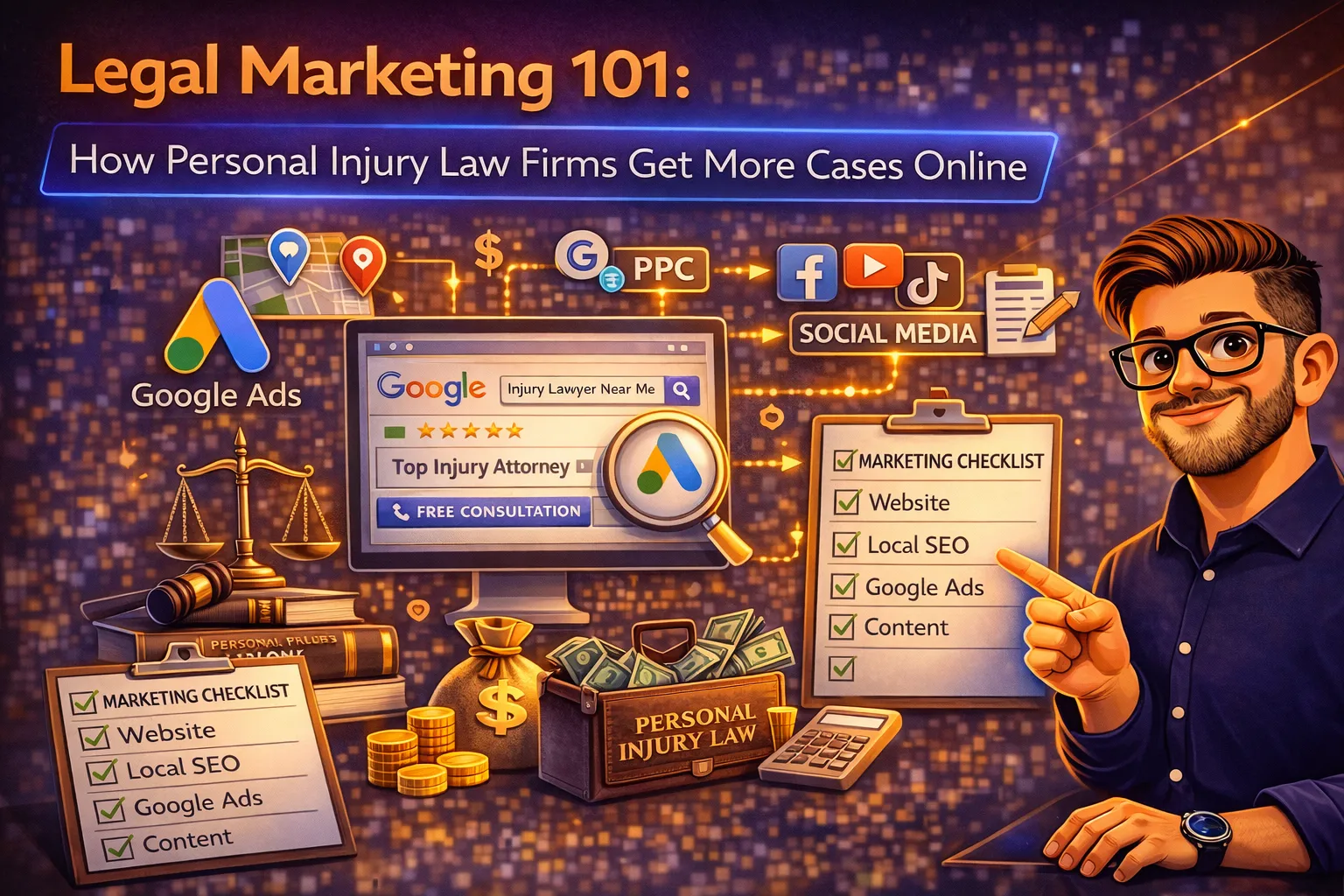
Legal Marketing 101: How Personal Injury Law Firms Get More Cases Online
The digital marketing channels, cost benchmarks, and client acquisition strategies that drive signed cases for personal injury firms—from SEO and Google Ads to intake optimization, reputation management, and the speed-to-lead data that separates growing firms from those burning cash.
Published: March 15, 2026 | Reading Time: ~12 minutes | Category: Vertical – Legal
The U.S. personal injury law market is projected to surpass $60 billion by 2026 (Grow Law), with approximately 164,500 personal injury lawyers spread across 60,000 firms competing for roughly 39.5 million injury cases requiring medical treatment annually. It is one of the most competitive—and most expensive—digital marketing verticals in existence. Google Ads cost-per-click for terms like “personal injury lawyer” can exceed $100 in major metros (WifiTalents), and the average cost per lead ranges from $200 to $1,500 depending on market and channel (National Law Review/WifiTalents).
Yet the firms that grow consistently are not necessarily the ones with the biggest budgets. They are the ones with the smartest systems: effective intake optimization (Revenue Memo), robust review generation (SeoProfy), and highly strategic localized SEO (Timpson Marketing). The gap between firms that convert leads into signed cases and those that burn marketing dollars is almost always found in three places: visibility, speed, and intake.
This guide breaks down the complete digital marketing playbook for personal injury law firms: the channels that work, the benchmarks that matter, and the systems that turn visibility into signed cases.
The Personal Injury Marketing Landscape in 2026
Before choosing channels and allocating budget, understand what makes PI marketing uniquely challenging:
| Market Dynamic | What It Means for Marketing |
|---|---|
| Extreme competition | 135,000+ PI attorneys nationwide; CPC for core keywords exceeds $100 in major metros; legal services ad spending reached $8.4 billion in 2024 (Revenue Memo) |
| High case values | Average PI contingency fees run 33–40% of settlements worth $15,000–$100,000+. A single signed case can generate $5,000–$40,000+ in firm revenue, justifying higher acquisition costs. |
| Fastest conversion timeline | PI has the fastest lead-to-client conversion at just 3 days from intake to signed retainer (Revenue Memo). Speed is everything. |
| Mobile-first searches | Over 75% of PI searches originate from mobile devices (AcuteSEO). Accidents happen away from desktops—victims search from hospital beds, roadside, and insurance offices. |
| Intake is the bottleneck | Only 40% of law firms answer their phones (Clio 2024 Legal Trends Report). 44% of firm business is lost due to poor call handling (WifiTalents). The best marketing cannot overcome a broken intake process. |
| Florida leads nationally | Florida has the highest rate of PI cases per capita—1,237% above the national average—and the highest pedestrian fatality rate. South Florida is one of the most competitive PI markets in the country (Grow Law). |
Channel 1: SEO—The Highest Long-Term ROI
Organic search generates over half of all PI website traffic (WifiTalents), and law firms see an average 526% ROI from SEO within three years (Andava/Law Firm Marketing Pros). SEO is the compounding engine that builds durable visibility without paying per click. For PI firms, it is the channel that delivers the lowest cost per signed case over time—but it requires patience and strategic execution.
Google Business Profile: Your Most Visible Asset
Google’s Local Pack appears in 93% of local-intent search results (Search Engine Land), and law firms appearing in the Local Pack capture approximately 44% of user clicks (Neil Patel/SeoProfy). For PI firms, this means your Google Business Profile must be fully optimized: primary category set to “Personal Injury Attorney,” all practice areas listed as services with detailed descriptions, real photos of your team and office uploaded weekly, consistent NAP across all directories, and a steady flow of client reviews. Your GBP is often the first—and sometimes only—thing a potential client sees before calling.
Practice-Area-Specific Service Pages
Every case type your firm handles needs a dedicated page: car accidents, truck accidents, motorcycle accidents, slip and fall, medical malpractice, wrongful death, workplace injuries, pedestrian accidents, and any specialty you pursue. Each page should target location-specific keywords (“car accident lawyer Miami,” “slip and fall attorney Coral Gables”), explain the legal process in plain language, address common questions, include relevant local statistics (accident rates, intersections, hospital information), and feature client testimonials specific to that case type. Without dedicated pages, you cannot rank for the high-intent, case-specific searches that generate signed retainers.
Content That Demonstrates Authority
PI content must balance legal education with empathy. Write about what to do after a car accident in your city, how the insurance claims process works, what victims should know about medical liens, and how to read a police report. This content serves dual purposes: it captures long-tail organic traffic from people actively dealing with an injury, and it builds the topical authority that Google and AI systems use to determine which firm deserves top rankings. The firms ranking in Position 1 for competitive PI keywords typically have the deepest, most comprehensive content libraries.
Channel 2: Google Ads and Local Services Ads
Paid search drives nearly a third of all client acquisition (Ruler Analytics/SeoProfy)—more than any other industry. For PI firms that need cases today (not six months from now when SEO matures), Google Ads is the immediate revenue engine.
Google Local Services Ads (LSAs)
LSAs are the highest-ROI paid channel for PI firms. They appear above all other results, operate on a pay-per-lead model (you only pay when someone calls or messages), and carry the Google Screened/Verified badge that builds instant trust. For personal injury attorneys, LSA cost per lead typically runs $75–$150—expensive, but dramatically cheaper than traditional search ads in the legal vertical. The conversion rate from LSA lead to signed case is significantly higher than PPC because the leads are pre-qualified by Google’s matching system. If your firm is eligible and not running LSAs, you are ceding the most visible SERP position to competitors.
Google Search Ads
Traditional search campaigns target high-intent keywords: “personal injury lawyer [city],” “car accident attorney near me,” “truck accident lawyer free consultation.” CPCs in major metros routinely exceed $50–$200+ per click for PI keywords (WifiTalents/Revenue Memo). At those rates, every element must be optimized: tight geographic targeting by zip code (not broad metro), dedicated landing pages for each case type, call tracking on every campaign, aggressive negative keywords to filter out irrelevant searches, and ad copy that pre-qualifies the prospect (“Injured? Call Now for a Free Case Review” vs. generic messaging). The firms generating positive ROI from PI search ads typically spend $3,000–$15,000+ per month and track cost per signed case, not just cost per lead.
The PPC + SEO Combination
The smartest PI firms use PPC to generate immediate case flow while building SEO for long-term cost reduction. PPC provides the cash flow to keep the firm running today; SEO reduces long-term cost per case acquisition as organic rankings strengthen over months. Firms that invest in both simultaneously see the strongest results because PPC data (which keywords convert, which case types generate the highest-value leads) directly informs SEO strategy.
Channel 3: Reputation and Reviews
Seventy-five percent of potential clients visit between two and five law firm websites before making contact (Practice Proof). When they compare your firm to competitors, your review profile is the tiebreaker. Over 80% of clients read reviews before hiring an attorney (WifiTalents)—and what those leads see on Google is your star rating, review count, and how you respond to feedback.
Building a Review System for PI Firms
- Ask every satisfied client for a Google review at case resolution. Provide a direct review link via text and email.
- Encourage clients to mention the case type and location: “They helped me with my car accident case in Miami and got me a settlement I never expected” provides more SEO value than “Great lawyer.”
- Respond to every review within 24 hours—positive and negative. Professional, empathetic responses to negative reviews demonstrate character to prospective clients.
- Maintain presence on legal-specific directories: Avvo, Justia, FindLaw, Martindale-Hubbell, and your state Bar Association. These citations confirm your NAP and strengthen local authority.
Video testimonials from satisfied clients are exceptionally powerful in PI marketing. Legal video marketing increases landing page conversion by 80% (WifiTalents). A 60-second video of a real client describing how your firm helped them through a difficult time builds more trust than any ad copy.
The Intake Problem: Where Most PI Marketing Dollars Die
This is the section most legal marketing guides skip—and it is the most important. Only 40% of law firms answer their phones (Clio 2024 Legal Trends Report). That number has actually declined from 56% in 2019. Sixty percent of firms are missing the very leads their marketing dollars generate. When a PI lead calls and reaches voicemail, they call the next firm on the list. At $200–$1,500 per lead, every missed call is a potential case walking out the door.
Speed to Lead: The Data Is Unambiguous
Over half of potential clients hire the first lawyer they speak with (Revenue Memo). The firm that responds first gets the signature 78% of the time (Timpson Marketing). PI has the fastest conversion timeline of any legal practice area—just three days from intake to signed retainer—which means the speed of your initial response determines whether you sign the case or lose it to a competitor who picked up the phone faster.
Fixing Your Intake
- Answer every call. If your front desk cannot handle call volume, invest in a trained legal intake service or AI-powered intake system that qualifies leads 24/7.
- Respond to web inquiries within five minutes or less. Set up automated text and email confirmations that go out instantly, followed by a human call within minutes.
- Train your intake team on empathy-driven scripts. A PI caller is often in pain, scared, and overwhelmed. The first voice they hear determines whether they trust your firm with their case.
- Track every lead source and follow-up action in your CRM. Know exactly which marketing channel generated each lead and whether intake converted it into a signed retainer.
- Implement AI-powered intake for after-hours coverage. Accidents happen at 2 a.m. on a Saturday—a firm with AI intake capturing and qualifying leads 24/7 signs cases that competitors lose to voicemail. Firms using automated intake systems have seen a 15% increase in lead conversion (WifiTalents), and one PI firm reported a 40% increase in client conversions after adopting AI-powered intake with sub-30-second response times (Revenue Memo).
Channel Performance Benchmarks for PI Firms
| Channel | Avg. Cost Per Lead | Cost Per Signed Case | Timeline to Results |
|---|---|---|---|
| SEO (organic) | Lowest at maturity (12+ months) | Compounds over time; 526% ROI within 3 years | 6–12 months to meaningful traffic |
| Google LSAs | $75–$150 | Varies; highest lead-to-case conversion rate | Immediate (after verification) |
| Google Search Ads | $200–$1,500 | $2,500–$3,000 avg. per signed case | Immediate |
| Referral / networking | $0 (relationship-based) | Lowest acquisition cost per case | Ongoing; unpredictable volume |
| Social media ads | $50–$200 | Lower intent; best for awareness and retargeting | Immediate for awareness; longer for cases |
| Legal directories (Avvo, FindLaw) | Varies by platform | 28% of lawyers cite directories as a client source | Ongoing passive visibility |
Sources: Revenue Memo, SeoProfy, National Law Review, WifiTalents, Andava, Practice Proof (2024–2026).
The ROI Math: A PI firm spending $10,000/month on Google Ads and SEO generates 25 leads at an average cost of $400 per lead. At a 10% conversion rate to signed cases, that is 2–3 new cases per month. If average case value is $15,000 in firm revenue (contingency fee on a $45,000 settlement), that is $30,000–$45,000 in revenue from $10,000 in marketing spend—a 3:1 to 4.5:1 return. As SEO matures and organic leads increase, the blended cost per case drops significantly while revenue grows.
The PI Marketing Playbook: Where to Start
Phase 1: Foundation (Month 1)
- Optimize your Google Business Profile: set “Personal Injury Attorney” as primary category, add all practice areas, upload team photos, and seed Q&A with common client questions.
- Audit your website: does every case type have a dedicated service page with location-specific keywords? Is your site mobile-optimized (critical for PI’s 75%+ mobile search share)? Is your NAP consistent across your site, GBP, and all directories?
- Install conversion tracking: call tracking with dynamic number insertion, GA4 conversion events for form submissions, and CRM integration to track lead-to-case conversion.
- Fix your intake: ensure every call is answered (staff, answering service, or AI intake). Set a five-minute response time standard for all web inquiries.
- Launch a systematic review generation process—ask every resolved case client for a review.
Phase 2: Paid Case Generation (Months 2–3)
- Set up Google Local Services Ads if eligible. Complete the Google Screened verification process (background checks, license verification). This is your fastest path to high-quality PI leads.
- Launch Google Search campaigns targeting your highest-value case types (car accidents, truck accidents, wrongful death) with tight geographic targeting, dedicated landing pages, and call tracking.
- Set a realistic budget: $5,000–$15,000/month minimum for competitive PI markets. Below this, you may not generate enough leads to optimize effectively.
- Begin building retargeting audiences by installing Meta Pixel and Google Ads remarketing tags.
Phase 3: SEO and Content (Months 4–6)
- Build or optimize dedicated service pages for every case type your firm handles. Target location-specific long-tail keywords for each.
- Create neighborhood and jurisdiction-specific landing pages: “Car accident lawyer in [neighborhood/city].”
- Publish two to four blog posts per month targeting informational PI queries: “What to do after a car accident in [city],” “How long do I have to file a personal injury claim in Florida?”
- Build citations across legal directories (Avvo, Justia, FindLaw, Martindale-Hubbell) and local directories.
- Pursue local link-building opportunities: community sponsorships, local press features, Bar Association involvement.
Phase 4: Optimization and Scaling (Months 7–12)
- Analyze cost per signed case by channel and case type. Shift budget toward the highest-ROI combinations.
- Launch retargeting campaigns on Facebook/Instagram and Google Display to recapture website visitors who did not contact your firm.
- Create video content: client testimonials (with consent), attorney introductions, and case-type explainers. Video increases landing page conversion by 80%.
- Expand content depth: build comprehensive guides for each case type, FAQ sections optimized for AI Overviews, and local accident statistics pages.
- Implement AI intake for 24/7 lead capture—ensuring after-hours and weekend inquiries (when many accidents occur) are captured and qualified instantly.
- Establish a monthly marketing review cadence: track signed cases by source, cost per signed case, ROAS by channel, and review velocity.
Common Mistakes PI Firms Make With Marketing
Measuring Leads Instead of Signed Cases
A hundred leads at $200 each means nothing if only two become signed cases. The only metric that determines marketing profitability is cost per signed case. Track it by channel, by case type, and by month.
Spending on Ads Without Fixing Intake
If your team answers only 40% of calls and takes hours to respond to web inquiries, no amount of ad spending will produce results. Fix intake first, then scale marketing. The most expensive marketing in the world fails if the intake process breaks down.
Using a General Marketing Agency
Agencies that serve restaurants, dentists, and law firms with the same playbook do not understand PI’s unique competitive dynamics, keyword economics, ethical advertising rules, or client psychology. Work with a team that understands the legal vertical and has demonstrated results with PI firms specifically.
Neglecting SEO Because PPC Works Today
PPC provides immediate cases, but costs increase every year as competition intensifies. Firms that invest exclusively in PPC without building SEO are on a treadmill—the moment they stop spending, leads stop entirely. SEO is the long-term asset that reduces cost per case over time and compounds in value.
Ignoring After-Hours Leads
Accidents do not happen during business hours only. Nearly half of all inbound leads arrive during evenings, weekends, and holidays. Without 24/7 intake coverage—whether through an answering service, AI intake, or trained on-call staff—you are losing cases to competitors who respond when you do not.
The Firms That Win Are the Ones That Answer
Personal injury marketing in 2026 is not primarily a visibility problem—it is a conversion problem. The channels are clear: SEO for long-term compounding value, Google Ads and LSAs for immediate case flow, reviews and reputation for trust, and content for authority. The budgets are justified by case values that can exceed $10,000–$40,000+ in firm revenue per signed retainer.
But the firms that actually grow are the ones that solve the conversion bottleneck: they answer every call, respond in minutes (not hours), qualify leads with trained intake teams, and track every case back to the marketing channel that generated it. The math is simple. Be visible, be fast, be responsive—and the cases will follow.
References
The following sources informed this article:
- AcuteSEO (2026). "How Personal Injury Lawyer SEO Differs From General SEO: The 2026 Guide."
- Andava (2025). "130+ Legal Marketing Statistics for 2025."
- Clio (2024). Legal Trends Report—Law Firm Responsiveness Study.
- Grow Law (2026). "Personal Injury Statistics for 2026: Key Data, Trends, and Insights."
- National Law Review (2025). PPC Cost Benchmarks for Personal Injury.
- Practice Proof (2026). "Law Firm Marketing Benchmarks for 2026."
- Revenue Memo (2026). "Law Firm Marketing Statistics for 2026: A Comprehensive Analysis."
- SeoProfy (2026). "92 Legal Marketing Statistics for 2026."
- SeoProfy (2025). "Personal Injury Lawyer Marketing in 2026: Proven Strategies."
- Timpson Marketing (2026). "Personal Injury Lawyer Marketing 2026: What Actually Drives Signed Cases."
- WifiTalents (2026). "Personal Injury Law Firm Industry: Data Reports 2026."