Rated 5 star on

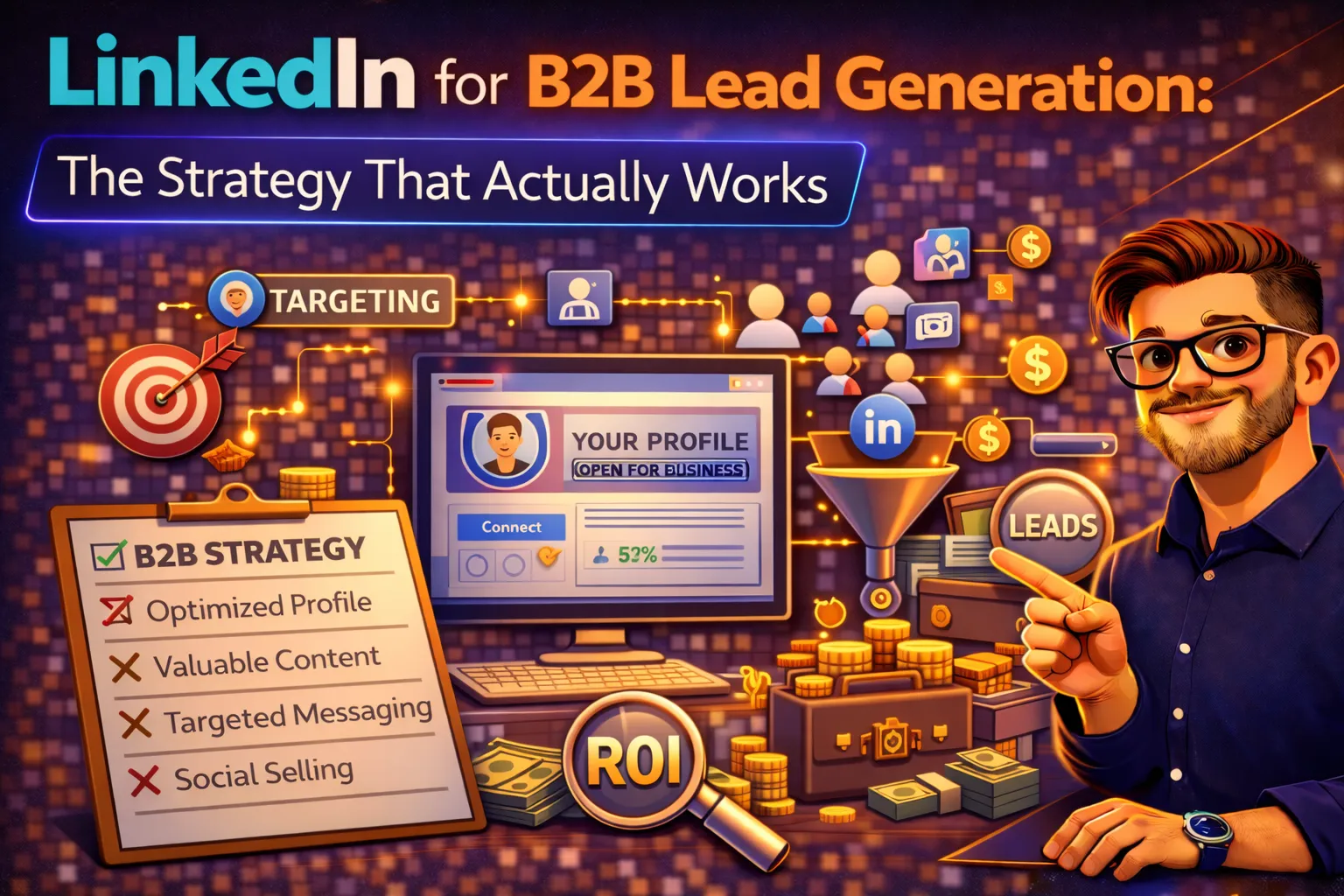
LinkedIn for B2B Lead Generation: The Strategy That Actually Works
Quick answer
LinkedIn's dominance in business-to-business lead generation is not accidental. It is the only major social platform built specifically for professional networking, which creates three structural advantages no other platform replicates. Treat your profile as a landing page for buyers rather than a resume, and treat content as the engine that makes outreach welcome.
Why LinkedIn dominates B2B lead generation, how to build a profile that attracts decision-makers, the content strategy that drives inbound leads, and the outreach framework that converts connections into pipeline.
Key Takeaways
- LinkedIn’s dominance is not accidental. It is the only major social platform built specifically for professional networking, which creates three structural advantages no other platform can replicate.
- Your LinkedIn profile is not a resume—it is a landing page for potential buyers.
- Content is the engine of LinkedIn lead generation.
- Content builds visibility and trust. Outreach converts that attention into meetings and pipeline.
- Organic content and outreach build the foundation.
Published: March 20, 2026 | Reading Time: ~11 minutes | Category: Social Media Marketing
If you sell to other businesses, LinkedIn is not optional. It is the top social platform for B2B lead generation, and the 2026 data proves it (Postiv AI / Martal Group). About 80% of B2B leads that come from social media come from LinkedIn (Retail Technology Review). That is more than double the share of any other social platform.
LinkedIn drives three times more conversions than Facebook and X combined. Its lead conversion rate is nearly three times higher, at 2.74% (Postiv AI). The platform now reaches users worldwide (ConnectSafely), with 310 million monthly active users and about 1.77 billion monthly visits (SalesSo). This is where your buyers research options, compare vendors, and decide what to buy.
Yet most businesses treat LinkedIn as an afterthought. They post now and then, connect at random, and never build a real system for turning the platform into a source of leads. This guide fixes that. It walks through the full B2B strategy: a strong profile, content that pulls in leads, outreach that converts, ads that scale, and the numbers that matter.
Why does LinkedIn dominate B2B lead generation?
LinkedIn’s dominance is not accidental. It is the only major social platform built specifically for professional networking, which creates three structural advantages no other platform can replicate.
Professional Intent
LinkedIn users are in a business mindset. They look for solutions, compare vendors, share industry news, and search for ways to grow. On Facebook or Instagram, people scroll for fun. On LinkedIn, they expect business content and business messages. About 40% of B2B buyers say they have reached out to a vendor after seeing them on LinkedIn (Martal Group). You cannot buy that kind of intent on other platforms.
Precision Targeting
No other platform targets buyers as precisely. LinkedIn lets you filter by job title, company size, industry, seniority, role, skills, growth rate, tools used, and recent job changes. You are not aiming at broad demographics. You are reaching the exact decision-makers at the exact companies you want. That is why LinkedIn's higher cost per lead still pays off. You reach the right people, not just more people.
Why does LinkedIn carry more trust?
LinkedIn's professional setting builds trust that other platforms cannot match. When a prospect sees your posts, views your profile, and gets a thoughtful connection request, they judge you as a fellow professional. They do not tune you out as a random advertiser. This is why LinkedIn InMail earns 18 to 25% response rates, while cold email earns just 1 to 5% (SalesSo). The professional setting removes much of the doubt that kills outreach elsewhere.
What does good LinkedIn performance look like?
Before building your strategy, understand what good looks like on the platform in 2026:
| Metric | 2026 Benchmark |
|---|---|
| Average engagement rate | 3.85% (up 44% year-over-year) |
| Carousel post engagement | 6.60% (highest of all formats) |
| Video content engagement | 5x average engagement rate |
| Image post engagement | 2x average engagement rate |
| InMail response rate | 18–25% (vs. 1–5% for cold email) |
| Personalized connection acceptance | 93% higher than generic requests |
| Average cost per lead (ads) | $310 (vs. $164 on Facebook) |
| Lead conversion rate | 2.74% (3x higher than Facebook/X) |
| Sponsored Content CTR | 0.44% average; 0.6–0.8% well-optimized |
| Posts with external links | 50–80% less reach (algorithm penalty) |
Sources: Socialinsider, SalesSo, LeadGen Economy, ConnectSafely (2025–2026).
Here is the key point. LinkedIn's cost per lead is nearly double Facebook's, but the leads are far more qualified (SalesSo). Measured by cost per qualified lead, LinkedIn beats every other digital channel for B2B.
Is your profile a resume or a landing page?
Your LinkedIn profile is not a resume—it is a landing page for potential buyers. Before any content or outreach strategy can work, your profile must communicate what you do, who you help, and why they should care.
Headline: Lead With Value, Not Your Title
Instead of “Owner at XYZ Company,” write a headline that speaks to your buyer: “Helping [target audience] achieve [specific result] through [your service].” Your headline appears in search results, connection requests, and every comment you make. It is your single most visible piece of copy on LinkedIn, so make it benefit-driven.
What should your About section answer?
Your About section should answer three questions from the buyer's point of view. What problem do you solve? Who do you solve it for? What results have you delivered? Lead with the problem your buyer faces, not your company's history. Add real numbers: revenue earned, leads delivered, clients served, or growth. End with a clear next step that tells visitors how to reach you.
Featured Section: Showcase Social Proof
Pin your best-performing content, case studies, testimonials, or lead magnets to the Featured section of your profile. This is prime real estate that most LinkedIn users ignore completely. A pinned case study showing a measurable result—“How we helped [client type] increase leads by 47%”—immediately establishes credibility and gives visitors a reason to reach out.
Should the experience section list duties or results?
Transform each experience entry from a job description into a results showcase. Instead of listing responsibilities, highlight measurable outcomes: campaigns managed, revenue generated, clients served, growth achieved. Prospects visiting your profile are evaluating whether you can deliver results for them—show them you have.
What content strategy drives inbound leads?
Content is the engine of LinkedIn lead generation. The platform has a massive audience, yet those creators generate 9 billion impressions (GrackerAI). The opportunity to stand out by consistently publishing valuable content is enormous—and most of your competitors are not taking it.
The 70/20/10 Content Framework
Use a simple content mix. Make 70% of your posts educational, to build reach and trust. Make 20% conversation-starters that spark debate. Make the last 10% promotional, to drive leads (GrackerAI). This balance keeps your audience engaged and your pipeline full. If every post is a sales pitch, people stop reading. If every post only teaches, you never turn attention into leads.
How often should you post on LinkedIn?
| Format | Engagement | Best Use Case |
|---|---|---|
| Carousels | 6.60% (highest) | Step-by-step guides, data breakdowns, frameworks, before/after comparisons |
| Video | 5x average | Client stories, behind-the-scenes, expert commentary, process walkthroughs |
| Image posts | 2x average | Data visualizations, infographics, team highlights, event photos |
| Text-only | Baseline | Strong-opinion takes, personal stories, lessons learned, industry commentary |
| Polls | High reach | Industry questions, preference surveys, conversation starters (use sparingly) |
Post 2–4 times per week consistently. Comments increased 37% year-over-year on LinkedIn in 2026 (Socialinsider), which means the algorithm is rewarding content that generates discussion. Ask questions, share counterintuitive insights, and take positions your audience cares about.
Do external links hurt your LinkedIn reach?
Posts with outside links get 50 to 80% less reach than native posts (SalesSo). LinkedIn's algorithm holds back content that sends users off the platform. So share your key points right in the post instead of linking to your blog. Give the value away on LinkedIn itself. If you want to send people to a resource, put the link in the first comment or a follow-up, not in the post.
Step 3: Execute Outreach That Converts Connections Into Pipeline
Content builds visibility and trust. Outreach converts that attention into meetings and pipeline. The two work together—outreach without content feels cold, and content without outreach leaves leads on the table.
The Connection Request
Personalized connection requests see 93% higher acceptance rates than generic requests (SalesSo). Every connection request should reference something specific: a post the person shared, a mutual connection, a company milestone, or an industry challenge you both face. Keep it under 300 characters. Do not pitch in your connection request—the goal is to start a relationship, not close a deal.
The Warm-Up Sequence
After a connection accepts, do not immediately pitch. Instead, engage with their content for one to two weeks: like their posts, leave thoughtful comments, and share relevant insights. This builds familiarity and positions you as a peer, not a salesperson. When you eventually send a direct message, the recipient already recognizes your name and has positive associations with your engagement.
The Value-First Message
Your first message should offer value, not ask for a meeting. Share an insight for their industry, a resource for a challenge they posted about, or a specific note about their business. For example: I saw your team just expanded into a new market, so we put together a quick analysis that might help, and I am happy to share it. This builds goodwill and starts a conversation on their terms.
InMail for Cold Outreach
LinkedIn InMail earns 18 to 25% response rates, while cold email earns 1 to 5% (SalesSo). Keep InMails under 400 characters for a 22% lift in replies. Lead with relevance, so they know why you picked them. Then close with a small ask: a quick question, a short call, or a useful resource. Decision-makers need to see the value in the first three or four sentences.
Multi-Channel Amplification
The highest-performing B2B outreach does not rely on a single channel. A multi-channel sequence converts at a higher rate than single-channel campaigns (SalesSo). Use LinkedIn engagement to warm up prospects before email outreach, and follow up on LinkedIn after phone calls. This surround-sound approach keeps your name visible across multiple touchpoints.
Step 4: Scale With LinkedIn Advertising
Organic content and outreach build the foundation. LinkedIn advertising lets you scale reach and lead generation beyond your network’s limits. Three-quarters of B2B marketers are already running LinkedIn ads (Postiv AI), and a third of businesses see a 33% increase in purchase intent from their campaigns.
Lead Gen Forms: The Highest-Converting Ad Format
LinkedIn Lead Gen Forms auto-populate user information from their profile, eliminating friction and dramatically increasing form completion rates. Because users do not leave LinkedIn, the experience is seamless. Lead Gen Forms consistently deliver lower cost per lead than ads that drive to external landing pages. Use them for gated content offers: whitepapers, industry reports, free audits, webinar registrations, or consultation requests.
Budget and Benchmarks
LinkedIn needs a $10 daily minimum per campaign. But real testing needs $3,000 to $5,000 a month to gather enough data (LeadGen Economy). Sponsored Content averages a 0.44% click rate, and well-run campaigns reach 0.6 to 0.8%. Cost per click usually runs $5 to $12. In competitive fields like finance and enterprise tech, it can hit $15 to $25. The higher cost is offset by much better lead quality and conversion.
Targeting Strategy
Start with your ideal customer profile. Build audiences by job title, seniority, company size, and industry. Then add filters like growth rate, tools used, or location for more precision. Use LinkedIn's Matched Audiences to retarget site visitors, and upload account lists for account-based campaigns. The Audience Network extends your posts to partner sites and apps for extra reach.
Best Practice: Educational content outperforms promotional content by 3:1 in engagement metrics on LinkedIn ads (LeadGen Economy). Lead with value—a useful insight, a relevant statistic, a practical framework—not a product pitch. Numbers in headlines improve CTR by 20–30% compared to qualitative statements.
Step 5: Measure What Matters—Pipeline, Not Vanity Metrics
The metric that matters is pipeline revenue generated from LinkedIn activities, not likes, followers, or impressions. Build your measurement framework around these KPIs:
| Metric | What It Tells You | Benchmark |
|---|---|---|
| Profile views per week | How visible you are to your target audience | Upward trend week-over-week |
| Connection acceptance rate | How relevant your outreach is | 40–60% for personalized requests |
| Content engagement rate | How valuable your audience finds your content | 3.85% average; 4–8% for small business |
| InMail/DM response rate | How compelling your messaging is | 18–25% for InMail; 10%+ for DMs |
| Leads generated per month | Whether LinkedIn is producing pipeline | Track against cost per lead target |
| Lead-to-meeting conversion | Quality of leads from LinkedIn | 15–25% for warm outreach leads |
| Revenue attributed to LinkedIn | The bottom-line impact of your investment | Track monthly with CRM attribution |
Review these metrics weekly and monthly. Compare LinkedIn’s cost per qualified lead against other channels—when measured on a pipeline basis rather than raw lead volume, LinkedIn frequently outperforms every other B2B digital channel.
The 90-Day LinkedIn Lead Generation Launch Plan
If you are starting from scratch or resetting a stalled LinkedIn strategy, this 90-day plan builds the system systematically:
- Days 1–14: Foundation
- Optimize personal profiles for all team members who will be active on LinkedIn (headline, About, Featured, Experience sections)
- Optimize your company page with current branding, clear service descriptions, and a compelling tagline
- Build your Ideal Customer Profile (ICP) and map target accounts by job title, company size, and industry
- Install the LinkedIn Insight Tag on your website for retargeting and conversion tracking
- Days 15–45: Content Engine
- Begin posting 2–4 times per week using the 70/20/10 framework
- Prioritize carousels and video content for maximum engagement
- Engage with 10–15 prospects’ content daily (likes, comments, shares)
- Start sending 10–20 personalized connection requests per day to ICP-matched prospects
- Days 46–75: Outreach Activation
- Launch the warm-up and value-first DM outreach sequence for accepted connections
- Begin testing LinkedIn Lead Gen Form ads with a $3,000–$5,000 monthly budget
- Track connection acceptance rates, DM response rates, and meetings booked
- Refine messaging based on which value propositions generate the highest response rates
- Days 76–90: Optimization and Scale
- Review all metrics against benchmarks and identify top-performing content formats
- Scale ad budget toward the campaigns with the lowest cost per qualified lead
- Implement multi-channel sequences (LinkedIn + email + phone) for highest-value prospects
- Calculate pipeline revenue generated and project forward based on current conversion rates
LinkedIn Is Where Your B2B Buyers Already Are
The data is unambiguous: LinkedIn drives 80% of all B2B social media leads, delivers a 2.74% lead conversion rate that is 3x higher than any other platform, and InMail outperforms cold email by 4–5x. (Dux-Soup), and the platform’s average engagement rate has increased 44% year-over-year to 3.85% (Socialinsider). The audience is growing, the engagement is increasing, and the buyers are actively using LinkedIn to research and evaluate vendors.
The businesses that win on LinkedIn are not the ones with the biggest ad budgets. They are the ones that show up consistently with valuable content, build relationships before asking for meetings, and treat the platform as a full-funnel revenue channel. —which means the opportunity to differentiate through consistent thought leadership remains wide open.
Start with your profile. Build your content engine. Launch your outreach system. Measure pipeline, not vanity metrics. Within 90 days, you can transform LinkedIn from a dormant professional network into your most productive B2B lead generation channel.
References
The following sources informed this article:
- ConnectSafely (2026). "100+ LinkedIn Statistics 2026: Revenue, Users, Engagement Rate."
- Dux-Soup (2026). "B2B Lead Generation Report 2026."
- GrackerAI (2025). "LinkedIn B2B Lead Generation: Advanced Strategies for 2026."
- LeadGen Economy (2026). "LinkedIn Lead Generation for B2B Companies: Complete 2026 Strategy Guide."
- Martal Group (2026). "LinkedIn Statistics 2026: Global Trends & Social Selling Data."
- Postiv AI (2026). "LinkedIn Marketing Strategy for B2B: The 2026 Lead Generation Playbook."
- Retail Technology Review (2026). "Why 62% of B2B Marketers Say LinkedIn Delivers the Best Leads."
- SalesSo (2025). "LinkedIn Marketing Statistics 2026: Latest B2B Benchmarks."
- Sopro (2025). "62 LinkedIn Lead Generation Statistics for 2025."