Rated 5 star on

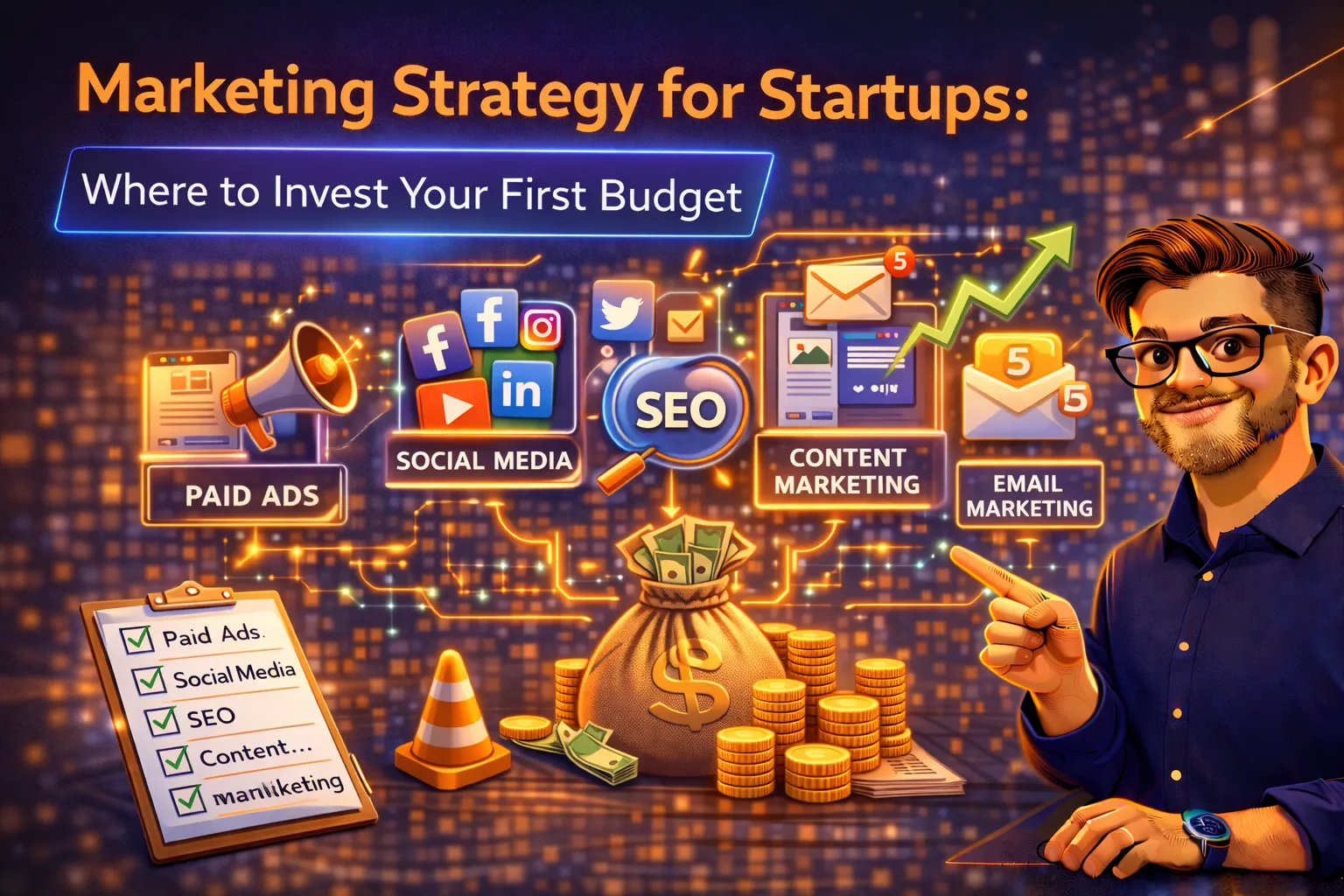
Marketing Strategy for Startups: Where to Invest Your First Budget
Quick answer
The most common mistake startups make with a first marketing budget is spreading it across too many channels at once, which produces no signal anywhere. The right mix depends on business model, sales cycle, and average order value, so earn before you spend and concentrate the budget where your category's buyers actually decide.
Published: March 2, 2026 | Reading Time: ~12 minutes | Category: Strategy
Key Takeaways
- The most common mistake startups make with their first marketing budget is distributing it across too many channels at once.
- The right channel mix depends on your business model, sales cycle, and average order value.
- The right allocation depends on your category.
- Most early-stage startups face a build vs. buy decision with marketing: do you hire a generalist employee, bring in a specialist agency, or keep marketing in the hands of the founders?
- There is no universal right answer to where a startup should invest its first marketing budget.
Most startup marketing advice falls into one of two traps: it is either too theoretical or too tactical without strategy. Neither helps a founder who has a real budget to deploy, a real timeline to hit, and real revenue targets to reach.
This guide is built for the startup that has moved past idea stage and is now asking the most important early marketing question: where do we put our first real dollars to generate return? We will cover the strategic framework for making that decision, channel-by-channel breakdowns for the most common startup contexts, and the budget allocation principles that give early-stage companies the best chance of building compounding marketing momentum.
Why do startups waste their first marketing budget?
The most common mistake startups make with their first marketing budget is distributing it across too many channels at once. The logic seems sound: diversify your bets, see what works, optimize from there. In practice, spreading $5,000 or $10,000 across six channels means you have enough spend in each channel to burn money, but not enough to learn anything meaningful or generate real traction.
The second most common mistake is investing in brand before investing in demand. Spending your first budget on a logo redesign, a beautiful website, or a brand film before you have validated that your core message converts is a luxury that early-stage startups cannot afford.
The third mistake is copying competitors without understanding their context. A well-funded Series A competitor running aggressive Meta ads has months of audience data, retargeting lists, and creative learnings behind those ads. A startup cannot compete on the same terms with a fraction of the budget. The strategy must be different, not just smaller.
What should you do before spending a dollar?
Before allocating a single dollar of paid budget, startups should pursue every available channel that has near-zero cost but high learning value:
- Direct outreach — email or LinkedIn messages to your ideal customer profile, manually written. If you cannot convert anyone through personal outreach, paid ads will not save you.
- Content creation — a blog, newsletter, or social presence built around your target customer's most pressing questions. This generates organic traffic, establishes credibility, and gives you content to amplify when you do have paid budget.
- Referral and partnership activation — every person who has expressed interest, used your product, or knows your target customer is a potential source of qualified leads at zero cost.
- PR and earned media — a compelling founder story or contrarian industry perspective can generate coverage that drives significant early traffic and brand awareness.
These channels are not just cheap — they are uniquely high-signal. Every conversion, every reply, every share tells you something about your message and your audience that you can use to make paid spend more efficient when you do deploy it.
When to Start Paying for Marketing
There are two conditions that indicate readiness to invest in paid marketing:
- You have a message that converts. This means you have validated through direct outreach, landing page tests, or organic content that some version of your pitch causes your target customer to take action. Without this, paid traffic will arrive at a message that does not convert, and you will learn nothing useful at an expensive cost.
- You know your unit economics well enough to set a target cost per acquisition. Even a rough lifetime value to customer acquisition cost estimate is necessary to evaluate whether a marketing channel is worth continuing. Without this, you cannot distinguish between channels that are underperforming and channels that need more time to optimize.
Which channel mix fits your startup?
The right channel mix depends on your business model, sales cycle, and average order value. Here is a breakdown of the most relevant channels for early-stage startups:
When is paid search the right first channel?
Best for: B2B services, local service businesses, and any category where people are actively searching for solutions.
Search advertising captures demand that already exists. When someone types 'accounting software for restaurants' or 'emergency plumber Miami,' they are actively looking for a solution — making them far more likely to convert than a cold audience on social. Starting budget recommendation: $1,500 to $3,000 per month. Start with tightly targeted keywords, single-focus landing pages, and call tracking. Do not launch search ads with a broad keyword strategy and a homepage as the destination.
2. Meta Ads (Facebook and Instagram)
Best for: B2C brands, e-commerce, consumer services, and any brand where visual storytelling can communicate value quickly.
Meta advertising creates demand rather than capturing it. This means it requires stronger creative, more patience, and a longer learning phase than search. Starting budget recommendation: $2,000 to $4,000 per month. Allocate at least 70% of creative budget to video. Plan for a 60 to 90 day testing phase before expecting consistent performance.
Which startups should invest in content and SEO?
Best for: Startups with longer sales cycles, knowledge-heavy industries, or products that require education before purchase.
Content marketing is a long-term investment that compounds in value over time. A well-structured blog targeting high-intent keywords can drive consistent organic traffic for years after publication. Starting budget recommendation: $1,000 to $2,000 per month (or equivalent in founder and team time). Prioritize content that targets bottom-of-funnel search queries — terms your potential customers search when they are ready to evaluate solutions.
Why should every startup run email?
Best for: All startups. Email is the only channel where you own your audience, and it consistently delivers the highest ROI of any digital marketing channel.
The first priority for any startup should be building an email list and establishing a consistent communication cadence. A monthly newsletter that delivers genuine value to your target audience is one of the highest-ROI marketing investments available, and the cost of email platforms at startup scale is negligible compared to paid channels. Starting budget: $50 to $200 per month for platform costs.
5. LinkedIn (for B2B Startups)
Best for: B2B startups targeting professionals, executives, or businesses in specific industries.
LinkedIn offers two distinct strategies: organic content from the founder's personal profile (zero ad cost, high credibility) and LinkedIn Ads (expensive but highly targeted). For most startups, the founder's organic LinkedIn presence should come before LinkedIn Ads investment. A founder with 500 followers in their target industry who publishes consistently can generate more qualified leads than $2,000 per month in LinkedIn Ads with a weak message.
Sample Budget Allocations by Startup Type
The right allocation depends on your category. Here are three common early-stage startup profiles and how their first marketing budgets should be structured:
Profile 1: Local Service Business Startup ($3,000/month)
| Channel | Monthly Budget | % of Total |
|---|---|---|
| Google Ads (local search) | $1,800 | 60% |
| Content / SEO (1 blog/week) | $600 | 20% |
| Email marketing | $150 | 5% |
| Social media organic | $200 | 7% |
| Analytics / tracking tools | $250 | 8% |
Profile 2: B2C E-Commerce Startup ($5,000/month)
| Channel | Monthly Budget | % of Total |
|---|---|---|
| Meta Ads (creative + spend) | $2,500 | 50% |
| Google Shopping / Search | $1,000 | 20% |
| Email / SMS marketing | $500 | 10% |
| Influencer / UGC content | $750 | 15% |
| Analytics tools | $250 | 5% |
Profile 3: B2B SaaS Startup ($8,000/month)
| Channel | Monthly Budget | % of Total |
|---|---|---|
| Content marketing / SEO | $2,000 | 25% |
| Google Ads (branded + competitor) | $2,000 | 25% |
| LinkedIn (organic + paid) | $1,500 | 19% |
| Email outreach and automation | $1,000 | 12% |
| Webinars / events / partnerships | $1,000 | 12% |
| Analytics and CRM tools | $500 | 6% |
The Principles That Make Early Marketing Budgets Work
Regardless of channel selection or budget size, startups that generate strong returns from their first marketing budgets tend to follow a consistent set of principles:
- Concentrate before you diversify. Pick one or two channels and achieve meaningful results before adding a third. The temptation to be everywhere is the enemy of early-stage marketing efficiency.
- Track everything from day one. Set up conversion tracking before you spend a dollar on paid media. Without it, you cannot tell which campaigns, ads, or keywords are driving results, and you will be unable to improve.
- Separate testing from scaling. Use a portion of your budget (roughly 20%) to test new creative, new audiences, or new channels. Scale spend only behind what has proven it can convert.
- Give channels enough time to generate signal. Most paid channels require 30 to 60 days of data before optimization decisions become reliable. Cutting channels after two weeks typically results in abandoning strategies before they have had a fair chance.
- Reinvest from revenue, not just from budget. The most scalable marketing operations are funded primarily by the revenue they generate. As soon as you can identify a positive unit economics channel, increase investment there before exploring new channels.
When to Hire Help vs. Keep Marketing In-House
Most early-stage startups face a build vs. buy decision with marketing: do you hire a generalist employee, bring in a specialist agency, or keep marketing in the hands of the founders? The general principle: founders should own marketing strategy and message. The customer understanding that informs strong marketing lives closest to the founder, and outsourcing strategic decisions too early is a common and expensive mistake.
Execution, however, can and often should be outsourced once a strategy is defined. A specialized PPC agency will set up and optimize Google Ads campaigns faster and more efficiently than a founder learning the platform while simultaneously running the business.
The right time to bring in outside marketing help is when you have a validated message, a working funnel, and a channel that is generating positive return — and you need more capacity to scale it. Bringing in an agency before you have product-market fit typically results in more expensive uncertainty rather than faster growth.
Final Thoughts
There is no universal right answer to where a startup should invest its first marketing budget. The right answer depends on your business model, your customer's buying behavior, your timeline, and how much you already know about what converts your audience.
What is universal is the principle: start with the lowest-cost channels to find your message, validate it, and understand your customer. Then invest paid dollars behind what is already working. Concentrate before you diversify. Track everything. Give strategies enough time to generate real data before making changes.
The startups that build sustainable marketing engines are not the ones that spend the most — they are the ones that learn the fastest and reinvest their learnings systematically. That discipline, more than any channel selection or budget size, is what separates startups that grow from startups that stall.
Ready to build a marketing strategy built around your startup's growth goals? Astra Results Marketing specializes in PPC, SEO, and AI-driven marketing for service businesses and startups. Visit astraresults.com to get started.