Rated 5 star on

Ad Copy That Converts: Frameworks and Examples
You can have great targeting, the right keywords, a generous budget, and a strong landing page — and still produce mediocre results if your ad copy doesn't earn the click. Ad copy is what determines whether prospects scrolling past your ad pause and engage, or whether they keep scrolling. Whether the searcher who saw your ad chooses you or the competitor's ad above or below yours. Whether your expensive impressions become clicks or wasted views. For most businesses running paid ads, ad copy is the highest-leverage thing they could improve — and most of them are running copy that's adequate but not great, leaving meaningful performance on the table.
Published: July 9, 2026 | Reading Time: ~9 minutes | Category: PPC
The good news is that ad copy isn't a black art. It's a learnable skill built on consistent frameworks that have worked for decades — frameworks any business owner or marketer can apply to their own ads. The bad news is that most ads in most categories are written without these frameworks, producing generic, forgettable copy that blends in rather than standing out. The businesses that take ad copy seriously and apply proven frameworks consistently outperform competitors whose copy is treated as an afterthought.
This guide covers ad copy that converts: why headlines do most of the work, the foundational frameworks (AIDA, PAS, Before-After-Bridge, the 4 Cs) and when to use each, how to write headlines and descriptions that actually drive clicks, calls to action that move searchers to take the next step, how to match copy to the platform and audience, the common mistakes that destroy ad performance, and the testing approach that turns good copy into great copy over time. Whether you're writing your own ads or evaluating what an agency produces, this is the practical playbook for ad copy that earns the click and produces the conversion.
What You'll Learn
- Why headlines do most of the work — and how to write headlines that get clicks
- The proven ad copy frameworks (AIDA, PAS, Before-After-Bridge, the 4 Cs) and when to use each
- Descriptions that elaborate, prove, and reinforce the value
- Calls to action that move searchers to take the next step
- How to match copy to the platform (Google, Facebook, LinkedIn) and audience (cold vs warm vs retargeting)
- Common ad copy mistakes that destroy performance
- The testing approach that turns good copy into great copy over time
Why Headlines Do Most of the Work
In ad copy, the headline carries most of the weight. It's what catches attention, communicates the offer, and determines whether the rest of the ad gets read or scrolled past. Get the headline right and the ad has a chance; get it wrong and nothing else in the ad matters because nobody read past it. This is true across virtually every platform — Google Search, Facebook, LinkedIn, YouTube, display — though the specifics vary by format.
What Makes Headlines Work
- Specific over generic: 'Save 30% on Your AC Repair' beats 'Quality AC Repair.' Specifics earn attention; generics blend in.
- Relevant to the search or audience: a headline that mirrors what the searcher typed (for Search) or speaks to the audience's specific situation (for Social) signals relevance immediately. Generic headlines miss this match.
- Benefit-focused, not feature-focused: 'Get Your Home Sold in 30 Days' beats 'Full-Service Real Estate Agency.' Benefits speak to outcomes the prospect cares about; features describe what you do internally.
- Urgency or scarcity (when honest): 'Same-Day Service Today' or 'Limited Spots This Month' add motivation — but only when true. False urgency destroys credibility once detected.
- Curiosity-inducing (without clickbait): 'The Mistake 80% of Homeowners Make Hiring a Roofer' creates curiosity that drives clicks — but the ad and landing page must deliver, or the clicked-through prospects bounce.
THE HEADLINE-FIRST WORKFLOW: Most ad writing starts with the wrong question — 'what do we want to say about our business?' — which produces company-focused, feature-listing headlines that don't convert. The better workflow starts with a different question: 'what would make the right prospect stop scrolling and click?' Write 10-20 headline options before settling on one. Test multiple headlines against each other in real campaigns. Keep iterating on the headlines that work and killing the ones that don't. Most of the performance improvement available in ad campaigns comes from headline iteration. Treat the headline as the most important thing you write — because it is.
The Proven Ad Copy Frameworks
Several copywriting frameworks have worked across industries for decades. Each fits different situations and audiences.
AIDA — Attention, Interest, Desire, Action
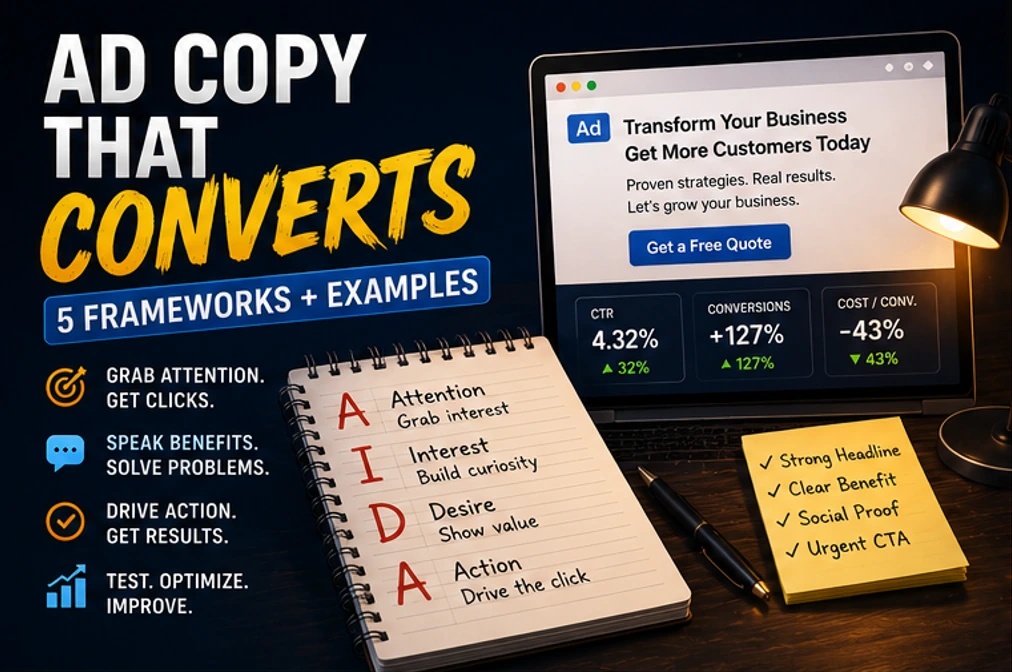
The classic framework: capture Attention (with a compelling headline), build Interest (with relevant detail about why it matters), create Desire (with specific benefits and proof), and prompt Action (with a clear call to act). AIDA fits most direct-response ad situations and works particularly well for short-form ads where you need to move the reader through the entire arc quickly. Example structure: 'AC Failed? [Attention] We Provide Same-Day Service Across [City]. [Interest] Get Your Family Cool Again Today With Our Licensed Technicians. [Desire] Call Now for Same-Day Repair. [Action]'
PAS — Problem, Agitate, Solution
Identify the problem your prospect has, agitate it briefly (remind them of the pain or stakes), then present your solution. PAS works powerfully when prospects have a specific painful problem you solve directly. Example: 'Slow Computer Driving You Crazy? [Problem] Wasted hours, missed deadlines, growing frustration. [Agitate] Our IT Specialists Fix Most Slow PCs in 24 Hours. [Solution]' PAS suits service businesses solving acute pains — emergency repair, urgent professional services, distress situations.
Before-After-Bridge
Show the prospect their Before (current situation), the After (what their life looks like with the problem solved), and the Bridge (your service that gets them from Before to After). This framework works well for transformations — outcomes that meaningfully change the prospect's situation. Example: 'Outdated Kitchen You're Embarrassed By? [Before] A Beautiful Kitchen That Becomes the Heart of Your Home. [After] Our Design-and-Build Team Delivers Your Dream Kitchen in 6 Weeks. [Bridge]'
The 4 Cs — Clear, Concise, Compelling, Credible
Less a framework than a quality checklist. Every ad should be Clear (immediately understandable), Concise (no wasted words), Compelling (gives the reader a reason to engage), and Credible (backed by proof or believable on its face). The 4 Cs apply across formats and check that your ad copy meets the basic standards even if you're using one of the other frameworks structurally.
Features → Benefits → Outcomes
Translate features (what you do) into benefits (what the prospect gets) into outcomes (the meaningful result in their life). 'Licensed and insured' (feature) → 'You're protected if anything goes wrong' (benefit) → 'Peace of mind during a stressful experience' (outcome). Ad copy that stays at the feature level ('Licensed and insured. 25 years experience. 24/7 service.') is informative but doesn't sell. Ad copy that translates to outcomes ('Sleep tonight knowing your AC will be running by morning.') converts.
Descriptions That Elaborate, Prove, and Reinforce
Where the headline gets the click, the description (second line of a Google Search ad, body text of a Facebook ad, etc.) elaborates on the value, provides proof, and reinforces the action. The description should add something to the headline rather than repeat it.
- Elaborate on the value: take the promise of the headline and explain specifically what the prospect gets, what makes you the right choice, or what's included.
- Add proof points: years in business, customers served, reviews and ratings, certifications, guarantees, specific results. Specific numbers ('5,000+ homes served') beat vague claims ('experienced team').
- Reinforce the call to action: tell the reader what to do next and what happens when they do. 'Call now for a free estimate — most quotes returned within 24 hours' is concrete and tells the reader what to expect.
- Match the description to the headline's framework: if the headline opened a PAS structure, the description continues it. If the headline made a benefit promise, the description elaborates on how that promise is fulfilled.
- Use the space efficiently: most platforms cap description length tightly. Every word should add something — cut filler ruthlessly.
Calls to Action That Move Searchers to Act
The call to action (CTA) is what makes the conversion happen — or fails to. A clear, compelling, specific CTA dramatically outperforms vague or weak ones.
- Be specific about the action: 'Get a Free Estimate' beats 'Learn More.' 'Book Your Consultation' beats 'Contact Us.' Specifics reduce uncertainty about what happens when the prospect clicks.
- Add benefit when possible: 'Get Your Free Quote in 24 Hours' adds the benefit of speed to the action. 'Save 30% This Month' combines action with offer.
- Match urgency to context: 'Call Now for Same-Day Service' works for emergencies; 'Schedule Your Consultation' works for considered purchases. The urgency should fit the buying situation.
- Test CTAs as variables: small changes in CTA wording can meaningfully affect click-through and conversion rates. Test variations alongside other ad elements.
- Don't bury the CTA: it should be visible, prominent, and obvious — not hidden in the description or absent altogether.
Matching Copy to Platform and Audience
The same product or service needs different ad copy depending on where the ad runs and who's seeing it. Ignoring this — running the same generic copy everywhere — produces mediocre performance across all of it.
By Platform
- Google Search: high-intent users who searched for what you offer. Copy should be direct, specific, and conversion-focused — they're already looking for what you sell, so match their search and offer the next step clearly.
- Facebook and Instagram: users not actively searching, scrolling for entertainment and connection. Copy should attract attention, build interest, and engage before asking for action. Hook them first; sell second.
- LinkedIn: professional context. Copy should be relevant to professional concerns, demonstrate authority, and respect the reader's time. More polished, less casual than Facebook copy typically works.
- YouTube: video, but the description and overlay text matter. Hook in the first second of the video; reinforce in text.
- Display and remarketing: users who've seen you before. Copy can be shorter, more contextual, more direct — they don't need full introduction.
By Audience Temperature
- Cold audiences: prospects who don't know you. Copy needs to introduce who you are, what you offer, and why it's relevant. More explanation, more proof, more education.
- Warm audiences: prospects familiar with you (organic visitors, retargeting). Copy can skip the introduction and focus on next steps, specific offers, and reasons to convert now.
- Hot audiences: existing customers or near-converters. Copy can be highly direct and offer-focused — they already know you.
PRO TIP: The single biggest ad copy mistake is using the same copy across platforms and audiences. The Facebook ad that works as cold-traffic discovery doesn't work as the Google Search ad answering 'plumber near me.' The cold-traffic ad that explains who you are doesn't work for retargeting where prospects already know you. Match the copy to the platform context and audience temperature — and you'll outperform competitors running identical copy everywhere. The discipline of writing different copy for different platform-audience combinations is one of the most consistent performance differentiators in ad campaigns.
Common Ad Copy Mistakes
- Company-focused instead of prospect-focused. Headlines like 'Welcome to Acme Services' or 'About Our Team' speak to the company instead of the prospect. Every ad element should answer the prospect's question 'what's in it for me?'
- Feature-listing without translating to benefits and outcomes. 'Licensed, insured, 24/7' tells the prospect what you do; doesn't tell them why they should care.
- Generic claims with no proof. 'Best service' and 'top-rated' are unsupported claims. 'Rated 4.9 stars by 1,500+ customers' is proof.
- Weak or absent calls to action. 'Learn More' is forgettable. 'Contact us' is vague. Specific, action-oriented CTAs convert.
- Mismatched ad and landing page. The ad promises one thing; the landing page is about something else. Visitors who feel misled bounce immediately — and the wasted clicks compound.
- Running the same copy too long. Even great copy fatigues — performance declines as audiences see it repeatedly. Refresh creative regularly.
- Not testing. Running one version of an ad indefinitely and assuming it's optimal. Continuous testing reveals what works for your specific audience.
The Testing Approach
Even great ad copy benefits from continuous testing — and what works for one business and audience differs from what works for another. The frameworks give you the starting point; testing finds your specific best performers.
- Test one variable at a time when possible: changing multiple things at once muddies the data. Isolate the headline, then the description, then the CTA.
- Run tests with enough volume and time: small samples produce noisy results. Wait for statistically meaningful signal before declaring winners.
- Kill underperformers fast: ad platforms often optimize spend toward winning variations automatically; reinforce this by manually killing clear losers and giving promising variations more budget.
- Test across the variables that matter: headlines, descriptions, CTAs, images, video hooks. Different elements often have different optimal values for different audiences.
- Refresh winners before they fatigue: even the best ad declines as audiences see it repeatedly. Continuously develop and test new variations alongside your current winners.
The Bottom Line
Ad copy is what determines whether your targeting and budget produce clicks and conversions or wasted impressions — and most ads in most categories are written without the frameworks and discipline that produce real performance. The fundamentals: headlines do most of the work and deserve most of the attention, proven frameworks (AIDA, PAS, Before-After-Bridge, the 4 Cs, Features → Benefits → Outcomes) provide starting structures that work, descriptions elaborate and prove rather than repeat, calls to action are specific and action-oriented, and copy matches the platform and audience rather than running generic everywhere.
The businesses that take ad copy seriously — write multiple headline variations, apply frameworks deliberately, match copy to platform and audience, avoid the common mistakes, and test continuously — outperform competitors whose ad copy is an afterthought. The difference between mediocre ads and converting ads isn't talent; it's discipline applied consistently. Whether you're writing your own ads or evaluating an agency's work, the frameworks and disciplines above are the practical path to ad copy that earns clicks and produces conversions — turning the targeting and budget you've already paid for into actual business results.
Key Takeaways
- Ad copy determines whether targeting and budget produce conversions or wasted impressions — and most ads are written without the frameworks and discipline that produce real performance
- Headlines do most of the work — specific over generic, relevant to search or audience, benefit-focused, urgency when honest, curiosity without clickbait. Treat headlines as the most important thing you write, because they are
- Proven frameworks: AIDA (Attention/Interest/Desire/Action), PAS (Problem/Agitate/Solution), Before-After-Bridge, the 4 Cs (Clear/Concise/Compelling/Credible), and Features → Benefits → Outcomes — each fits different situations and audiences
- Descriptions elaborate and prove rather than repeat — add specific value, proof points, reinforce the CTA, and continue the headline's framework. Use the space efficiently
- Calls to action: specific about the action, benefit when possible, urgency matched to context, tested as variables, prominent rather than buried
- Match copy to platform (Google Search vs Facebook vs LinkedIn vs YouTube vs Display) and audience temperature (cold vs warm vs hot) — running identical copy everywhere is one of the biggest performance leaks
- Common mistakes: company-focused instead of prospect-focused, feature-listing without benefits, generic claims without proof, weak CTAs, ad-landing-page mismatch, running copy too long, not testing — discipline avoids all of these
READY TO BUILD A LEAD PIPELINE THAT'S YOURS? Astra Results Marketing writes and tests ad copy for service businesses — applying the frameworks that drive clicks and conversions, matching copy to platform and audience, avoiding the common mistakes, and running the continuous testing that compounds performance over time. Stop running adequate ad copy that leaves performance on the table. Convert the targeting and budget you've already paid for into real business results. Astra Results Marketing · astraresults.com · (+1) 786-643-3036