Rated 5 star on

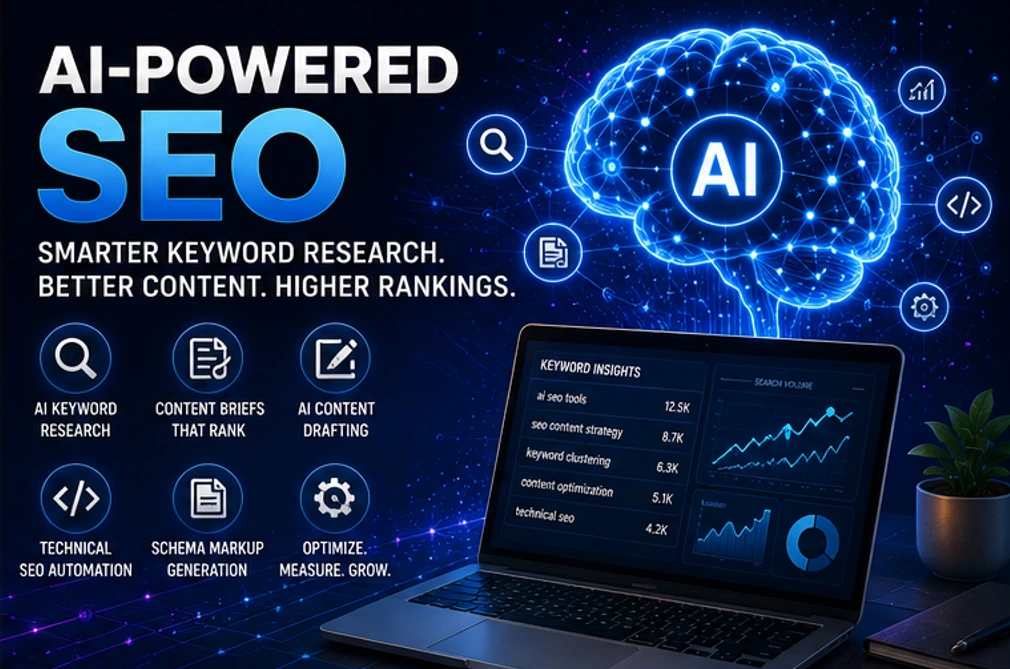
AI-Powered SEO: How to Use AI Tools for Keyword Research and Content
AI tools have changed what's possible for a small or mid-sized business doing its own SEO. The keyword research, content brief, drafting, optimization, and analysis work that used to require a full team of specialists can now be accelerated dramatically by AI — letting a lean operation accomplish in days what used to take weeks. For businesses without big budgets or in-house SEO departments, this changes the math: meaningful SEO is now within reach in a way it wasn't even two years ago. But the AI hype around SEO is also overblown in places, and businesses that treat AI as a magic solution often produce worse SEO results than businesses that didn't use AI at all.
Published: July 6, 2026 | Reading Time: ~10 minutes | Category: SEO
The honest truth is somewhere in the middle. AI tools genuinely accelerate the parts of SEO that can be accelerated — ideation, drafting, structure, optimization, and analysis. They don't replace the strategy, judgment, or expertise that determines whether the accelerated work is pointed in the right direction. A business using AI well does dramatically more SEO than it could without AI; a business using AI carelessly produces volumes of generic, ineffective SEO output that doesn't rank, doesn't convert, and damages credibility. The difference between the two outcomes is in how the AI tools are integrated with human judgment.
This guide covers AI-powered SEO practically: where AI genuinely accelerates the work (keyword research, content briefs, drafting, optimization, analysis), where AI's limits require human direction, the tools that fit different stages of the workflow, the honest evaluation of AI keyword data and content quality, and the integration that makes AI a force multiplier rather than a replacement. Whether you're a business owner doing your own SEO, a marketing manager building processes, or anyone evaluating how AI fits in modern SEO, this is the practical guide.
What You'll Learn
- Where AI genuinely accelerates SEO — and where it doesn't
- AI for keyword research: ideation, clustering, and intent mapping (and why you still need real search data)
- Building content briefs and outlines with AI
- Using AI for content drafting and optimization without producing generic output
- AI for technical SEO tasks: schema, internal linking, and audits
- The integration: AI accelerates the work, humans direct the strategy
- The honest limits — what AI can't do for your SEO
Where AI Genuinely Accelerates SEO
Several parts of the SEO workflow involve repetitive, structured work that AI handles well — and dramatically faster than humans can. Understanding which parts of SEO genuinely benefit from AI acceleration helps focus where the tools earn their place.
- Ideation and brainstorming: keyword ideas, topic clusters, content angles, FAQ questions — AI generates volumes of starting points in minutes that would take a human hours.
- Content briefs and outlines: turning a target keyword into a structured brief (outline, key points to cover, related questions to address, recommended sections) — AI produces solid first-draft briefs quickly.
- Drafting: producing first-draft content from a clear brief — AI accelerates the drafting work that bottlenecks content production.
- Editing and optimization: tightening drafts, improving clarity, adjusting tone, ensuring keywords are naturally placed, shortening or expanding to target length.
- Structured-content generation: FAQ sections, comparison tables, schema markup, meta descriptions, title-tag variations — the structured outputs AI generates quickly and accurately.
- Analysis and synthesis: summarizing data, interpreting analytics reports, identifying patterns across competitor content, drafting analysis sections.
THE AI-ACCELERANT MODEL: The right mental model for AI in SEO is an accelerant — AI dramatically speeds up the parts of the work that can be accelerated, while strategy, judgment, and expertise remain human. AI doesn't decide what topics matter for your business, what your brand voice is, what's true versus confidently-wrong, or what content actually serves your customers. Humans do those things. AI then accelerates the execution: producing the briefs, drafts, structured content, and analysis at a pace that makes meaningful SEO accessible to businesses that couldn't sustain it otherwise. The businesses that win use AI as the accelerant it is, with the human direction it requires.
AI for Keyword Research
Keyword research is one of the highest-leverage applications of AI in SEO — and one of the most commonly misused. Used well, AI accelerates ideation and structure; used poorly, it produces lists of irrelevant or fictional keywords that send SEO efforts in the wrong direction.
Ideation and Topic Clusters
AI excels at generating keyword ideas, topic clusters, and related questions around a target topic. Ask it for keyword ideas around your services, the questions your customers ask, the variations of your core terms, and the related topics your audience cares about — and it produces volumes of starting points in minutes. The brainstorming work that used to start with a blank page now starts with hundreds of candidate ideas to evaluate. This ideation acceleration is genuinely powerful.
Clustering and Intent Mapping
AI is good at organizing keyword ideas into clusters and mapping search intent (informational, commercial, transactional, navigational). Given a list of keywords, it can group them by topic, identify intent, and suggest content types appropriate for each. This clustering work used to take hours of manual organization; AI accelerates it significantly.
Why You Still Need Real Search Data
Here's where AI falls short: AI doesn't have live search volume data. It can list keywords related to your topic, but it can't reliably tell you which keywords people actually search and at what volume. The keywords it suggests may or may not have real search demand, and the volume estimates AI provides should be treated with skepticism — they're often wrong or fabricated entirely. The practical approach: use AI for ideation and clustering, then validate the candidates against real keyword data from a dedicated SEO tool (Google Keyword Planner, Ahrefs, Semrush, or similar). AI ideates; real tools validate.
- Use AI for: generating volumes of keyword ideas, organizing them into clusters, mapping intent, identifying related questions and topics.
- Use real keyword tools for: actual search volume, competition difficulty, current ranking data, SERP analysis — the empirical signals AI doesn't have.
- Combine both: AI breadth and ideation plus real-data validation produces a far stronger keyword foundation than either alone.
Building Content Briefs and Outlines
Once you have a validated target keyword, AI accelerates the brief-and-outline work that bridges keyword research and content production.
Given a target keyword and intent, AI can produce a solid content brief in minutes — outline structure, key points to cover, related questions to address, recommended sections, suggested word count, and the elements (FAQ, comparison content, examples) that should be included. A skilled SEO can produce a similar brief in 30-60 minutes; AI produces a first draft in under five, which the human then refines based on understanding of the specific business, customers, and competitive context. The acceleration is meaningful, and the human-refined brief is the foundation for content that ranks.
Best practice: combine AI brief generation with competitor SERP analysis — look at the top-ranking pages for the target keyword to understand what's actually winning, and have the AI synthesize what those pages cover plus what's missing. The result is a brief grounded in both AI-generated comprehensiveness and empirical SERP data.
Drafting and Optimization Without Producing Generic Output
Content drafting is where AI is both most useful and most often misused. AI can dramatically accelerate the drafting work; AI can also produce volumes of generic, forgettable content that doesn't rank and doesn't differentiate. The difference is in how the AI is directed.
What Produces Good Drafts
AI produces good drafts when given detailed direction: a clear brief, target audience specifics, your perspective and angles, examples of tone and style, specific points to cover, and your business's specific knowledge and positioning. A detailed prompt produces a draft that's a useful starting point. A vague prompt ('write a blog about HVAC marketing') produces generic output that sounds like every other AI-generated piece on the topic — which doesn't rank and doesn't differentiate.
Human Refinement Is Essential
AI drafts are starting points, not finished work. The drafts need human refinement: adding the specific knowledge and examples only you can provide, sharpening the perspective, ensuring brand voice, cutting generic AI phrasings, verifying factual claims, and making the content actually useful and distinctive. Published raw, AI drafts produce the kind of generic content that floods the internet and doesn't earn rankings; published after substantive human refinement, they can rank well and serve customers. The acceleration is real; the refinement is non-negotiable.
Optimization Tasks
Beyond drafting, AI accelerates structured optimization work: meta description and title-tag variations, FAQ section generation with FAQPage schema markup, internal link suggestions based on content topics, image alt text, schema markup generation, and content audits identifying gaps or thin sections. These structured tasks AI handles fast and accurately, freeing human time for the strategic work that requires it.
PRO TIP: The single biggest factor separating useful AI-assisted SEO from worthless AI slop is the quality of the prompt and the depth of human refinement. A detailed prompt (clear brief, audience, perspective, tone, examples, specific knowledge) produces output worth refining; a vague prompt produces generic output that even refinement can't save. And even good AI output needs substantive human refinement — adding the specific knowledge, examples, and perspective that AI doesn't have — before publishing. The businesses that get useful results from AI in SEO invest in good prompts and substantive refinement; the businesses that don't produce volumes of generic content that ranks poorly and damages credibility.
AI for Technical SEO Tasks
AI accelerates several technical and structured SEO tasks that used to require specialist time.
- Schema markup generation: AI generates accurate schema markup (FAQPage, LocalBusiness, Service, Article, HowTo, Product, Review) from page content quickly. The human reviews and deploys; AI produces the structured data.
- Internal linking suggestions: AI analyzes content and suggests relevant internal links between pages, building the topical authority cluster that supports rankings.
- Content audits: AI processes existing site content to identify gaps, thin pages, duplicate or near-duplicate content, and opportunities for consolidation or expansion.
- Competitor content analysis: AI synthesizes competitor pages to identify what they cover, what they miss, and where you can differentiate.
- Title and meta description optimization: AI generates variations for testing, adapts to character limits, and ensures keyword inclusion.
- Image alt text and accessibility content: AI generates descriptive alt text at scale across an existing image library.
These structured tasks are where AI's acceleration is most clearly valuable — the work is repetitive enough that AI does it well, and the volume is high enough that human-only execution bottlenecks. AI processes the volume; humans review the output and deploy it.
The Integration: AI Accelerates, Humans Direct
The businesses that get the most from AI-powered SEO build an integrated workflow where AI does the work that AI does best, humans do the work that humans do best, and the combination produces output neither could match alone.
- Strategy and direction: human. What topics matter, what audience you're serving, what your positioning is, what brand voice sounds like, what business outcomes the SEO is supporting — humans decide these, because they require judgment AI doesn't have.
- Ideation and structured output: AI. Keyword ideas, brief outlines, draft content, schema, meta descriptions, internal link suggestions — AI generates these fast, and humans select and refine.
- Specific knowledge and examples: human. The case examples, specific data, customer stories, and business-specific insights that make content distinctive and useful — humans provide these, because AI doesn't have them.
- Refinement and publication: human. Reviewing AI output, adding the specific knowledge, sharpening the perspective, verifying factual claims, ensuring brand voice — humans do this, because it requires judgment and accountability AI can't provide.
- Measurement and iteration: hybrid. AI synthesizes data and identifies patterns; humans decide what to do about them and direct the next round of work.
This division of labor is what makes AI-powered SEO genuinely effective. The AI accelerates the execution work that scales with effort; the humans provide the strategy, knowledge, judgment, and accountability that don't. Together, a lean team produces SEO output that would have required a full team a few years ago — and the output is good rather than generic because of the human direction throughout.
The Honest Limits
AI has clear limits in SEO that no amount of better prompting overcomes.
AI can be confidently wrong about facts, especially current ones, specific data, and niche topics. It generates content that sounds authoritative but is sometimes inaccurate. SEO content that ranks needs to be reliably accurate, which means verifying anything AI states as fact before publishing. AI doesn't know your business, customers, or market — the context that makes content actually useful must come from humans. And AI doesn't have live data — search volumes, current rankings, real competitive intelligence — that real SEO tools and human research provide. Used as if it had these capabilities, AI produces bad SEO outputs; used within its actual capabilities, it accelerates the work humans direct.
AI also doesn't replace strategy. The most important SEO decisions — which topics to invest in, which audiences to target, how to position content, what business outcomes the SEO serves — require human judgment about the business that AI doesn't have. SEO strategy delegated entirely to AI produces generic, unfocused output that doesn't serve any specific business well. The strategy must come from humans who understand the business; AI accelerates the execution of that strategy.
The Bottom Line
AI-powered SEO is genuinely transformative for what's possible — accelerating ideation, briefs, drafting, optimization, and analysis dramatically and making meaningful SEO accessible to businesses without dedicated departments. But it's not magic, and businesses that treat it as a replacement for strategy and judgment produce worse SEO than they would have without AI. The integration that works is AI as accelerant for the execution work, with humans directing strategy, providing specific knowledge, and refining output before publishing. Within that integration, a lean team produces SEO output at a pace and quality that would have required a full team a few years ago.
The practical playbook: use AI for ideation, clustering, briefs, drafts, structured outputs, schema, and analysis — validating keyword data against real tools, refining drafts substantively before publishing, verifying factual claims, and adding the specific knowledge and perspective AI doesn't have. Maintain human strategy and direction throughout. The businesses that build this integrated workflow turn AI into the genuine SEO force multiplier it can be; the businesses that don't either miss the acceleration entirely or produce generic AI output that ranks poorly and damages credibility. AI-powered SEO is real, useful, and accessible — and the integration is the strategy.
Key Takeaways
- AI tools dramatically accelerate parts of SEO (ideation, briefs, drafting, optimization, structured outputs, analysis) while strategy, judgment, expertise, and specific business knowledge remain human — the AI-accelerant model where AI speeds execution and humans direct the work
- Keyword research: use AI for ideation, clustering, intent mapping — but validate against real search data (Google Keyword Planner, Ahrefs, Semrush) because AI doesn't have live search volume and its estimates are often wrong or fabricated
- Briefs and outlines: AI produces solid first-draft briefs in minutes that humans then refine based on business and competitive context — combine with competitor SERP analysis for empirically-grounded briefs
- Drafting: AI is most useful and most misused here — detailed prompts (clear brief, audience, perspective, tone, examples, specific knowledge) plus substantive human refinement produce content that ranks; vague prompts produce generic slop that doesn't
- Technical SEO acceleration: schema generation, internal link suggestions, content audits, competitor analysis, meta/title optimization, image alt text — repetitive structured tasks AI handles well
- The integration: humans do strategy/direction, specific knowledge and examples, refinement, and final accountability; AI does ideation, structured outputs, drafting, and analysis — the division of labor makes lean teams produce what used to require full ones
- Honest limits: AI can be confidently wrong about facts (verify before publishing), doesn't know your business or customers, doesn't have live data, and doesn't replace strategy — SEO delegated entirely to AI produces generic unfocused output that doesn't serve any specific business
READY TO BUILD A LEAD PIPELINE THAT'S YOURS? Astra Results Marketing offers AI-powered SEO services that integrate AI acceleration with human strategy and direction — accelerated ideation and content production, validated keyword research, substantive refinement that produces content that actually ranks, technical SEO automation, and the strategy that makes the AI execution serve the business. Stop treating AI as either magic or threat. Use it as the force multiplier it is, integrated correctly. Astra Results Marketing · astraresults.com · (+1) 786-643-3036