Rated 5 star on

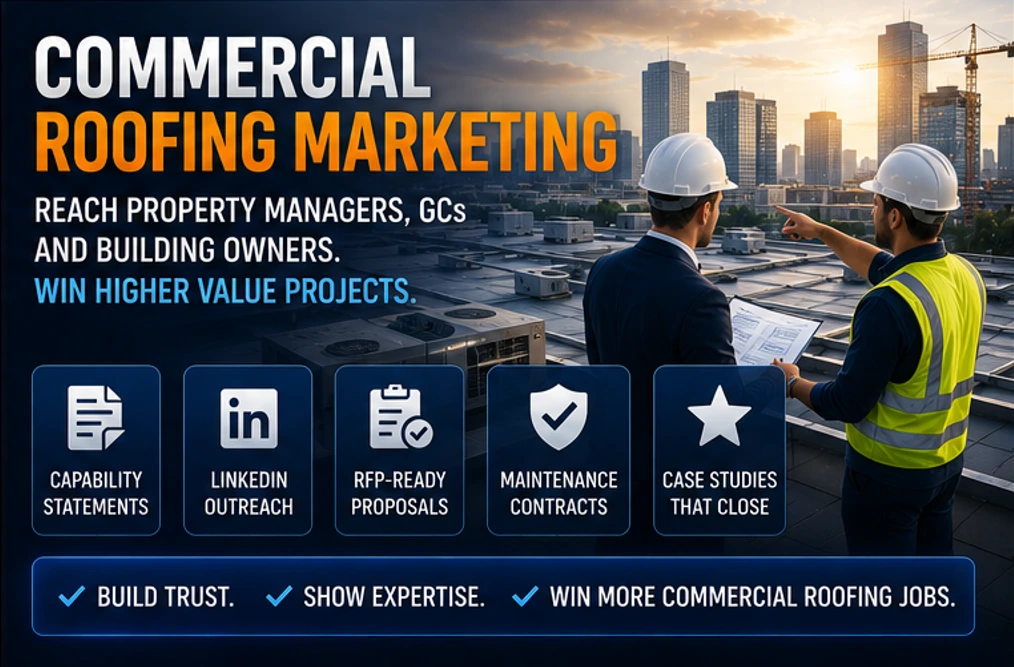
Commercial Roofing Marketing: Reaching Property Managers, GCs, and Building Owners
Commercial roofing work — property management portfolios, commercial real estate properties, general contractor relationships, industrial accounts, institutional properties — represents a fundamentally different business than residential. Different buyers, different sales cycles, different contract structures, different marketing infrastructure, and different unit economics. The marketing approaches that win residential roofing don't transfer effectively to commercial; building commercial accounts requires dedicated investment in capability development, relationship building, and the marketing infrastructure that actually reaches commercial decision-makers.
Published: July 22, 2026 | Reading Time: ~9 minutes | Category: Roofing Marketing — Commercial B2B
The economics justify the investment. Commercial roofing projects often involve substantial single-project values; maintenance contracts produce predictable monthly recurring revenue; portfolio relationships with property management companies and commercial real estate operations produce repeat work across multiple properties; and general contractor relationships route significant work to qualified subcontractors. Operations building commercial alongside residential produce diversified channel mixes with substantially better unit economics than pure-residential operations can sustain.
This guide covers commercial roofing marketing practically: why commercial is fundamentally different from residential, the distinct buyer types and decision processes, the marketing channels that actually reach commercial decision-makers, capability statements and case studies as foundational marketing assets, RFP and proposal capability, maintenance contracts vs project work economics, the credentialing and qualifications commercial buyers actually evaluate, differentiation strategies across commercial roof types, and measurement specific to commercial pipeline development.
What You'll Learn
- Why commercial roofing is fundamentally different from residential
- Distinct commercial buyer types: property managers, GCs, building owners, REITs, facility managers
- Marketing channels that actually reach commercial decision-makers
- Capability statements and case studies as foundational marketing assets
- RFP and proposal capability that wins competitive work
- Maintenance contracts vs project work economics
- Credentialing and qualifications commercial buyers actually evaluate
- Differentiation strategies across commercial roof types (TPO, EPDM, modified bitumen, BUR, metal)
- Measurement specific to commercial pipeline development
Why Commercial Is Fundamentally Different
- Different buyers. Commercial buyers are professional decision-makers (property managers, facility managers, real estate executives) evaluating vendors against defined criteria with multi-stakeholder approval requirements.
- Different sales cycles. Commercial sales cycles often run months from initial contact through signed contract, with formal procurement processes, multiple touchpoints, written submissions, references, and verification.
- Different contract structures. Multi-year maintenance contracts, portfolio agreements, RFP-driven project work, and formal contracts with defined scope and performance standards rather than residential one-off transactions.
- Different credentialing requirements. Commercial buyers often require specific insurance levels (typically substantially higher than residential), bonding for substantial projects, manufacturer certifications for specific commercial roof systems, and documented experience with comparable commercial work.
- Different decision factors. Commercial decisions weight reliability, documentation discipline, project-management capability, financial stability, and references heavily — alongside price. Residential price-sensitivity translates poorly to commercial decisions.
- Different lifetime value. Commercial relationships, once established, often produce repeat work over years across multiple properties. The lifetime value of a single property management relationship can be substantial.
THE ECONOMICS JUSTIFY THE INVESTMENT: Commercial roofing projects often involve substantial single-project values; maintenance contracts produce predictable recurring revenue; portfolio relationships produce repeat work; and successful commercial accounts generate references and case studies that compound future commercial sales efforts. The marketing investment for commercial is real (capability statement development, LinkedIn presence, industry association engagement, direct outreach, RFP-response capability) but pays back through diversification of revenue streams, operational efficiencies of recurring work, and the multi-year value of successful commercial relationships.
Distinct Commercial Buyer Types
Property Managers
Commercial property managers oversee portfolios of properties — office complexes, retail centers, industrial sites, multi-family residential properties — often across multiple sites within a region. They manage vendor relationships across roofing, HVAC, landscaping, and other ongoing maintenance categories. Property managers value reliability above almost everything else — they manage by exception, respond to issues, and contract with vendors who handle issues without escalation. Winning property management portfolios produces recurring work across multiple sites.
General Contractors
General contractors managing new construction, major renovations, and tenant improvements subcontract roofing work to qualifying specialty contractors. GC relationships, once established, produce ongoing project work as the GC's project pipeline rolls forward. Reaching GCs requires industry presence (construction trade events, subcontractor introductions), capability demonstration, and consistent performance on initial projects.
Commercial Building Owners
Owner-occupied commercial buildings, smaller commercial real estate operations, and individual building owners make their own vendor decisions for roofing work. Decision dynamics involve fewer stakeholders than property-management or REIT decisions, and the owner often has direct involvement in vendor selection. Building strong reputation through completed commercial work and visible local presence reaches these buyers effectively.
REITs and Large Real Estate Operations
Real estate investment trusts and substantial commercial real estate operations manage substantial property portfolios with formal vendor evaluation processes. Qualification often involves credentialing checks, financial reviews, insurance verification at substantial levels, and references from comparable substantial work. The buy cycles are longer but the contracts can be substantial.
Facility Managers
Facility managers of substantial commercial properties (corporate headquarters, manufacturing facilities, institutional properties) handle ongoing facility maintenance including roofing. They value documented professionalism, response time discipline, and the operational reliability that supports their broader facility management work.
Institutional Buyers
Schools, hospitals, government facilities, and religious institutions buy roofing through procurement processes that vary by institution type. Public-sector buyers (schools, government) typically involve formal RFPs and prevailing wage compliance; private institutional buyers (hospitals, religious institutions) often have facility management or board-driven processes.
Marketing Channels for Commercial
- LinkedIn presence and outreach: property managers, facility managers, and commercial real estate professionals operate professionally on LinkedIn. Substantive presence, content engagement, and direct outreach reach these audiences effectively.
- Industry association membership: BOMA (Building Owners and Managers Association), IFMA (International Facility Management Association), local property management associations, IREM (Institute of Real Estate Management), and construction industry associations. Membership, event attendance, and active engagement build relationships and visibility.
- Direct outreach to defined target lists: property management companies in your market, commercial real estate operations, general contractors, and institutional buyers can be identified through public records and industry directories. Systematic outreach over time produces relationship-building opportunities.
- Capability statement distribution: the professional capability statement document is itself a marketing tool — distributed to qualified prospects, included in proposal responses, and serving as the formal credential summary commercial buyers expect.
- Case studies and documented references: written case studies of successful commercial projects (with client permission) provide substantiation commercial buyers need when evaluating contractors. References from comparable commercial accounts carry particular weight.
- Commercial-positioned web presence: a commercial section of the website distinct from residential positioning, with capability statement, case studies, credentials display, commercial roof type expertise, and clear contact paths for commercial inquiries.
- Strategic partnerships: relationships with architects, civil engineers, property-management firms, and other commercial service providers produce referrals into commercial work.
- Industry events and trade shows: construction industry events, property management conferences, commercial real estate events where target decision-makers attend.
Capability Statements and Case Studies
Capability statements and case studies are foundational marketing assets for commercial roofing. They demonstrate actual capability rather than asserting it, support proposal responses, and provide the documentation commercial decision-makers expect.
The Master Capability Statement
A professionally-designed document consolidating credentials, experience, project portfolio, references, insurance, equipment, and approach into a comprehensive presentation. Used in proposal responses, distributed to prospective clients during sales outreach, referenced in introductions, and updated annually as experience and credentials grow. The capability statement should include: company overview, key personnel and credentials, services offered, project portfolio highlights, manufacturer certifications, insurance and bonding levels, geographic coverage, references, and contact information.
Project Case Studies
Written case studies documenting completed commercial projects with substantive detail: project description (location, type, scope), challenge or objective addressed, approach and methodology, completion outcomes, customer satisfaction outcomes, and visual documentation. Case studies serve as marketing assets distributed to prospects, included in proposals, and referenced during sales conversations.
- Property management portfolio case studies — demonstrating ongoing relationship work across multiple properties.
- Substantial commercial project case studies — replacement and major work on substantial commercial properties.
- GC subcontractor case studies — work performed as part of larger construction projects.
- Maintenance contract case studies — ongoing maintenance work demonstrating recurring-relationship capability.
- Storm restoration case studies for commercial — substantial commercial restoration work demonstrating capability scale.
- Specialty roof type case studies — TPO, EPDM, modified bitumen, BUR, metal work demonstrating technical capability across systems.
RFP and Proposal Capability
Commercial work often procures through formal proposal processes. Operations winning commercial work develop systematic proposal capability rather than improvising responses to each opportunity.
- Proposal templates with substantive structure that adapt to specific opportunities without starting from blank pages: executive summary, company profile, detailed approach to scope, personnel qualifications, references, insurance and compliance documentation, pricing, timeline, and project management approach.
- Reference systems with vetted contacts willing to provide positive references on request.
- Cost estimation systems calibrated to commercial work — historical job data informing accurate pricing on new projects.
- Site assessment capability — substantive on-site evaluation before quoting that informs accurate pricing and demonstrates professionalism.
- Project management documentation — systems demonstrating how you'd manage projects from award through completion.
- Compliance and credentialing documentation maintained current and ready for proposal inclusion.
PRO TIP: Most roofing operations entering commercial markets focus on proposal responses without first investing in the prerequisite credentialing, capability statement development, and case study accumulation that win the work. Without substantial commercial experience documented, comparable references, manufacturer certifications for the specific commercial roof systems involved, and the insurance and bonding levels commercial buyers require, proposals fail at the qualifications screening before pricing is even considered. Plan 12-24 months of foundation work — credentialing, initial project accumulation, reference building, capability statement development, industry presence — then pursue proposals systematically. Reversing the sequence produces years of failed bids without winning the work.
Maintenance Contracts vs Project Work
Commercial roofing economics differ substantially between maintenance contracts and project work, and operations balancing both produce stronger economics than operations focused on either alone.
Maintenance Contract Economics
- Predictable monthly or quarterly recurring revenue.
- Operational efficiencies from working known properties with established access and procedures.
- Customer relationship building producing project work when major replacement or restoration is needed.
- Lower customer acquisition cost per dollar of revenue once the contract is established.
- Steady workflow that smooths the project-based work irregularities.
Project Work Economics
- Substantial single-project revenue with substantial gross margins on well-priced work.
- Surge revenue during storm seasons and event-driven demand.
- Variable workflow requiring crew capacity flexibility.
- Higher customer acquisition cost per project but potentially significant single-project value.
Operations building both contract and project revenue streams produce diversified economics — contracts smooth the cash flow and capacity utilization that pure project work struggles with, while project work produces the substantial revenue events that pure contract work doesn't generate.
Credentialing and Qualifications Commercial Buyers Evaluate
- Manufacturer certifications at substantial levels for commercial roof systems: GAF Master Commercial Contractor, Carlisle SynTec Authorized Applicator, Firestone Master Contractor, Versico Premier Contractor, and similar credentials for the commercial roof systems you install.
- Insurance at commercial-grade levels: substantial general liability coverage (often $2M+ aggregate), workers' compensation, commercial auto, and excess/umbrella coverage.
- Bonding capacity for substantial projects: many commercial projects require bonding, and bonding capacity is a qualification gate.
- State contractor licensing at commercial levels: some states have different licensing tiers for commercial work.
- Documented safety program and OSHA compliance: substantial commercial buyers evaluate safety record, training documentation, and operational safety procedures.
- Financial stability indicators: substantial commercial buyers may evaluate financial statements, banking references, or other indicators of operational stability.
- Years of commercial-specific experience: track record on comparable commercial work, not just residential.
- Documented references from comparable commercial customers.
Differentiation Across Commercial Roof Types
- TPO (Thermoplastic Polyolefin): widely used on commercial flat roofs, requires specific manufacturer certifications, installation discipline matters substantially for warranty integrity.
- EPDM (Ethylene Propylene Diene Monomer): traditional commercial flat roof material, substantial installed base, installation expertise distinguishes capable contractors.
- Modified Bitumen: torch-down or self-adhered options, requires specific safety protocols and installation expertise.
- Built-Up Roofing (BUR): traditional multi-ply systems still in use on many older commercial properties.
- Metal commercial roofing: substantial roofing systems for commercial and industrial applications with specific installation requirements.
- PVC: alternative single-ply system for specific commercial applications.
Operations positioning capability across multiple commercial roof types access broader portions of the commercial market than operations limited to specific types. Manufacturer certifications for each system installed signal genuine capability rather than just willingness to take the work.
Measurement Specific to Commercial Pipeline
- Pipeline volume by stage: contacts made, capability statements distributed, proposals responded to, contracts won. Tracks the longer commercial sales cycle through its progression.
- Time-to-close metrics: average days from initial contact to signed contract by buyer type and project type.
- Win rate on proposals submitted: percentage of proposals that result in awarded work. Reveals competitive positioning.
- Customer lifetime value of commercial relationships: revenue accumulated from each relationship over time.
- Maintenance contract retention: percentage of contracts renewed at end of terms.
- Cost per commercial customer acquired: total commercial marketing and sales investment divided by new commercial customers gained per period.
The Bottom Line
Commercial roofing represents a fundamentally different business than residential — different buyers, sales cycles, contract structures, credentialing requirements, and marketing channels. The infrastructure that wins residential doesn't automatically win commercial; building commercial accounts requires dedicated investment in capability development, relationship building, and the marketing infrastructure (LinkedIn, industry associations, direct outreach, capability statements, case studies, RFP-response capability) that actually reaches commercial decision-makers.
The economics justify the investment for operations willing to do the foundation work over 12-24 months minimum. Successful commercial accounts produce substantial single-project revenue, recurring maintenance contracts, multi-year portfolio relationships, and the diversified revenue streams that pure residential operations can't match. For roofing operators positioned to make the capability and relationship investment, commercial represents one of the highest-leverage strategic growth opportunities available. The framework is concrete, the work is substantial, and operations building commercial alongside residential consistently outperform pure-residential alternatives across business cycles and economic conditions.
Key Takeaways
- Commercial roofing is fundamentally different from residential — different buyers (property managers, GCs, building owners, REITs, facility managers, institutional buyers), longer sales cycles, multi-year contracts, formal procurement, higher credentialing requirements, lifetime value over years
- Economics justify the investment: substantial single-project values, predictable recurring maintenance revenue, multi-year portfolio relationships, operational efficiencies from known properties, diversification of revenue streams
- Distinct commercial buyer types: property managers (portfolio work, reliability emphasis), general contractors (subcontractor relationships), commercial building owners (direct decision-makers), REITs and large real estate operations (formal qualification), facility managers (operational reliability), institutional buyers (procurement processes)
- Marketing channels: LinkedIn presence and outreach, industry association membership (BOMA, IFMA, IREM), direct outreach to defined target lists, capability statement distribution, documented case studies and references, commercial-positioned web presence, strategic partnerships, industry events
- Capability statements and case studies are foundational marketing assets — master capability statement maintained and updated annually, project case studies documenting completed commercial work, used in proposals and distributed to prospects
- RFP and proposal capability: structured templates that adapt to specific opportunities, vetted references, cost estimation systems, site assessment capability, project management documentation, compliance and credentialing documentation maintained current
- Maintenance contracts vs project work: contracts produce predictable recurring revenue and operational efficiencies; project work produces substantial single-project value and surge revenue. Operations building both produce diversified economics
- Credentialing commercial buyers evaluate: manufacturer certifications for commercial systems (GAF, Carlisle, Firestone, Versico), commercial-grade insurance ($2M+ aggregate typical), bonding capacity, state licensing at commercial levels, safety program documentation, financial stability, years of commercial experience, documented references
- Differentiation across commercial roof types (TPO, EPDM, modified bitumen, BUR, metal, PVC) accesses broader portions of commercial market — manufacturer certifications for each system installed signal genuine capability
- Commercial pipeline measurement: pipeline volume by stage, time-to-close metrics, win rate on proposals, customer lifetime value, maintenance contract retention, cost per commercial customer acquired
READY TO BUILD A LEAD PIPELINE THAT'S YOURS? Astra Results Marketing builds commercial roofing marketing programs — LinkedIn presence and outreach to property managers and GCs, industry association engagement, capability statement development, case study documentation, RFP-response support, commercial-positioned web infrastructure, and the integrated approach that develops commercial accounts alongside residential operations. Stop leaving substantial commercial work to operators with better channel infrastructure. Build the commercial marketing system that accesses the multi-year contracts and portfolio relationships your residential business alone can't reach. Astra Results Marketing · astraresults.com · (+1) 786-643-3036