Rated 5 star on

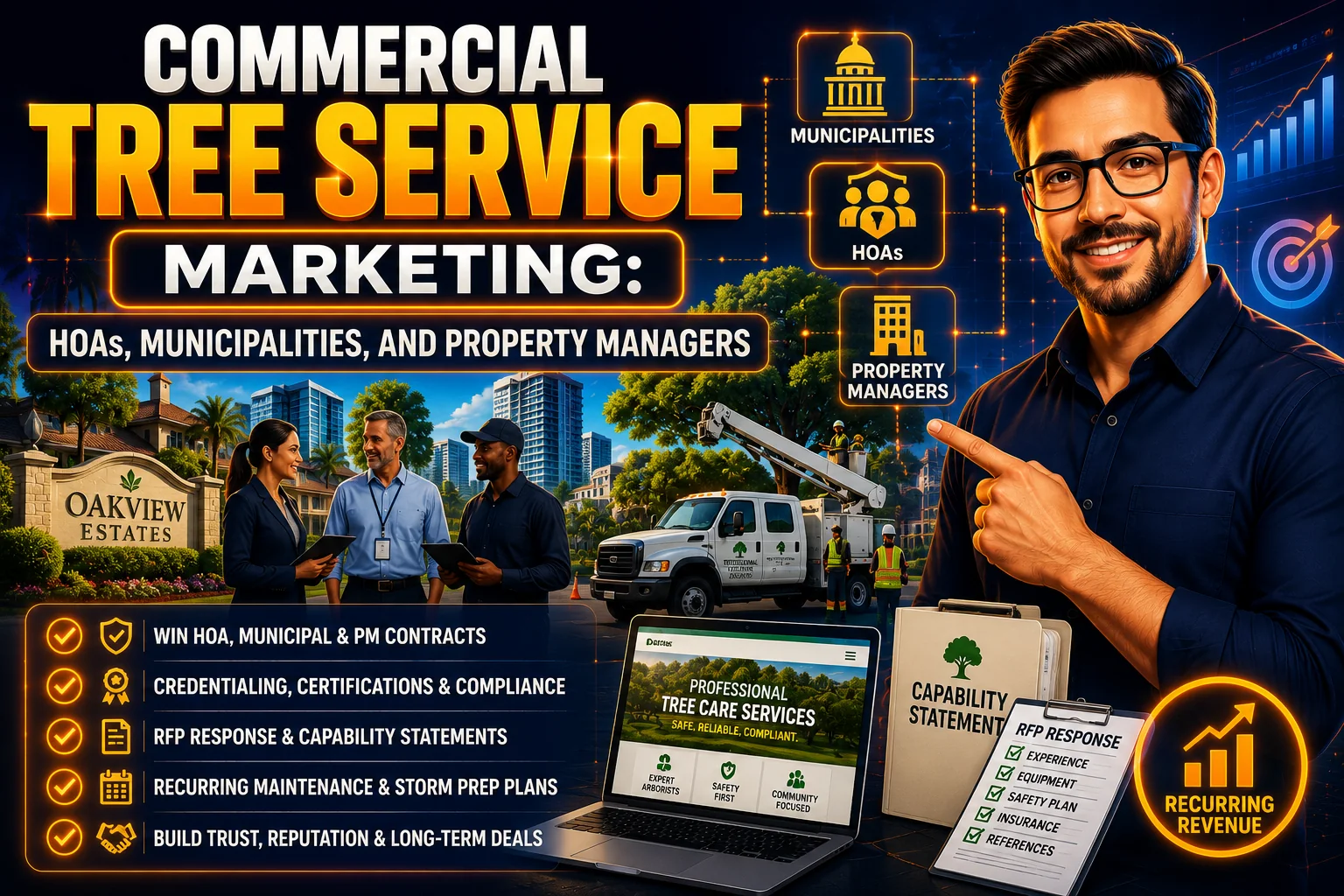
Commercial Tree Service Marketing: HOAs, Municipalities, and Property Managers
Commercial tree-service work is a different business than residential tree-service work, with different buyers, different sales cycles, different contract structures, and substantially different marketing requirements. The same company that competes for individual homeowners on Map Pack rankings and emergency SEO has to compete for HOA contracts through RFP processes, for municipal work through public-sector bidding, and for property-management portfolios through capability statements and reference work. The marketing infrastructure that wins residential work doesn't automatically win commercial work — and the operators who don't recognize this gap stay locked out of the larger contracts and recurring-revenue accounts that commercial work represents.
Published: July 13, 2026 | Reading Time: ~13 minutes | Category: Tree Service — Commercial B2B
The economics of commercial tree-service work justify the marketing investment. A single multi-year HOA contract can be worth more than dozens of residential jobs, with predictable monthly or quarterly revenue, reduced sales overhead per dollar of revenue, and the operational efficiencies of working repeat customers in known properties. A municipal contract for ongoing tree maintenance, a property-management portfolio across multiple sites, or a commercial real estate account anchoring a service area — each represents the kind of stable, scalable revenue that residential work can't replicate. And the credentialing, capability, and reference development that wins commercial work also strengthens the residential positioning, producing compounding benefits across the operation.
This guide covers commercial tree-service marketing practically: why commercial is a different business than residential, the three main commercial markets (HOAs, municipalities, property managers) and the distinct dynamics of each, the decision-maker map and sales process for commercial accounts, the credentialing and capability requirements that commercial buyers actually evaluate, the marketing channels that work for commercial (different from residential), RFP response and capability statement work, the recurring contract structures that produce the strongest economics, and how ArborCentric Solutions built commercial accounts across South Florida alongside their residential business. Whether you've never sold a commercial contract or you have a handful and want to systematize the growth, this is the practical playbook.
What You'll Learn
- Why commercial tree-service work is a different business than residential
- The three commercial markets — HOAs, municipalities, property managers — and their distinct dynamics
- The decision-maker map for each market and how the sales process actually works
- Credentialing and capability requirements commercial buyers actually evaluate
- Marketing channels for commercial — different from residential, more relationship-driven
- RFP responses and capability statements that win contracts
- Recurring contract structures that produce stable, scalable revenue
- How ArborCentric Solutions built commercial accounts across South Florida
Why Commercial Is a Different Business Than Residential
Residential tree-service marketing optimizes for individual-homeowner decisions — search visibility, trust signals, conversion-focused websites, fast response. The buyer is one person making a relatively quick decision based on the contractors available at the moment of need. Commercial tree-service marketing operates in a fundamentally different decision environment.
Different Buyers, Different Sales Cycles
Commercial buyers — HOA boards, municipal procurement officers, property managers — are professional decision-makers evaluating contractors against defined criteria, often with multi-stakeholder approval requirements, formal procurement processes, and long evaluation timelines. The sales cycle from initial contact to signed contract can run months rather than days. The decision involves multiple meetings, written submissions, references, and verification rather than a homeowner picking from search results.
Different Contract Structures
Commercial work typically involves multi-year contracts, recurring service schedules (monthly, quarterly, seasonal), defined scope of services, performance standards, insurance and liability requirements, and pricing structures that account for the volume and predictability. The dollar value of any individual contract can be substantial — a comprehensive HOA contract spanning year-round maintenance and storm response, a municipal contract covering miles of public right-of-way, or a property-management portfolio of multiple commercial properties. The revenue is more predictable than residential work, and the operational efficiencies of recurring work in known properties are substantial.
Different Credentialing Requirements
Commercial buyers often have explicit credentialing requirements that residential buyers don't enforce. Insurance certificates above standard residential coverage levels. ISA Certification beyond just owning the credential — sometimes requiring multiple certified arborists on staff, specialty certifications for specific work types, or TCIA Accreditation as a company-level credential. Bonding requirements for larger contracts. Documentation of safety programs, OSHA compliance, and equipment standards. The credentialing isn't aspirational marketing positioning — it's a baseline qualification for bidding the work.
THE ECONOMICS JUSTIFY THE INVESTMENT: A single multi-year HOA contract or property-management portfolio can be worth more revenue than dozens of residential jobs, with predictable monthly recurring revenue, reduced sales overhead per dollar of revenue, and operational efficiencies from working repeat customers in known properties. Tree-service operations that build commercial accounts alongside their residential business build the recurring-revenue base that funds growth investment, smooths seasonal variation, and produces the unit economics that pure residential operations can't match. The marketing investment to win commercial work is substantial, but the return on a successful commercial program runs multiples ahead of equivalent investment in residential lead generation — once the foundation is built.
The HOA Market
Homeowner associations are one of the most accessible commercial markets for tree-service operators — substantial properties with ongoing tree-care needs, professional management in most cases, and recurring-contract structures that fit tree service naturally.
The HOA Decision-Maker Map
HOA decisions typically involve multiple stakeholders. The property manager (where the HOA contracts with a management company) often initiates and recommends contractor decisions. The HOA board approves contracts above defined thresholds, with the board president and treasurer typically most involved in vendor evaluation. The landscape or grounds committee (where one exists) may have specific input on tree-care and landscape contracts. Individual residents have indirect influence through complaints, requests, or board engagement. Selling into HOAs requires understanding which decision-makers carry weight for which decisions, and building relationships across the stakeholder map rather than just pitching the property manager.
The HOA Sales Cycle
Typical HOA sales cycles involve initial introduction (often through property manager or board contact), proposal submission with detailed scope and pricing, references and verification, board presentation or committee meetings, contract negotiation, and final approval. The cycle commonly runs 60-120 days from first contact to signed contract. Operations expecting quick turnaround should plan their pipeline accordingly — commercial deals are won through patient, structured pursuit, not single sales calls.
What Wins HOA Work
- Comprehensive capability statement: a written document describing your services, credentials, insurance, references, and approach to ongoing tree care for HOA properties.
- References from comparable HOAs: contact information for HOA boards or property managers you've worked with, with permission to be contacted by prospective clients.
- ISA-Certified Arborist credentialing visible and verifiable: the credential matters more in HOA selection than in residential because boards are typically asking the questions that surface qualifications.
- Insurance certificates at the levels HOAs require: typically higher than residential standards, with the HOA listed as additional insured on the policy.
- Proposals tailored to the specific property: not a generic template, but a proposal addressing the actual trees, conditions, and needs of the property after you've walked the site.
- Reliability indicators: years in business, capacity to handle the work, evidence that you complete commitments on time and on budget.
- Storm-response capability: HOAs in storm-prone markets evaluate vendors heavily on storm response, since the worst time to find out a vendor can't respond is during a hurricane aftermath.
The Municipal Market
Municipal tree-service work involves public-sector contracting with its own procurement rules, qualification requirements, and competitive dynamics. The contracts can be substantial — covering miles of right-of-way maintenance, park-system tree care, hazard tree assessment and removal, and storm response across an entire municipality.
Municipal Procurement Process
Municipal work is typically procured through formal bidding processes — invitations for bid (IFBs), requests for proposals (RFPs), or requests for qualifications (RFQs). The processes are open, regulated, and require formal responses meeting specific format and content requirements. Some municipalities also use cooperative purchasing agreements or master-service-agreement structures that pre-qualify vendors for various categories of work.
Qualification Requirements
Municipal qualifications often include: minimum years in business (typically 3-5 years or more), minimum revenue or contract size handled, ISA Certification including specialty credentials (Municipal Specialist Certification is particularly valuable for this market), TCIA Accreditation, specific insurance requirements (often higher than commercial-private requirements, with the municipality named as additional insured), bonding capacity, equipment lists and capabilities, safety program documentation, OSHA training records, and references from comparable government contracts. The qualification bar is meaningfully higher than for residential or HOA work, and many tree-service operations don't meet it without dedicated effort to build the credentialing and capability documentation.
Prevailing Wage and Other Compliance
Government contracts often involve prevailing wage requirements, which set minimum wages that contractors must pay workers performing the contract work. Compliance includes documenting wage rates, submitting certified payroll, and meeting other government-contracting requirements. Operations not familiar with prevailing wage compliance can find it operationally complex; the operations that do this work routinely build the back-office capability over time.
What Wins Municipal Work
- Formal RFP response capability: producing professional, complete RFP responses on time, meeting all stated requirements, with clear pricing and qualifications presentation.
- ISA Municipal Specialist certification on staff: the specialty credential designed for this market segment carries weight in evaluation.
- TCIA Accreditation: the company-level credential that signals professional business practices beyond individual certifications.
- Demonstrable government-contract experience: previous municipal or other government work, with references and performance evaluations.
- Storm-response capacity at municipal scale: equipment, crews, and logistics to respond to weather events affecting the entire municipality.
- Local presence: many municipalities preference local contractors, and having a local address, local workforce, and community involvement can be material in evaluation.
PRO TIP: Many tree-service operators looking at municipal work focus on the proposal and bid response stages without first investing in the prerequisite credentialing that the bid responses ask for. Without ISA Municipal Specialist certification on staff, TCIA Accreditation as a company credential, demonstrable government-contract experience, the insurance and bonding levels municipalities require, and the formal-RFP-response capability, no proposal will win — the qualifications screening filters the bid out before the pricing is even considered. The work to qualify for the market often takes 12-24 months and substantial investment. Plan that pre-work first, then pursue the bids; reversing the sequence produces years of failed bids without ever winning the work.
The Property-Management Market
Commercial property managers oversee portfolios of properties — office complexes, retail centers, industrial sites, multi-family residential communities — often spanning multiple sites within a region. Winning a property-management portfolio means landing recurring tree-service work across all the properties the manager controls, which can be substantial.
Property-Management Decision Dynamics
Unlike HOAs (governed by boards) or municipalities (governed by procurement rules), property managers typically make vendor decisions based on the property manager's own evaluation, sometimes with regional or corporate input depending on the management company size. The decision-maker is generally accessible, the sales cycle is faster than HOA or municipal work, and the relationship between property manager and contractor can produce long-running portfolio assignments. Property managers value reliability above almost everything else — they need contractors who respond when called, perform consistently across properties, document work for owner reporting, and handle issues without escalating problems back to the property manager.
What Property Managers Actually Care About
- Response time and reliability: property managers manage by exception, responding to issues as they arise. Vendors who respond fast and handle issues without follow-up earn the recurring work.
- Consistent performance across properties: portfolio work means the same standards applied across all the manager's properties, not variable quality depending on which crew shows up.
- Documentation and reporting: property managers report to property owners, and the documentation contractors provide (job photos, scope completion confirmation, before-and-after documentation) feeds those reports.
- Single point of contact for the manager's portfolio: rather than the manager dealing with multiple contact points for different properties, an account-management approach where the same person from the contractor handles all of the manager's work.
- Predictable pricing structures: property managers prefer recurring contracts with defined scope and pricing over per-job estimating that requires manager involvement each time.
- Compliance with property-owner requirements: insurance levels, additional-insured certifications, contractor-vetting requirements that property owners impose on managed properties.
Marketing Channels for Commercial Tree Service
Commercial marketing uses different channels than residential. Map Pack rankings and Google Search ads matter less; relationship-driven and content-driven approaches matter more.
- LinkedIn presence and outreach: property managers, HOA board members, and municipal staff often have professional LinkedIn presence. Direct outreach, content engagement, and relationship building on LinkedIn produces commercial leads in ways residential marketing doesn't.
- Industry association membership and presence: state and local property management associations, HOA management associations, municipal arboriculture organizations. Membership, event participation, and engagement at industry conferences produces the relationships that commercial decisions are made through.
- Direct mail and outreach to defined target lists: HOA board members, property management firms, and municipal contacts are identifiable through public records and association directories. Direct outreach to these defined lists — done professionally and persistently — produces commercial leads that no inbound channel reaches.
- Capability statements as marketing collateral: the professional capability statement document is itself a marketing tool — distributed to qualified prospects, referenced in RFP responses, and serving as the formal credential summary commercial buyers expect.
- Case studies and references documented: written case studies of successful commercial accounts (with client permission) provide the substantiation commercial buyers need when evaluating contractors. References from comparable commercial accounts carry particular weight.
- Local presence and community involvement: visible community presence — chamber of commerce, civic organizations, community events — generates the awareness and relationships that municipal and HOA work runs through.
- Strategic partnerships: relationships with landscape architects, civil engineers, property-management firms, and other commercial service providers can produce referrals into the commercial market that wouldn't come through direct marketing.
- Web presence positioned for commercial: a commercial section of the website with capability statement, case studies, credentials display, and contact paths for commercial buyers — separate from (but linked to) the residential-focused main site.
RFP Responses and Capability Statements
Formal procurement processes (RFPs, IFBs, RFQs) require formal responses that meet specific format and content requirements. Operations that win commercial work develop the capability to produce these documents professionally and on time.
What a Strong RFP Response Includes
- Executive summary: clear, concise overview of who you are, why you're qualified, and the value you'd bring to the contract.
- Company profile: history, structure, key personnel, geographic coverage, and the credentials/capabilities relevant to the specific contract.
- Detailed approach to the scope: how you'd actually perform the work, the methodology, the standards (ANSI A300, ISA practices), the equipment and crew structure, and the supervision approach.
- Personnel qualifications: the specific people who'd be assigned to the contract, their credentials (ISA Certified Arborists, Municipal Specialists, etc.), their experience with comparable work.
- References: contacts from comparable contracts who can speak to your performance — vetted in advance and willing to provide positive references.
- Insurance, bonding, and compliance documentation: certificates of insurance at required levels, bonding capacity demonstration, OSHA and safety program documentation, prevailing-wage compliance if applicable.
- Pricing presented clearly: in the format the RFP requires, with appropriate detail and pricing assumptions documented.
- Storm-response and emergency capability: particularly relevant for HOAs, municipalities, and properties in storm-prone areas — the explicit description of what you'd do in storm events and what response time you commit to.
- Reporting and communication approach: how you'd document work, report progress, communicate with the client's management, and handle issues that arise.
The Capability Statement as a Foundation Document
Many of the elements above belong in a master capability statement that you maintain and update — a document that consolidates your credentials, experience, references, insurance, equipment, and approach into a comprehensive presentation. The capability statement gets used in RFP responses (often as the body of the qualifications section), distributed to prospective clients during sales outreach, referenced in introductions and relationship building, and updated annually as the company's experience and credentials grow. Investing in a professional, well-designed capability statement is foundation work that supports every subsequent commercial sales effort.
Recurring Contract Structures That Produce Scalable Revenue
The strongest commercial economics come from recurring service contracts rather than per-job billing. The contract structure matters for both sides — the customer gets predictable service and pricing; the contractor gets predictable revenue and efficient operations.
- Annual maintenance contracts: yearly contracts covering scheduled tree care (pruning rotations, health assessments, deadwood removal) for defined properties at fixed annual pricing. Customers spread cost over the year; contractor secures recurring revenue.
- Multi-year contracts: agreements spanning multiple years, often with annual price-adjustment provisions, providing longer revenue visibility for both sides and reducing the procurement burden of annual rebidding.
- Master service agreements (MSAs): umbrella agreements pre-qualifying the contractor for various services with pricing structures defined, then drawing down against the MSA as specific work is needed. Common in larger HOAs, property-management portfolios, and municipal work.
- Hybrid contracts: combinations of recurring maintenance work at fixed pricing plus call-out provisions for emergency or non-routine work at agreed rates. Captures both the predictable revenue of maintenance work and the upside of additional work as it arises.
- Storm-response addendums: contractual provisions for storm and emergency response — committed response times, dedicated capacity, and agreed pricing for storm work, often as part of the broader maintenance contract.
How ArborCentric Built Commercial Accounts
ArborCentric Solutions built commercial accounts across South Florida alongside their residential operation, methodically over time. The components — ISA credentialing including specialty certifications, TCIA Accreditation as a company-level credential, insurance levels meeting commercial requirements, a professional capability statement maintained and updated regularly, RFP-response capability with the templates and processes to produce strong responses, LinkedIn and industry-association presence connecting with property managers and HOA decision-makers, direct outreach to defined target lists, and the case-study and reference development from each commercial account won — built the foundation for sustained commercial growth.
The cumulative outcome over time: ArborCentric serves a portfolio of HOA, property-management, and commercial accounts across South Florida service areas — contracts with multi-year terms, recurring monthly revenue, predictable workload smoothing the variation of residential demand, and operational efficiencies from recurring work in known properties. The commercial revenue base funds growth investment, stabilizes the operation through seasonal variation, and produces the unit economics that pure residential operations can't match. And the credentialing and capability development that won the commercial work also strengthens the residential positioning, with the credentials and references compounding across both sides of the business. Commercial isn't an afterthought to the operation — it's a deliberate strategic asset that complements and reinforces the residential work.
The Bottom Line
Commercial tree-service work — HOAs, municipalities, property managers, commercial real estate — is a different business than residential, with different buyers, sales cycles, contract structures, credentialing requirements, and marketing channels. The marketing infrastructure that wins residential work doesn't automatically win commercial; building commercial accounts requires dedicated investment in the credentialing, capability statements, RFP-response capacity, industry presence, direct outreach, and relationship development that commercial decisions actually run on.
The investment is worth it because the economics of successful commercial accounts run substantially ahead of equivalent residential investment — multi-year recurring contracts, predictable monthly revenue, operational efficiencies from known properties, and the stability that funds growth in ways residential lead-by-lead work doesn't. ArborCentric Solutions built their commercial portfolio over time alongside the residential business and the combined operation has economics that pure residential or pure commercial operations couldn't match. For tree-service operators sized to do the work, committed to the credentialing and capability investments, and patient enough for the longer commercial sales cycles, the commercial market is one of the highest-leverage growth opportunities available. The market is real, the buyers are accessible to operators who do the foundation work, and the unit economics reward the investment.
Key Takeaways
- Commercial tree-service work is a different business than residential — different buyers (HOA boards, property managers, municipal procurement), longer sales cycles, multi-year contract structures, stricter credentialing requirements, and different marketing channels
- The economics justify the investment: a single multi-year HOA contract or property-management portfolio can be worth more than dozens of residential jobs, with predictable monthly recurring revenue, reduced sales overhead per dollar, and operational efficiencies from known properties
- HOA market: multi-stakeholder decisions (property manager, board, committee), 60-120 day sales cycles, won through capability statements, comparable HOA references, ISA credentialing, appropriate insurance, tailored proposals, and storm-response capability
- Municipal market: formal procurement (RFPs/IFBs/RFQs), higher qualification bar (ISA Municipal Specialist, TCIA Accreditation, government-contract experience, prevailing wage compliance), substantial contracts but requires 12-24 months of pre-work to qualify
- Property-management market: single decision-maker, faster sales cycles, portfolio assignments across multiple properties, won through response time/reliability/consistency/documentation/single point of contact
- Commercial marketing channels: LinkedIn presence and outreach, industry association membership, direct mail to target lists, capability statements as marketing collateral, documented case studies and references, local presence and community involvement, strategic partnerships, commercial-positioned web presence
- Strong RFP responses include executive summary, company profile, detailed approach to scope, personnel qualifications, references, insurance/bonding/compliance documentation, clear pricing, storm-response capability, and reporting/communication approach — supported by a master capability statement
- Recurring contract structures (annual maintenance, multi-year, MSAs, hybrid contracts, storm-response addendums) produce the strongest economics for both sides — customer gets predictable service, contractor gets predictable revenue and operational efficiency
- ArborCentric Solutions built commercial accounts across South Florida methodically — credentialing and capability statements, LinkedIn and industry presence, direct outreach to defined target lists, and case-study/reference development from each account won. The commercial portfolio produces multi-year revenue stability that complements and reinforces the residential business
READY TO BUILD A LEAD PIPELINE THAT'S YOURS? Astra Results Marketing builds commercial tree-service marketing programs — capability statement development, LinkedIn and industry presence, direct outreach to HOA boards and property managers, RFP-response support, case-study and reference systems, and the integrated approach that wins multi-year commercial contracts alongside residential lead generation. We worked with ArborCentric Solutions to build commercial accounts across South Florida that now produce the recurring revenue stability the residential business alone couldn't. Stop competing only on individual residential jobs. Build the commercial portfolio that produces multi-year contracts and operational scale. Astra Results Marketing · astraresults.com · (+1) 786-643-3036