Rated 5 star on

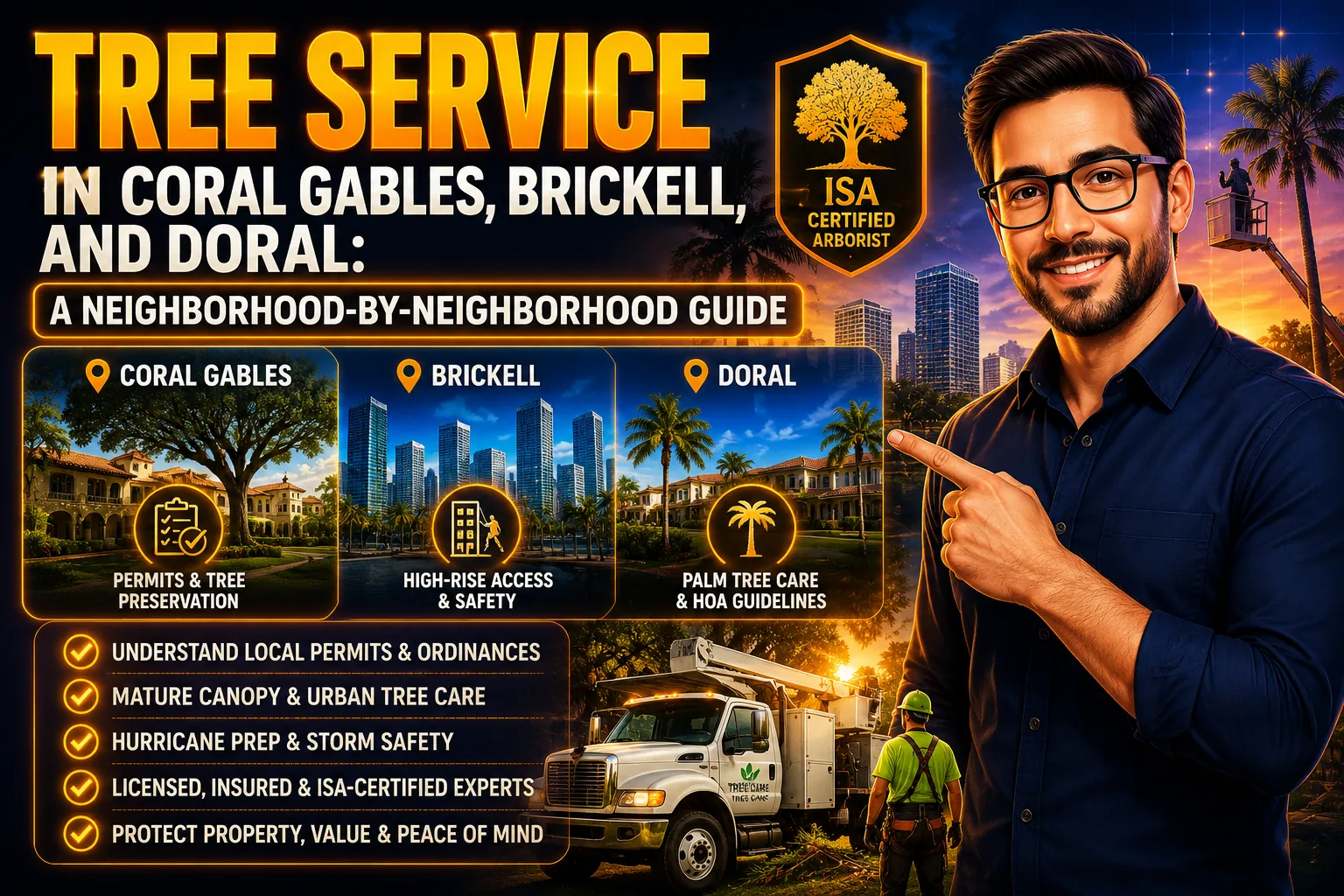
Tree Service in Coral Gables, Brickell, and Doral: A Neighborhood-by-Neighborhood Guide
South Florida's neighborhoods differ dramatically from each other in ways that affect what tree service actually looks like in each. Coral Gables, with its mature live oak canopy, designated Tree City USA status, strict tree-preservation ordinances, and historic estate properties, presents tree-service work substantially different from the same work in Brickell, where high-rise development, urban density, and ornamental landscaping dominate. Both differ from Doral, with its master-planned residential communities, established palm-heavy landscaping, and growing commercial development. Tree-service operations serving these three neighborhoods well understand the local dynamics that shape work in each — and property owners navigating decisions about their trees benefit from understanding the same dynamics.
Published: July 15, 2026 | Reading Time: ~11 minutes | Category: Tree Service — Coral Gables Brickell Doral
This guide covers tree service in Coral Gables, Brickell, and Doral practically — the specific neighborhood characteristics that shape tree work in each, the regulatory landscape (particularly significant in Coral Gables), the property types and tree species predominant in each area, the common service needs and the considerations specific to each neighborhood, and how professional tree-service operations approach work across these distinct South Florida markets. Whether you're a property owner in one of these areas trying to understand what's involved in tree work on your property, a property manager handling multiple sites, or an HOA board evaluating tree-service providers, the practical context here applies. ArborCentric Solutions provides tree service across Coral Gables, Brickell, Doral, and broader South Florida, with operational and regulatory familiarity in each market.
What You'll Learn
- Coral Gables — the regulatory landscape, mature canopy, and historic-estate dynamics that shape tree work
- Brickell — urban-density considerations, ornamental focus, and the high-rise property type dynamics
- Doral — master-planned communities, palm-heavy landscaping, and the suburban-commercial mix
- Property type and tree species predominant in each neighborhood
- Common service needs and considerations specific to each area
- Regulatory considerations across all three (with Coral Gables requiring the most attention)
- How professional operations approach work across these distinct markets
Coral Gables — The Most Regulated Tree Environment in South Florida
Coral Gables is the City Beautiful, and the city takes that designation seriously. The municipality holds Tree City USA status, maintains substantial tree-preservation ordinances, and actively manages the urban forest as a defining characteristic of the city. Tree work in Coral Gables involves regulatory complexity that work in less-regulated neighborhoods doesn't, and property owners and tree-service operations alike need to understand the framework.
The Regulatory Landscape
- Tree-removal permits are required for most significant trees on private property in Coral Gables — typically trees over a defined diameter threshold (measured DBH, diameter at breast height). The exact requirements have been refined over time; current ordinance language should be verified before any planned work.
- The city maintains a list of protected species that require special consideration regardless of size — native and culturally significant species like live oaks, mahogany, and historic trees.
- Pruning of substantial trees may also require permits or approvals depending on the work and the tree, particularly for street trees or trees in protected areas.
- Replacement requirements often apply when removal is approved — the property owner may be required to replant comparable trees to preserve the canopy.
- Fines for unpermitted work can be substantial — operations performing work without proper permits, and property owners authorizing such work, may face significant penalties.
What This Means for Property Owners
Property owners considering tree work in Coral Gables need to start with the question of whether permits are required for the work in question. The city's tree division can advise on requirements; tree-service operations familiar with Coral Gables work also navigate the regulatory landscape routinely. Operations not familiar with Coral Gables sometimes perform work that creates regulatory problems for property owners after the fact — the work was performed without required permits, fines accumulate, and the property owner is left to navigate consequences. Operations experienced in Coral Gables incorporate permitting into the project from the start.
The Mature Canopy and Historic Properties
Coral Gables' tree canopy includes substantial mature live oaks, royal poincianas, mahogany trees, and other species that have been growing for decades. Tree work on mature specimens involves different considerations than work on younger trees — careful pruning preserving the natural architecture, attention to species-specific responses to different cut types, structural assessment of trees with age-related issues, and the recognition that mistakes on mature trees can't be undone within the property owner's lifetime. Combined with the substantial historic-property base in Coral Gables — Mediterranean Revival estates, original Coral Gables development homes, properties with significant landscape design heritage — tree work here requires capability calibrated to the value of what's being worked on.
Service Needs Common in Coral Gables
- Structural pruning of mature trees to maintain longevity and reduce hurricane wind resistance.
- Deadwooding and crown cleaning to address the limb-shedding that affects properties under mature canopies.
- Hurricane-season preparation work, often performed during off-season pre-season windows.
- Removal work with permitting navigation when trees have reached end-of-life or become hazardous.
- Disease and pest management for the substantial oak and palm populations.
- Storm cleanup with attention to historic-property considerations and tree-canopy preservation where possible.
WHY CORAL GABLES SPECIFICALLY NEEDS CREDENTIALED OPERATORS: The combination of regulatory complexity, substantial property values, mature and significant trees, and the city's active management of the urban forest means tree work in Coral Gables benefits more than most markets from credentialed, experienced operators. ISA-Certified Arborists understand the species and the technical considerations that mature-tree work requires. Operations familiar with Coral Gables permitting incorporate it routinely. Substantial insurance protects against the property-value exposure tree work in this market involves. Documentation supports both regulatory compliance and property-owner records. Property owners in Coral Gables hiring uncredentialed operators to save money on tree work often pay substantially more in fines, replacement requirements, and remediation than they saved on the initial work.
Brickell — Urban Density, Ornamental Landscaping, High-Rise Reality
Brickell is a different world from Coral Gables. The neighborhood has urbanized substantially over recent decades, with extensive high-rise residential and commercial development replacing earlier single-family and low-rise patterns. The tree-service work here involves urban-density considerations, ornamental and amenity landscaping (rather than mature canopy), and a property-type mix dominated by condominium buildings, commercial real estate, and high-rise residential — with the property-management and HOA structures that come with that built environment.
Property Types and Their Tree-Service Dynamics
- High-rise condominium buildings: ornamental landscaping in amenity areas (pool decks, common spaces, building approaches), street trees in adjacent rights-of-way, and the property-management structures that handle tree service as part of building maintenance.
- Commercial real estate: office buildings, retail centers, mixed-use developments — tree service typically handled through property management or facilities contracts.
- Older single-family properties (where they remain): the substantially smaller residential market in Brickell still has tree-service needs, often for trees on properties slated for redevelopment or held by long-time residents.
- Public spaces and street trees: municipal responsibility but affecting private property work in adjacent areas.
Urban-Density Challenges
- Equipment access — crane operations, large trucks, and bucket trucks can be difficult to position in dense Brickell streets and parking-constrained sites.
- Pedestrian and traffic management — high-density areas require active pedestrian and traffic safety during work.
- Debris staging and removal — limited space for debris staging means more frequent removal trips or coordination with building facilities for staging areas.
- Time-of-day restrictions — some buildings and commercial properties have restrictions on when noisy work can occur to minimize disruption to residents and businesses.
- Coordination with building management — work on or affecting buildings requires coordination with property management for access, scheduling, and resident notification.
Service Needs Common in Brickell
- Ornamental pruning and maintenance of palms, royal poincianas, and other specimen trees in amenity areas.
- Street tree care where private properties extend to maintained streetscape areas.
- Storm damage response on building exteriors and amenity landscaping.
- Removal of trees in conflict with redevelopment or building modifications.
- Maintenance contracts with condominium associations and commercial property managers.
Doral — Master-Planned Communities, Palms, and Suburban-Commercial Mix
Doral has grown substantially as a master-planned residential and commercial community, with extensive single-family residential development, master-planned communities with HOA structures, growing commercial development, and the landscape characteristic of newer South Florida planned communities. The tree work here differs from both Coral Gables (more regulatory complexity, more mature trees) and Brickell (more density, more vertical) — and the operational reality of Doral tree service reflects the master-planned suburban character.
Property Types and Communities
- Single-family residential in master-planned communities — HOA-managed neighborhoods with specific landscape requirements and ongoing tree-service needs across the developed community.
- Townhomes and multi-family residential — property-management structures handling tree service for the developed properties.
- Commercial development — office parks, retail centers, hospitality properties (including major golf and resort properties) with substantial landscape-maintenance contracts.
- Educational and institutional properties — schools, religious institutions, and community facilities with tree-service needs.
Doral Landscape Characteristics
- Substantial palm populations — royal palms, queen palms, coconut palms, and other species characteristic of newer South Florida development.
- Mature canopy varies by community age — older Doral communities have substantial mature trees; newer development is still maturing.
- Ornamental and amenity landscaping — master-planned communities and commercial developments invest in ongoing landscape maintenance including tree care.
- Golf course and resort properties — substantial tree populations on golf properties with specific maintenance considerations.
Service Needs Common in Doral
- Palm care — pruning, disease management, removal, and replacement work on the substantial palm population.
- HOA and community-wide tree-care contracts — recurring service across master-planned communities.
- Commercial property tree maintenance — office parks, retail centers, hospitality properties.
- Hurricane preparation and storm response across both residential and commercial properties.
- Removal and replacement work as the developed community matures and individual trees reach end-of-life.
PRO TIP: Each of these three neighborhoods rewards operations with established local presence and operational familiarity. Coral Gables rewards regulatory knowledge and mature-tree expertise. Brickell rewards urban-operations capability and property-management coordination. Doral rewards palm expertise and HOA-relationship work. Tree-service operations parachuting between neighborhoods without the local familiarity tend to underperform local operations that have built specific capability in each market over time. Property owners and managers benefit from working with operations that demonstrably know the neighborhood — its trees, its regulations, its dynamics, and its expectations.
Regulatory Considerations Across All Three
Beyond Coral Gables' substantial ordinance framework, all three neighborhoods involve regulatory considerations property owners should understand.
- Municipal permits — varying requirements across Miami-Dade jurisdictions, with Coral Gables substantially more involved than Brickell or Doral but all requiring attention to local requirements.
- HOA architectural and landscape committees — master-planned communities and many condominium buildings have committees that approve tree work, with specific procedures and timelines for approvals.
- Environmental considerations — protected species, mature specimen trees with special status, and wetland areas (where applicable) all involve additional consideration beyond standard tree work.
- Utility coordination — work near power lines requires utility coordination; FPL (Florida Power & Light) involvement for substantial work affecting utility infrastructure.
- Insurance and liability — substantial property values across all three neighborhoods elevate insurance requirements; operations performing work need adequate coverage, and property owners benefit from verifying it.
How Professional Operations Approach Work Across These Markets
Operations serving Coral Gables, Brickell, and Doral well share several characteristics that distinguish them from operations approaching the markets generically.
- Neighborhood-specific operational familiarity — knowledge of access patterns, parking realities, building procedures, and the practical realities of working in each environment.
- Regulatory familiarity — particularly for Coral Gables, but applicable across all three; routine handling of permitting, HOA approvals, utility coordination, and environmental considerations.
- Species-specific expertise — different tree populations in each neighborhood require different knowledge. Live oak expertise serves Coral Gables; palm expertise serves Doral; ornamental expertise serves Brickell amenity work.
- Property-management relationships — established relationships with property managers, HOA contacts, and building facilities staff streamline ongoing work across multi-property contexts.
- Bilingual capability — serving the actual market reality across all three neighborhoods, with crews and intake systems capable of operating in both English and Spanish.
- Insurance and credentialing at the levels these markets require — substantial coverage, current credentials, and the documentation that supports work in high-value environments.
Choosing a Provider for Cross-Neighborhood Work
Many South Florida property owners and managers have interests in multiple neighborhoods — a personal residence in Coral Gables, a condo investment in Brickell, a commercial property in Doral, or a portfolio spanning all three. Selecting tree-service providers for cross-neighborhood work involves additional considerations beyond single-neighborhood selection.
- Operations capable of serving all the neighborhoods you have interests in — verifying capability across each market rather than assuming generic competence translates.
- Single point of contact for cross-neighborhood work — whether the provider assigns account-management functions or operates through a structure that handles multi-property work cohesively.
- Pricing consistency or appropriate variation — neighborhood-specific factors (regulatory complexity in Coral Gables, urban-operations complexity in Brickell, master-planned community structures in Doral) legitimately affect pricing, but the variation should be explainable rather than arbitrary.
- Documentation and reporting that supports portfolio oversight — for property owners with multiple properties, the documentation should support portfolio-level visibility into work performed, costs, and ongoing needs.
- Insurance and credentialing that satisfies the requirements of each neighborhood — the substantial requirements of Coral Gables work, the property-management coordination of Brickell, and the HOA structures of Doral master-planned communities.
Seasonal Patterns Across These Neighborhoods
Different neighborhoods experience tree-service demand at different intensities through the year. Understanding the patterns helps property owners plan work appropriately and helps property managers schedule maintenance efficiently.
- Spring through early summer: pre-hurricane preparation work picks up across all three neighborhoods, with assessment and selective pruning work concentrated in this window. Property managers serving multiple properties often plan preparation work during this period.
- Active hurricane season (June-November): emergency response capability is the priority, with planned work scheduled around weather forecasts and reduced during periods of elevated storm risk.
- Late fall through winter: substantial planned-work window — pruning, removal, and structural work that's not weather-dependent. Coral Gables permitting work concentrates here for projects that don't need pre-hurricane completion. Brickell ornamental work and Doral community-wide planned work both increase.
- Year-round baseline: ongoing maintenance contracts in commercial and HOA contexts, emergency response capability sustained at full readiness, and the steady residential work that doesn't concentrate seasonally.
How ArborCentric Serves These Markets
ArborCentric Solutions provides tree service across Coral Gables, Brickell, Doral, and the broader Miami-Dade market — with the operational familiarity, regulatory knowledge, species expertise, bilingual capability, and credentialing that work in these neighborhoods requires. The components — ISA-Certified Arborists with knowledge of the species characteristic of each neighborhood, established familiarity with Coral Gables permitting and tree-preservation requirements, urban-operations capability for Brickell density and high-rise property work, palm expertise and HOA-relationship work for Doral master-planned communities, bilingual crews and intake serving the metro's actual language reality, insurance and credentialing at the levels these markets require, and the equipment and crew capacity to handle work across the range of property types from Coral Gables estates to Brickell high-rises to Doral master-planned communities — produce consistent professional service across these distinct South Florida markets.
Property owners and managers in Coral Gables, Brickell, and Doral benefit from working with operations that demonstrably know each neighborhood's specific dynamics. ArborCentric's positioning as the credentialed, locally-experienced, bilingual operation serving each of these markets specifically — rather than as a generic regional tree service applying uniform approaches — produces the kind of service that property owners in each neighborhood actually need. The work calibrated to the neighborhood matters; the operations that calibrate are the operations property owners should seek out for ongoing tree care in these South Florida markets.
The Bottom Line
Coral Gables, Brickell, and Doral represent three distinct tree-service environments within the broader South Florida market. Coral Gables involves substantial regulatory complexity, mature canopy considerations, and the historic-property dynamics that elevate the value of credentialed work. Brickell involves urban-density operations, ornamental and amenity-focused landscape work, and property-management coordination. Doral involves master-planned community work, palm-heavy landscapes, and the suburban-commercial mix typical of newer South Florida development. Operations serving these neighborhoods well bring neighborhood-specific operational familiarity, regulatory knowledge, species expertise, property-management relationships, and bilingual capability — calibrated to each market rather than applied uniformly across them.
ArborCentric Solutions serves all three neighborhoods with the credentialing, capability, and operational familiarity each market requires. Property owners and managers in Coral Gables, Brickell, and Doral benefit from understanding the specific dynamics that shape tree work in each — and from working with operations that demonstrably know these markets rather than applying generic approaches. The investment in finding a credentialed local operation familiar with your specific neighborhood pays back through better work, fewer regulatory issues, more efficient operations, and the ongoing relationship that ensures your trees receive the care these distinctive South Florida environments deserve.
Key Takeaways
- Coral Gables, Brickell, and Doral represent three distinct tree-service environments within South Florida — each with specific dynamics that shape work, requiring operations with neighborhood-specific familiarity rather than uniform regional approaches
- Coral Gables involves substantial regulatory complexity (tree-removal permits, protected species, pruning approvals, replacement requirements, substantial fines for non-compliance), mature canopy and historic properties, and elevated value of credentialed work
- Brickell involves urban-density operations (equipment access, pedestrian/traffic management, debris staging, time-of-day restrictions, building coordination), ornamental and amenity landscape focus, and high-rise property-management dynamics
- Doral involves master-planned communities (HOA-managed neighborhoods, community-wide contracts), substantial palm populations, suburban-commercial mix, and the property types characteristic of newer South Florida development
- Regulatory considerations across all three: municipal permits varying by jurisdiction (most involved in Coral Gables), HOA approvals in master-planned communities and condominiums, environmental considerations for protected species and areas, utility coordination, substantial insurance requirements
- Professional operations serving these markets bring neighborhood-specific operational familiarity, regulatory knowledge, species-specific expertise (live oaks in Coral Gables, ornamentals in Brickell, palms in Doral), property-management relationships, bilingual capability, and substantial credentialing/insurance
- ArborCentric Solutions provides tree service across Coral Gables, Brickell, Doral, and the broader Miami-Dade market with the operational familiarity, regulatory knowledge, species expertise, bilingual capability, and credentialing each market requires
READY TO BUILD A LEAD PIPELINE THAT'S YOURS? Astra Results Marketing partners with ArborCentric Solutions to provide tree service across Coral Gables, Brickell, Doral, and the broader Miami-Dade market — ISA-Certified Arborists with neighborhood-specific familiarity, regulatory knowledge for Coral Gables permitting, urban-operations capability for Brickell density, palm expertise and HOA relationships for Doral master-planned communities, bilingual capability serving the metro's actual language reality, and the substantial credentialing and insurance these markets require. Property owners and managers in these neighborhoods benefit from working with operations that know the specific dynamics — and the marketing infrastructure that connects credentialed operations to property owners who need them. Whether you're a property owner looking for tree-service partners or a tree-service operation building market presence, the neighborhood-specific approach is what these markets actually reward. Astra Results Marketing · astraresults.com · (+1) 786-643-3036