Rated 5 star on

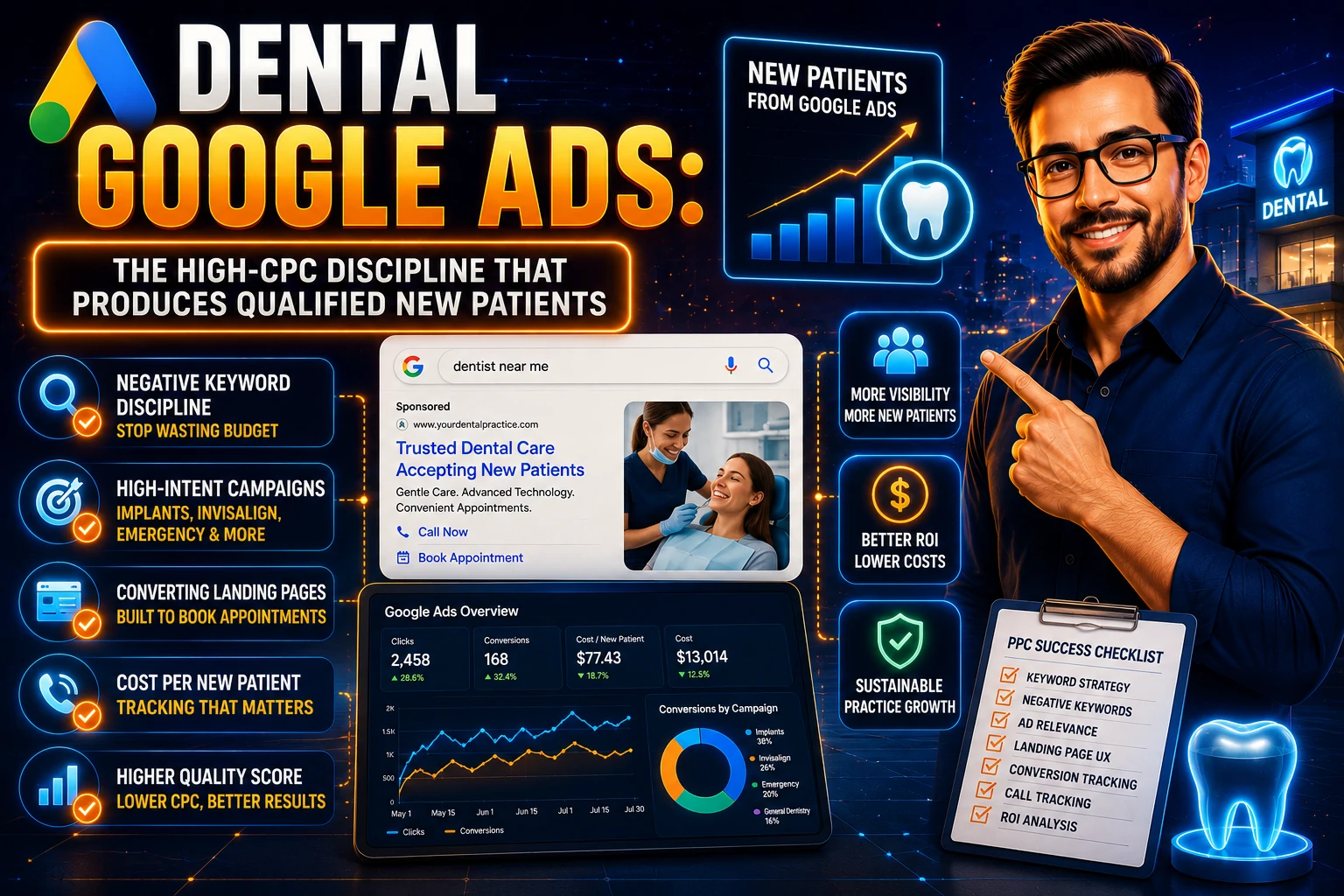
Dental Google Ads: The High-CPC Discipline That Produces Qualified New Patients
Dental Google Ads is one of the most expensive paid-search categories in any local service vertical. Per-click costs in competitive metros run substantial amounts for high-intent terms ('dentist near me,' 'emergency dentist,' specific procedure terms), driven by aggressive bidding from practices with high patient lifetime value and the dental marketing agencies competing for substantial accounts. Practices running dental Google Ads without disciplined negative keyword management, intent-matched landing pages, conversion tracking that attributes new patient acquisition correctly, and active ongoing optimization burn budget at rates that destroy unit economics. Practices running dental Google Ads with discipline produce favorable new-patient flow as part of integrated channel mixes — but the discipline required is substantially higher than for less-competitive categories.
Published: July 27, 2026 | Reading Time: ~8 minutes | Category: Dental Marketing — PPC
This guide covers dental PPC for practice owners and marketing decision-makers serious about making Google Ads work as part of their channel mix. It covers why dental PPC is structurally expensive and what that means for strategy, the negative keyword discipline that's non-negotiable in this vertical, the cost-per-new-patient framing that distinguishes working PPC from budget hemorrhaging, the match types and intent considerations that affect spend efficiency, the procedure-specific campaign strategy that produces strong economics on substantial cases, the landing-page work that converts the expensive clicks, the Quality Score factors that affect what you pay per click, and the common mistakes that bleed dental PPC budget.
What You'll Learn
- Why dental PPC is structurally expensive and what that means for strategy
- Negative keyword discipline as non-negotiable foundation
- Cost-per-new-patient framing rather than cost-per-lead focus
- Match types and intent considerations for dental keywords
- Procedure-specific campaign strategy for substantial cases (implants, invisalign, cosmetic)
- Landing pages that convert the expensive clicks you pay for
- Quality Score factors specific to dental PPC
- Common mistakes that destroy dental PPC economics
Why Dental PPC Is Structurally Expensive
- High patient lifetime value supports aggressive bidding. Dental practices bid heavily because acquired patients produce multi-year revenue across recurring cleanings, restorative work, and family members. The bid floor in competitive dental markets reflects what aggressive operators willingly pay for new patient acquisition.
- Specialty procedures support exceptional bidding. Implants, orthodontics, full-mouth restoration, and cosmetic work involve substantial per-case revenue that supports per-click costs much higher than general dentistry could sustain. Specialty-targeted campaigns see particularly elevated CPCs.
- Multi-location and DSO competition. Dental service organizations and multi-location practice groups operate at scale that supports aggressive paid acquisition. Independent practices facing this competition pay elevated CPCs to maintain visibility.
- Intent ambiguity in head terms. 'Dentist' includes intent ranging from immediate need to research to family decisions. Operations bidding broad terms pay for substantial click volume that won't convert.
- Insurance shopping complicates conversion. Patients filtering for specific insurance acceptance create conversion drop-off if landing pages don't address insurance prominently. The 'clicked but didn't book' patterns reflect this filtering.
THE COST-PER-CLICK REALITY FOR DENTAL: Dental PPC in competitive markets sees per-click costs that would be unsustainable for most other local categories — substantial dollars per click on competitive head terms, with specialty terms (implants, invisalign, cosmetic) running higher still. The economics only work when landing pages, intake, sales process, and treatment plan conversion all execute well. Practices running dental PPC without disciplined negative keywords, tight geographic targeting, conversion-focused landing pages, insurance acceptance prominence, and honest cost-per-new-patient tracking burn budget at rates that destroy margins. The discipline isn't optional in this vertical.
Negative Keyword Discipline
Negative keyword management is more important in dental PPC than in many other verticals. The breadth of related-but-unintended searches that match dental keywords without proper exclusion produces substantial wasted spend.
- Job-search queries: 'dental assistant jobs,' 'dental hygienist jobs,' 'dental jobs near me,' 'dentist employment.' Substantial volume that never converts to patients.
- DIY and information searches: 'how to whiten teeth at home,' 'home dental remedies,' 'DIY tooth pain,' 'how to remove tartar.' Researchers not seeking professional care.
- Educational and career searches: 'dental school,' 'how to become a dentist,' 'dental hygienist program,' 'dental certification.' Industry research not patient intent.
- Product purchase searches: 'electric toothbrush,' 'teeth whitening kit,' 'mouthwash,' 'floss.' Product shopping not service intent.
- Off-target services: searches for related services you don't provide should be excluded if not relevant to your practice. A general dentistry practice may exclude orthodontics-specific terms; specialty practices may exclude general dentistry terms.
- Competitor brand terms where appropriate. Some competitor conquest can work strategically but often wastes budget in untargeted match types.
- Wrong demographics or context: 'free dental care,' 'low-cost dentist,' 'dental school clinic' for practices not positioned at those price points; 'student dental,' 'medicaid dentist' for practices not accepting those situations.
- Geographic exclusions outside service area. Even with geographic targeting, specific city or state names can require keyword-level exclusions.
Ongoing Maintenance
Search Query Reports reviewed weekly during early optimization and monthly thereafter, with new negatives added based on what actually triggers ads. Operations that skip SQR review miss negatives that emerge as search behavior evolves.
Cost-Per-New-Patient Framing
CPL alone misleads in dental PPC because conversion rates from lead to actual new patient vary dramatically by campaign type and intent quality. The metric that matters is cost-per-new-patient — total channel spend divided by new patients actually acquired and booked into the practice.
- Track new-patient attribution by campaign and ad group, not just lead-level attribution. The metric that matters is what each campaign produces in new patients, not just inquiry volume.
- Calculate cost-per-new-patient monthly: total channel spend divided by new patients from that channel.
- For specialty procedures, calculate cost-per-case-booked: for implant campaigns, the metric is cost per implant case booked; for invisalign campaigns, cost per invisalign case started. These metrics capture the actual economic reality of specialty marketing.
- Compare against patient lifetime value. The cost-per-new-patient that produces favorable economics depends on practice LTV. Practices with substantial LTV can absorb higher acquisition cost; practices with lower LTV cannot.
- Make budget decisions based on cost-per-new-patient and case-booked metrics, not raw CPL.
Match Types and Intent
- Exact match for highest-intent core terms (specific service plus geography, 'near me' variants, urgent intent terms). Tightest control, highest relevance.
- Phrase match for substantial intent terms where reasonable variation is acceptable.
- Broad match generally not recommended without aggressive negative keyword management. Broad in dental PPC produces substantial waste.
- Smart Bidding with broad match in mature accounts with substantial conversion data may work but requires sophisticated negative keyword discipline and ongoing oversight.
Procedure-Specific Campaign Strategy
Dental practices serving multiple procedure types benefit from procedure-specific campaign structure rather than generic dental campaigns. The economics of an implant case justify different bidding than the economics of a cleaning appointment; intent on a specific procedure search differs from intent on generic dentist searches.
Implant Campaigns
Implants involve substantial per-case revenue and patient research over weeks. Campaigns targeting 'dental implants [city],' 'implant cost,' 'implant consultation,' and related terms with landing pages addressing the specific case. CPCs run high but cost-per-case can produce strong economics when conversion infrastructure executes.
Orthodontics Campaigns (Invisalign, Braces)
Invisalign and traditional orthodontics targeting separate campaigns. Adult vs adolescent invisalign campaigns may benefit from separate targeting and creative. Substantial per-case revenue supports elevated bidding when conversion produces booked cases.
Cosmetic Campaigns
Veneers, smile design, whitening, and broader cosmetic work targeted with separate campaigns. Patient intent differs substantially across cosmetic categories; each deserves its own campaign structure.
Emergency Campaigns
Emergency dentist searches represent particularly high-intent traffic with substantial conversion rates. Dedicated emergency campaigns with landing pages addressing immediate availability, after-hours capability, and emergency procedure capability capture these high-value inquiries.
General New Patient Campaigns
Baseline new-patient acquisition campaigns targeting 'dentist near me,' 'family dentist,' 'new patient' searches. Lower per-case immediate value than specialty campaigns but volume produces sustained patient flow.
PRO TIP: Most dental practices running PPC structure campaigns by location or by broad service category, missing the procedure-specific structure that produces substantially better economics. Building dedicated campaigns for implants, invisalign, cosmetic work, and emergency capture lets you bid intentionally for each, build landing pages matched to each, and measure cost-per-case-booked at the procedure level. The same budget reallocated from broad campaigns into procedure-specific campaigns typically produces meaningfully better unit economics because each campaign matches intent and landing page to specific patient research and decision dynamics.
Landing Pages That Convert
- Match landing page content to ad and keyword intent: searches for 'dental implants [city]' should land on implant-specific pages, not a generic services page.
- Page speed and Core Web Vitals: substantial portions of dental PPC traffic abandons slow-loading pages. Target excellent performance.
- Mobile-first design: dental searches skew mobile, particularly emergency. Mobile experience must be fast, easy to navigate, easy to contact.
- Insurance acceptance visible above the fold: substantial portion of patients filter by insurance. Failing to address it prominently loses substantial conversion.
- Trust signals throughout: years in practice, credentials, manufacturer affiliations (Invisalign Diamond Provider, etc.), team photos with credentials, reviews integrated.
- Multiple conversion paths: tap-to-call, online booking, contact form, chat. Different patients prefer different paths.
- Procedure-specific value proposition: what makes this practice the right choice for the specific procedure searched.
- Pricing guidance or financing visibility: addresses cost concerns that often kill conversion when not addressed.
- Conversion tracking properly implemented across calls (with call tracking), forms, online booking, and chat.
Quality Score Factors
- Expected CTR: ad copy matching keyword intent drives this. Strong relevance and compelling messaging produce strong CTR.
- Ad relevance: how closely your ad matches keyword intent. Generic ads across diverse keywords score poorly.
- Landing page experience: speed, mobile experience, content relevance, ease of navigation. Quality Score directly affects CPC and ad position with real economic consequences.
- Account history: mature accounts with conversion history and refined optimization receive Quality Score benefits new accounts don't.
Common Mistakes
- No negative keyword management — the most common cause of dental PPC underperformance.
- Broad match without sophistication — produces massive waste in dental PPC.
- All traffic to the homepage — generic homepages convert dental PPC traffic at rates well below intent-matched landing pages.
- No conversion tracking or weak attribution — can't optimize what can't be measured.
- Set-and-forget management — dental PPC requires active management.
- Ignoring procedure-specific economics — running broad dental campaigns rather than procedure-specific structure that matches actual case economics.
- Insurance acceptance not addressed prominently — loses substantial conversion when patients filter by insurance.
- Mobile experience neglected — most dental traffic is mobile; weak mobile destroys conversion on majority of spend.
- Bidding into specialty terms without specialty landing pages — paying for premium clicks then sending to generic content.
The Bottom Line
Dental PPC is among the most expensive paid-search categories in local services, with structural factors (high patient LTV supporting aggressive bidding, specialty procedure economics supporting exceptional bidding, multi-location and DSO competition, intent ambiguity in head terms, insurance filtering complicating conversion) producing per-click costs that destroy unit economics without disciplined management. The operations that make dental PPC work combine aggressive negative keyword discipline, cost-per-new-patient and cost-per-case tracking rather than CPL focus, procedure-specific campaign structure matched to actual case economics, intent-matched landing pages addressing insurance and trust signals, and active ongoing management.
For most dental practices, PPC works best as part of an integrated mix alongside SEO foundations and ongoing patient retention rather than as primary channel. SEO produces more durable economics; PPC supplements with high-intent capture and procedure-specific acquisition when run with discipline. Practices new to dental PPC should expect 60-90 days of intensive optimization to reach favorable cost-per-new-patient, with ongoing active management thereafter. Dental PPC is one of those marketing channels where the difference between disciplined execution and casual management produces dramatically different outcomes — and the discipline is what every successful dental PPC program shares.
Key Takeaways
- Dental PPC is structurally expensive — high patient LTV, specialty procedure economics, multi-location and DSO competition, intent ambiguity, and insurance filtering all push CPCs to levels that destroy unit economics without disciplined management
- Negative keyword discipline non-negotiable: exclude job-search, DIY/information, educational/career, product purchase, off-target services, wrong demographics, geographic queries. Weekly SQR review during optimization, monthly thereafter
- Cost-per-new-patient and cost-per-case-booked are the metrics that matter, not CPL. Compare against patient LTV to evaluate whether economics work
- Match types: exact and phrase for high-intent terms; broad match generally not recommended without sophisticated negative keyword management
- Procedure-specific campaign structure produces substantially better economics — separate campaigns for implants, orthodontics, cosmetic, emergency, and general new patient with budgets and landing pages matched to each
- Landing pages: intent-matched, fast loading, mobile-first, insurance acceptance above the fold, trust signals throughout, multiple conversion paths, procedure-specific value proposition, pricing/financing visibility, proper conversion tracking
- Quality Score factors: expected CTR, ad relevance, landing page experience, account history — directly affects CPC and ad position
- Common mistakes: no negative keyword management, unsophisticated broad match, traffic to generic homepages, weak conversion tracking, set-and-forget management, ignoring procedure-specific economics, insurance not addressed prominently, neglected mobile experience, bidding specialty terms without specialty landing pages
READY TO BUILD A LEAD PIPELINE THAT'S YOURS? Astra Results Marketing builds and manages dental PPC programs with the disciplined negative keyword management, cost-per-new-patient tracking, procedure-specific campaign structure, intent-matched landing pages addressing insurance and trust signals, and active ongoing optimization that produces favorable economics in a vertical where casual PPC management destroys budgets fast. Stop bidding into the aggressive dental PPC auction without the discipline required to make it work. Build the PPC infrastructure that produces qualified new patients at favorable cost-per-acquisition alongside your SEO and patient retention work. Astra Results Marketing · astraresults.com · (+1) 786-643-3036