Rated 5 star on

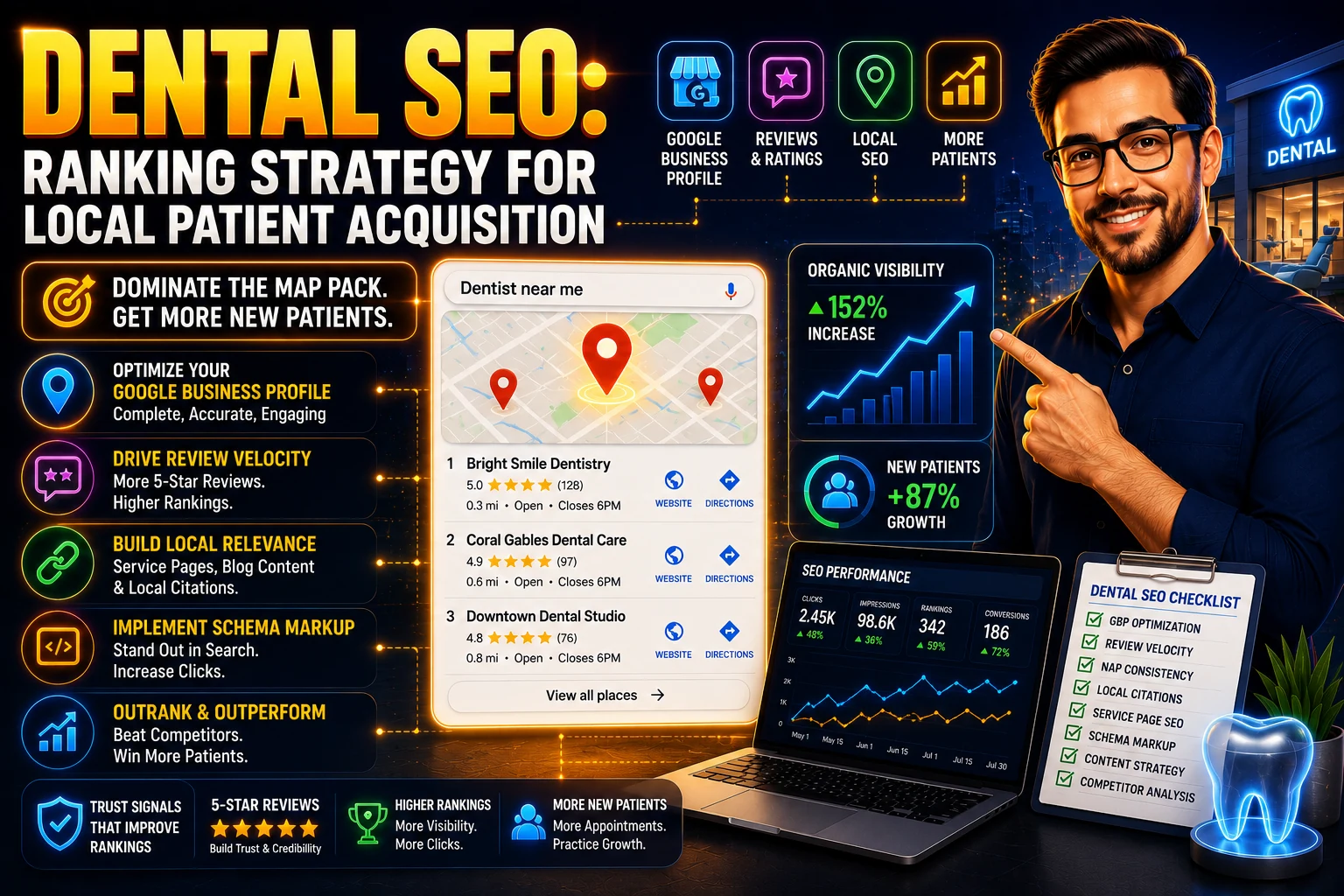
Dental SEO: Ranking Strategy for Local Patient Acquisition
Dental practice marketing has distinct dynamics that generic local-services SEO advice misses entirely. Patients searching for dentists weigh trust signals heavily because dental decisions involve health, anxiety, and ongoing relationships rather than one-off transactions. Insurance acceptance shapes practice selection dramatically because most patients filter providers by what their insurance covers before considering anything else. The lifetime value of acquired patients runs substantially higher than typical service categories because dental relationships often span years across recurring cleanings, restorative work, and family members. And the competition in dental local search is intense in most metros because practice owners with sustained marketing budgets and patient-volume incentives bid aggressively for top placements. Generic SEO playbooks produce mediocre rankings for dental practices; dental-specific SEO strategy produces the Map Pack dominance and qualified-patient flow that actually drive practice growth.
Published: July 27, 2026 | Reading Time: ~8 minutes | Category: Dental Marketing — SEO
This guide covers dental SEO for practice owners and marketing decision-makers focused on growing new patient flow from organic local search. It covers what makes dental distinct as a search category, why Map Pack dominance is the primary battleground for new patient acquisition, the Google Business Profile work that anchors local rankings for dental practices specifically, the service-area and service-line pages that capture different patient intents, the schema markup that supports both traditional SEO and AI search, the review velocity that compounds across years, the content strategy that captures research-phase patients, the insurance and treatment-specific dynamics that affect strategy, and the measurement that distinguishes working dental SEO from activity. Whether you're a general dentistry practice, a cosmetic specialty, a multi-location group, or a specialist (orthodontist, periodontist, oral surgeon), the framework applies.
What You'll Learn
- What makes dental distinct as a search category and what that means for strategy
- Map Pack dominance as the primary battleground for new patient acquisition
- Google Business Profile optimization specific to dental practices
- Service-area pages and service-line pages capturing different patient intents
- Schema markup for dental services supporting traditional and AI search
- Review velocity as foundational ranking asset for trust-sensitive dental decisions
- Content strategy that captures research-phase patient questions
- Insurance and treatment-specific dynamics affecting strategy
- Measurement that distinguishes working dental SEO from activity
What Makes Dental Distinct as a Search Category
- Trust-sensitivity at health-decision levels. Dental decisions involve health considerations, anxiety for many patients, and ongoing relationships that span years. Trust signals affect both ranking (through review and credentialing signals) and conversion at substantially higher weight than typical local services.
- Insurance filtering shapes practice selection. Most patients filter providers by insurance acceptance before evaluating anything else. SEO that ranks the practice highly but doesn't address insurance acceptance prominently misses substantial conversion at the trust-evaluation stage.
- High lifetime value justifies marketing investment. Acquired patients often produce multi-year revenue across recurring cleanings, restorative procedures, and family members joining the practice. The lifetime value supports marketing investment levels that lower-LTV categories couldn't sustain.
- Intense local competition. Most metros have substantial dental practice density competing for the same searches, with practices that invested in SEO years ago holding strong positions and newer practices facing structurally difficult competition for head terms.
- Different patient intents across search categories. 'Dentist near me' (general patient acquisition), 'emergency dentist' (urgent intent), 'cosmetic dentist' (elective procedures), 'invisalign provider' (specific treatment), 'pediatric dentist' (family-driven decisions) all represent different patient intents with different conversion dynamics.
- Long research cycles for substantial procedures. Patients researching implants, orthodontics, full-mouth restoration, or cosmetic work often spend weeks or months evaluating providers before committing. The marketing infrastructure that captures and nurtures this research-phase traffic produces converted patients other practices miss.
MAP PACK IS THE PRIMARY BATTLEGROUND: For dental practices specifically, Map Pack ranking matters more than organic ranking for the searches that produce new patients. The Map Pack appears above traditional organic results, dominates mobile screens, shows reviews and ratings prominently (substantial trust signals for health decisions), and provides direct-action buttons (call, directions) that convert at higher rates than organic results requiring additional clicks. Practices with weak Map Pack presence and strong organic content underperform practices with strong Map Pack presence and adequate organic content. Concentrate the foundational SEO work on Map Pack ranking and use organic content to reinforce it.
Google Business Profile Optimization for Dental
Google Business Profile is the foundation of dental Map Pack ranking. Comprehensive optimization is non-negotiable for any practice serious about local search.
- Primary category set to Dentist (or specialty as appropriate: Orthodontist, Periodontist, Pediatric Dentist, Cosmetic Dentist, Oral Surgeon). Category selection affects which searches you show up for.
- Complete business information: practice name, address, phone, hours, website URL, with multi-location practices maintaining separate complete listings for each location.
- Substantial business description: covers what the practice offers, services emphasized, what distinguishes the practice, and language matching how patients search.
- Comprehensive services list: every service the practice provides (general dentistry, cleanings, restorative, cosmetic, implants, orthodontics, periodontal, oral surgery, pediatric, emergency, sedation) with substantive descriptions.
- Insurance acceptance prominently noted where applicable. Major insurance carriers accepted should appear in services or attributes where patients can find them.
- Substantial photo library: practice exterior, interior (reception, operatory, technology), team photos with credentials visible, and (where patient permission allows) before/after photos for cosmetic work. Photos affect both ranking and patient evaluation.
- GBP Posts regularly: weekly or biweekly Posts covering offers, new technology or services, patient education content, and current promotions. Posts are an underused ranking signal and surface in search results.
- Q&A section populated proactively: answer common patient questions (insurance acceptance, new patient processes, emergency policies, treatment options) before patients ask publicly. Populates the section with quality answers preventing inaccurate community-submitted answers.
- Products and services properly listed where applicable, including treatment packages, membership programs, or specific service offerings with pricing guidance where appropriate.
- Attributes accurately marked: wheelchair accessible, accepts new patients, languages spoken, payment options accepted, online appointment booking — all attributes that affect specific search surfaces.
- Review responses on every review: professional engagement with both positive and constructive reviews.
Service-Area Pages and Service-Line Pages
Two distinct page types support dental SEO: service-area pages targeting geographic searches, and service-line pages targeting treatment-specific searches. Both deserve substantive investment, and they serve different patient intents.
Service-Area Pages
Pages targeting geographic searches like 'dentist in [city/neighborhood],' 'family dentist [area],' 'cosmetic dentist [city].' Substantive content (800-1500+ words) covering services in the specific area, references to local neighborhoods and communities served, accessibility and transit information, and clear contact paths. Avoid thin doorway pages with only city names changed; substantive geographic content ranks where thin pages don't.
Service-Line Pages
Pages targeting treatment-specific searches like 'dental implants [area],' 'invisalign [city],' 'teeth whitening,' 'pediatric dentistry.' Substantive content covering the treatment, what patients should know, the practice's specific approach and experience, before/after examples (with permissions), FAQ addressing common questions, and clear consultation request paths.
- Major treatment service-line pages: cleanings/preventive, restorative (fillings, crowns, bridges), endodontic (root canal), periodontal, implants, orthodontics, cosmetic (whitening, veneers, smile design), pediatric, emergency, sedation.
- Specialty service-line pages: more specific treatments warranting their own pages (full-mouth restoration, cosmetic case planning, implant overdentures, specific orthodontic systems).
- Comparison content where relevant: invisalign vs traditional braces, dental implants vs bridges, treatment options for specific patient situations.
- Insurance and financing pages: dedicated pages for insurance acceptance, financing options, membership programs, and payment structures matter for patients filtering by these factors.
Schema Markup for Dental
- LocalBusiness or MedicalBusiness schema marking up the practice with hours, location, contact, credentialing, and accepted insurance.
- Dentist or MedicalOrganization schema where applicable for the practice type.
- Service schema for each major service category with substantive descriptions and applicable details.
- FAQPage schema on service pages with substantive FAQ content. AI search systems particularly favor FAQPage-marked content for direct-answer extraction, making this schema especially valuable for AI-search visibility.
- Review and AggregateRating schema where reviews are featured. Schema surfaces star ratings in search results, improving CTR.
- Physician or Person schema for dentists with credentials, education, and specialties documented.
- BreadcrumbList schema on internal pages supporting both navigation clarity and search-result presentation.
Review Velocity for Dental Practices
Reviews are foundational to dental SEO for multiple reinforcing reasons: Map Pack ranking factor, trust signal patients heavily evaluate for health decisions, AI-search citation factor, and referral generator. Sustained review velocity (rather than total review accumulation alone) is the asset that drives consistent ranking and patient flow.
- Systematic post-appointment review requests: every routine appointment, completed procedure, and new patient experience is a review opportunity. Operations that ask consistently generate sustained velocity; operations that ask sporadically don't.
- Multi-channel requesting: email and text both, with direct links to the Google review form. Friction kills review completion; eliminate it.
- Timing at peak satisfaction: typically immediately after appointment completion when patient experience is freshest.
- Response discipline on every review: positive reviews deserve genuine appreciation, constructive reviews deserve professional acknowledgment and accountability. Patterns affect both perception and ranking.
- Sustained velocity over bursts: 10-20 new monthly reviews sustained outranks 100 reviews in one month followed by silence.
- HIPAA considerations: review responses should never reference specific treatment details patients didn't share publicly. Professional acknowledgment without HIPAA-sensitive specifics.
PRO TIP: The single highest-leverage SEO improvement for most dental practices is systematic review generation built into the patient appointment workflow. Practices generating 15-25 new monthly Google reviews with sustained velocity rank consistently in Map Pack ahead of practices with larger absolute counts but lower recent activity. The discipline is operational rather than technical: integrate review requests into appointment-completion processes (front desk, hygienist closeout, automated post-visit messaging), provide direct links eliminating friction, and follow up with non-responders. The downstream effect compounds: better Map Pack ranking produces more new patient inquiries, more new patients produce more reviews, more reviews reinforce ranking. Practices that build this discipline produce sustainable competitive advantage; practices that skip it watch competitors with worse credentialing but better review velocity outrank them.
Content Strategy: Capturing Research-Phase Patients
Substantial dental decisions (implants, orthodontics, cosmetic work, full restoration) involve patient research over weeks or months. Content that captures research-phase searches positions the practice as a credible authority while the patient evaluates options.
- Treatment explanation content: substantive pages explaining what specific treatments involve, candidacy considerations, what to expect, timelines, and outcomes. Captures research searches like 'what are dental implants' or 'is invisalign right for me.'
- Treatment comparison content: invisalign vs braces, implants vs bridges, different cosmetic approaches. Captures patient comparison decision-making.
- Cost and insurance content: 'how much do implants cost,' 'does insurance cover invisalign,' 'how to finance dental work.' Captures financial-evaluation searches before patients commit.
- Pain and anxiety content: 'sedation dentistry options,' 'dental anxiety,' 'painless dentistry.' Addresses substantial patient concerns affecting practice selection.
- Family-focused content: pediatric dentistry topics, age-appropriate care, what to expect for children's appointments. Captures family-driven practice selection decisions.
- Emergency content: 'dental emergency,' 'broken tooth,' 'severe tooth pain' — substantial intent searches that benefit from substantive content addressing what to do and when to seek care.
- FAQ format with schema: question-and-answer format with FAQPage schema markup, supporting both traditional SEO and AI search citation.
Measurement
- Map Pack ranking by service area: rank tracking specifically for Map Pack positions across searches that matter for your practice.
- New patient inquiries by month attributed to organic search and Map Pack.
- Cost-per-new-patient from SEO: total SEO investment divided by acquired patients attributed to organic channels. Compares against other acquisition channels.
- Review velocity: new reviews per month tracked consistently.
- Branded search volume growth: searches for your practice name indicate broader brand awareness.
- Service-line page performance: traffic and conversion by service-line page reveals which treatments your content is reaching.
- Insurance-filter conversion: how many patients filter for your accepted insurances and proceed vs drop off.
The Bottom Line
Dental SEO is local-search work calibrated to a vertical with distinct trust-sensitivity, insurance filtering, high lifetime value, intense local competition, and diverse patient intents across treatments. The strategy that produces qualified new patients concentrates on Map Pack dominance as the primary battleground, supported by comprehensive Google Business Profile optimization, substantive service-area and service-line pages, schema markup, sustained review velocity, and content strategy capturing research-phase searches. Operations executing this consistently build durable new-patient flow that compounds across years, supports practice growth, and survives the competitive pressures that displace less-established practices.
The work is concrete: GBP optimization comprehensively maintained, service-area pages with substantive content for each market, service-line pages for each major treatment area, schema markup deployment, review-generation systems producing sustained velocity, content production targeting research-phase searches, and measurement focused on the metrics that distinguish working SEO from activity. Dental practices investing in this foundation outcompete practices relying on paid acquisition alone — and the foundation, once built, produces patient flow for years with marginal ongoing investment.
Key Takeaways
- Dental SEO is distinct from generic local-services SEO — trust-sensitivity at health-decision levels, insurance filtering shaping practice selection, high lifetime value justifying marketing investment, intense local competition, diverse patient intents across treatments
- Map Pack is the primary battleground — concentrate foundational work there with organic content reinforcing rather than competing for impossible head-term organic positions
- GBP foundation: primary category Dentist (or specialty), complete information, substantial description, comprehensive services list, insurance acceptance noted, substantial photo library, regular Posts, proactive Q&A, products/services listed, accurate attributes, review responses
- Two distinct page types: service-area pages targeting geographic searches and service-line pages targeting treatment-specific searches. Both deserve substantive 800-1500+ word content with genuine local or treatment-specific relevance
- Schema markup: LocalBusiness/MedicalBusiness, Dentist/MedicalOrganization, Service for each category, FAQPage on service pages (valuable for AI search), Review/AggregateRating, Physician/Person, BreadcrumbList
- Review velocity is the single highest-leverage SEO improvement for most dental practices — systematic post-appointment requests integrated into workflow, multi-channel, timing at peak satisfaction, response discipline with HIPAA considerations, sustained 15-25 monthly velocity
- Content strategy captures research-phase patients: treatment explanation, comparison content, cost/insurance content, pain/anxiety content, family-focused content, emergency content, FAQ format with schema
- Measurement: Map Pack ranking by service area, new patient inquiries by month, cost-per-new-patient from SEO, review velocity, branded search growth, service-line page performance, insurance-filter conversion
READY TO BUILD A LEAD PIPELINE THAT'S YOURS? Astra Results Marketing builds dental SEO programs that produce durable Map Pack dominance and sustained new patient flow — Google Business Profile optimization, substantive service-area and service-line page architecture, comprehensive schema markup, review-generation systems producing sustained velocity, content strategy capturing research-phase patients, and the integrated approach that compounds rankings over years. Stop relying on paid acquisition alone or competing for impossible head-term battles. Build the SEO foundation that produces compounding new patient flow for your practice. Astra Results Marketing · astraresults.com · (+1) 786-643-3036