Rated 5 star on

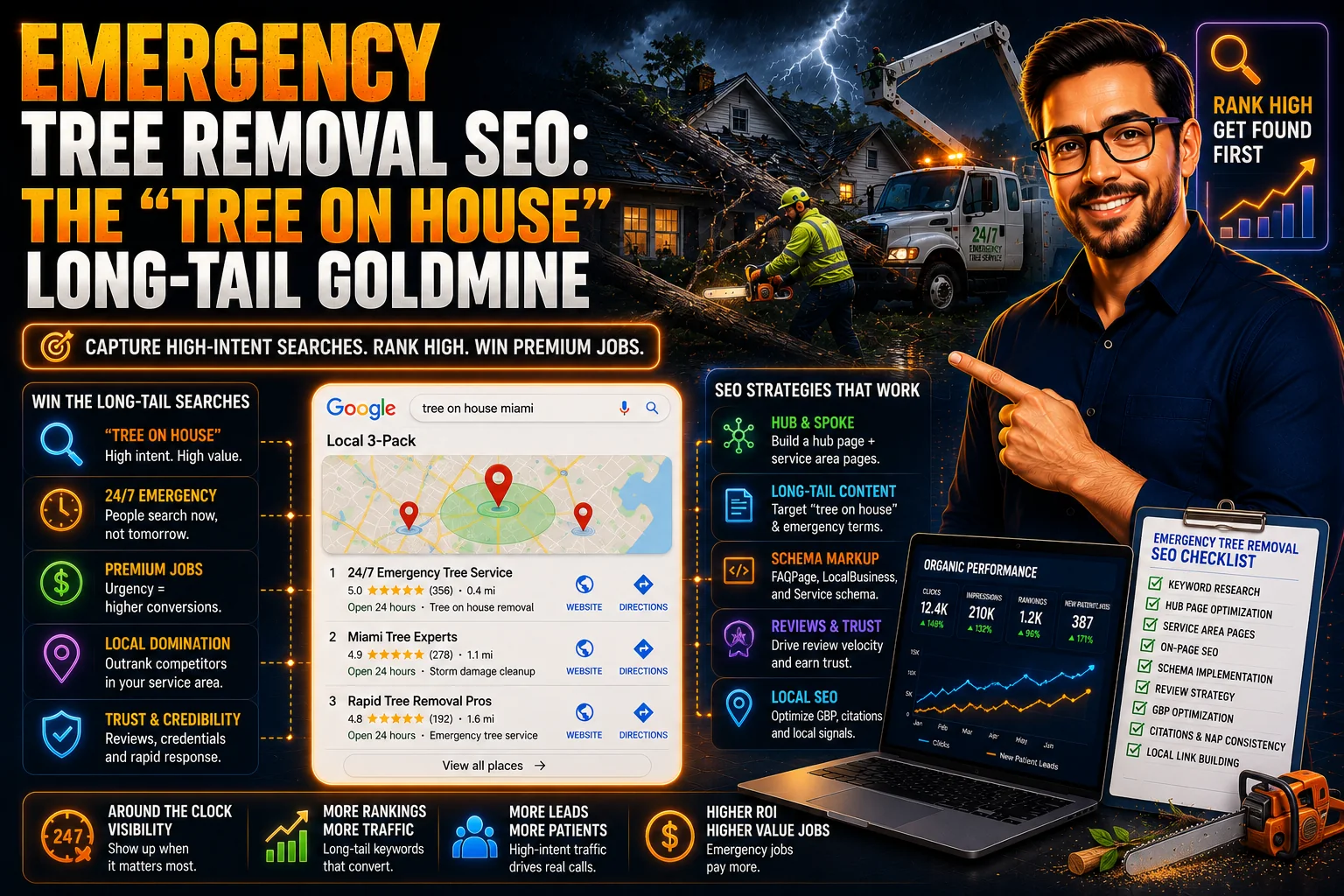
Emergency Tree Removal SEO: The "Tree on House" Long-Tail Goldmine
Few keyword categories combine intent, urgency, and revenue potential quite like emergency tree removal searches. A homeowner typing 'tree on my house,' 'emergency tree removal near me,' or 'tree fell on car' isn't researching — they're in a crisis, looking for help right now, and willing to pay premium pricing for fast professional response. The job values that come from these searches are among the highest in tree service, the competition is often thinner than for the head terms most companies chase, and the intent gap between searcher and customer is essentially zero. The companies that build SEO infrastructure around this long-tail layer capture some of the most profitable work tree service has on offer.
Published: July 11, 2026 | Reading Time: ~12 minutes | Category: Tree Service — Emergency SEO
Yet most tree-service websites treat emergency removal as one item in a long service list, with maybe a sentence or two on the homepage and no dedicated content depth. The result: when a panicked homeowner with a tree through their roof searches for help, the companies that actually built emergency-specific content rank above them — and capture the job. This isn't because the better-ranking competitors are larger or better-funded; it's because they recognized the long-tail opportunity, built the content infrastructure to rank for it, and now harvest the high-value calls those rankings produce. The advantage compounds: more emergency jobs lead to more emergency-specific reviews, which reinforce the rankings, which produce more jobs.
This guide covers emergency tree removal SEO practically: why the long-tail layer is the goldmine, the keyword landscape worth mapping, the dedicated content infrastructure that ranks for emergency searches, the schema markup that signals emergency capability, the local SEO foundations that make any of this work, the mobile and speed considerations specific to emergency search behavior, and the review-and-content compounding that turns initial rankings into durable competitive advantage. ArborCentric Solutions built this layer methodically across South Florida service areas, and the emergency-call pipeline that resulted is one of the more profitable parts of the operation.
What You'll Learn
- Why emergency tree removal long-tails are the goldmine — intent, urgency, job value, thinner competition
- Mapping the keyword landscape — the 'tree on X' patterns and emergency intent variations
- Dedicated emergency content infrastructure that ranks (and why the homepage-mention approach doesn't)
- Schema markup signaling emergency capability and 24/7 availability
- Local SEO foundations that make emergency long-tails work — service areas, NAP, GBP
- Mobile and speed considerations specific to emergency-search behavior
- How emergency-specific reviews compound rankings into durable advantage
- What ArborCentric Solutions built across South Florida emergency long-tails
Why Emergency Long-Tails Are the Goldmine
Most tree-service SEO conversations focus on the head terms — 'tree service [city],' 'tree removal [city],' 'arborist [city].' These terms have higher volume, but they're also the terms every competitor in the market is fighting for, with the entrenched leaders sitting in the Map Pack and capturing most of the clicks. Long-tail emergency terms work differently: lower individual search volume but multiplied across many variations, dramatically higher intent, thinner competition because most operators don't bother building dedicated content, and substantially higher job values from the work the searches produce.
The Four Properties That Make Emergency Long-Tails Different
- Intent is essentially perfect. Someone searching 'tree on house' or 'tree through roof' is not browsing — they have an active emergency and need a contractor immediately. Conversion rates from these searches to booked calls run dramatically higher than from head-term searches, because the searcher is past the research phase entirely.
- Urgency drives premium pricing. Emergency tree-removal work commands higher per-job revenue than scheduled removal because the customer is in distress, the work is often more dangerous (compromised tree, structural damage, power line involvement), and the customer's price sensitivity is dramatically reduced when their roof has a tree in it.
- Competition is thinner than head terms. Most tree-service companies haven't built dedicated emergency-removal content — they have the head-term service pages everyone has and treat emergency removal as a sentence on the homepage. The companies that build dedicated long-tail content face less competition for those rankings than they do for the head terms.
- Volume aggregates across variations. Any single emergency long-tail keyword might have only 20-100 searches a month, but the aggregate volume across all the 'tree on [X]' and emergency-removal variations is substantial — particularly in storm-prone markets where the volume spikes with weather events.
THE JOB-VALUE MATH: Emergency tree removal jobs frequently bring revenue several times higher than scheduled removal of the same tree, because the work involves more complexity (compromised tree, structural damage, often power-line proximity), more risk (cleanup of an already-fallen tree on a roof is harder and more dangerous than a controlled takedown), and customers who are not in price-shopping mode. Combine this elevated per-job revenue with the high intent and thinner competition of the long-tail keyword layer, and the unit economics of emergency-removal SEO traffic become some of the most favorable in tree service. The companies that recognize this and build the infrastructure to capture it harvest disproportionate value from a relatively modest content investment.
Mapping the Emergency Removal Keyword Landscape
Before building content, understand the keyword patterns that exist. Emergency tree removal searches fall into several recognizable patterns, each of which deserves dedicated content.
The 'Tree on X' Pattern
The single most distinctive emergency pattern is 'tree on [structure]' — tree on house, tree on roof, tree on car, tree on garage, tree on fence, tree on power line, tree on driveway. Each variation describes a specific emergency scenario the searcher is experiencing, and each warrants dedicated content that addresses that specific situation. The content doesn't have to be long — focused, practical, and immediately actionable beats lengthy general-emergency content for these specific searches.
The 'Emergency Tree' Pattern
Direct emergency searches: 'emergency tree removal,' 'emergency tree service,' '24/7 tree service,' 'urgent tree removal,' 'storm damage tree removal.' These tend to be more general than the 'tree on X' pattern but still high-intent, and they aggregate substantial volume when targeted across service areas.
The 'Fallen Tree' Pattern
Post-incident searches: 'fallen tree removal,' 'tree fell on house,' 'how to remove fallen tree,' 'who to call for fallen tree.' The searcher has the tree already down rather than threatening to fall, but the urgency and intent are still high — the work needs to happen quickly and the person needs a contractor.
The 'After Storm' Pattern
Storm-driven variations: 'after storm tree removal,' 'hurricane tree damage,' 'storm damage tree service,' 'tornado tree removal.' These spike heavily during and after weather events and feed the storm-window strategy covered in the prior post in this cluster.
Local Modifiers Across All Patterns
Every pattern above gets multiplied by location modifiers: 'tree on house [city],' 'emergency tree removal [neighborhood],' '24/7 tree service [county].' For a multi-area operator, the comprehensive keyword landscape involves the pattern variations × the location variations — easily several hundred individual long-tail targets across a regional market. Most won't have huge individual volume, but the aggregate is substantial and the competition for each specific long-tail is often minimal.
The Dedicated Content Infrastructure That Ranks
The common approach — putting 'emergency tree removal' in a list of services on the homepage — doesn't rank for the long-tail emergency landscape. Ranking requires dedicated content that signals real emergency-removal capability and addresses the specific scenarios searchers describe.
The Emergency Service Hub Page
Build a dedicated emergency tree removal page as the hub for this content layer. The page should clearly communicate: that you handle emergency removals 24/7, your typical response time and service area, the kinds of emergencies you handle (tree on structures, storm damage, power line involvement, fallen trees), what to do immediately when an emergency happens, what the homeowner should expect during the response, your credentials and insurance, and clear emergency contact options (prominent phone, immediate-response messaging). This hub anchors the topical authority for emergency-removal content and ranks for the broader emergency searches in your area.
Scenario-Specific Spoke Pages
Build dedicated pages for the high-intent scenario variations — separate pages for 'tree on house,' 'tree on car,' 'tree through roof,' 'fallen tree removal,' and the other distinct scenarios. Each page focuses tightly on that specific scenario: what to do first (safety, insurance contact, when to call professionals), what makes the situation dangerous or complicated, how your team handles that specific scenario, response time expectations, and the call-to-action. The scenario-specific pages rank for the long-tails their head terms target while reinforcing the topical depth of the hub page.
Service-Area Coverage Across Both Layers
For each emergency content page, build service-area variations that target the specific cities, counties, or neighborhoods you serve. 'Emergency tree removal in [neighborhood]' or 'tree on house [city]' pages capture the location-modified searches that the unmodified hub and scenario pages won't rank as well for. The service-area coverage is what turns the content infrastructure from rankings in a few cities to comprehensive coverage across the regional market — and it's how ArborCentric built dominant emergency-removal presence across South Florida's many service areas.
Why Content Depth Matters for Emergency Topics
Emergency content benefits from depth that addresses what searchers actually need to know — not just SEO filler, but practical information about the situation they're in. Safety steps to take while waiting, how insurance typically handles this kind of damage, what you should photograph before any work begins, how to identify whether a situation is safe enough to wait or requires immediate professional attention. Substantive content signals expertise to both search engines and prospective customers — and it's content AI-mediated search increasingly cites in answer-generation, which is why GEO and traditional SEO foundations reinforce each other in this category.
Schema Markup Signaling Emergency Capability
Schema markup helps search engines understand the nature of your services and surface emergency-specific signals. For tree services with emergency capability, several schema elements matter.
- Service schema indicating emergency tree removal as a specific offered service — separate Service schema entries for emergency removal vs scheduled removal vs trimming/pruning vs other services.
- LocalBusiness schema with the service areas you cover and 24/7 availability where applicable — opening hours marked appropriately to signal round-the-clock emergency response.
- FAQPage schema on the emergency content pages, with questions covering the common emergency scenarios — what to do when a tree falls on your house, what response time to expect, what to photograph for insurance, etc. The FAQ schema both supports traditional ranking and increases the likelihood of AI citation when searchers ask emergency questions.
- Review and AggregateRating schema where applicable, with emergency-relevant reviews surfaced — the trust signals that matter when a panicked homeowner is choosing fast.
- HowTo schema where appropriate for the safety/initial-response content on emergency pages — what to do first when a tree falls, how to safely wait for the crew, etc.
PRO TIP: The single most-overlooked schema improvement for emergency tree-service pages is comprehensive FAQPage schema on each scenario page covering the questions searchers actually ask in those situations. 'My tree fell on my house — what do I do?' 'How fast can you get here?' 'Does insurance cover this?' 'Is it safe to wait?' Each answered directly and concisely, with FAQPage schema marking them up for both traditional search and AI-citation contexts. Emergency searchers value direct answers more than almost any other category of searcher, and content structured for direct-answer extraction earns both rankings and the citations that increasingly drive search visibility. Build the FAQ section on every emergency page and mark it up properly — it's high-leverage work.
Local SEO Foundations That Make Any of This Work
Emergency tree removal SEO sits on top of the local SEO foundations that make any local-service ranking possible. Without the foundation, the content infrastructure ranks slowly or not at all.
- Google Business Profile fully optimized for tree service with emergency capability indicated — appropriate primary category (Tree Service), secondary categories (Emergency Service where applicable), services list including emergency removal, photos of emergency work where you have them, and accurate 24/7 hours if you offer round-the-clock response.
- NAP consistency across web — your business name, address, and phone consistent on your website, GBP, citations, and any directories. Inconsistent NAP suppresses local rankings broadly.
- Citation building in tree-service and contractor directories — the niche directories specific to tree service and broader local-business directories. Each citation reinforces the local presence and authority.
- Service area pages structured properly — not thin doorway pages, but substantive pages with genuine content about the specific area, the services offered there, response times, and the kinds of trees and emergencies common to that geography. Thin service-area pages can hurt rankings; substantive ones support them.
- Reviews from completed work across service areas — Google reviews, with sustained velocity, mentioning emergency work where applicable. The reviews drive Map Pack ranking and provide trust signals for emergency searchers choosing fast.
Mobile and Speed Considerations for Emergency Searchers
Emergency searches behave differently from research searches. The searcher is using their phone (often outside, looking at the damage), they're stressed, they're scrolling fast, and they're calling whoever loads first and presents clearly. The site experience matters more than for almost any other search category.
- Page speed is decisive. Slow-loading pages lose emergency searchers immediately — they don't wait. Target excellent Core Web Vitals on emergency pages specifically, with image optimization, minimal blocking scripts, and fast time-to-interactive.
- Mobile experience must be flawless. Most emergency searches are mobile. The mobile design has to load fast, present clearly, and make calling effortless on a phone.
- Prominent tap-to-call. Emergency searchers want to call, not fill out forms. The tap-to-call element should be prominent at the top, repeated through the page, and impossible to miss on mobile.
- Clear 24/7 and response-time messaging. Above the fold: that you handle emergencies, that you're available now, and what response time looks like. The emergency searcher needs to confirm these before they call.
- Form simplicity if forms are offered. For the searchers who do use a form rather than call, minimum-field forms (name, phone, brief description of the emergency) convert dramatically better than long lead forms.
- Trust signals visible without scrolling. License, insurance, years in business, certifications, and reviews visible immediately — the emergency searcher confirming trustworthiness in seconds before committing to a call.
How Emergency-Specific Reviews Compound the Advantage
The work that emergency SEO produces feeds itself when the operational follow-through is solid. Emergency customers — particularly satisfied ones — tend to leave specific, story-driven reviews that mention the emergency situation, the response time, and the outcome. These reviews are exactly the trust signal future emergency searchers look for.
- Request reviews systematically after emergency jobs. The customer was in a stressful situation and you helped — gratitude tends to be high, and the requests are willingly responded to.
- Encourage specificity in reviews. The reviews mentioning 'they came at 11pm with a tree on our roof and had it cleared by morning' carry vastly more weight for future emergency searchers than generic 'great service' reviews.
- Document the work with photos and case examples where customer permission allows. The before-and-after content from emergency jobs fuels social media, website testimonials, and case content that builds the broader credibility.
- The compounding effect: emergency-specific reviews and case content reinforce the Map Pack ranking, the website credibility, and the LSA performance — which produces more emergency calls, which produces more reviews, which compounds further. The flywheel becomes substantial after a year or two of consistent execution.
What ArborCentric Built Across South Florida
ArborCentric Solutions built emergency tree removal SEO infrastructure across multiple South Florida service areas methodically over time. The components — a dedicated emergency hub page with comprehensive scenario coverage, scenario-specific spoke pages for the high-intent variations (tree on house, tree on car, fallen tree, storm damage), service-area coverage extending the scenarios across the markets served, comprehensive schema markup including FAQPage on every emergency page, GBP and NAP foundations supporting the whole structure, mobile-first fast-loading site experience built for emergency-search behavior, and review systems capturing the strong post-job reviews emergency customers tend to leave — work together as an integrated infrastructure rather than scattered tactics.
The cumulative result over multiple storm seasons and steady-state quarters: ArborCentric ranks across the emergency long-tail layer in their service areas, captures a substantial share of the high-intent emergency-removal traffic those rankings produce, books the high-value emergency work that traffic represents, and feeds the compounding reviews and reputation that make the next quarter's rankings even stronger. The unit economics of the work — high per-job revenue from emergency capture, modest ongoing content-maintenance cost, and the durable rankings that produce traffic month after month — make the emergency SEO infrastructure one of the highest-ROI long-term marketing investments the business has made.
The Bottom Line
Emergency tree removal SEO is the goldmine the long-tail layer in tree service represents — high intent, urgency-driven premium pricing, thinner competition than head terms, substantial aggregate volume across variations, and per-job revenue that justifies meaningful content investment. The companies that build dedicated content infrastructure around the emergency keyword landscape — hub pages with topical depth, scenario-specific spoke pages for the high-intent variations, service-area coverage extending across markets, schema markup signaling emergency capability, local SEO foundations supporting the rankings, mobile-first fast-loading experience built for emergency-search behavior, and review systems compounding the advantage — capture work that the homepage-mention approach simply doesn't rank for.
The build takes deliberate work — keyword landscape mapping, content production across hub-spoke-service-area structure, schema implementation, mobile and speed discipline, and review-system follow-through after every job. But the returns compound: durable rankings producing traffic month after month, high-value emergency jobs that justify the investment several times over, and the reputation flywheel where emergency reviews reinforce rankings that produce more jobs that produce more reviews. ArborCentric built it methodically across South Florida and harvests the emergency-call pipeline year-round. The opportunity is real, the work is concrete, and most tree-service operators in any given market haven't built this layer — leaving it available to the operator who does.
Key Takeaways
- Emergency tree removal long-tails are the goldmine: essentially perfect intent (active emergencies, not research), urgency-driven premium pricing (job values multiples higher than scheduled removal), thinner competition than head terms (most operators don't build dedicated content), and substantial volume aggregated across variations
- Keyword landscape: the 'tree on X' pattern (house, roof, car, garage, fence, power line, driveway), the 'emergency tree' pattern, the 'fallen tree' pattern, the 'after storm' pattern — each multiplied by service-area modifiers for comprehensive coverage
- Content infrastructure that ranks: dedicated emergency hub page (topical authority), scenario-specific spoke pages (the 'tree on house,' 'tree on car,' 'fallen tree' variations), and service-area coverage extending each scenario across the markets served — not homepage mentions
- Schema markup signaling emergency capability: Service schema for emergency removal specifically, LocalBusiness with 24/7 hours where applicable, FAQPage schema on every emergency page (the single most-overlooked improvement), Review/AggregateRating, and HowTo where appropriate
- Local SEO foundations make the content layer work: GBP optimized for tree service with emergency capability, NAP consistency, citation building, substantive service-area pages, and reviews from completed work across service areas
- Mobile and speed are decisive for emergency searchers — fast load, flawless mobile, prominent tap-to-call, clear 24/7 messaging, form simplicity, and trust signals visible without scrolling. The site experience matters more than for almost any other search category
- Emergency-specific reviews compound the advantage: stressed-then-helped customers leave specific story-driven reviews, the reviews drive Map Pack and credibility, more emergency calls follow, the flywheel becomes substantial after a year or two of consistent execution
- ArborCentric Solutions built this layer across South Florida — the infrastructure produces durable rankings, high-value emergency work, and the compounding flywheel that makes the investment one of the highest-ROI long-term marketing assets the business has
READY TO BUILD A LEAD PIPELINE THAT'S YOURS? Astra Results Marketing builds emergency tree removal SEO infrastructure for tree-service operators — keyword landscape mapping, hub-and-spoke content production, scenario-specific service pages, service-area coverage, schema markup implementation, the local SEO foundations supporting everything, and the review systems that compound the advantage. We built this layer with ArborCentric Solutions across South Florida and the emergency-call pipeline became one of the most profitable parts of their operation. Stop letting your homepage mention be the only thing competing for the highest-value tree-service searches. Build the long-tail infrastructure that captures the goldmine. Astra Results Marketing · astraresults.com · (+1) 786-643-3036