Rated 5 star on

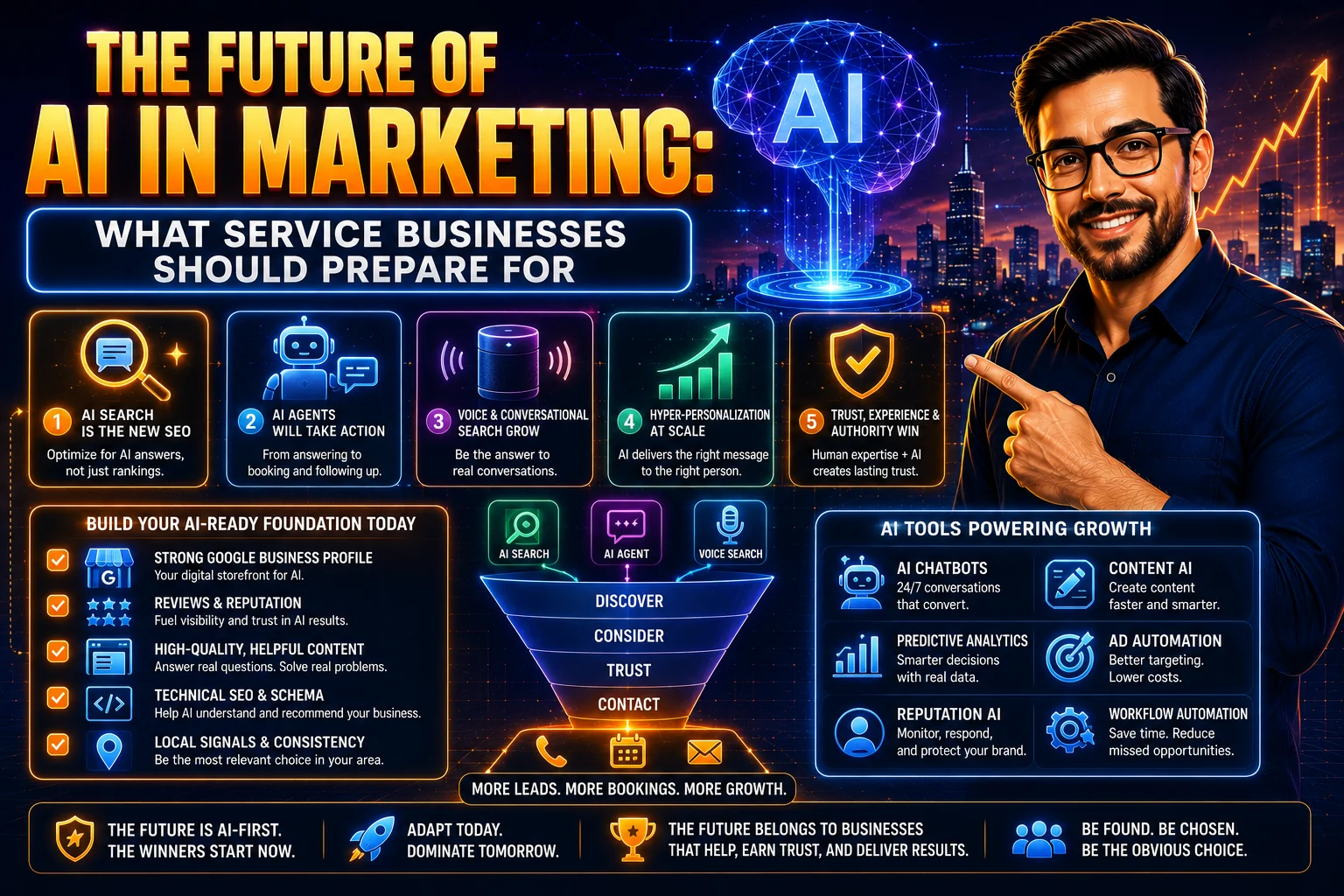
The Future of AI in Marketing: What Service Businesses Should Prepare For
AI in marketing has gone from speculation to reality faster than almost any technology shift in recent memory. Two years ago, AI tools were curiosities for early adopters; today they're embedded in how marketing actually gets done — AI generates content, qualifies leads, optimizes ad bids, summarizes data, answers customer questions, and increasingly mediates how people search and compare businesses. The pace of change isn't slowing. For service-business owners trying to plan ahead, the practical question isn't whether AI will reshape marketing — that's already happened — but what to prepare for next and how to position your business for a marketing landscape that looks meaningfully different in two or three years.
Published: July 9, 2026 | Reading Time: ~9 minutes | Category: AI
Predicting the future of AI specifically is genuinely hard. Anyone making confident claims about exactly how things will unfold over the next several years is either guessing or selling something. But certain trends are clear enough to plan around, and the principle of building durable competitive advantages applies regardless of which specific predictions prove most accurate. The businesses that prepare well aren't the ones chasing every AI tool that launches — they're the ones investing in the foundations that pay off across multiple possible futures and that AI's advance makes more valuable, not less.
This guide covers what's reasonable to expect from AI in marketing over the next several years, what's already changing for service businesses now, what stays durably human even as AI advances, and the practical preparation that positions your business well regardless of how the specific predictions play out. The honest goal is strategic perspective — not breathless hype about every emerging tool, but a sober view of where this is heading and what to do about it.
What You'll Learn
- What's reasonable to expect from AI in marketing over the next several years
- What's already changing for service businesses right now
- What stays durably human as AI advances (and what that means for your strategy)
- Practical preparation that positions your business well across multiple AI futures
- Why some 'AI threats' to service businesses are less dramatic than feared
- Why some shifts are bigger than service-business owners realize
What's Already Changing Now
Before predicting the future, it's worth establishing what's already happened — because parts of the future are already here, just not evenly distributed.
- AI-mediated search is already a meaningful share of search behavior. Google's AI Overviews answer a growing share of queries; ChatGPT, Perplexity, and Claude are used as search engines by millions of people daily. Businesses whose content isn't cited by AI systems are increasingly invisible to a portion of search behavior that's already substantial and growing.
- AI is already handling significant customer-communication volume. AI receptionists answer phones, AI chatbots qualify leads, AI agents handle routine inquiries. The technology has crossed from novelty to genuine commercial use, and businesses that don't deploy these capabilities are losing leads to competitors who do.
- AI-generated content is flooding the internet. Volumes of AI-produced content — much of it generic — are being published across every category. This is both a challenge (more content competition) and an opportunity (genuine differentiated content stands out more in a sea of AI slop).
- Ad platform automation is increasingly AI-driven. Smart Bidding, audience optimization, creative testing, and bid management are increasingly handled by algorithms. The skill of running paid ads has shifted from manual bidding toward strategic direction of the automation.
- AI tools are accessible to small businesses. The same AI capabilities that used to require enterprise platforms are now accessible through consumer tools — leveling the playing field in ways that benefit lean operations willing to use the tools well.
THE TRENDS ARE ALREADY HERE: The 'future' of AI in marketing isn't a far-off scenario — it's substantially the present. AI search is already mediating a meaningful share of how people find businesses. AI is already handling significant customer communication. AI-generated content is already flooding the internet. Ad platforms are already AI-driven. Service businesses that haven't adapted to these changes are already losing ground; the question isn't whether to prepare for AI in marketing, but how fast to adapt to what's already happening and what's coming next. Treating AI as a future concern rather than a present reality is one of the most common strategic mistakes service businesses are making right now.
What's Reasonable to Expect Next
Predicting AI's specific trajectory is hard, but several trends are clear enough to plan around with reasonable confidence.
AI Search Will Continue to Grow
The share of search behavior mediated by AI — Google AI Overviews, dedicated AI search tools, AI assistants — will continue increasing. The exact pace and final balance between AI-mediated and traditional search is uncertain, but the direction is clear. Businesses whose content earns AI citations will benefit; businesses that ignore the shift will become increasingly invisible in AI-mediated search.
AI Agents Will Do More on Behalf of Consumers
Consumers are increasingly using AI agents to research, compare, and make recommendations — sometimes even to make initial contact with businesses. As these agents become more capable, more consumer touchpoints will be mediated by AI before the consumer ever directly interacts with a business. This shifts the persuasion target: you're not just convincing the consumer, you're convincing the AI evaluating you. The businesses that present well to AI evaluation (clear positioning, comprehensive information, strong review signals, structured content) will be favored over those that don't.
Voice and AI Assistants Will Mature
Voice search, voice-enabled AI assistants, and voice-based commerce will continue to grow. For service businesses, this matters because voice queries are often local and emergency-driven ('find me a plumber') — the kinds of queries where AI assistants will likely recommend a small number of businesses rather than offering a list to browse. Optimizing for voice and AI-assistant recommendations becomes increasingly important.
Personalization Will Become More Granular
AI enables personalization at a scale and granularity that was previously impossible — different content, different offers, different communication for different prospects based on their specific behavior and context. Service businesses that build the infrastructure to personalize will deliver experiences that feel custom to each prospect; businesses running the same generic communication will increasingly stand out as inefficient.
AI Will Make More Mistakes Visible
As AI handles more customer-facing interactions, the mistakes will become more visible too. AI customer service that fails customers, AI content that's confidently wrong, AI agents that misrepresent businesses — these will create both reputational risks and opportunities. The businesses that deploy AI thoughtfully, with human oversight where it matters, will navigate this better than businesses that automate everything carelessly.
What Stays Durably Human
Equally important to understanding what's changing is understanding what isn't — the elements of service-business marketing that remain durably human even as AI advances. These are the foundations worth investing in because they retain (and often gain) value as the AI shift continues.
- Trust and reputation. AI can produce content, but it can't produce a reputation. Real reviews from real customers, sustained over years, signal trustworthiness that AI can't fake. Trust signals — reviews, certifications, local presence, established relationships — become more valuable as AI-generated content floods every category.
- Actual service delivery. Marketing brings the customer in; service delivery determines whether they become a repeat customer and referral source. The quality of the actual work — what happens after the marketing has done its job — remains entirely human and entirely consequential.
- Local relationships and community presence. Local service businesses thrive on local relationships, community involvement, and the recommendations that come from being a real presence in a real place. AI doesn't replicate these, and the businesses that build them retain an advantage.
- Strategic judgment. AI accelerates execution, but the strategic decisions — what to invest in, how to position, what audiences to serve, what trade-offs to make — remain human. Businesses with strong strategic judgment will deploy AI tools well; businesses without it will deploy AI tools badly, no matter how good the tools are.
- Authentic brand and voice. AI can mimic patterns, but the genuine voice, perspective, and character of a business — the things that make it distinctive — come from real humans. As AI-generated content becomes ubiquitous and undifferentiated, authentic human voice becomes more valuable, not less.
- The human-AI interface. Even as AI does more, humans direct it, evaluate it, refine its output, and intervene when it goes wrong. The judgment about when to trust AI and when to override it is itself a human skill that becomes more valuable as the technology spreads.
Practical Preparation
Knowing what's changing and what isn't, here's the practical preparation that positions a service business well across multiple possible AI futures.
- Build the GEO foundation now. Comprehensive content with schema markup, direct declarative answers, topical authority, and the structure that AI systems cite. The earlier you build this, the more compounding benefit you accrue as AI-mediated search grows.
- Invest in the Map Pack and local SEO. Local search and the Map Pack remain durable lead sources, and the review and authority signals that drive them are foundations AI can't replace — and that AI search tools increasingly use as evaluation signals themselves.
- Build the review and reputation base. Reviews compound over years, and they signal trustworthiness to both human prospects and AI evaluation. The systematic review-generation process is more valuable now than ever.
- Deploy AI tools thoughtfully where they help. AI customer service (answering calls 24/7), AI lead intake (qualifying leads instantly), AI content acceleration (drafting and structured outputs with human refinement), AI-driven ad optimization — these are productivity multipliers when deployed well.
- Invest in genuine differentiation. The things that make your business genuinely different — the specific expertise, the local presence, the customer experience, the reputation — become more valuable as AI commoditizes the surface-level marketing work.
- Maintain human judgment and oversight. Don't automate everything carelessly. Keep humans in the loop on strategic decisions, brand voice, customer relationships, and the work that requires real judgment.
- Focus on durable assets, not chasing tools. Tool fads come and go; foundations like content authority, review base, Map Pack rankings, and customer relationships compound over years. Invest in foundations; deploy tools to accelerate building them.
PRO TIP: The most useful question to ask when evaluating any AI-related marketing investment is whether it builds a durable asset or just produces transient activity. AI content that becomes a foundation of topical authority is durable; AI content published as filler is transient. AI customer service that captures leads systematically is durable; AI chatbot novelty that frustrates customers is transient. AI-accelerated content production that earns AI citations builds compounding value; AI slop that floods the internet doesn't. Apply this filter to every AI investment: am I building something that pays off year after year, or am I producing activity for its own sake? The durable-asset filter cuts through the AI hype and points to where the real opportunities are.
What's Overhyped — and What's Under-Recognized
The AI conversation has notable distortions worth correcting.
Overhyped
- 'AI will replace marketing teams.' Marketing teams that adopted AI as a force multiplier are doing more, not being replaced. The skills that matter are shifting — toward strategic direction, AI oversight, and the human judgment AI doesn't have — but the function of marketing isn't going away.
- Every new AI tool is essential. The tool landscape is changing fast, and most of the breathless announcements about new AI tools are noise. The fundamentals — content authority, reviews, Map Pack, conversion infrastructure — matter more than chasing every tool. Invest in foundations; deploy tools selectively.
- 'AI search will kill SEO.' SEO has changed dramatically — what it requires now is different from what it required five years ago. But the underlying activity (helping the right prospects find your business through search) is more important than ever, including in AI-mediated search where the same authority signals matter.
Under-recognized
- The compounding advantage of building foundations now. Service businesses that build content authority, review velocity, and Map Pack dominance over the next year or two will compound advantages that newer competitors can't easily catch up to. Acting early matters more than waiting for perfect clarity.
- How quickly AI search is changing consumer behavior. The share of search happening through AI tools is growing faster than most business owners realize. Treating GEO and AI-citation optimization as future concerns rather than current priorities is increasingly costly.
- The growing value of authentic human content. As AI-generated content floods every category, content with genuine human perspective, specific expertise, and authentic voice becomes more valuable, not less. The 'AI commoditizes content' narrative often misses that it commoditizes generic content and elevates distinctive content.
The Bottom Line
The future of AI in marketing is already substantially here — AI mediates a meaningful share of search, handles significant customer communication, generates volumes of content, and drives ad platform automation. The pace of change continues. For service businesses, the strategic question is how to prepare for a marketing landscape that looks meaningfully different in two or three years while building durable advantages that pay off across multiple possible futures. The businesses that prepare well aren't the ones chasing every AI tool — they're the ones investing in the foundations that retain (and often gain) value as AI advances.
The preparation: build the GEO foundation now, invest in Map Pack and local SEO, build the review and reputation base that signals trust to both humans and AI, deploy AI tools thoughtfully where they help, invest in genuine differentiation, maintain human judgment and oversight, and focus on durable assets rather than chasing tools. What stays human — trust, reputation, service delivery, local relationships, strategic judgment, authentic voice — becomes more valuable as AI advances, not less. The service businesses that combine practical AI deployment with durable human foundations position themselves well regardless of how the specific predictions play out. The future is uncertain in details; the principles of preparing for it are clear.
Key Takeaways
- The 'future' of AI in marketing is substantially the present — AI mediates a meaningful share of search, handles significant customer communication, floods every category with content, and drives ad platform automation. Treating it as a future concern rather than current reality is a common strategic mistake
- What's reasonable to expect next: AI search will continue to grow, AI agents will do more on behalf of consumers, voice and AI assistants will mature, personalization will become more granular, and AI mistakes will become more visible (creating both risks and opportunities)
- What stays durably human: trust and reputation, actual service delivery, local relationships, strategic judgment, authentic brand voice, and the human-AI interface itself — these become more valuable as AI advances, not less
- Practical preparation: build the GEO foundation now, invest in Map Pack and local SEO, build the review and reputation base, deploy AI tools thoughtfully where they help, invest in genuine differentiation, maintain human judgment and oversight, focus on durable assets rather than chasing tools
- The durable-asset filter is the most useful question for any AI investment: am I building something that pays off year after year, or producing activity for its own sake? This cuts through hype and points to real opportunities
- Overhyped: AI replacing marketing teams, every new AI tool being essential, AI search killing SEO. Under-recognized: the compounding advantage of building foundations now, how quickly AI search is changing consumer behavior, the growing value of authentic human content as AI floods every category
- Service businesses that combine practical AI deployment with durable human foundations position themselves well regardless of how specific predictions play out — the future is uncertain in details; the principles of preparing for it are clear
READY TO BUILD A LEAD PIPELINE THAT'S YOURS? Astra Results Marketing helps service businesses prepare for the AI-mediated marketing landscape — building the GEO foundations that earn AI citations, deploying AI tools thoughtfully where they actually help (customer service, lead intake, content acceleration), investing in the durable assets (content authority, review base, Map Pack, reputation) that compound across multiple AI futures, and maintaining the human strategic direction that makes the AI work pay off. Stop chasing AI hype. Build the foundations that matter regardless of how AI evolves. Astra Results Marketing · astraresults.com · (+1) 786-643-3036