Rated 5 star on

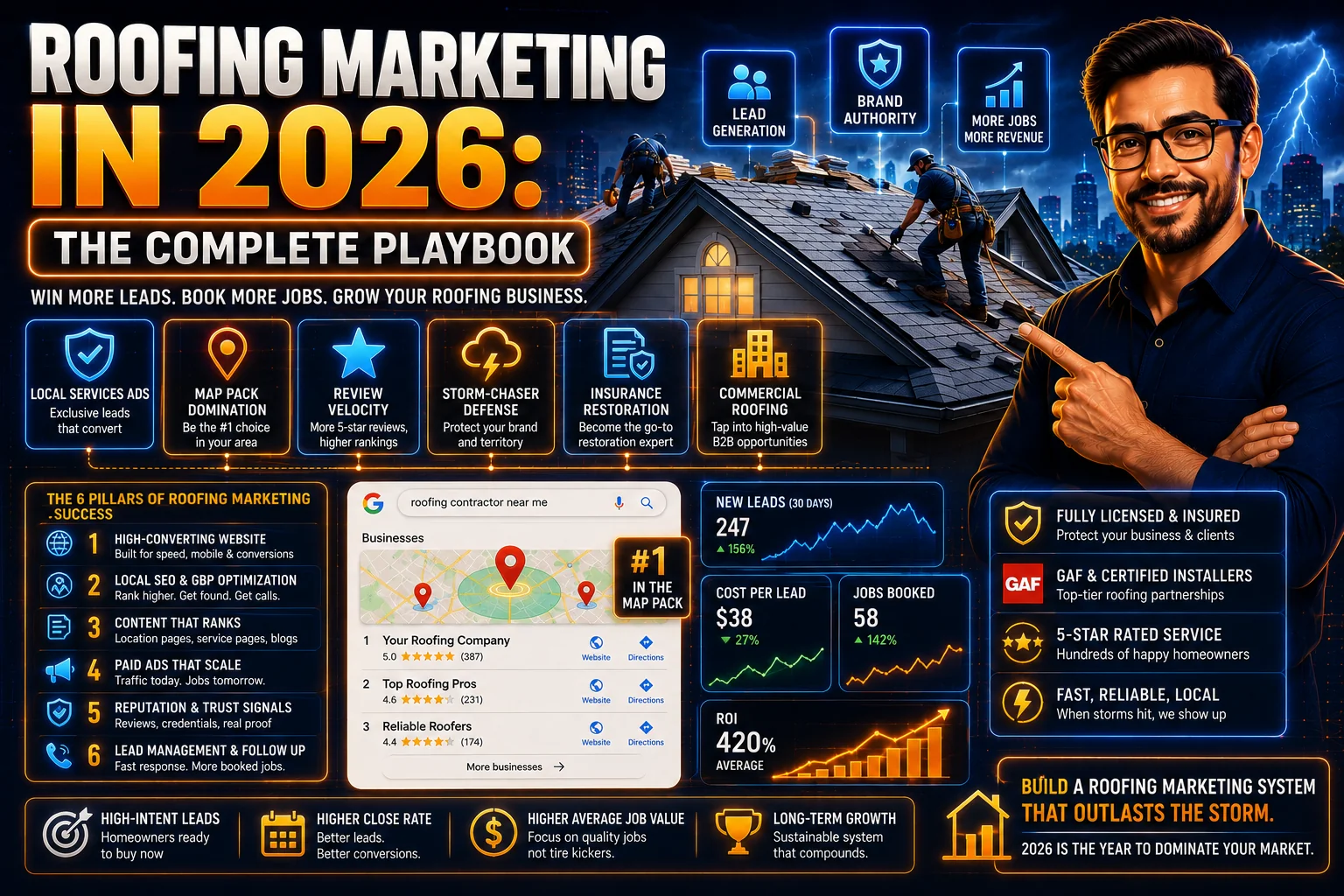
Roofing Marketing in 2026: The Complete Playbook
Roofing is one of the most competitive home-service categories — and one of the most poorly marketed by the operators who work in it. In any given metro, dozens of roofing operations compete for the same homeowners, the same insurance restoration work, the same commercial accounts. Most compete on price because they haven't built marketing infrastructure to compete on anything else. The few that have built integrated marketing systems — capturing storm-window demand at position zero, dominating local Map Pack rankings, building the credentialed authority that lets premium pricing hold, defending against the out-of-state storm-chasers that flood markets after weather events, accessing the insurance-restoration channel that pure direct-marketing operations miss, and operating with the discipline that compounds reviews and referrals over time — generate the lead flow and unit economics that price-competing operations can't match.
Published: July 21, 2026 | Reading Time: ~24 minutes | Category: Roofing Marketing — THE HERO PILLAR
This is the complete guide to roofing marketing in 2026. Not a generic local-services playbook with 'roofing' swapped in, but the actual strategic framework that wins in this specific vertical. It covers the vertical dynamics that make roofing marketing distinct, the multiple revenue streams a sophisticated operation balances (residential emergency, residential planned, insurance restoration, commercial recurring), the channels that produce exclusive leads at favorable economics (LSAs, Map Pack and local SEO, paid search with discipline, insurance-restoration relationships, direct mail that still works, referral systems that compound), the operational disciplines that make any of it work (response rate, review velocity, field coordination, systematic capture), the credentialing and trust positioning that distinguishes established operations from storm-chasers, the AI tools that increasingly factor into operational scale, the measurement that distinguishes working marketing from activity, and how the components integrate into a system where each reinforces the others.
Whether you're a $2M operation looking to grow, a $10M+ operator looking to systematize and scale, or anywhere in between, the framework applies — and the work is concrete. The opportunity in roofing marketing isn't a missing tactic or a new platform. It's the integration of components into an operating system that produces compounding returns across years. Let's get into it.
What You'll Learn
- Why roofing marketing is fundamentally different from generic local-services marketing
- The multi-revenue-stream strategic framework: residential emergency, residential planned, insurance restoration, commercial
- Local Services Ads at position zero — the highest-value placement in roofing search
- Google Business Profile and Map Pack dominance for sustained exclusive-lead flow
- Roofing SEO foundations including storm-content infrastructure
- Paid search discipline in a vertical where casual management destroys budgets
- Storm-chaser defense — retaining market share against out-of-state competition
- Insurance-restoration channel reaching adjusters, public adjusters, and preferred-contractor networks
- Review velocity and reputation systems that compound across years
- Commercial roofing market — different buyers, longer cycles, larger contracts
- Content and credentialed authority positioning that supports premium pricing
- AI tools (receptionist, content acceleration, GEO foundations) that extend operational scale
- Conversion infrastructure: website, intake, sales process that converts the traffic everything else produces
- Measurement: cost-per-booked-job by channel and the KPIs that distinguish working marketing from activity
- The integrated system: how every component reinforces the others into compounding competitive advantage
Why Roofing Marketing Is Fundamentally Different
Generic local-services marketing advice misses what makes roofing distinct. The differences shape strategy at the foundational level and explain why operators running generic playbooks systematically underperform operators running roofing-specific approaches.
Storm-Driven Demand Compression
Roofing emergency demand — storm damage, hail damage, wind events, fallen trees — compresses heavily into short windows after weather events. A storm hits; affected homeowners check their roofs; the calls start within hours. The first-wave demand books with operations that respond fast and have established trust. The marketing infrastructure that wins this window — always-on Map Pack and LSA presence, pre-built paid search ready to activate within hours, expanded intake capacity for surge volume, and field operations ready to dispatch — separates operations capitalizing on storms from operations getting the leftovers.
Trust-Sensitive Substantial-Dollar Decisions
Roof replacement involves substantial homeowner investment — often the largest single home-improvement expense a homeowner faces. Customers evaluating providers are protecting substantial assets, and trust signals matter enormously. The credentialing, review history, established local presence, and substantive web presence that distinguish established operations from reactive operators affect both ranking and conversion at multiple touchpoints. Operations that build visible credentialing and accumulated reputation operate in fundamentally different sales conversations than operations competing as undifferentiated 'roofers.'
Multiple Revenue Streams With Different Marketing Requirements
A sophisticated roofing operation balances residential emergency work (storm capture, urgent repair), residential planned work (full replacements, scheduled repairs, maintenance), insurance-restoration work routed through adjusters and claim processes, and commercial accounts ranging from small commercial replacement through substantial portfolios. Each stream has its own demand patterns, decision processes, sales cycles, and marketing requirements. The infrastructure that wins emergency work doesn't automatically win commercial contracts (RFP processes, capability statements, multi-stakeholder relationships) or insurance restoration (adjuster relationships, preferred-contractor networks, claim documentation). Operations building all four streams produce the unit economics single-stream operations can't match.
Storm-Chaser Competition That Floods Markets After Events
Roofing markets see substantial out-of-state and reactive-local storm-chaser competition after every major weather event. Established operations face aggressive door-to-door canvassing, inflated paid-search bidding, and urgency-tactic sales that capture market share during the highest-value periods. The marketing defense — pre-storm brand awareness, search dominance built before storms, trust positioning that distinguishes from storm-chasers, operational capacity for surge windows — determines whether established operations retain their market position during storms or watch storm-chasers harvest the surge work.
Insurance Restoration as a Distinct Channel
A meaningful portion of substantial roofing work routes through insurance restoration — claim-driven work paid by insurance rather than out-of-pocket. The channel involves adjusters, public adjusters, preferred-contractor networks, and decision dynamics that differ from typical direct-to-homeowner marketing. Operations building insurance-restoration channels access work pure direct-marketing operations miss. The marketing infrastructure for this channel (adjuster relationships, capability statements, network qualifications) develops over years and produces compounding returns.
WHY GENERIC PLAYBOOKS UNDERPERFORM: Roofing operations running generic home-service marketing playbooks systematically underperform operations running roofing-specific approaches. The generic playbook misses the storm-window compression that determines emergency capture. It treats credentialing as a footer logo rather than the central trust differentiator the vertical requires. It doesn't address storm-chaser defense or insurance-restoration channels. It defaults to residential and ignores the commercial markets where multi-year revenue stability comes from. And it measures click metrics that don't capture storm-driven volatility, credentialed-positioning premium, or the operational disciplines that distinguish professional work. The strategy that wins in roofing is roofing-specific in foundation, not generic local-services with 'roofing' branding.
The Strategic Framework — Multiple Revenue Streams
Sophisticated roofing operations balance four primary revenue streams, each with distinct dynamics, marketing approach, and contribution to overall economics.
Residential Emergency Work
Storm damage, urgent repairs, hazardous situations — high-intent emergency demand captured through position-zero LSA visibility, Map Pack dominance, fast response, and the emergency-content SEO infrastructure that wins long-tail storm-driven searches. Emergency work commands premium pricing because customers face urgency, conversion rates from lead to booked work are exceptionally high, and the customer experience produces specific story-driven reviews that reinforce future emergency-search rankings.
Residential Planned Work
Scheduled full replacements, planned repairs, gutter work, and the broader residential roofing maintenance and renewal market. Steady baseline revenue between storm events, benefits from credentialed authority positioning where homeowners have time to research and choose deliberately. Educational content addressing decisions homeowners face (when to repair vs replace, material choices, contractor selection criteria) captures research-phase customers and converts them at credential-driven economics.
Insurance Restoration
Storm-driven and event-driven work paid by insurance — substantial portion of meaningful roofing revenue in storm-prone markets. Requires distinct marketing infrastructure (adjuster relationships, public adjuster networks, preferred-contractor network qualifications, capability statements positioning insurance-restoration competence) and produces work flow that pure direct-marketing operations can't access. Multi-year investment that compounds across storm seasons.
Commercial Recurring Accounts
Property managers, commercial real estate, industrial accounts — multi-year contracts and substantial project work with predictable economics and operational efficiencies. Requires different marketing (capability statements, LinkedIn presence, industry-association engagement, direct outreach, RFP-response capability) and different sales processes (longer cycles, multi-stakeholder decisions, formal evaluations). Investment is substantial but unit economics on successful accounts run favorable.
Strategic value of balancing multiple streams: residential funds growth investment, commercial recurring produces stable cash flow, emergency work generates high-margin surge revenue, insurance restoration adds substantial storm-period contribution. Operations building all four streams diversify against single-segment underperformance, balance volatility, and access economies of scale single-stream operations can't match.
Local Services Ads at Position Zero
Local Services Ads occupy the highest-value placement in local search — position zero, above the Map Pack and traditional paid ads. For roofing specifically, the placement is particularly valuable because emergency demand spikes route through the same searches where LSAs appear, the Google Guaranteed badge addresses trust concerns in a vertical where credentialing matters enormously, and the per-lead pricing model aligns spend with actual lead acquisition rather than click volume.
The verification process gates entry — business license, insurance, background checks, business verification, service-area documentation. Verification typically takes days to weeks and often surfaces credentialing improvements operations should have made anyway. Within LSAs, ranking is driven by reviews (most important factor), response rate and time, verification completeness, proximity, bid preferences, and business profile completeness. The two highest-leverage improvements for most roofing operations are response rate discipline (answer every call, AI receptionist for overflow) and sustained review velocity — both rewarding operational behaviors the business should already be performing.
Think in cost-per-booked-job rather than cost-per-lead. A higher per-lead cost producing favorable cost-per-booked-job through strong conversion beats a lower per-lead cost producing poor conversion. Lead-quality matching through tight LSA configuration, conversion infrastructure that books qualified leads, methodical disputing of inappropriate charges, and focus on higher-value job mix drive favorable economics. Storm-window dynamics shift the calculation — per-lead costs rise but conversion rates and job values rise faster, keeping unit economics favorable during well-managed storm capture.
Google Business Profile and Map Pack Dominance
Below LSAs and above traditional organic results, the Map Pack captures the bulk of clicks for roofing local searches. Map Pack ranking is the highest-leverage exclusive-lead outcome for sustained residential and emergency demand. Unlike LSAs (pay-per-lead) and paid search (pay-per-click), Map Pack visibility is earned through organic local-SEO work and produces ongoing lead flow without per-interaction cost.
Google Business Profile is the foundation. Optimization includes complete and accurate business information, appropriate primary category (Roofing Contractor) and secondary categories, comprehensive services list with substantive descriptions, photos showing completed work and team, GBP Posts publishing regularly, Q&A section with proactive answers to common questions, products and services properly listed, and review responses showing engagement with both positive and constructive feedback.
Map Pack ranking depends on the broader local SEO foundation: NAP consistency across the web, citation building in roofing and contractor directories, schema markup including LocalBusiness and Service schemas, service-area pages with substantive content for each market served, reviews aggregated across Google and other platforms, and broader topical authority establishing the company as a legitimate substantial operation. Active spam-fighting (reporting fake business locations, keyword-stuffed names, review manipulation) protects ranking from competitors gaming the system.
Sustained Google review velocity is among the most consistent Map Pack ranking factors. Operations generating 8-15+ new reviews per month sustain the velocity that drives ranking; operations generating reviews sporadically lose ground to systematic competitors. Building the review-generation process is foundational infrastructure for sustained Map Pack performance.
Roofing SEO Foundations
Beyond Map Pack, broader SEO captures the long-tail layer that aggregates to substantial traffic and supports the topical authority that reinforces all rankings. Roofing SEO concentrates on long-tail content production rather than fighting impossible head-term battles against entrenched competitors with substantial domain authority and accumulated review history.
- Service-specific long-tails: 'metal roof installation [city],' 'tile roof repair [neighborhood],' 'flat roof commercial [area].'
- Material-specific searches: 'cost of metal roof,' 'asphalt vs metal,' 'tile roof maintenance,' 'TPO commercial roofing.'
- Decision-research searches: 'how long does a roof last,' 'when to replace vs repair,' 'roof inspection cost,' 'how to choose roofing contractor.'
- Storm and damage searches: 'emergency roof tarp,' 'hail damage roof inspection,' 'wind damage assessment.'
- Insurance process searches: 'roof insurance claim process,' 'roofing public adjuster,' 'how to document storm damage.'
Storm-content infrastructure must be built before storms hit. Content built reactively during storms is too late to rank for the searches storms produce. Substantive pages addressing storm damage assessment, insurance restoration process, storm preparation, region-specific damage patterns, and emergency-response services capture the demand spike when storms arrive.
Paid Search Discipline
Roofing PPC is among the most expensive paid-search categories in home services — high job values supporting aggressive bidding, lead aggregators bidding up auctions, storm-chaser dynamics inflating spend, and intent ambiguity in head terms all producing per-click costs that destroy unit economics without disciplined management.
Negative keyword discipline is non-negotiable. Exclude job-search queries ('roofer jobs'), DIY/information searches ('how to roof'), material supplier searches ('roofing supply'), educational queries ('roofing school'), competitor brand terms where appropriate, wrong-service queries ('gutter cleaning'), geographic exclusions outside service areas, and property-type mismatches. Search Query Reports reviewed weekly during early optimization and monthly thereafter, with new negatives added based on what actually triggers ads.
Cost-per-booked-job framing rather than CPL focus. A $80 lead at 40% conversion produces $200 cost-per-booked-job; a $30 lead at 3% conversion produces $1,000 cost-per-booked-job. The lower per-lead cost is dramatically worse economically. Match types should favor exact and phrase for high-intent terms; broad match generally not recommended without sophisticated negative keyword discipline. Geographic targeting tight to service areas with zip-code granularity. Storm-driven bid adjustments activated within hours of weather events. Intent-matched landing pages with fast loading, mobile-first design, prominent tap-to-call, and trust signals above the fold convert the expensive clicks at favorable rates.
Storm-Chaser Defense
After every major storm, affected markets see out-of-state and reactive-local storm-chasers racing to capture surge demand through door-to-door canvassing, aggressive paid advertising, urgency-tactic sales, and work completed fast at potentially questionable quality. Established operations defend market share through marketing infrastructure built before storms hit.
Pre-storm foundation produces first-look advantage: sustained local brand awareness (sponsorships, mail, PR, vehicle and yard signs), search dominance (Map Pack, LSAs, organic ranking, substantive web presence built before storms), and the accumulated reputation that storm-chasers can't replicate. In-storm tactics execute against this foundation: rapid-deploy paid search in affected zip codes, LSA bid adjustments maintaining position zero, direct mail to affected areas, customer database activation, social and local media engagement.
Trust positioning distinguishes established operations: years in business prominently communicated, local establishment verifiable, substantial review history accumulated over years, credentialing visible (licenses, insurance, manufacturer certifications), community involvement evidence, warranty backed by sustained presence, and insurance-restoration competence positioned substantively. Operational capacity for storm windows includes intake that scales (human plus AI receptionist), crew capacity through standing expansion or subcontractor relationships, equipment and materials ready, scheduling and dispatch tested for surge volume, current credentialing, and cash flow management for delayed insurance payments.
Post-storm reputation work compounds the advantage across future storms: systematic review generation from completed storm jobs, customer database growth, case-study documentation, storm-chaser contrast content educating future customers, and warranty follow-through that distinguishes from disappeared storm-chasers.
Insurance Restoration Channel
Insurance restoration involves different decision dynamics than typical roofing sales — adjusters shape outcomes substantially, public adjusters represent homeowners in some claims, insurance companies maintain preferred-contractor networks, documentation requirements are substantial, and sales cycles often involve multiple touchpoints. Operations building insurance-restoration channels access work pure direct-marketing operations miss, with economics that often run favorable for established operations willing to do the relationship and capability work.
Marketing channels reaching insurance decision-influencers: direct adjuster outreach and relationship building (months-to-years investment that produces ongoing claim referrals), industry presence in restoration contexts, LinkedIn targeting insurance professionals, capability statements positioning insurance-restoration competence, preferred-contractor network applications systematically pursued, content marketing addressing insurance-restoration topics, and referral programs from past insurance-restoration customers.
Credentialing and capability that qualify operations: manufacturer certifications at substantial levels (GAF Master Elite, CertainTeed SELECT ShingleMaster, Owens Corning Platinum Preferred), substantial insurance and bonding, documentation systems supporting claims, code knowledge and compliance, experience with major insurance carriers in your market, storm restoration capability at scale, and financial capability to handle delayed payment cycles. Compliance and ethics non-negotiable — state licensing requirements, deductible-handling restrictions, public adjuster relationship rules, truthful claim documentation, advertising regulations, and anti-fraud provisions all require attention.
Review Velocity and Reputation Systems
Reviews are simultaneously a Map Pack ranking factor, an LSA ranking factor, a trust signal customers genuinely evaluate, an AI-search citation factor, and a referral generator that produces ongoing leads from satisfied customers. For roofing specifically — substantial dollar decisions, trust-sensitivity at peak, storm-chaser distinction through accumulated reputation — sustained review velocity is among the highest-leverage marketing investments available.
Systematic generation process: review request integrated into every job completion, timing at peak satisfaction (immediately after job completion), multiple touchpoints with follow-up, direct links eliminating friction, clear ask, and sales-process integration. Multi-channel requesting through email, text/SMS, in-person, follow-up phone for substantial jobs, and email signature inclusion. Response discipline on every review — personalized appreciation on positive reviews, professional acknowledgment on constructive reviews, measured handling of negative reviews aimed at future prospects reading the exchange.
Velocity beats accumulation once an operation has 50-100+ baseline reviews. Algorithms favor operations showing active recent engagement: 10 new reviews this month signals active operation, while accumulated counts with no recent activity signal stagnation. Target sustained 8-15+ monthly velocity rather than concentrated bursts. The downstream effects — Map Pack dominance, LSA performance, customer trust at decision moments, referral compounding — strengthen every other channel the operation runs.
Commercial Roofing Market Dynamics
Commercial roofing work — property managers, commercial real estate, industrial accounts — represents a different business than residential, with different buyers, sales cycles, contract structures, and marketing requirements. The marketing infrastructure that wins residential work doesn't automatically win commercial; building commercial accounts requires dedicated investment.
Commercial buyers (property managers, facility managers, commercial real estate decision-makers, building owners) evaluate vendors against defined criteria with multi-stakeholder approval requirements, formal procurement processes, and substantial evaluation timelines. Sales cycles run months rather than days. Contract structures typically involve multi-year agreements, defined scope of services, performance standards, insurance and liability requirements, and predictable pricing structures.
Commercial marketing channels: LinkedIn presence and outreach to property managers and facility managers, industry association membership (BOMA, IFMA, regional property management associations), commercial real estate industry events, direct mail and outreach to defined target lists, capability statements as professional marketing collateral, written case studies of comparable commercial projects, strategic partnerships with architects, civil engineers, and general contractors, and commercial-positioned web presence distinct from residential-focused main site.
Different commercial roof types (TPO, EPDM, modified bitumen, built-up roofing, metal, shingle for commercial residential) involve different technical requirements and customer considerations. Operations positioning capability across multiple commercial roof types access broader portions of the commercial market than operations limited to specific types.
Content and Credentialed Authority Positioning
Beyond service positioning, educational content captures research-phase customers, reinforces credentialed authority, and produces topical depth supporting broader rankings, AI-search citations, and the kind of content that ranks for question-format searches AI Overviews increasingly cite.
- Decision-research content: when to repair vs replace, material selection guides, contractor selection criteria, warranty considerations.
- Process content: what to expect during roof replacement, the insurance restoration process, what storm damage assessment involves.
- Storm-specific content: storm damage identification, what to document, how to handle the claim process, contractor selection after storms.
- Material and product content: comparison guides, lifespan expectations, maintenance considerations across roof types.
- FAQ content on service pages: direct answers marked with FAQPage schema for both traditional ranking and AI-search citation. The FAQ format matches how AI systems extract answer content.
- Manufacturer credentialing content: GAF Master Elite, CertainTeed SELECT ShingleMaster, Owens Corning Platinum Preferred — explaining what each credential means and why it matters for customer decisions.
Credentialed authority positioning extends beyond a footer logo to substantive integration: prominent above-the-fold treatment, dedicated 'Our Credentials' page with verification details, team page showing individual credentials with photos, transparency on actual certification numbers and license details, and ANSI standards adherence mentioned in service descriptions and educational content.
AI Tools That Increasingly Factor Into Operational Scale
AI Receptionist for Intake Capacity
AI receptionist tools answer calls when human capacity is exceeded, gather damage details from emergency callers, qualify leads, and either book directly or hand off to human callback. During storm windows and surge periods, AI receptionist capability captures calls that would otherwise go to voicemail or busy signal — recovering LSA leads and emergency searches that miss-handled would lose to competitors. For most roofing operations, intake capacity is the single highest-leverage improvement available for storm-window capture and ongoing LSA performance.
AI-Accelerated Content Production
AI tools accelerate the educational and service-page content production that supports SEO and GEO foundations — generating first-draft briefs, drafting content, producing FAQ sections, drafting schema markup, optimizing meta descriptions. Human refinement is essential (raw AI content doesn't rank well and damages credibility), but the acceleration lets lean operations produce content volume that traditionally required dedicated content teams.
AI Search Optimization (GEO)
As AI-generated answers consume increasing share of search behavior, GEO — earning citations in AI-generated answers — becomes increasingly important alongside traditional SEO. The practices overlap heavily: well-structured content, direct declarative answers, comprehensive FAQ sections with FAQPage schema, factual specificity, topical authority. Roofing operations building these foundations earn citations across AI search tools when prospective customers ask AI about roofing services, professional standards, or care decisions — capturing the search behavior moving from traditional engines to AI tools.
Conversion Infrastructure
Marketing investments above all funnel through the website that converts traffic into booked work. Operations driving substantial traffic to weak websites bleed conversions; operations with conversion-focused infrastructure convert the traffic everything else produces.
- Speed and Core Web Vitals: fast page load supports ranking (Google signals) and conversion (slow pages lose visitors before reading). Target excellent Core Web Vitals; emergency searchers in particular won't wait.
- Mobile-first design: most roofing searches are mobile, particularly emergency. The mobile experience must be fast, easy to navigate, easy to contact.
- Prominent tap-to-call: emergency searchers want to call, not fill forms. The call action should be impossible to miss on mobile.
- Clear 24/7 and storm-response messaging: above the fold for emergency capability and response time expectations.
- Service-specific pages: dedicated pages for each major service (replacement, repair, storm damage, insurance restoration, commercial) with content matched to searches that lead to each page.
- Trust signals throughout: credentialing visible, manufacturer certifications prominent, team and credentials displayed, project gallery showing actual work, reviews integrated.
- Simple lead capture: minimum-field forms (name, phone, brief description) capturing customers who prefer forms over calls. Excessive fields kill conversion.
- Service-area pages: dedicated pages for each market served with substantive content rather than thin doorway pages — supporting local SEO and converting location-modified searches.
Referral Systems That Compound
Beyond paid channels and organic search, referral systems produce among the highest-quality leads at among the lowest acquisition costs. Operations building systematic referral programs alongside their primary marketing channels access lead flow competitors without comparable programs don't see.
- Customer referral programs: structured incentives for past customers referring new business — referral credits toward future work, gift cards, or simple thank-you gestures that acknowledge the referral. The program structure should be simple enough that customers actually participate.
- Real estate agent referral programs: real estate agents handle properties needing pre-sale inspections, post-purchase repairs, and ongoing maintenance recommendations. Operations building agent referral programs access steady project flow tied to real estate transactions.
- Insurance adjuster referrals (overlapping with insurance restoration channel): adjusters who've had positive experiences with your work refer ongoing claim work.
- General contractor and trade partner referrals: GCs, electricians, HVAC contractors, and other trade partners refer roofing work that emerges in their projects.
- Property manager referrals: property managers in your network refer roofing work for their managed properties and refer to their colleagues at other management firms.
- Past customer reviews and social mentions that generate organic referrals: the systematic review generation feeds organic referral activity beyond direct programmatic incentives.
Direct Mail and Offline Marketing
Digital marketing dominates roofing marketing discussion, but offline channels still produce favorable economics for operations willing to run them with discipline. Direct mail, vehicle wraps, yard signs, local sponsorships, and community presence collectively build the brand awareness that defends market position during storm windows and supports premium pricing in steady-state demand.
- Direct mail to mature-roof neighborhoods: targeted mail to homes 15+ years old where roof replacement is approaching natural timing. Sustained programs over months produce response rates that justify the per-piece costs.
- Vehicle wraps and visible field presence: branded vehicles working in neighborhoods build cumulative awareness that storm-chasers can't match.
- Yard signs on every completed job (where permitted): visible signage during and after project completion builds neighborhood awareness.
- Local community sponsorships: youth sports, charity events, community organizations — visible local presence that storm-chasers can't replicate.
- Local media presence: contributions to home-improvement content, appearance in local news during storm coverage, and the kind of presence that establishes you as the recognized local expert.
- Trade shows and home expos: where appropriate for your market, presence at home shows and consumer events builds direct customer awareness alongside digital channels.
Measurement — The KPIs That Distinguish Working Marketing
Marketing measurement in roofing depends on tracking metrics reflecting actual business outcomes rather than vanity activity.
- Cost per booked job by channel: the metric reflecting actual business reality. Tracks spend against jobs that booked from each channel, revealing where the operation produces favorable economics.
- Lead-to-booking conversion rate: tracks operational conversion of qualified leads into booked work.
- Map Pack ranking by service area: tracks competitive position. Declining ranking indicates competitive issues; sustained or improving ranking confirms foundation is working.
- Review velocity (reviews per month): tracks systematic capture driving Map Pack and LSA ranking.
- Response rate on phone calls and LSA leads: tracks operational discipline LSAs reward directly.
- Storm-window performance: lead volume, conversion to booked work, and average job value during storm windows reveal whether storm-marketing infrastructure is delivering.
- Commercial pipeline metrics: tracks longer-cycle commercial sales — relationships built, capability statements distributed, RFPs responded to, contracts won.
- Insurance-restoration metrics: adjuster relationships maintained, claim referrals received, conversion through claim process.
- Customer lifetime value: tracks long-term value of customers acquired through different channels.
Building the System Over 12-24 Months
The integrated roofing marketing system isn't built in a quarter. The components — credentialing investments, Map Pack ranking, LSA verification and history, review accumulation, content infrastructure, commercial relationships, insurance-restoration channels — develop over 12-24 months minimum, with continued compounding beyond that horizon. Operations entering the build with realistic expectations about the timeline make better strategic decisions than operations expecting transformation within a quarter.
First 90 Days — Foundation Setting
Initial 90 days focus on foundational infrastructure: Google Business Profile fully optimized and verified, Local Services Ads verification process initiated and (where possible) completed, website conversion infrastructure assessed and addressed for critical gaps, review-generation systems built into job-completion workflows, credentialing inventory completed with gaps identified for closure. The 90-day window won't produce dramatic ranking or lead-flow changes but establishes the infrastructure that subsequent months build on.
3-6 Months — Initial Compounding
Months 3-6 see initial compounding effects: review velocity sustaining momentum, Map Pack rankings beginning to respond to GBP optimization and review signals, LSA performance stabilizing as account learns and response-rate discipline builds, content infrastructure (service pages, FAQ content, schema markup) producing initial organic traffic, paid search dialed in with negative keyword discipline and intent-matched landing pages.
6-12 Months — Sustained Returns
Months 6-12 typically show substantial returns from the foundation: Map Pack ranking established across service areas, LSA at position zero with strong economics, organic SEO producing sustained lead flow, review base substantial and growing, paid search producing favorable cost-per-booked-job, insurance-restoration relationships beginning to mature, commercial pipeline development underway with initial contracts won.
12-24 Months — System Maturity
By 12-24 months, the integrated system produces compounding returns: dominant Map Pack presence across markets served, strong LSA performance contributing meaningful lead volume, organic SEO foundation producing sustained traffic, review base in the hundreds with sustained velocity, insurance-restoration channel producing ongoing claim referrals, commercial portfolio building with multi-year contracts in place, content and credentialed authority positioning supporting premium pricing. The competitive position established by 24 months is substantially defensible against competitors without comparable infrastructure.
Geographic and Regional Considerations
Roofing markets vary substantially by region, and marketing strategy benefits from calibration to specific market conditions. The framework applies broadly but execution adjusts to regional realities.
Storm-Prone Markets
Florida, Gulf Coast, Texas, Tornado Alley, and other storm-prone regions see substantial portions of roofing revenue routed through storm and insurance restoration work. The marketing infrastructure for these markets weights storm-window capture infrastructure heavily — pre-built rapid-deploy paid search, weather monitoring tied to marketing triggers, surge-capable intake including AI receptionist, and substantial insurance-restoration channel development. Storm-chaser defense is non-negotiable; pre-storm marketing foundation determines whether established operations capture storm demand or watch storm-chasers harvest it.
Hail Markets
Texas, Colorado, Oklahoma, Kansas, Nebraska, and other hail-prone markets see substantial demand from hail events, with insurance restoration playing particularly important roles. The marketing infrastructure overlaps substantially with storm markets but with hail-specific content (hail damage identification, claim processes for hail events) and the operational capacity to handle the substantial demand pulses hail events produce.
Northern Climate Markets
Northern markets see seasonal patterns that affect both demand and marketing emphasis — substantial spring/summer/fall demand for roofing work, ice dam and winter damage repair during cold months, snow load considerations affecting commercial work. Marketing seasonal calibration matches the demand patterns; insurance-restoration involvement around winter damage produces meaningful revenue.
Established Mature Markets
Markets with substantial mature housing stock see steady residential replacement demand as roofs reach end-of-life cycles. Marketing emphasis weights credentialed authority positioning (trust signals matter enormously for substantial mature-market customers), educational content addressing replacement decisions, and the systematic customer-database building that produces ongoing referral flow from past customers.
Growing Markets and New Construction
Markets with substantial new construction add commercial subcontractor work to the mix, with general contractor relationships becoming particularly valuable. The capability statement and project portfolio work that supports residential commercial development also supports new-construction subcontract work.
The Integrated System — How Everything Reinforces
The components above aren't independent tactics; they form an integrated system where each part reinforces the others into compounding competitive advantage.
The local SEO foundation supports Map Pack ranking. The Map Pack ranking captures residential and emergency demand that produces revenue. The completed work generates reviews. The reviews drive both Map Pack ranking (organic) and LSA ranking (paid) simultaneously. The LSA ranking captures position-zero traffic that produces more bookings. The bookings produce more reviews. The reviews reinforce the rankings. The cycle compounds.
Meanwhile: the credentialed authority positioning differentiates from storm-chasers and price-competing operations and enables premium pricing. The premium pricing supports marketing infrastructure investment. The educational content captures research-phase customers AND demonstrates credentialed depth AND earns AI-search citations AND supports SEO ranking. The insurance-restoration channel adds revenue diversification and accesses work pure direct-marketing operations miss. The commercial markets produce multi-year contracts that fund growth. The storm-window capture generates high-value emergency revenue AND the customer base AND reviews that strengthen future positioning. The AI receptionist captures surge intake during storms AND ongoing LSA leads when human capacity is at limits.
Each component pays back beyond its immediate function. The credentialing investment supports LSA verification AND commercial qualifications AND customer trust AND educational content credibility AND insurance-restoration network qualifications. The AI receptionist supports storm-window capture AND ongoing LSA performance AND general intake. The review-generation system supports Map Pack ranking AND LSA ranking AND customer trust AND AI-search citations AND referral velocity. The educational content supports SEO AND GEO AND customer trust AND authority positioning AND commercial-buyer due diligence AND insurance-restoration positioning.
THE INTEGRATION IS THE STRATEGY: Roofing operations chasing individual tactics — running LSAs without the review infrastructure, building SEO without the credentialing, capturing residential without commercial, optimizing for storms without sustaining steady-state, focusing on direct-to-homeowner without insurance restoration — leave most of the available competitive advantage on the table. The compounding returns come from integration: the way each component reinforces others into a system competitors without the same integration can't match. Operations that build the system deliberately over 12-24 months develop durable advantage that price-competing operations, storm-chasers, and tactic-chasing competitors can't replicate. The strategy isn't any single tactic; it's the integration that turns the tactics into a system.
The Bottom Line
Roofing marketing in 2026 isn't a generic local-services playbook. The vertical's specific dynamics — storm-driven demand compression that decides emergency capture in the first hours, trust-sensitive substantial-dollar customer decisions, multiple revenue streams (residential emergency, residential planned, insurance restoration, commercial) with different marketing requirements, storm-chaser competition that floods markets after events, and the high job values that justify substantial marketing investment when properly executed — shape strategy at the foundational level. Operations running generic playbooks against these dynamics systematically underperform; operations building roofing-specific integrated systems consistently outperform.
The integrated system covers Local Services Ads at position zero with Google Guaranteed badge and per-lead economics that reward operational discipline; Map Pack and local SEO foundations producing sustained exclusive leads; paid search with disciplined negative keyword management and cost-per-booked-job tracking; storm-chaser defense through pre-storm marketing foundations, in-storm rapid-deploy infrastructure, and trust positioning that distinguishes from out-of-state competition; insurance-restoration channel through adjuster relationships, public adjuster networks, and preferred-contractor network qualifications; review and reputation systems that compound across years; commercial market investment producing multi-year contract stability; content and credentialed authority positioning that supports premium pricing; AI tools extending operational scale; conversion-focused websites turning traffic into booked work; and measurement focused on the KPIs that distinguish working marketing from activity.
The competitive landscape in roofing rewards operations that invest deliberately in the integrated system and punishes operations chasing individual tactics in isolation. Operations that build sustained Map Pack presence outcompete operations relying on paid acquisition alone for visibility. Operations that develop insurance-restoration channels access revenue streams pure direct-marketing operations don't see. Operations that build commercial pipelines diversify against residential-only volatility. Operations that maintain sustained review velocity outrank operations with larger accumulated counts but lower recent activity. Operations that prepare for storm windows before storms arrive capture surge demand that operations scrambling after events miss. None of these advantages come from individual tactics — they all come from the systematic integrated investment that builds the marketing operating system over time.
The build is real work — 12-24 months minimum for foundations to compound, sustained discipline beyond that — but the durable competitive advantage that emerges is substantial. For roofing operators committed to the work, the strategic playbook is clear, the components are concrete, and the integrated system is what produces the unit economics, exclusive-lead flow, and competitive position that price-competing alternatives, storm-chasers, and single-tactic competitors can't match. The market is full of roofing operations competing as commodities. The opportunity is to build the integrated marketing system that lets your operation compete as something genuinely better — and capture the work that follows.
Key Takeaways
- Roofing marketing is fundamentally different from generic local-services marketing — storm-driven demand compression, trust-sensitive substantial-dollar decisions, multiple revenue streams with different marketing requirements, storm-chaser competition flooding markets after events, and insurance-restoration channels operating alongside typical homeowner work shape strategy at the foundational level
- Strategic framework balances four revenue streams: residential emergency (storm capture, high margins), residential planned (steady baseline, credentialed positioning supports premium pricing), insurance restoration (substantial portion of storm-market work routed through adjusters and claim processes), and commercial recurring (multi-year stability)
- LSAs at position zero with Google Guaranteed badge address trust concerns in a trust-sensitive vertical — verification gates entry, ranking factors reward operational discipline, cost-per-booked-job thinking beats cost-per-lead focus, storm-window dynamics keep economics favorable when properly managed
- Map Pack dominance produces sustained exclusive leads — GBP optimization, NAP consistency, service-area pages, schema markup, citation building, sustained review velocity, and active spam-fighting together drive ranking that captures large share of local-intent roofing searches
- Roofing SEO concentrates on long-tail content production rather than fighting impossible head-term battles. Storm-content infrastructure must be built before storms hit
- Paid search discipline non-negotiable: aggressive negative keyword management, cost-per-booked-job framing, exact and phrase match types, tight geographic targeting, storm-driven bid adjustments, intent-matched landing pages
- Storm-chaser defense through pre-storm marketing foundation (brand awareness + search dominance + trust positioning + operational capacity built before storms hit), in-storm rapid-deploy tactics, and post-storm reputation work that compounds across future seasons
- Insurance-restoration channel through adjuster relationships, public adjuster networks, preferred-contractor network qualifications, manufacturer credentialing, capability statements, content marketing — multi-year investment that compounds across storm seasons
- Review velocity is foundational — systematic post-job generation, multi-channel requesting, response discipline, specificity encouragement, sustained 8-15+ monthly velocity drives Map Pack ranking, LSA performance, customer trust, AI-search citations, and referral compounding
- Commercial roofing market different from residential — different buyers, longer cycles, multi-year contracts, formal procurement, requires LinkedIn presence, industry association engagement, capability statements, case studies, RFP-response capability
- Content and credentialed authority positioning: educational content captures research-phase customers, manufacturer certifications and license credentialing visible across every touchpoint, FAQ format with FAQPage schema supports both traditional SEO and GEO citation foundations
- AI tools (receptionist for intake surge and ongoing capacity, AI-accelerated content with human refinement, GEO foundations earning AI-search citations) increasingly factor into operational scale and competitive positioning
- Conversion infrastructure: speed and Core Web Vitals, mobile-first design, prominent tap-to-call, clear 24/7 messaging, service-specific pages, trust signals throughout, simple lead capture, service-area page coverage
- Measurement focused on cost-per-booked-job by channel, lead-to-booking conversion, Map Pack ranking by service area, review velocity, response rate, storm-window performance, commercial pipeline metrics, insurance-restoration metrics, customer lifetime value
- The integration is the strategy — each component reinforces others into compounding competitive advantage that single-tactic operations can't match. Building the system deliberately over 12-24 months produces durable advantage tactic-chasing competitors and storm-chasers can't replicate
READY TO BUILD A LEAD PIPELINE THAT'S YOURS? Astra Results Marketing builds integrated roofing marketing systems for credentialed operators committed to competing as professionals rather than commodities — Local Services Ads at position zero, Map Pack and local SEO dominance, paid search discipline with cost-per-booked-job tracking, storm-chaser defense infrastructure, insurance-restoration channel development including adjuster relationship building, review-generation systems producing sustained velocity, commercial-market development, AI tools for intake capacity and content acceleration, conversion-focused websites, and the integrated approach that produces compounding competitive advantage over 12-24 months of deliberate build. Stop competing as a commodity. Build the integrated marketing system that turns your credentialed standing and operational discipline into the durable advantage they can be. Astra Results Marketing · astraresults.com · (+1) 786-643-3036