Rated 5 star on

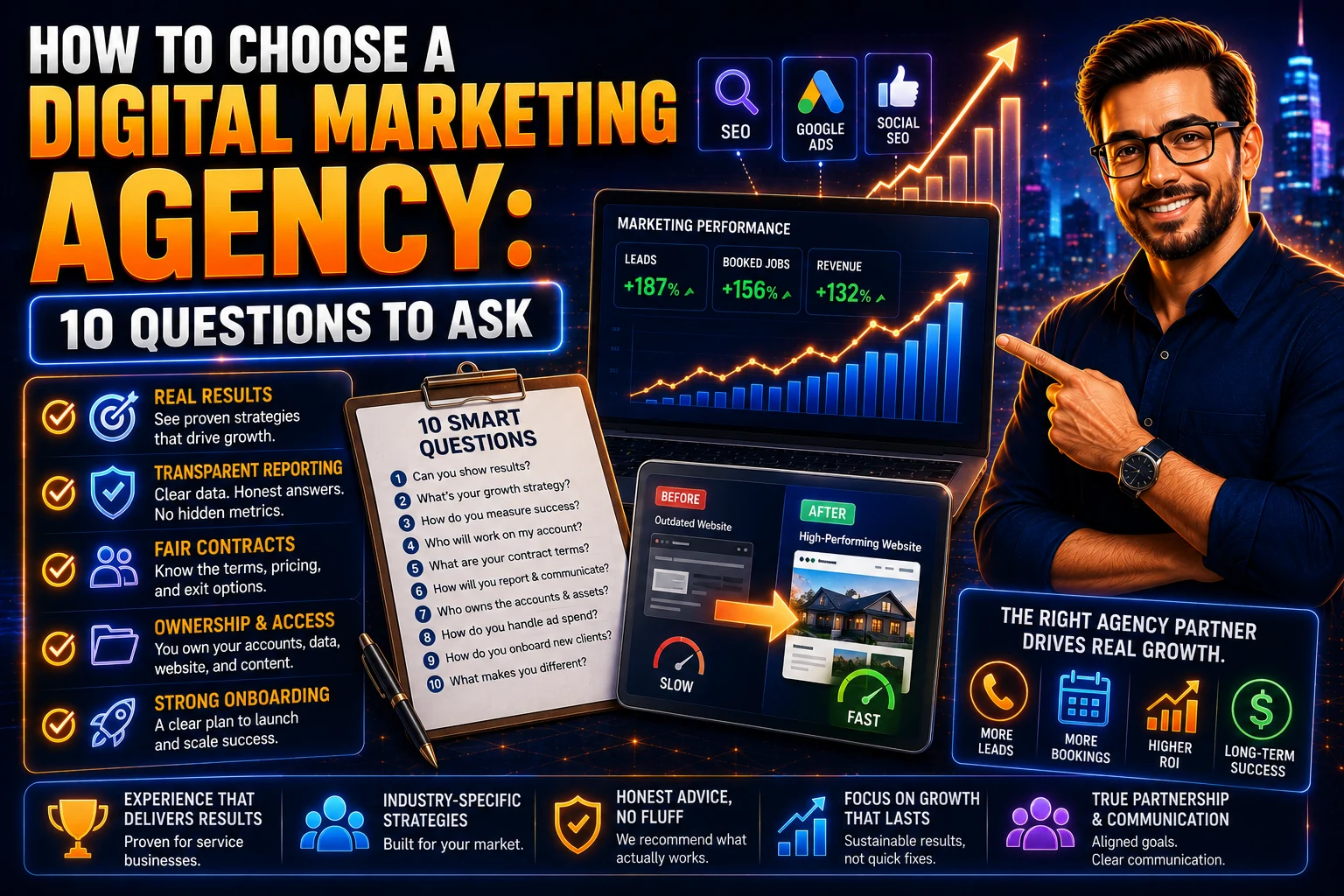
How to Choose a Digital Marketing Agency: 10 Questions to Ask
Choosing a digital marketing agency is one of the higher-stakes business decisions a service-business owner makes. A great agency partner produces real growth — exclusive leads at favorable economics, a marketing system that compounds over time, a team that actually understands the business. A poor agency partner burns through budget for months while producing little, locks you into contracts that don't deliver, and sets your marketing back by the time it takes to recognize the relationship isn't working. The cost of choosing badly isn't just the wasted spend; it's the months of lost growth and the rebuilding required after the bad agency is finally fired.
Published: July 7, 2026 | Reading Time: ~9 minutes | Category: Strategy
The problem is that most agency sales conversations are designed to sell the agency, not to help you evaluate it accurately. You'll see polished case studies, hear confident promises about results, and meet smooth account executives who say all the right things. None of that tells you whether the agency will actually deliver for your business specifically. The agencies that produce real results and the agencies that look great but underperform are nearly indistinguishable in the typical pitch — until you ask the questions that reveal the difference.
This guide is 10 questions to ask any agency you're considering, with what each question reveals and what to listen for in the answer. The right questions don't trip up good agencies — they actually help good agencies demonstrate why they're worth hiring. They do trip up agencies that aren't a fit, because the answers to honest questions are hard to fake. Bring these questions to every agency conversation, and you'll separate the agencies that can genuinely produce results from the agencies that just sell well.
What You'll Learn
- 10 specific questions to ask any digital marketing agency you're considering
- What each question actually reveals about the agency
- What to listen for in the answers — and what should make you walk away
- How to evaluate the answers across the agencies you're comparing
- The questions that good agencies welcome and weak agencies struggle with
1. Can You Show Me Real Results From Businesses Like Mine?
Generic case studies don't tell you what an agency can do for your business. What you want to see is results from businesses similar to yours — same industry, similar size, comparable challenges. A roofer should see roofing results; a dental practice should see dental results; a $5M home services business should see results from businesses of similar scale, not a $50M e-commerce case study.
What to listen for: specific metrics tied to business outcomes (booked jobs, revenue, qualified leads — not just clicks or impressions), realistic numbers presented honestly, and an honest discussion of what worked and what didn't. Beware: cherry-picked best-case results presented without context, vague claims of 'increased traffic,' or an inability to produce results from businesses similar to yours.
2. Who Will Actually Do the Work, and What's Their Experience?
Many agencies have a senior team that sells the contract and a junior team that executes it. The pitch impresses you with the principal's experience; the daily work is then done by junior staff or outsourced overseas. You want to know who specifically will be working on your account, what their experience is, and how much time they'll spend on your business.
What to listen for: clear names and backgrounds of the people who'll do the work, transparency about the agency's structure (in-house vs outsourced), and honest answers about how much senior attention you'll get vs how much is delegated. Beware: vague 'a team of specialists,' refusal to name the people doing the work, or a clear disconnect between who you're talking to in sales and who you'll actually work with.
THE SALES-VS-EXECUTION GAP: One of the most common patterns in bad agency relationships is the gap between who sells the contract and who executes it. The senior partner you're impressed with in the pitch isn't who's doing the work on your account — and the work is being done by someone with less experience, less domain knowledge, or simply less attention. The way to surface this gap is to ask directly who will do the work and to ask to meet them before signing. Agencies that produce real results are happy to introduce you to your actual team; agencies that rely on a sales-execution disconnect resist this and explain it away. The willingness to introduce the actual team is a strong signal.
3. How Do You Measure and Report on What Matters?
The reports you get from your agency reveal what they think matters. An agency that reports on impressions, clicks, and rankings is measuring vanity metrics; an agency that reports on qualified leads, booked jobs, cost per booked job, and contribution to revenue is measuring what actually matters to your business. The reporting tells you whether the agency is optimizing for outcomes you care about or for metrics that look good in slide decks.
What to listen for: focus on business outcomes (leads, booked jobs, revenue, ROI) rather than vanity metrics, integration with your CRM and call tracking, clear attribution methodology, and honest reporting on what's not working in addition to what is. Beware: heavy emphasis on impressions, clicks, or rankings without connection to business outcomes; no plan for tracking actual booked jobs and revenue; reports that always show wins and never show problems.
4. What's the Contract Structure, and What Happens If It's Not Working?
Contract structure tells you whether the agency is confident in their work. Agencies confident in producing results offer reasonable terms — month-to-month or short initial commitments with cancellation provisions if the work isn't producing. Agencies that lock you into long contracts with steep cancellation penalties are protecting themselves from the consequences of underperformance — which tells you they expect to underperform.
What to listen for: flexible terms (month-to-month or short initial commitment), clear out-clauses if performance targets aren't met, and a willingness to be evaluated on results. Beware: 12+ month contracts with steep cancellation penalties, vague performance commitments, or pressure to sign immediately without time to think it through. The pressure tactics tell you the agency knows results won't sell the renewal.
5. What Does Communication Look Like — Cadence, Format, Point of Contact?
Communication patterns reveal how the relationship will actually work. You want to know how often you'll meet, what reporting you'll receive, who your point of contact is, how fast they respond to questions, and how proactive they are in raising issues. Good agencies have established communication rhythms; weak agencies improvise and inevitably underperform on responsiveness.
What to listen for: established meeting cadence (monthly or biweekly check-ins typical), a clear primary point of contact, response time expectations, and proactive communication when something needs attention. Beware: 'we'll figure that out as we go,' no clear point of contact, evasiveness about response times, or a pattern of slow responses in your sales conversations (which previews what client communication will be like).
PRO TIP: Your sales experience is your most reliable preview of the client experience. The agency that's slow to respond in sales will be slow to respond as a client. The agency that's vague about deliverables in sales will be vague about deliverables in execution. The agency that lets things slip in the pitch process will let things slip in your account work. The patterns you see in sales are nearly always the patterns you'll see in the relationship — pay attention to them and trust what they tell you. Good agencies are responsive, clear, and proactive in sales, and that's exactly how they show up as a client.
6. What's Your Approach to My Specific Industry or Vertical?
Generic agencies use the same playbook for every client. Industry-specialized agencies (or generalists with deep experience in your vertical) understand the dynamics specific to your industry — the channels that work, the regulations that apply, the customer behavior that's distinctive, the competitive dynamics. For service businesses especially, vertical understanding makes a major difference in results.
What to listen for: demonstrable understanding of your industry's dynamics (channels, customer behavior, competitive landscape, regulations where applicable), case studies in your vertical, and substantive insights about your business specifically rather than generic marketing principles. Beware: a one-size-fits-all approach, no examples in your industry, or generic answers that could apply to any business.
7. How Do You Handle the Channels I Actually Need?
Some agencies specialize in one or two channels (SEO only, or paid only, or social only) and try to fit every client into what they do. Others handle multiple channels with genuine integration. For most service businesses, growth requires coordinated work across multiple channels (SEO, paid search, LSAs, social, content, web, often more), and the agency needs to handle them in an integrated way rather than as disconnected silos.
What to listen for: integrated multi-channel capability where you need it, with substantive depth in each channel rather than surface-level offerings, and a strategic view of how the channels work together. Beware: depth in one channel and weakness in others you need, channels handled as disconnected siloed services, or strategy that doesn't coordinate across channels.
8. Who Owns the Accounts, Content, and Data?
This is one of the most overlooked but most consequential questions. Some agencies set up campaigns under their own accounts, host websites on their platforms, and create content that doesn't transfer if the relationship ends — effectively holding your marketing hostage. When the relationship ends, you lose the campaigns, the content, the website, and the data. Other agencies operate on your accounts with proper access — leaving you in full ownership of everything if the relationship changes.
What to listen for: explicit confirmation that accounts (Google Ads, Meta Ads, GBP, analytics, etc.) are in your ownership with the agency given access; content and websites owned by you; data and historical reporting accessible to you; smooth transition provisions if the relationship ends. Beware: campaigns on the agency's accounts, websites on agency-controlled platforms with no clear path to transfer, content that doesn't transfer to you, or unclear ownership of historical data and reporting.
9. What's the Realistic Timeline for Results in My Category?
Different channels and categories have different realistic timelines. Paid search can produce leads in days; SEO and Map Pack ranking compound over 6-12 months; brand awareness builds over even longer periods. An agency that promises fast SEO results is either lying or planning to use tactics that won't last. An agency that's clear about realistic timelines — what to expect in 30 days, 90 days, 6 months, 12 months — is being honest and setting up the relationship for sustained success.
What to listen for: clear, realistic timelines that account for the different speeds of different channels, honest milestones with what you should expect to see at each, and a plan for early wins (where possible) while the longer-term work compounds. Beware: promises of fast results in slow channels, vague 'we'll see' timelines, or pressure to expect results faster than the category realistically allows.
10. What Happens During Onboarding and Ramp-Up?
Onboarding is where many agency relationships go wrong. A clear onboarding process — gathering the necessary information, setting up tracking and access, agreeing on strategy and priorities, establishing communication patterns — sets the relationship up for success. A vague or rushed onboarding signals an agency that will struggle to deliver because they didn't set the foundation correctly.
What to listen for: a defined onboarding process with timeline, the specific information and access they need from you, the strategic and operational decisions to be made up front, and what you should expect during the first 30 days. Beware: 'we'll figure it out as we go,' jumping straight to execution without strategic setup, or unclear expectations about what you need to provide.
Putting the Answers Together
Take notes during each agency conversation, comparing their answers across the questions side by side. Patterns emerge quickly — the agencies that produce real results give substantive, honest answers that often include acknowledgment of what's difficult or doesn't always work; the agencies that don't produce results give vague, defensive, or boilerplate answers that sound good but don't actually address the question.
Pay particular attention to the questions agencies struggle with — those are the areas they're weakest in. An agency that gives strong answers on results and reporting but is evasive about who does the work and contract terms is probably weak in execution and protective of long contracts. An agency that's clear on strategy and integration but vague on metrics and timelines is probably better at planning than at delivering measurable results. The pattern of strengths and weaknesses tells you what to expect.
The Bottom Line
Choosing the right digital marketing agency is one of the higher-stakes business decisions a service-business owner makes — and the typical agency sales conversation isn't designed to help you evaluate accurately. Asking the right questions is what separates the agencies that will produce real results from the agencies that just sell well. The 10 questions above — real results from businesses like yours, who actually does the work, how you measure and report, contract structure, communication, industry approach, channel integration, account and content ownership, realistic timelines, and onboarding — surface the substance behind the pitch.
Good agencies welcome these questions because the answers are how they demonstrate why they're worth hiring. Bad agencies struggle with them because the answers expose what the pitch is hiding. Ask them every time, listen carefully to the answers, and trust the patterns. The agency that gives substantive, honest, specific answers is the agency you want to work with. The agency that gives vague, defensive, or boilerplate answers is the one you'll regret hiring later. Your marketing — and the months of growth you can't afford to waste — depends on getting this choice right.
Key Takeaways
- Choosing an agency is high-stakes — a good one produces real growth, a bad one burns budget while setting your marketing back. The typical sales conversation isn't designed to help you evaluate accurately; asking the right questions is what separates the substance from the pitch
- The 10 questions: (1) Show me results from businesses like mine, (2) Who actually does the work, (3) How do you measure what matters, (4) Contract structure and out-clauses, (5) Communication cadence and contact, (6) Approach to my industry, (7) How you handle the channels I need, (8) Account/content/data ownership, (9) Realistic timeline for my category, (10) Onboarding and ramp-up
- The sales-vs-execution gap is one of the most common patterns in bad agency relationships — the senior team sells, the junior team executes. Ask to meet the people who'll actually do your work and to know their experience
- Reports reveal what an agency thinks matters — focus on business outcomes (leads, booked jobs, revenue) over vanity metrics (impressions, clicks, rankings). Watch for honest reporting of what's not working in addition to what is
- Contract structure signals confidence — flexible terms with out-clauses signal confidence in delivering results; long contracts with steep cancellation penalties protect agencies from underperformance consequences
- Account and content ownership is often overlooked but consequential — campaigns, websites, content, and data should be in your ownership with the agency given access, not controlled by the agency in ways that hold your marketing hostage
- Your sales experience is the most reliable preview of the client experience — slow, vague, or evasive in sales = slow, vague, or evasive in execution. Trust the patterns you see in the pitch process
READY TO BUILD A LEAD PIPELINE THAT'S YOURS? Astra Results Marketing welcomes every one of these questions from prospects evaluating us. Ask us about specific results from businesses like yours, who'd actually do your work and their experience, how we report on business outcomes (not vanity metrics), our contract terms and out-clauses, account and content ownership, realistic timelines, and onboarding. The questions that surface substance are the questions that good agencies want clients to ask. Bring them to your conversation with us. Astra Results Marketing · astraresults.com · (+1) 786-643-3036