Rated 5 star on

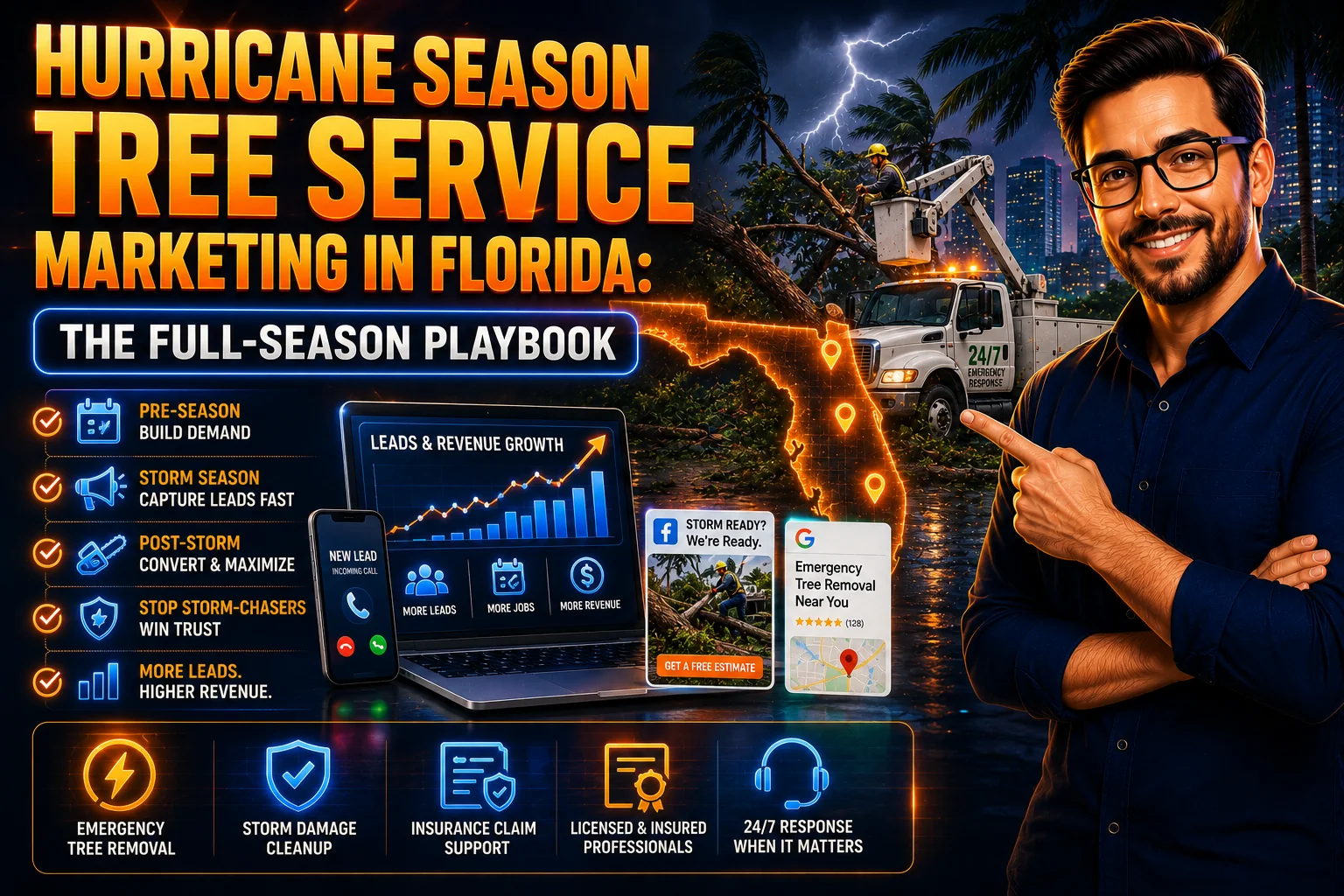
Hurricane Season Tree Service Marketing in Florida: The Full-Season Playbook
Florida hurricane season runs from June 1 through November 30 — six months where every tree-service operation in the state needs to be ready for substantial demand spikes that can come with little warning. The operations that capture meaningful hurricane-season revenue don't react when storms hit; they prepare deliberately during the months leading up to and through the season, with marketing, operations, and capacity infrastructure built before the demand arrives. The operations that scramble after storms hit watch competitors who prepared capture the high-value work first.
Published: July 14, 2026 | Reading Time: ~10 minutes | Category: Tree Service — Hurricane Season FL
Hurricane-season marketing for Florida tree-service operations involves three distinct phases with different objectives. Pre-season (roughly March through May) focuses on preparation marketing — getting homeowners and commercial customers to assess and address tree risks before the season begins. Active season (June through November) involves always-ready storm response capability, with marketing infrastructure built to activate immediately when forecasts and damage reports start coming in. Post-storm windows (the hours and days after specific events) require rapid-deploy marketing in affected zip codes plus operational capacity to handle surge demand. Each phase has its own marketing approach, customer messaging, and operational requirements.
This guide covers the full-season hurricane playbook for Florida tree-service operations: the pre-season preparation marketing that produces meaningful revenue while building the customer base that converts during storm events; the active-season infrastructure that sits ready to activate; the post-storm rapid-deploy capabilities that capture the first-4-hour emergency window; the operational and capacity considerations that make any of the marketing valuable; the messaging approaches that work for different customer segments throughout the season; and how ArborCentric Solutions runs this full-season approach across South Florida. Whether you're entering hurricane season prepared or scrambling to build capability before the next major event, this is the practical playbook.
What You'll Learn
- The three-phase hurricane-season approach: pre-season preparation, active-season readiness, post-storm rapid deploy
- Pre-season marketing that produces revenue while building the customer base for storm events
- Active-season always-on infrastructure that activates when events occur
- Post-storm rapid-deploy capabilities for the first-4-hour emergency window
- Operational and capacity considerations that make the marketing valuable
- Messaging approaches that work for different customer segments throughout the season
- How ArborCentric Solutions runs full-season hurricane marketing across South Florida
The Three Phases of Hurricane-Season Marketing
Effective hurricane-season marketing isn't a single strategy applied across six months. It's three distinct phases with different objectives, customer messaging, and operational requirements. Operations that recognize the phases and execute each one deliberately produce substantially better full-season results than operations running undifferentiated 'storm marketing' year-round.
WHY REACTIVE STORM MARKETING FAILS: Operations that wait to do hurricane-season marketing until storms are forecasted or hitting consistently underperform operations that prepare. The reasons: pre-built rapid-deploy paid search campaigns can't be assembled in the hours after a storm hits when affected homeowners are already calling. Intake capacity expansion (additional staff, AI receptionist deployment) needs to be operational before the surge. Field operations (crew positioning, equipment readiness) require advance planning. Customer database building, review velocity, and credentialed positioning compound over months — not in the days after a storm. The operations winning the storm window built the infrastructure before the season started; the operations losing the window are still trying to build infrastructure while the demand is happening around them.
Phase 1 — Pre-Season Preparation (March through May)
The pre-season window — roughly March through May — produces both meaningful revenue from preparation work and the customer base, review velocity, and operational readiness that pays off during the active season. The marketing focus during this window targets homeowners and commercial customers thinking about hurricane preparation.
Pre-Season Marketing Messages That Work
- 'Get your trees assessed before hurricane season': targets risk-aware homeowners who know they should address tree concerns before the season but haven't yet. Direct, practical messaging with a clear next step (free assessment, scheduled consultation).
- 'Selective thinning reduces wind resistance': educational content explaining how proper pruning before the season can reduce damage risk during storms. Demonstrates expertise and creates demand for preparation work.
- 'Identify the tree that could fall on your house': triggers the latent concern most homeowners have about specific trees on their property. Converts to assessment requests at favorable rates.
- 'HOAs and property managers: prepare your properties': commercial messaging targeting the multi-property decision-makers who plan ahead and contract preparation work as a routine part of season prep.
Pre-Season Marketing Channels
- Targeted paid search on hurricane-preparation keywords with seasonal copy and offers.
- Direct mail to mature-tree neighborhoods with preparation messaging.
- Email marketing to existing customer database with preparation reminders and offers.
- Social media content covering preparation considerations, building awareness while season approaches.
- Content marketing: blog posts, FAQ updates, and educational content addressing the preparation decisions homeowners face.
- Direct commercial outreach to HOAs and property managers ahead of their contract-renewal cycles.
Pre-Season Revenue Opportunities
Preparation work — selective thinning to reduce wind resistance, removal of compromised or damaged trees, deadwooding, and structural pruning of young trees — represents real revenue opportunity rather than just lead generation for the active season. Operations that effectively market preparation work see substantial revenue contribution from March through May, with the additional benefit that completed preparation jobs produce reviews, build customer relationships, and create the database for active-season retargeting.
Phase 2 — Active-Season Readiness (June through November)
Through the active season, marketing infrastructure sits ready to activate immediately when events occur. The baseline marketing continues — sustaining Map Pack and LSA presence, ongoing SEO, regular paid search — while the rapid-deploy components remain primed for storm activation.
Always-On Infrastructure That Must Be Ready
- Google Business Profile current and complete, with hurricane-response capability indicated in the services list and descriptions.
- LSA account active with sustained response rate and review velocity that ranks well in the always-on baseline plus during storm-driven LSA spikes.
- Map Pack rankings sustained through ongoing local SEO, citation maintenance, and review generation.
- Website ready for surge traffic — fast loading, mobile-optimized, prominent emergency contact paths, clear 24/7 messaging.
- Intake systems tested for surge capacity — primary call routing, AI receptionist backup, message and form-submission monitoring.
Pre-Built Rapid-Deploy Components
- Paid search campaigns built and ready to activate, targeting storm-specific keywords ('tree on house,' 'emergency tree removal,' 'hurricane damage') with zip-code-level geographic targeting that can be activated for specific affected areas within hours.
- Direct mail piece designs and lists prepared for rapid deployment to affected areas after major events.
- Social and email content templates ready for activation during and immediately after storms.
- Press and PR materials prepared for media inquiries that often follow major storms (local stations covering recovery).
Weather Monitoring Tied to Marketing Triggers
Operations capturing the storm window effectively tie their marketing activation to actual weather data — National Hurricane Center advisories, NWS warnings, forecast tracks, and damage reports. As forecasts develop, geographic targeting refines from broad regional ('areas that might be affected') to specific zip codes ('areas where damage occurred'). The marketing activation isn't generic 'storm in Florida' messaging; it's geographic precision matching the actual demand pattern.
PRO TIP: Florida hurricane season produces multiple opportunities for capture, not just a single major event. Tropical storms, severe thunderstorms, and minor hurricanes that don't make national news still produce localized demand spikes worth capturing. Operations that monitor weather actively throughout the season and activate marketing for smaller events as well as the major ones capture demand other operations miss — the tropical storm hitting a county with localized damage produces meaningful work for tree-service operations that activate rapidly. The infrastructure doesn't have to wait for category 4 hurricanes to pay back.
Phase 3 — Post-Storm Rapid Deploy
The hours and days immediately following a specific storm event are where the rapid-deploy infrastructure produces its highest-value capture. The first-wave demand decides itself within 4-6 hours; operations that activate within that window capture disproportionate value compared to operations responding more slowly.
First Few Hours After the Event
- Paid search campaigns activated for affected zip codes with elevated bids and storm-specific messaging.
- Intake capacity at peak — human staff plus AI receptionist ensuring every incoming call gets handled.
- Field crews positioning toward affected areas as the damage pattern becomes clear.
- Real-time monitoring of incoming volume and routing decisions about geographic focus.
First Days After the Event
- Direct mail deployment to affected areas with storm-recovery messaging.
- Targeted social content covering the response and recovery work.
- PR engagement with local media covering recovery efforts.
- Active management of LSA accounts as lead volume and pricing dynamics shift.
- Field operations scaling to demand with crew scheduling and equipment positioning.
First Weeks After the Event
- Sustained marketing presence as recovery work continues — the demand from significant events extends for weeks, not just the first days.
- Systematic review generation from completed storm jobs as the work is finished.
- Customer database building from new contacts acquired during the event.
- Documentation of work for case studies, social content, and future marketing collateral.
Capacity and Operational Considerations
Marketing infrastructure that produces calls only works if operational capacity converts those calls into completed work. Hurricane season exposes operations whose marketing reach exceeds their operational capability.
- Crew capacity that can scale during storm windows — whether through standing crew expansion, subcontractor relationships, or partnership arrangements with adjacent operations.
- Equipment availability that supports surge volume — chippers, dump trucks, climbing equipment, and the consumables (chainsaw chains, fuel, safety gear) that storm work consumes at elevated rates.
- Communication systems that handle the surge — both customer-facing (intake, scheduling, status updates) and internal (crew dispatch, job tracking, field reporting).
- Safety protocols specific to storm work — compromised trees behave differently than healthy trees, post-storm sites have unique hazards, and crews working extended hours under stressful conditions need clear safety discipline.
- Insurance and credentialing current and verifiable — storm work attracts both legitimate insurance claims and scrutiny, and operations with all credentials current handle the resulting documentation more efficiently.
- Cash flow management for the surge — storm work often involves customer payments delayed by insurance processes, while the operation's costs (labor, fuel, equipment) hit immediately.
Messaging by Customer Segment
Residential Homeowners
Direct, practical messaging emphasizing fast response, credentialed work, insurance coordination, and the specific damage scenarios the homeowner may be facing. Avoid marketing-speak; emergency searchers want clear information about how fast you can respond and what to expect.
HOAs and Property Managers
Reliability emphasis — multi-property capability, documented response protocols, insurance coordination, and the substantive credentialing these professional buyers evaluate. Pre-existing relationships built during pre-season convert dramatically faster than cold contacts during the response window.
Commercial Property Owners
Business-continuity messaging — emphasis on rapid restoration of access, professional documentation for insurance and stakeholder reporting, and the operational capacity to handle commercial-scale damage. Pre-existing commercial relationships from off-season work activate first.
Insurance Companies and Adjusters
Operations that build relationships with insurance adjusters and claims-management firms capture the work that routes through insurance processes — often the substantial residential and commercial damage that requires professional remediation documented for claims. The relationship-building happens off-season; the work flows during and after events.
Capacity Building Across Multiple Seasons
Hurricane-season capability is built across multiple seasons, with each year's experience informing the next year's improvements. Operations entering their first serious hurricane season typically capture less of the available demand than they could, learn from the gaps and missed opportunities, and use that learning to perform substantially better in subsequent years. The compounding effect across seasons is one of the most important dynamics in Florida tree-service economics.
- First-season operations: build basic infrastructure, capture what they can during events, document what worked and what didn't, accumulate the customer base and reviews that strengthen future seasons.
- Second-season operations: refine the components that underperformed, expand the components that produced results, deepen the relationships with insurance adjusters and adjacent service providers, scale field capacity based on actual storm-window demand patterns.
- Third-and-beyond season operations: substantial accumulated customer base, refined operational processes, established adjacent relationships, and the brand recognition that produces inbound customer flow without requiring as much active marketing during events.
The Community Dimension
Florida tree-service operations serving their markets through multiple hurricane seasons build a community dimension that goes beyond commercial transactions. The operations that show up consistently — responding when called, performing work to standards, supporting recovery in their communities, contributing to neighborhood resilience — build the reputation that becomes substantial competitive advantage over time. The reputation isn't built through marketing; it's built through the work itself, accumulated across years of consistent professional response. Storm windows test the operation; the operations that perform well year after year become the operations communities trust.
- Visible community presence — local establishment, community involvement, recognition as part of the South Florida tree-service community.
- Consistent professional response — showing up reliably when called, performing work to standards, completing what was promised.
- Support for community recovery — operations capable of contributing to broader recovery efforts beyond individual property work build the kind of community standing that pure-commercial operations don't.
- Multi-generational customer relationships — Florida tree-service operations that have served properties through multiple storms, multiple ownership transitions, and multiple seasons of work build the kind of trust new operations can't match.
How ArborCentric Runs This Across South Florida
ArborCentric Solutions runs the full-season hurricane playbook across South Florida service areas, with the components — pre-season preparation marketing that produces substantial March-through-May revenue while building the customer base, active-season always-on infrastructure (LSAs, Map Pack, GBP, website) sustained at full readiness, pre-built rapid-deploy paid search and direct mail components ready to activate within hours of events, weather monitoring tied to marketing-activation triggers, intake systems combining human capacity with AI receptionist overflow ensuring no call goes unanswered during surges, field operations that scale through both standing capacity and established partnership arrangements, systematic post-storm review generation, customer database building, and the operational discipline that converts the marketing reach into completed work — running as an integrated system across each season.
The cumulative outcome: ArborCentric consistently captures meaningful storm-window work across South Florida during each hurricane season, generates substantial pre-season preparation revenue that funds the readiness investment, builds customer database and review velocity through each season that strengthens performance the following year, and operates with the credentialed positioning and operational capability that distinguishes professional storm response from reactive scrambling. The full-season approach produces revenue and customer-base building that's not available to operations running only reactive storm marketing — and the compounding effects across seasons make each successive year easier to execute than the last.
The Bottom Line
Florida hurricane season is six months — June through November — during which every tree-service operation in the state needs marketing, operations, and capacity infrastructure ready for events that can come with little warning. The operations that capture meaningful season revenue run a three-phase approach: pre-season preparation marketing that produces revenue while building customer base and operational readiness; active-season always-on infrastructure sustained at full readiness throughout the season; and post-storm rapid-deploy capabilities for the first-4-hour emergency window plus sustained presence through the weeks of recovery work each event produces. The phases require different marketing approaches, messaging, and operational requirements — and operations that don't differentiate the phases underperform operations that do.
ArborCentric Solutions runs this full-season approach across South Florida and the cumulative outcome substantially outperforms what reactive storm marketing produces. The build is real work — pre-built rapid-deploy components, weather monitoring tied to triggers, intake capacity for surges including AI receptionist overflow, field operations that scale, systematic review and customer-database systems — but the infrastructure built once continues paying back across multiple seasons, with each year's experience improving the next year's execution. For Florida tree-service operators serious about hurricane-season performance, the playbook is concrete and the opportunity is real. The infrastructure that wins is built before the season starts; the operations scrambling during events were already too late.
Key Takeaways
- Florida hurricane season runs June 1 through November 30 — six months requiring marketing, operations, and capacity infrastructure ready for events that can come with little warning
- Three-phase approach: pre-season preparation (March-May) producing revenue while building customer base, active-season readiness (June-November) with always-on infrastructure sustained at full readiness, and post-storm rapid deploy capturing the first-4-hour window plus weeks of recovery work
- Pre-season preparation marketing targets homeowners and commercial customers thinking about tree risk before season — 'get assessed before season,' 'selective thinning reduces wind resistance,' 'identify the tree that could fall on your house,' commercial HOA/property manager outreach
- Active-season always-on infrastructure: GBP complete, LSAs maintained with response rate and review velocity, Map Pack rankings sustained, surge-ready website, tested intake systems with AI receptionist backup
- Pre-built rapid-deploy components: paid search campaigns ready to activate with zip-code targeting, direct mail piece designs and lists prepared, social/email content templates ready, PR materials prepared, all tied to weather-monitoring triggers
- Post-storm rapid deploy in three time horizons: first hours (paid search activation, intake at peak, field positioning), first days (direct mail deployment, social/PR engagement, LSA management, operations scaling), first weeks (sustained presence, review generation, customer database building)
- Operational capacity must match marketing reach — crew capacity scaling, equipment availability, communication systems, safety protocols, current credentialing, cash-flow management for surge
- Messaging differs by segment: homeowners (fast response, credentialed work, insurance coordination), HOAs/property managers (reliability, multi-property, pre-existing relationships), commercial (business continuity), insurance adjusters (relationship-driven work routing)
- ArborCentric Solutions runs full-season approach across South Florida — substantial pre-season preparation revenue, sustained active-season readiness, rapid-deploy post-storm capture, and compounding effects across seasons producing performance improvements year over year
READY TO BUILD A LEAD PIPELINE THAT'S YOURS? Astra Results Marketing builds hurricane-season marketing systems for Florida tree-service operations — the full-season three-phase approach with pre-season preparation marketing, active-season readiness infrastructure, post-storm rapid-deploy capabilities, weather monitoring tied to marketing triggers, intake systems including AI receptionist overflow, and the integrated approach that produces meaningful season revenue rather than reactive scrambling. We built this with ArborCentric Solutions across South Florida and the season-over-season results compound substantially. Stop scrambling when storms hit. Build the infrastructure that wins the season. Astra Results Marketing · astraresults.com · (+1) 786-643-3036