Rated 5 star on

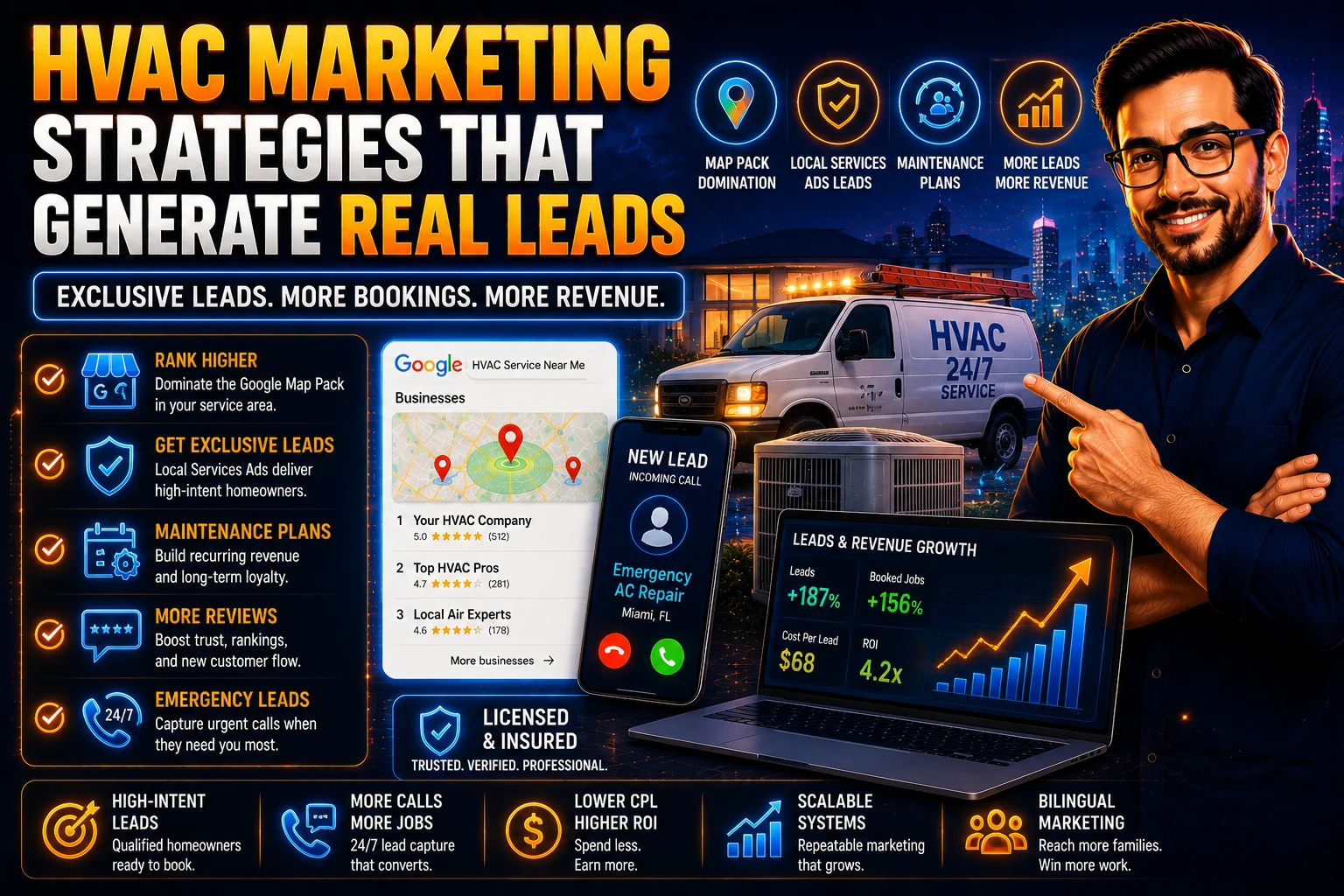
HVAC Marketing Strategies That Generate Real Leads
HVAC contractors live or die by lead flow. The work itself is largely standardized — most contractors can install systems, fix problems, and provide service competently — so the businesses that grow aren't necessarily the ones with the best technicians; they're the ones with the best lead flow. And in 2026, lead flow comes from marketing systems specifically calibrated to how HVAC customers actually search, decide, and buy. The contractors who run generic marketing playbooks or depend on shared aggregator leads watch their margins compress and their growth stall. The contractors who build HVAC-specific marketing systems generate exclusive, high-quality leads at favorable economics and scale steadily.
Published: July 1, 2026 | Reading Time: ~8 minutes | Category: Vertical: HVAC
HVAC marketing is distinct enough from generic local-business marketing that the differences matter. Demand is emergency-driven (a system fails, the customer needs help now). It's seasonal (cooling peaks in summer, heating in winter). Service volume is high (every call is a lead-generation, review-generation, and relationship-building opportunity). And the maintenance plan — the recurring-revenue offering at the heart of HVAC — is the strategic asset that smooths the seasonal swings and produces the customer base that drives referrals, replacements, and long-term value. Strategies that account for these dynamics generate real leads; strategies that don't underperform consistently.
This guide covers the HVAC marketing strategies that actually generate leads in 2026: the channels that capture emergency-driven demand, the maintenance plan as the strategic engine, exploiting HVAC's service volume for reviews and referrals, hyper-local and bilingual market capture, and how the strategies integrate. Whether you're a $1M operation looking to grow or a $5M+ contractor looking to optimize, this is the practical guide to HVAC marketing that produces real leads.
What You'll Learn
- The channels that capture emergency-driven HVAC demand — Map Pack, LSAs, and emergency-optimized search
- The maintenance plan as the strategic center of HVAC marketing — recurring revenue, demand smoothing, and the customer base that drives everything else
- Exploiting HVAC's service-volume advantage for reviews, referrals, and reactivation
- Hyper-local and bilingual market capture in competitive HVAC markets
- Why aggregators compress margins for HVAC and how exclusive-lead channels solve it
- How the strategies integrate into a system that produces compounding leads
The HVAC Dynamics That Shape Strategy
Effective HVAC marketing strategy starts with the dynamics that make HVAC distinct. Four dynamics shape the entire approach.
- Emergency-driven demand: a meaningful share of HVAC demand is emergency-driven — a system fails, and the customer needs help today. The strategy must capture that emergency search, often at the moment of acute need.
- Seasonal swings: cooling peaks in summer (extreme in Florida and other warm-climate markets), heating in winter, with shoulder seasons of maintenance and replacement. The strategy must capture peak demand and smooth the swings.
- High service volume: HVAC produces high service volume across the year — repairs, maintenance, installations, emergency calls. Every interaction is a touchpoint for reviews, referrals, maintenance plan conversion, and relationship-building. The strategy must exploit the service volume.
- Aggregator margin compression: lead aggregators (HomeAdvisor, Angi, and similar) charge per shared lead sold to multiple competitors, compressing margins and producing the dependency that traps many HVAC contractors. The strategy must build exclusive-lead channels to escape this.
WHY GENERIC PLAYBOOKS UNDERPERFORM IN HVAC: Generic local-business marketing playbooks miss the dynamics that define HVAC. They don't optimize specifically for emergency-search capture, they don't position the maintenance plan as the strategic center, they don't exploit the high service volume for compounding reviews and referrals, and they don't escape aggregator margin compression. The contractors who run them get generic results — moderate lead flow at compressed margins, dependent on aggregators. The contractors who build HVAC-specific strategies calibrated to the actual dynamics generate exclusive leads, build the maintenance plan base that smooths and compounds, and grow steadily at favorable economics. The difference between the two outcomes is the calibration.
The Channels That Capture Emergency-Driven Demand
Emergency-driven demand is captured at the top of local search results, where the panicked customer searching 'AC repair near me' chooses fast. Three channels dominate this capture.
Google Map Pack
The Map Pack — the three local businesses shown at the top of local searches — captures a large share of emergency-search clicks. For HVAC, Map Pack ranking is the highest-leverage local SEO outcome. Ranking is driven by relevance (Google Business Profile optimization with HVAC categories and complete information), distance (proximity to the searcher — which weighs heavily for emergency intent), and prominence (reviews — the most controllable factor and HVAC's structural advantage given the service volume). A top-3 Map Pack position produces exclusive emergency leads at a fraction of aggregator cost.
Google Local Services Ads
LSAs sit at position zero — above the Map Pack and organic results — with the Google Guaranteed badge. They charge per exclusive lead rather than per click, ranking on reviews, response rate, bid, and proximity. For HVAC, LSAs combine with the Map Pack to occupy the top of local search results, capturing the emergency search before customers scroll. LSAs and the Map Pack share the GBP and review foundation, so building the foundation reinforces both channels at once.
Emergency-Optimized Search and Website
Beyond the Map Pack and LSAs, the website that emergency searchers reach must convert them — fast mobile load (emergency searchers don't wait for slow pages), prominent tap-to-call (the emergency searcher wants to call now), clear 24/7 and same-day messaging, and emergency-keyword content that captures the long-tail emergency queries. The emergency-conversion infrastructure ensures the searches you capture become booked jobs rather than bounces.
The Maintenance Plan as the Strategic Engine
If emergency capture is how new HVAC customers enter the business, the maintenance plan is how they become long-term value. It's the strategic asset at the center of HVAC marketing — the recurring-revenue engine that smooths seasonal demand, funds growth, and produces the customer base that drives referrals, replacements, and lifetime value far exceeding the one-time service transaction.
Why It's the Strategic Center
The maintenance plan transforms an HVAC contractor from a transactional emergency-response business into a relationship-based recurring-revenue business. Plan members produce recurring revenue (predictable monthly or annual fees), priority for replacements (members replace their systems with their plan contractor — high-value replacement revenue), referrals (satisfied plan members refer at high rates), and the demand-smoothing that stabilizes the business through seasonal swings. A base of plan members compounds over time into a substantial recurring-revenue stream and customer relationship asset.
Building the Maintenance Plan Base
- Convert across every service interaction: every service call, installation, and emergency response is a maintenance plan conversion opportunity. The technician and follow-up process should present the plan systematically, not occasionally.
- Reactivation campaigns: re-engage past customers from your database to convert them into plan members, exploiting HVAC's accumulated customer base.
- Plan structure that converts: clear value (priority service, maintenance visits, repair discounts, no-overtime-charges), straightforward pricing (monthly or annual), and easy enrollment.
- Technician incentives: incentivize technicians to present and convert the plan at every interaction — they're at the moment of highest customer satisfaction and the most natural conversion opportunity.
- Marketing positions the plan: campaigns featuring the plan's value (priority response when storms hit, system longevity, predictable maintenance) build awareness and drive enrollment.
Exploiting HVAC's Service-Volume Advantage
HVAC's high service volume is a structural advantage that contractors should exploit systematically — every service interaction generates compounding marketing value when the systems are in place.
- Systematic review generation: automated review requests after every service call, maintenance visit, and installation produce the sustained monthly velocity that drives Map Pack and LSA prominence in competitive markets. HVAC's service volume provides more review opportunities than any project-based trade.
- Referral generation: satisfied service customers refer at high rates when the request is systematic. Post-service referral requests, referral incentives, and maintenance-plan-member referral programs convert the service volume into a steady referral stream.
- Reactivation: every past customer is a future maintenance plan member, replacement customer, or service call. Reactivation campaigns to the accumulated customer database produce exclusive leads at near-zero cost.
- Reviews compound into LSA and Map Pack ranking: the reviews generated from service volume drive both LSA ranking and Map Pack prominence, which generate more emergency leads, which generate more service volume — a compounding loop.
PRO TIP: HVAC's service volume is the structural advantage, and most contractors waste it. Every service call is a potential review, referral, maintenance plan conversion, and relationship moment — but only when you systematize the capture. Automated post-service review requests after every interaction. Technician-driven referral and maintenance plan conversion at job completion. Reactivation campaigns to the accumulated customer database. The contractors who systematize across the service volume build compounding marketing returns; the contractors who treat each service call as a one-time transaction waste their biggest advantage. Make the systems do the capturing — don't rely on memory and good intentions.
Hyper-Local and Bilingual Market Capture
HVAC is hyper-local — emergency search happens at the neighborhood level — and in diverse markets like Miami, bilingual capability captures meaningful market share.
Hyper-Local Positioning
Neighborhood-level marketing beats city-level marketing on both SEO (neighborhood-specific searches face less competition than city-level terms) and conversion (matching service to each neighborhood's HVAC profile — high-capacity systems in established affluent areas, urban condo configurations in dense neighborhoods, dual residential-commercial in mixed areas). Neighborhood-specific service pages with genuine local context, neighborhood Map Pack rankings, and local reviews capture the local emergency search that city-level marketing misses. The hyper-local approach turns a metro into a series of winnable neighborhood micro-markets.
Bilingual Capability in Diverse Markets
In markets with substantial Spanish-speaking populations — Miami, much of Texas, southern California, and others — bilingual HVAC marketing is non-optional. Spanish-language SEO captures the substantial Spanish-language emergency-search volume, separate Spanish paid campaigns capture the demand at favorable costs (the Spanish landscape is often less competitive than English), and bilingual operational capability (Spanish phone answering for emergency calls, bilingual technicians) converts the leads. The bilingual capability potentially doubles the addressable market in diverse markets, with thinner competition on the Spanish side.
Escaping Aggregator Margin Compression
Many HVAC contractors are trapped in aggregator dependency — paying $250-$542 per booked job for shared leads that compress margins to single digits. The strategies above are explicitly about building the exclusive-lead alternative.
Exclusive-lead channels (Map Pack, LSAs, the maintenance plan base, referrals, reactivation) produce leads at $40-$120 per booked job — a fraction of aggregator cost — and the leads are exclusive rather than shared with three competitors. Building these channels takes 6-12 months of consistent investment, but they compound into a durable lead source that escapes the margin compression aggregators impose. The transformation isn't about increasing marketing spend — it's about reallocating from aggregators to the exclusive channels that produce better unit economics.
How the Strategies Integrate
The strategies aren't independent — they integrate into a system where each reinforces the others. High service volume generates the reviews that drive Map Pack and LSA prominence, which generate emergency leads, which become maintenance plan members and referral sources, which produce more service volume. The maintenance plan base funds the marketing investment in Map Pack, LSAs, and SEO. The hyper-local and bilingual capabilities multiply the reach of every other channel. The integration is what produces compounding returns — each marketing dollar feeds multiple engines, and the maintenance plan base compounds across recurring revenue, replacements, and referrals.
This integration is why HVAC marketing should be built as a system rather than a collection of disconnected tactics. The contractor who runs Map Pack without converting service customers into plan members captures emergency leads but misses the long-term value. The contractor who builds a plan base without exploiting service volume for reviews can't rank in the Map Pack. The contractor who runs aggregators-only never escapes margin compression. The integrated system — emergency capture feeding the maintenance plan base feeding referrals and reactivation, all exploiting the service volume — generates real, compounding leads.
The Bottom Line
HVAC marketing strategies that generate real leads in 2026 are calibrated to HVAC's specific dynamics — emergency-driven demand captured through Map Pack and LSA dominance, the maintenance plan as the strategic engine that smooths seasonal swings and produces recurring value, HVAC's high service volume systematically exploited for reviews and referrals and reactivation, hyper-local and bilingual capability for market capture, and the exclusive-lead channels that escape aggregator margin compression. The strategies integrate into a system where each reinforces the others and the maintenance plan base compounds over time.
The contractors who build these HVAC-specific strategies generate exclusive, high-quality leads at favorable economics and grow steadily. The contractors who run generic playbooks or depend on aggregator dependency watch their margins compress and their growth stall. The work — systematic Map Pack and LSA optimization, maintenance plan acquisition across every service interaction, automated review and referral systems, hyper-local content and bilingual capability — takes 6-12 months of consistent investment to compound into a durable lead engine. But the result is what HVAC contractors actually need: real lead flow, recurring revenue, favorable unit economics, and a marketing system that grows the business rather than just feeding the aggregators.
Key Takeaways
- HVAC marketing is shaped by 4 dynamics: emergency-driven demand, seasonal swings, high service volume, and aggregator margin compression — generic playbooks underperform because they don't calibrate to these
- Emergency-driven demand is captured through Map Pack (top-3 ranking, the highest-leverage local SEO outcome), LSAs (position zero with Google Guaranteed badge), and emergency-optimized search/website (fast mobile, prominent tap-to-call, 24/7 signals)
- The maintenance plan is the strategic engine — recurring revenue, demand smoothing, priority replacements, referrals, and lifetime value transforming the business from transactional to relationship-based recurring revenue
- Exploit HVAC's service-volume advantage systematically: automated review generation after every interaction, post-service referral requests, reactivation campaigns to the accumulated customer database — every service call should generate compounding marketing value
- Hyper-local positioning (neighborhood-level marketing beats city-level on both SEO and conversion) and bilingual capability (in diverse markets, potentially doubling addressable market with thinner competition on the Spanish side) capture market share
- Exclusive-lead channels (Map Pack, LSAs, maintenance plan, referrals, reactivation) produce leads at $40-$120 per booked job vs $250-$542 aggregator cost — building them over 6-12 months escapes aggregator margin compression
- The strategies integrate into a system: service volume feeds reviews feed Map Pack and LSA rankings feed emergency leads feed plan members and referrals feed service volume — compounding returns from integration, not isolated tactics
READY TO BUILD A LEAD PIPELINE THAT'S YOURS? Astra Results Marketing builds HVAC marketing systems calibrated to the realities of the industry — Map Pack and LSA domination for emergency capture, maintenance plan acquisition that builds recurring revenue, automated review and referral systems exploiting service volume, hyper-local and bilingual capability, and the integrated approach that escapes aggregator margin compression. HVAC is one of our deepest verticals. Stop running generic marketing against HVAC-specific dynamics. Astra Results Marketing · astraresults.com · (+1) 786-643-3036