Rated 5 star on

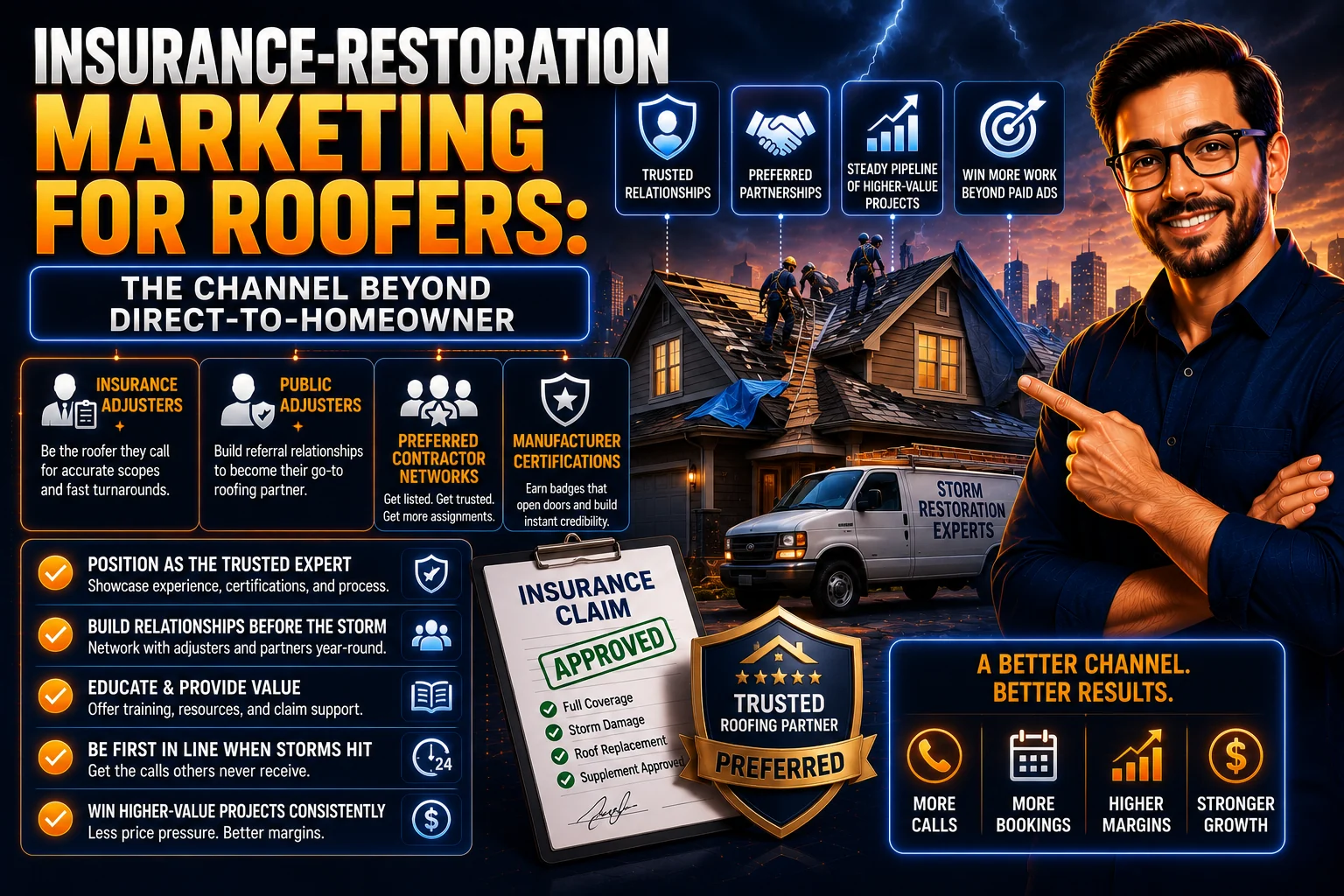
Insurance-Restoration Marketing for Roofers: The Channel Beyond Direct-to-Homeowner
A meaningful portion of substantial roofing work routes through insurance restoration — storm damage, hail damage, wind damage, and other covered events where homeowner insurance pays for repair or replacement. The economics of insurance restoration work are often favorable (substantial job values, payment routed through insurance, work specifications often clearer than out-of-pocket jobs) but the channel works differently from typical direct-to-homeowner roofing marketing. Operations that build insurance-restoration marketing infrastructure access a category of work that pure direct-marketing-focused operations miss, with relationships and processes that compound across years and storm seasons.
Published: July 20, 2026 | Reading Time: ~8 minutes | Category: Roofing Marketing — Insurance Restoration
Insurance restoration involves different decision flows than typical roofing sales. Insurance adjusters often shape outcomes substantially — recommending contractors, evaluating damage claims, and approving scope of work. Public adjusters operate as homeowner advocates in some markets, with their own networks and contractor preferences. Insurance company preferred-contractor networks route work to qualifying operations. The marketing channels that reach these decision-influencers differ substantially from the channels that reach homeowners directly, and operations targeting insurance restoration build distinct infrastructure alongside their direct marketing.
This guide covers insurance-restoration marketing for roofing operations: why insurance restoration is a distinct channel requiring its own marketing approach, the decision-makers and influencers that shape insurance-restoration work, the marketing channels that reach these decision-influencers, the credentialing and capability that qualify operations for insurance work, the content and positioning that supports both direct and insurance-routed work, the compliance and ethics considerations specific to this work, and how operations build insurance-restoration as a sustained channel alongside direct-to-homeowner marketing.
What You'll Learn
- Why insurance restoration is a distinct channel requiring its own marketing approach
- The decision-makers and influencers shaping insurance-restoration work
- Marketing channels that reach insurance decision-influencers
- Credentialing and capability that qualify operations for insurance work
- Content and positioning that supports both direct and insurance-routed work
- Compliance and ethics considerations specific to insurance restoration
- How to build insurance restoration as a sustained channel alongside direct marketing
Why Insurance Restoration Is a Distinct Channel
Insurance-restoration roofing work involves different dynamics than typical out-of-pocket roofing. Understanding the differences shapes the marketing approach that wins this work.
- Insurance pays substantial portion or all of the work. The homeowner is the policyholder but doesn't bear the primary cost (beyond deductible and any out-of-pocket portions). Decision dynamics shift from price-sensitivity to qualification and scope considerations.
- Adjuster involvement shapes outcomes. Insurance adjusters inspect damage, evaluate claims, approve scope, and often influence contractor selection. The adjuster relationship affects whether a claim moves forward favorably or gets denied or reduced.
- Public adjusters represent homeowners in some claims. Public adjusters operate as homeowner advocates, often involved in substantial claims, with their own contractor networks and recommendations.
- Insurance company preferred-contractor networks route work. Many insurance companies maintain networks of preferred contractors they recommend to policyholders. Qualifying for these networks produces ongoing referrals.
- Documentation and compliance requirements are substantial. Insurance restoration involves more documentation than out-of-pocket work — claim documentation, photo evidence, scope documents, code-compliance verification, and the records that support payment and any subsequent disputes.
- Sales cycles often involve multiple touchpoints. The adjuster inspection, claim approval, scope negotiation, work scheduling, and payment processing involve multiple stakeholders and timelines longer than direct roofing sales.
THE ECONOMIC CASE FOR INSURANCE-RESTORATION INVESTMENT: Insurance-restoration work often involves substantial job values, payment that doesn't require homeowner financing or extended collection cycles, and work scope that's often more comprehensive than out-of-pocket replacement decisions. Operations that build sustained insurance-restoration channels alongside direct marketing access work that pure direct-marketing operations miss, with economics that often run favorable compared to direct-acquisition work after accounting for the relationship-building investment. Storm-prone markets see particularly favorable insurance-restoration economics; markets with lower storm exposure see more modest but still meaningful contribution. The channel investment is real, but the economics support it for most established roofing operations willing to do the relationship and capability work.
The Decision-Makers and Influencers
Insurance Adjusters
Insurance company adjusters inspect damage, evaluate claims, and often influence or determine which contractor performs the work. Adjuster relationships built over time produce ongoing claim referrals. Operations that build professional working relationships with adjusters — through reliable performance on past claims, professional documentation that supports the adjuster's work, and the kind of reputation that adjusters trust to recommend — access work that operations without these relationships don't see.
Public Adjusters
Public adjusters represent homeowners against insurance companies, advocating for higher claim payments and broader scope. They're licensed professionals (regulated in most states) who work on contingency. Public adjusters often refer their clients to specific contractor networks they've built relationships with. Operations qualifying for and building relationships with public adjusters access homeowner clients during active claims processes.
Insurance Company Preferred-Contractor Networks
Major insurance companies maintain networks of preferred contractors they recommend to policyholders. The qualification process for these networks varies by insurance company — credentialing requirements, performance history, financial qualifications, and specific application processes. Operations qualifying for preferred-contractor status with major insurers in their market access steady referral flow that competitors without network status don't see.
Homeowner Direct, Through Insurance Claims
Some homeowners initiate the claims process themselves and select contractors directly. Marketing reaches these homeowners through the same channels as out-of-pocket marketing (search, Map Pack, LSAs, referrals) but with content addressing the insurance-restoration process specifically.
Marketing Channels That Reach Insurance Decision-Influencers
- Direct adjuster outreach and relationship building: networking events, professional associations, regulatory meetings, and direct outreach with capability statements and references. The relationship building happens over months and years, not single contacts.
- Industry presence in insurance-restoration contexts: membership in professional associations like RCAT (Restoration Contractors Association of Texas) or regional equivalents, attendance at industry events, and the visible professional presence that signals legitimacy in the insurance-restoration space.
- LinkedIn presence targeting adjusters, public adjusters, and insurance professionals. Substantive content about insurance-restoration topics reaches these audiences through their professional networks.
- Capability statements specifically positioning insurance-restoration competence: documented experience with substantial claims, references from adjuster and public adjuster contacts, manufacturer certifications relevant to insurance work, and the systematic documentation that distinguishes professional insurance-restoration operations.
- Preferred-contractor network applications: identifying which major insurance companies operate networks in your market, completing applications systematically, and maintaining the relationships and qualifications that sustain network membership.
- Content marketing addressing insurance-restoration topics: blog content, educational guides, and substantive resources that reach both decision-influencers and homeowner-direct insurance claimants. Substantive content positions you as the knowledgeable resource for insurance restoration.
- Referral programs from past insurance-restoration customers: customers who had positive insurance-restoration experiences refer friends and neighbors facing similar situations.
PRO TIP: The single highest-leverage insurance-restoration marketing investment for most established roofing operations is systematic adjuster relationship development. Independent claims adjusters and staff adjusters working in your market have ongoing claim assignments and influence which contractors get recommended. Building professional relationships with adjusters in your market through industry events, capability demonstrations, and consistent reliable performance on initial referrals produces ongoing claim flow that compounds over time. The relationship investment is months to years to mature, but once established, produces work flow that direct marketing alone can't replicate. Identify the adjusters in your market and start the relationship-building work systematically.
Credentialing and Capability That Qualify Operations
- Manufacturer certifications at substantial levels: GAF Master Elite, CertainTeed SELECT ShingleMaster, Owens Corning Platinum Preferred, and similar credentials that signal substantial commitment to manufacturer programs. Many insurance situations require or favor these credentials.
- Insurance and bonding at levels insurance work requires: substantial general liability and workers' compensation coverage, and bonding where applicable for substantial commercial restoration work.
- Documentation systems supporting claims: photo documentation, scope documents, code-compliance verification, and the systematic records that support insurance claims and any subsequent disputes.
- Code knowledge and compliance: roofing code requirements vary by jurisdiction and substantially affect insurance scope. Operations with substantive code knowledge produce work that complies with requirements; operations without it produce work that fails inspections and triggers rework.
- Experience with the major insurance carriers in your market: each major insurer has documentation preferences, scope considerations, and process patterns. Operations with experience working through claims with each insurer move work through more efficiently than operations encountering each process for the first time.
- Storm restoration capability at scale: equipment, crew capacity, and operational discipline to handle substantial storm-restoration work when major events occur.
- Financial capability to handle delayed payment cycles: insurance restoration involves payment timelines longer than out-of-pocket work. Operations need working capital to support work performance while insurance payments process.
Content and Positioning
Content addressing the insurance-restoration process serves multiple audiences — homeowners researching the claims process before or during active claims, adjusters evaluating contractor capability, and the broader market positioning that distinguishes insurance-restoration specialists from generalist roofers.
- 'How the insurance restoration process works' substantive content: walks homeowners through inspection, claim filing, adjuster involvement, scope approval, contractor selection, work execution, and payment processing. Captures research-phase searches and demonstrates expertise.
- 'What homeowners should know about insurance claims' content: practical guidance on documentation, timing, working with adjusters, understanding scope decisions, and avoiding common claim mistakes. Builds trust with future customers.
- Storm-specific damage assessment content: what hail damage looks like, how to identify wind damage, what to document, when to call professionally. Serves the seasonal search demand around storm events.
- Code compliance and insurance restoration content: addresses the technical requirements that affect both work quality and insurance scope. Demonstrates expertise that uncredentialed operations can't credibly produce.
- FAQ content covering insurance-restoration questions: AI-search-friendly format that captures voice search and AI-generated answer surfaces. Each FAQ addresses a specific question homeowners or adjusters ask.
- Case studies and project documentation from insurance work: substantive case studies (with appropriate privacy considerations) demonstrating completed insurance-restoration projects, the scope involved, and the outcomes.
Compliance and Ethics Considerations
Insurance restoration operates in a regulated space with specific compliance requirements and ethical considerations that affect marketing and operations.
- State licensing requirements: many states require specific roofing or contractor licensing for insurance work, with additional requirements for public adjuster relationships.
- Restrictions on deductible-handling: state regulations vary on whether contractors can absorb or waive insurance deductibles. Some states explicitly prohibit deductible waiver as a form of insurance fraud.
- Public adjuster relationships under regulation: public adjusters are licensed and regulated; contractor-public adjuster relationships are subject to specific rules in most states.
- Truthfulness in claim documentation: documentation submitted for insurance claims must accurately represent the work and damage. Operations that overstate scope or fabricate damage face substantial legal exposure.
- Advertising and solicitation regulations: some states regulate how contractors solicit insurance work, particularly door-to-door canvassing after storms.
- Anti-fraud provisions: insurance fraud is a serious offense, and operations involved in fraudulent claims face criminal as well as civil exposure. Maintaining honest documentation and claim representation is essential.
Operations approaching insurance restoration ethically and in full compliance build sustainable channels that produce work over years. Operations cutting corners or operating in legally questionable space face consequences ranging from regulatory action through criminal exposure that destroy the business. The compliance investment is non-negotiable for sustainable insurance-restoration operations.
Building Insurance Restoration as a Sustained Channel
- Multi-year horizon for relationship building: adjuster relationships, public adjuster networks, and preferred-contractor network qualifications mature over years. Plan and invest accordingly.
- Integration with direct-to-homeowner marketing: insurance restoration alongside direct marketing produces a diversified channel mix more resilient than either alone.
- Documentation systems that support both immediate work and long-term reference: case studies, project documentation, and reference materials accumulated systematically support ongoing marketing and relationship building.
- Sustained education investment: insurance, restoration, and code knowledge evolve over time. Continuing education, manufacturer training, and industry involvement sustain capability.
- Capacity planning for storm windows: insurance restoration during major storm events produces substantial demand. Capacity strategies (standing crews, subcontractor relationships, materials and equipment pre-positioning) prepare operations for the demand surges.
- Measurement of channel performance: track leads attributed to insurance-restoration channels, conversion rates, job values, and cost-per-booked-job. The metrics inform channel investment decisions over time.
The Bottom Line
Insurance restoration represents a substantial channel for roofing operations willing to build the relationships, capability, and infrastructure the channel requires. The marketing approach differs from direct-to-homeowner roofing — reaching adjusters, public adjusters, insurance company preferred-contractor networks, and homeowner-direct insurance claimants through different channels with different content. The credentialing, documentation, code knowledge, and compliance discipline that qualify operations for substantial insurance work are real investments, but they support a channel with favorable economics for operations that build it sustainably.
Operations building insurance restoration alongside direct-to-homeowner marketing produce diversified channel mixes more resilient than single-channel approaches. The work compounds over time — adjuster relationships mature, network qualifications expand, documentation libraries grow, and the operations that built the foundation early access work flow that operations starting later can't quickly match. For roofing operations in storm-prone markets particularly, insurance-restoration investment is among the highest-leverage strategic decisions available. The framework is concrete; the work is substantial; and the operations that invest sustainably build channel infrastructure that produces favorable economics across years and storm seasons.
Key Takeaways
- Insurance restoration is a distinct roofing channel — insurance pays substantial portion, adjuster involvement shapes outcomes, public adjusters represent homeowners, preferred-contractor networks route work, documentation is substantial, sales cycles involve multiple touchpoints
- Decision-makers and influencers: insurance company adjusters (relationship-driven referrals), public adjusters (homeowner advocates with contractor networks), insurance company preferred-contractor networks (qualification-based steady referrals), homeowner-direct through claims
- Marketing channels that reach insurance decision-influencers: direct adjuster outreach and relationships, industry presence in restoration contexts, LinkedIn targeting insurance professionals, capability statements positioning insurance competence, preferred-contractor network applications, substantive content marketing, referral programs
- Credentialing requirements: manufacturer certifications (GAF Master Elite, CertainTeed SELECT ShingleMaster, Owens Corning Platinum Preferred), substantial insurance and bonding, documentation systems, code knowledge, experience with major insurers, storm restoration capability, financial capability for delayed payment cycles
- Content positioning addresses multiple audiences: insurance restoration process explanations, claim documentation guidance, storm damage assessment, code compliance, FAQ for AI search, case studies and project documentation
- Compliance and ethics non-negotiable: state licensing, deductible-handling restrictions, public adjuster relationship rules, truthful claim documentation, advertising regulations, anti-fraud provisions. Sustainable channels require ethical operation
- Building insurance restoration as sustained channel: multi-year horizon for relationship building, integration with direct marketing, documentation systems, sustained education investment, capacity planning for storm windows, measurement of channel performance
- Adjuster relationship development is the single highest-leverage insurance-restoration marketing investment for most established roofers — months-to-years investment that produces ongoing claim flow no direct marketing alone can replicate
READY TO BUILD A LEAD PIPELINE THAT'S YOURS? Astra Results Marketing builds insurance-restoration marketing programs for roofing operations — adjuster outreach and relationship development infrastructure, industry presence and association engagement, capability statement and case study development, preferred-contractor network application support, content marketing positioning insurance-restoration competence, and the integrated approach that builds insurance restoration as a sustained channel alongside direct-to-homeowner marketing. Stop leaving substantial insurance-restoration work to operators with better channel infrastructure. Build the relationships and positioning that access the work your credentialing and capability deserve. Astra Results Marketing · astraresults.com · (+1) 786-643-3036