Rated 5 star on

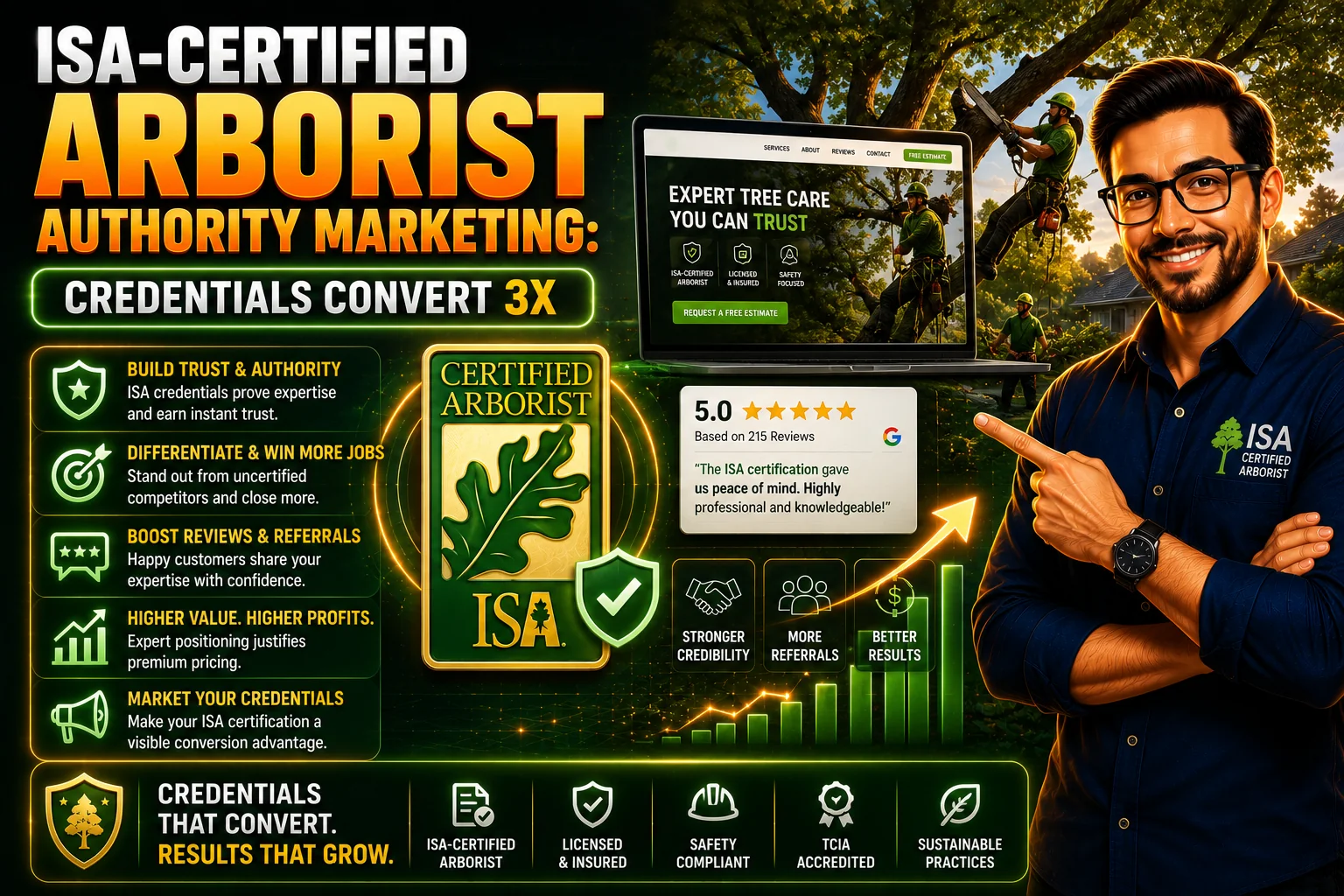
ISA-Certified Arborist Authority Marketing: Credentials Convert 3x
In a market where anyone with a chainsaw and a pickup can call themselves a 'tree guy,' the ISA-Certified Arborist credential is the single clearest signal of professional competence available to a homeowner — and one of the most underleveraged marketing assets in the entire tree-service industry. The companies that hold this credential have invested in real training, passed a substantive exam, and committed to ongoing continuing education. The companies that don't hold it are often technically capable but lack the credentialing that lets a homeowner verify professional standing before hiring. Yet most certified tree-service companies treat the credential as a small footer logo on their website and leave the conversion advantage on the table.
Published: July 12, 2026 | Reading Time: ~12 minutes | Category: Tree Service — Authority Marketing
Properly marketed, professional credentials transform the sales conversation. A homeowner deciding between two estimates — both quoting similar work at similar prices — overwhelmingly chooses the credentialed company when the credentials are visible, explained, and verified. The price-shoppers who would have chosen the cheapest option self-select out when the value of credentials is communicated clearly; the customers who remain are willing to pay the modest premium that credentialed work commands. The effect compounds across the sales funnel — better lead quality, higher close rates, higher average ticket, fewer cancellations, and stronger post-job satisfaction that produces specific credential-mentioning reviews. The unit economics of credential-marketed tree service are substantially better than the unit economics of price-competition tree service, and the credential is what enables the shift.
This guide covers ISA-Certified Arborist authority marketing practically: what the credential actually means and why it carries weight, why most certified companies dramatically underleverage it, how to position credentials on your website beyond a footer logo, educational content that captures research-phase homeowners, credentials in the sales process, the trust signals across reviews and social, the other credentials that compound (TCIA accreditation, state licenses, insurance), and how to build the compounding authority that turns credentials into durable competitive advantage. ArborCentric Solutions built this authority positioning systematically across South Florida service areas, and the conversion advantage it produces is one of the most consistent contributors to the company's unit economics.
What You'll Learn
- What ISA-Certified Arborist actually means — and why the credential matters in a 'tree guy' market
- Why most certified tree-service companies dramatically underleverage their credentials
- Website positioning of credentials beyond a small footer logo
- Educational content that captures research-phase homeowners and demonstrates expertise
- Using credentials in the estimate, contract, and sales conversation
- The trust signals across reviews, social media, and content that compound credential authority
- Other credentials that stack — TCIA accreditation, state licenses, insurance verification
- How ArborCentric built authority positioning that consistently improves conversion economics
What ISA-Certified Arborist Actually Means
ISA-Certified Arborist is a credential issued by the International Society of Arboriculture (ISA), the leading professional body for tree care. To earn the credential, an individual must have a minimum of experience (typically three years of full-time experience in arboriculture, or a combination of education and experience), pass a comprehensive examination covering tree biology, identification, soil management, pruning standards, safety, and related disciplines, and commit to continuing education to maintain the certification. The credential indicates the holder has demonstrated baseline professional competence and is held to the ISA's code of ethics.
This matters because the alternative — uncredentialed tree workers — varies enormously in actual competence. Some uncredentialed tree workers are highly skilled professionals who simply haven't pursued certification; others are barely competent, occasionally outright dangerous, with practices that can damage the trees and properties they're hired to work on. From the homeowner's perspective, the difference between these is impossible to assess from a yard sign or business card. The ISA credential is the third-party verification that the company you're hiring has demonstrated baseline professional knowledge.
Why the Credential Is Particularly Meaningful in Tree Service
Tree work is genuinely dangerous and technically demanding in ways many home services aren't. Improper pruning can damage trees permanently, opening them to disease and structural failure that costs the homeowner thousands later. Inadequate safety practices put crews, property, and bystanders at serious risk. Removal of compromised or damaged trees involves complex assessment of structural integrity, drop patterns, and rigging requirements that uncredentialed workers often misjudge with serious consequences. The technical and safety differences between a credentialed arborist and an uncredentialed tree worker are real and consequential — even when both can technically complete the job.
THE CREDENTIAL GAP MOST HOMEOWNERS CAN'T SEE: Most homeowners can't tell the difference between a properly trained arborist and an uncredentialed tree worker until something goes wrong — by which time the damage is done. The ISA credential bridges this assessment gap. When a homeowner sees that the company they're considering employs ISA-Certified Arborists, they're seeing the third-party verification they couldn't generate themselves. This is precisely why the credential carries weight in the buying decision: it's the proxy for competence that homeowners genuinely need but can't independently verify. Companies that make their certified status visible and verifiable communicate this competence proxy directly; companies that bury it leave homeowners guessing — and price-shopping based on the only variable they can compare.
Why Most Certified Companies Underleverage Their Credentials
Walk through the websites of ten ISA-Certified tree-service companies and you'll see a consistent pattern: a small ISA logo somewhere in the footer, perhaps a mention on the About page, and nothing else. The credential is held but not marketed. The certification matters but doesn't shape the customer's experience of the brand. This is dramatically suboptimal — but it's also typical, because credential marketing isn't something most operators learn to do well.
Why the Underleverage Happens
- Familiarity bias. Owners of certified companies have lived with their credentials for years; they assume customers know what they mean. They don't. Most homeowners have never heard of ISA, don't know what 'Certified Arborist' verifies, and have no frame of reference for why it matters. The credential is invisible to them unless it's explicitly positioned.
- Reluctance to seem promotional. Many credentialed operators are uncomfortable making their credentials prominent because it feels self-promotional. But homeowners genuinely need this information to make informed choices — communicating credentials clearly is informative, not promotional.
- Belief that work quality speaks for itself. The credentialed company that does excellent work assumes the work itself proves competence. The problem: a prospective customer can't assess the work until they hire the company. The credential is the verification available before the work is done.
- Lack of marketing frameworks for credentials. Most credentialed operators don't have a clear sense of how to integrate credentials into their marketing — what content to build around them, how to position them in the sales process, how to use them in reviews and social. The credentials sit unused because no one taught the owner how to use them.
Website Positioning of Credentials Beyond the Footer Logo
The website is where most prospective customers form their first impression of credentialing — and where most credentialed tree-service operations bury the asset. Effective credential positioning makes the credentials visible, explained, and verifiable across the site.
Prominent Above-the-Fold Treatment
The homepage hero section is the highest-value placement on the site, and credentials belong there alongside the value proposition. Not buried in a 'trust badges' strip among generic icons, but treated as substantive: 'ISA-Certified Arborists serving [region] since [year]' with the cert displayed prominently. The visitor seeing the homepage in the first three seconds should understand that this company employs certified professionals. The same prominent treatment applies to service pages, especially the high-value ones (tree removal, large-tree work, technical pruning) where credential weight matters most.
Dedicated Credentials/About Section
Beyond the homepage prominence, a dedicated 'Our Credentials' page or About section that explains what ISA Certification means, why it matters for tree work specifically, what the certification requires, and what other credentials the company holds (TCIA, state licenses, insurance verification). This page captures the research-phase homeowners specifically looking to verify credentials before hiring, and it provides the substantive content that schema-marked authority pages need to rank for credential-related searches.
Verification and Transparency
Display actual credential details — the certifying body, the certified individuals' names where appropriate (with permission), certification numbers where applicable, license numbers, and insurance information. The homeowner skeptical enough to verify can actually verify; the homeowner who isn't still sees the substantive credentialing rather than just badges. Transparency beats opacity: 'ISA-Certified Arborist, certification number XX-XXXX' beats a generic logo.
Team Page With Credentials Visible
Show your team and their individual credentials. Photographs of crew members with their certifications listed (where applicable) humanizes the company and demonstrates that the credentialing isn't just an ownership badge — it's embedded in the actual people who'll do the work. Companies with multiple certified arborists on staff have a particularly strong differentiator most operations can't match.
Educational Content That Captures the Research-Phase Homeowner
Beyond the website's core positioning, educational content captures the substantial volume of homeowners researching tree care, credentials, and decision criteria before they're ready to call. Educational content that genuinely helps these homeowners also demonstrates expertise and builds the topical authority that supports broader rankings.
- 'What Is an ISA-Certified Arborist?' content explaining the certification, what it requires, and why it matters for homeowners hiring tree care. This content captures the specific research searches and positions your company as the credentialed answer.
- 'How to Choose a Tree-Service Company' content covering the decision criteria homeowners should use — credentialing, insurance, references, written estimates, and the questions to ask. Honest decision-criteria content builds trust even with prospects who don't end up choosing you, and the ones who do choose you arrive better-educated and more committed.
- 'Why Improper Pruning Damages Trees' or similar technical content demonstrating expertise in tree biology and care. The content educates homeowners and signals the credentialed-arborist depth that uncredentialed operators can't credibly produce.
- Tree-care guides for the specific tree species in your service area — content that homeowners search for ('how to care for an oak tree,' 'royal palm pruning,' etc.) and that demonstrates the species-specific knowledge credentialed arborists have.
- Storm preparation and damage-assessment content positioning your team as the experts homeowners should turn to. This content captures the seasonal volume and feeds the storm-marketing strategy from earlier in this cluster.
PRO TIP: The highest-leverage credential-marketing content is the 'how to choose a tree service' guide that walks homeowners through the decision criteria they should actually use — credentialing, insurance, written estimates, references, and the questions to ask. Write this honestly and substantively, treating it as if you were advising a friend rather than promoting your company. The prospects who arrive at this content learn what to look for, naturally compare other companies against the criteria, and the credentialed companies win that comparison consistently. The content builds genuine trust (you helped them make a good decision rather than pitching them) and converts at higher rates than direct-promotional content because the prospects who reach the decision arrive informed and committed. This single piece of content, well-built, can become one of the most consistent lead sources for a credentialed tree-service operation.
Credentials in the Estimate, Contract, and Sales Conversation
The marketing positioning sets up the credential advantage; the sales process delivers it. From the first call through the estimate and into the contract, credentials should be visible and explicit — not aggressively pitched, but consistently present.
- Phone intake mentions credentialing. The first conversation references that an ISA-Certified Arborist will assess the work or that the work will be performed under certified supervision. This frames the engagement from the start as a professional service rather than a commodity bid.
- Estimates list credentials prominently. The estimate document itself should list the credentialing of the people who'll perform the work — certifications, licenses, and insurance. The estimate becomes a credentialing document, not just a price quote.
- On-site assessment demonstrates expertise. When an ISA-Certified Arborist performs the on-site assessment, the conversation itself differentiates the service — explaining the technical considerations, the species-specific factors, the safety requirements. The homeowner experiences the expertise directly during the estimate.
- Written explanation of work and recommendations. Quality tree work involves judgment calls (which limbs to remove vs preserve, how to address structural issues, what timing to recommend). Documenting this in writing — informed by the arborist's professional knowledge — both serves the customer and demonstrates the value of credentialed work.
- Contract references credentials and standards. The contract identifying the credentialed individuals and the work standards being followed (ISA pruning standards, ANSI A300 where applicable) makes the credentialing concrete and binding.
Why This Closes Better Than Price-Quote Sales
The sales conversation that includes credentialing as a consistent thread reframes the customer's decision. Instead of 'who's cheapest,' the question becomes 'who's qualified to do this work properly.' Customers comparing a credentialed estimate against a 'tree guy' estimate at a similar price reliably choose the credentialed company; customers comparing a credentialed estimate against a cheaper 'tree guy' estimate often still choose the credentialed company once the value gap is clear. The credentialed sales process self-selects for the customers who care about quality — exactly the customers worth working for.
Trust Signals Across Reviews and Social That Compound Authority
Credential marketing doesn't end at the sale. The review and social-media work that captures completed jobs reinforces the credential positioning when done deliberately.
- Encourage reviews that mention credentials and expertise. When asking for reviews after completed jobs, reference the technical aspects of the work and the credentialed approach. Reviews that specifically mention the arborist's expertise, the technical assessment, or the credentialed quality reinforce the authority positioning for future prospects reading them.
- Photo and video content from completed jobs documenting the technical work. Time-lapses of complex removals, before-and-after content showing proper pruning, footage of the technical equipment and rigging involved — content that demonstrates the actual expertise rather than generic feel-good marketing.
- Educational social content from your certified arborists. Short videos or posts where credentialed team members explain tree-care concepts, demonstrate proper technique, or address common questions. This content humanizes the credentialing and produces a steady stream of demonstrable-expertise content.
- Case studies of complex work. Where customer permission allows, document the technical challenges of major jobs — the assessment process, the equipment and crew required, the outcome. Complex job case studies position the company as the operation capable of work that smaller uncredentialed competitors can't safely perform.
- Engagement with arboriculture professional content. Sharing and engaging with ISA, TCIA, and other professional-body content signals the company's professional integration and ongoing engagement with the field.
Other Credentials That Stack with ISA
ISA-Certified Arborist is the headline credential, but several other certifications and verifications compound the authority positioning when held.
- TCIA Accreditation — the Tree Care Industry Association accredits tree-service companies meeting business standards across safety, business practices, customer satisfaction, and ethics. Where ISA certifies individuals, TCIA accredits the company. TCIA Accreditation is a particularly strong differentiator because relatively few companies hold it.
- ISA Board-Certified Master Arborist — the highest individual credential in arboriculture, beyond the standard Certified Arborist credential. Operations with Board-Certified Master Arborists on staff command meaningful differentiation.
- State arborist or contractor licenses — where applicable to your state, the relevant licenses (often required for commercial tree work) demonstrate regulatory compliance and add to the credentialing stack.
- Insurance verification — comprehensive general liability and workers' compensation insurance with verification documents available on request. Many uncredentialed operations carry inadequate or no insurance, which exposes the customer to significant liability.
- Specialty certifications — ISA's specialty credentials (Municipal Specialist, Utility Specialist, Climber Specialist, Tree Risk Assessment Qualification) for the specific work types each addresses.
- Crew-level safety credentials — OSHA training, first-aid certifications, climbing certifications. The crew-level credentialing demonstrates that safety culture extends through the operation.
What ArborCentric Built Across South Florida
ArborCentric Solutions built systematic credential authority positioning across their South Florida operation. The components — homepage and service-page prominence for ISA credentials, dedicated credentials and team pages with verification details, comprehensive educational content for research-phase searches, credentialing integrated through the sales process from phone to estimate to contract, review-generation systems that captured credential-mentioning reviews, social and case-study content demonstrating technical expertise, and the stacked credentials beyond ISA (TCIA, state licenses, insurance, specialty certifications where applicable) — work together as an integrated authority position rather than scattered logos.
The cumulative outcome over time: ArborCentric consistently competes for the higher-value tree-service work — large removals, technical pruning, commercial accounts, insurance work — where credentialed capability is genuinely required and where the credential positioning is the differentiator that wins the work. The unit economics on credentialed work are substantially better than commodity competition; close rates on estimates run higher than they would for an uncredentialed competitor at the same price points; reviews specifically mention the credentialed expertise, reinforcing future credentialing-driven decisions; and the operation has built a position in the market that price-competing 'tree guys' simply cannot occupy regardless of what they bid. The credentialing investment — both the actual professional training and the marketing work to communicate it — is one of the highest-ROI strategic assets the business holds.
The Bottom Line
ISA-Certified Arborist credentialing is the single clearest signal of professional competence available in tree service, and one of the most consistently underleveraged marketing assets in the industry. Credentialed companies that bury the credential in a footer logo leave the conversion advantage on the table; companies that make credentials visible, explained, and verified across website, content, sales process, reviews, and social media transform the customer decision from price comparison into qualification-based selection. The customers who emerge from this process are willing to pay the modest premium credentialed work commands, close at higher rates, and produce the credential-mentioning reviews that compound future credentialing-driven decisions.
The work involves real integration — homepage and service-page positioning, dedicated credential and team pages, educational content for research-phase homeowners, credentialing woven through the sales process, review and social systems that capture credential-mentioning trust signals, and the stacked credentials beyond ISA (TCIA, state licenses, insurance, specialty certifications) that compound the authority. ArborCentric built this systematically across South Florida and consistently wins the higher-value work where credentialed capability is the differentiator. The credential is the asset most tree-service companies hold and few properly use; the operators who use it well harvest disproportionate returns from the same professional standing competitors also hold but fail to communicate. In a market full of 'tree guys,' the credentialed company that markets the credential is the one homeowners can confidently choose — and the unit economics follow.
Key Takeaways
- ISA-Certified Arborist is the clearest signal of professional competence in a market where many uncredentialed 'tree guys' compete — but most credentialed companies dramatically underleverage their credentials, treating them as small footer logos rather than central marketing assets
- The credential matters because tree work is technically demanding and genuinely dangerous, the differences between credentialed and uncredentialed work are real and consequential, and homeowners can't independently assess competence — the credential bridges the assessment gap they can't bridge themselves
- Most credentialed companies underleverage their credentials because of familiarity bias (assume customers know what it means), reluctance to seem promotional, belief work quality speaks for itself (it can't until they're hired), and lack of frameworks for credential marketing
- Website positioning: prominent above-the-fold homepage treatment, dedicated credentials/about page with verification details and certification numbers, team page showing individual credentials, transparency over opacity — actual cert numbers beat generic badges
- Educational content captures research-phase homeowners: 'What Is an ISA-Certified Arborist,' 'How to Choose a Tree Service Company,' 'Why Improper Pruning Damages Trees,' species-specific care guides, storm preparation — the content educates while demonstrating credentialed depth
- Sales process integration: phone intake mentions credentialing, estimates list credentials prominently, on-site assessment by certified arborist demonstrates expertise directly, written work explanations, contracts reference standards and credentials — reframes 'who's cheapest' into 'who's qualified'
- Reviews, social, and case studies that reinforce credentials over time: encourage credential-mentioning reviews, document complex work, educational content from certified team members, engagement with professional-body content — the trust signals compound credentialing into durable advantage
- Stacking credentials beyond ISA: TCIA Accreditation, ISA Board-Certified Master Arborist, state licenses, insurance verification, ISA specialty certifications, crew-level OSHA/first-aid/climbing certifications — each addition strengthens the overall authority position
- ArborCentric Solutions built this systematic credential authority across South Florida — consistently competes for higher-value work, better unit economics on credentialed jobs, higher close rates, credential-mentioning reviews compounding future decisions, and a position in the market price-competitors can't occupy
READY TO BUILD A LEAD PIPELINE THAT'S YOURS? Astra Results Marketing builds credential authority marketing for ISA-certified and credentialed tree-service operators — homepage and service-page positioning beyond the footer logo, dedicated credential pages with verification depth, educational content capturing research-phase homeowners, credentialing integrated through the sales process, review and social systems that reinforce authority, and the stacked-credential positioning that compounds advantage over time. We built this with ArborCentric Solutions across South Florida and the credential-authority position consistently produces better conversion economics than commodity tree-service competition. Stop leaving your credentials buried in the footer. Build the authority positioning that turns credentialed standing into the durable competitive advantage it can be. Astra Results Marketing · astraresults.com · (+1) 786-643-3036