Rated 5 star on

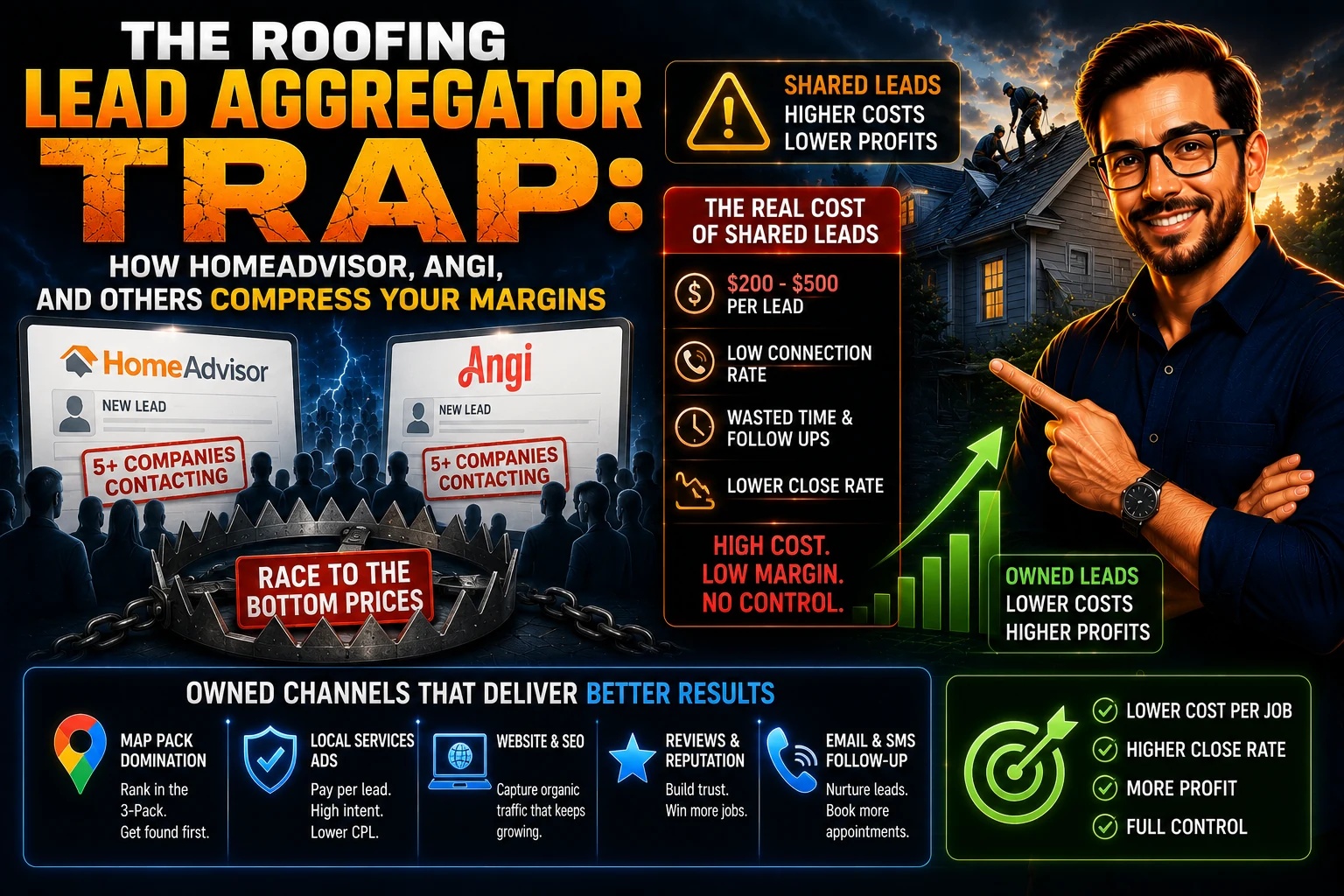
The Roofing Lead Aggregator Trap: How HomeAdvisor, Angi, and Others Compress Your Margins
Lead aggregators — HomeAdvisor, Angi, Thumbtack, Networx, Modernize, Roofr, and similar platforms — sell roofing leads to contractors on a per-lead basis. The platforms market aggressively to roofing operators, particularly those without strong owned marketing channels, and the math looks reasonable at the per-lead price quoted. The economic reality, once examined honestly, is substantially worse than the per-lead pricing suggests. Shared lead distribution compresses conversion rates to single digits. Cost-per-booked-job runs multiples of what the per-lead pricing implies. The dependency that builds up over months traps operations in a channel that compresses margins rather than building durable lead acquisition infrastructure.
Published: July 22, 2026 | Reading Time: ~8 minutes | Category: Roofing Marketing — Lead Aggregator Escape
This isn't an argument that lead aggregators have zero legitimate use. Some operations use aggregators tactically for specific purposes — fill-in lead volume during slow periods, geographic expansion testing, supplemental volume alongside primary owned channels. The argument is that aggregators should never be the primary lead acquisition strategy for serious roofing operations, and the operations relying on aggregators as their primary channel face structural disadvantages that compound over years. The escape path involves building the owned channels (Map Pack, LSAs, organic SEO, referrals, direct outreach) that produce favorable cost-per-booked-job — and then using aggregators only where they fill specific tactical gaps.
This guide covers the lead aggregator trap for roofing operations: the actual economics of aggregator leads once shared distribution is honestly accounted for, the lock-in dynamics that build up over time, the structural conflicts between aggregator economics and contractor economics, the escape strategy through owned channel development, where aggregators may make tactical sense, and how to evaluate honestly whether your current channel mix is producing favorable economics or compressing margins through aggregator dependency.
What You'll Learn
- Why per-lead pricing dramatically understates the actual cost of aggregator leads
- The shared-distribution economics that compress conversion rates to single digits
- The lock-in dynamics that build dependency over months
- Structural conflicts between aggregator business models and contractor economics
- The escape strategy through owned channel development
- Where aggregators may make tactical sense as supplement
- How to evaluate honestly whether your channel mix is producing favorable economics
Why Per-Lead Pricing Dramatically Understates Actual Cost
Aggregator pricing is typically quoted on a per-lead basis — $30, $50, $80, sometimes more for roofing leads depending on platform and market. The pricing looks reasonable in isolation. The math falls apart when honestly examining what's actually purchased.
- Leads are shared with multiple contractors. The same lead — same homeowner inquiry — is sold to 3, 4, sometimes 5+ contractors simultaneously. Each contractor pays the per-lead price for what's effectively a fractional opportunity.
- Conversion rates from shared leads run dramatically lower than exclusive leads. While exclusive lead conversion (LSA leads, direct organic, referrals) often runs 25-40%+ for qualified roofing leads, shared aggregator leads frequently convert at 5-10%. The first contractor to respond often books the work; the rest paid for nothing.
- The customer comparison shopping is implicit. Customers contacting aggregators specifically expect multiple contractor outreach and explicitly compare options. The decision dynamics favor lowest pricing over qualification, which works against operations with credentialed positioning and substantial overhead.
- Lead quality is often poor. Aggregator leads include substantial portions of price-shopping researchers, inquiries for work outside what you do, geographic mismatches the platform's targeting let through, and other non-qualified inquiries. The 'qualified lead' marketing language doesn't match the actual lead composition.
THE COST-PER-BOOKED-JOB REALITY: Take an aggregator lead at $60 per lead. Sounds reasonable. But it's shared with 4 other contractors. Your realistic conversion rate from shared lead to booked work runs ~8%. That means you book one job for every 12.5 leads received — at total cost of $750. Your effective cost-per-booked-job from this channel is $750. Compare that to LSA leads at $80 per lead with 30% conversion: $267 cost-per-booked-job. Or Map Pack leads at $20 attributed cost with 35% conversion: $57 cost-per-booked-job. Or referral leads at $5 attributed cost with 60% conversion: $8 cost-per-booked-job. The aggregator looks reasonable on per-lead pricing and is dramatically the worst channel on cost-per-booked-job. The math that matters is the cost-per-booked-job math; aggregator economics consistently fail that test.
The Lock-In Dynamics
Aggregator dependency builds up over months and becomes operationally difficult to escape. The dynamics that create lock-in are recognizable once examined.
- Operations relying on aggregators don't invest in owned channels. Map Pack rankings, LSA verification and history, SEO foundations, review velocity, and direct outreach all require sustained investment that compounds over time. Operations buying leads instead of investing in owned channels accumulate no owned-channel asset value, so they remain dependent.
- Cancelling aggregator spend creates immediate lead-flow gap. Operations that built operational scale on aggregator lead flow can't simply turn it off — without owned channels in place, the cancellation eliminates the lead flow funding the operation.
- Aggregators pitch volume guarantees and contracts. Some platforms structure relationships with volume commitments or minimum monthly spend that create explicit lock-in beyond the economic dependency.
- Switching costs feel real even when they aren't. Operations that have spent months optimizing aggregator account configurations face a perceived switching cost of leaving — even though the optimization was building dependency on a fundamentally inferior channel.
Structural Conflicts Between Aggregator and Contractor Economics
Aggregator and contractor business models have structurally opposed incentives in ways that produce the contractor-unfavorable outcomes the math reveals.
- Aggregator revenue scales with lead volume sold, regardless of conversion. The platform makes more money selling the same lead to more contractors. Contractors lose money when leads are shared more widely. The platform's incentive is wider sharing; the contractor's interest is exclusivity.
- Aggregator marketing pitches 'qualified leads' but qualifies leads to maximize platform revenue. Liberal qualification accepts more leads from the homeowner side and sells more to the contractor side. Strict qualification would benefit contractor conversion but reduce platform revenue.
- Aggregator pricing tiers reward volume buying. Discounts for higher monthly spend incentivize contractors to commit to higher dependency rather than diversifying away.
- Aggregator content marketing pitches lead-buying as scalable acquisition strategy. The platforms' content marketing positions itself as the way to grow contractor businesses, which is precisely what serves the platform's interests rather than the contractors'.
- Customer experience considerations don't align. Aggregators that overwhelm homeowners with contractor contacts (poor customer experience) generate more revenue from contractors paying for the leads — even though the bad customer experience reduces conversion rates.
PRO TIP: The honest test of whether your aggregator spend is producing favorable economics is the cost-per-booked-job calculation across the past 12 months. Total spend on aggregator platforms divided by jobs actually booked from those leads. Compare against your LSA cost-per-booked-job, organic Map Pack attributed cost-per-booked-job, and referral cost-per-booked-job. If aggregator cost-per-booked-job runs substantially worse than your other channels (it almost always does), the math is telling you what the strategic decision should be. The decision isn't 'pay more for aggregator leads' or 'optimize aggregator account configurations harder.' It's redirect the spend toward channels with structurally better economics and use aggregators only as tactical supplement where they fill specific gaps.
The Escape Strategy Through Owned Channels
Reducing aggregator dependency and rebuilding margins requires deliberate development of owned channels that produce favorable cost-per-booked-job. The work compounds over time, and operations that commit to the build over 6-12 months reduce aggregator dependency substantially while improving overall economics.
Build Map Pack Foundation
Google Business Profile optimization, sustained review velocity, citation work, schema markup, and service-area page development produce Map Pack ranking that captures exclusive leads at substantially lower attributed cost than aggregators. This investment is foundational — once established, produces lead flow with marginal ongoing cost.
LSA Verification and Account Building
Complete LSA verification, build response-rate discipline, and let review velocity feed LSA ranking. The Google Guaranteed badge and per-lead pricing produce exclusive leads with structurally better economics than shared aggregator leads.
Organic SEO Foundation
Substantive service pages, long-tail content production, FAQ schema markup for AI search citations, and the broader content investment that builds organic lead flow. The investment timeline is 6-12 months for substantial returns, but the resulting lead flow is exclusive and ongoing.
Referral System Development
Systematic post-job referral request systems, real estate agent partnerships, GC and trade partner referrals, customer database building, and the referral infrastructure that produces leads at the lowest cost-per-acquisition of any channel. Sustained referral generation often produces 20-30%+ of well-built operations' lead flow.
Direct Outreach and Commercial Development
For operations targeting commercial work specifically, the direct outreach to property managers, GCs, and commercial decision-makers produces relationship-driven work flow that aggregators don't access. The investment is months of relationship building but produces multi-year contract relationships.
Where Aggregators May Make Tactical Sense
- Fill-in lead volume during slow periods: when seasonal demand drops and you have crew capacity available, supplemental aggregator volume can fill operational gaps. Use selectively rather than continuously.
- Geographic expansion testing: testing demand in a new market before building full owned-channel infrastructure. Aggregator leads can validate market viability before committing to substantial Map Pack and LSA investment in the new area.
- Specific service line development: testing demand for new service offerings before building dedicated marketing infrastructure for the offering.
- Surge demand periods when owned channels are at capacity: when storm windows produce demand exceeding what your owned channels can support, supplemental aggregator leads can fill marginal capacity. Be careful that this doesn't transition to ongoing dependency.
- Lead categories aggregators serve better than your owned channels: very specific niches where the aggregator has built unique market position you can't replicate cost-effectively. Rare but exists in some cases.
Evaluating Your Current Channel Mix
The honest evaluation of whether your current channel mix is producing favorable economics requires assembling channel-specific cost-per-booked-job math across the trailing 12 months.
- Pull total channel spend by channel over trailing 12 months.
- Pull lead volume by channel for the same period from attribution sources.
- Pull booked-job count by channel with attribution preserved.
- Calculate cost-per-booked-job by channel.
- Compare aggregator cost-per-booked-job against LSA, Map Pack, organic, referral, and direct outreach economics.
- Identify where economics are favorable for additional investment and where economics are unfavorable for reduction or restructuring.
Most operations completing this evaluation honestly find that aggregator economics run substantially worse than owned channels. The strategic implication: redirect the aggregator spend toward owned channel development over 6-12 months while reducing aggregator dependency. The transition period sometimes involves temporary lead-flow gap; the resulting channel mix produces substantially better economics.
The Bottom Line
Lead aggregators (HomeAdvisor, Angi, Thumbtack, Networx, Modernize, Roofr, and similar platforms) sell roofing leads on per-lead pricing that looks reasonable in isolation but produces dramatically worse cost-per-booked-job than owned channels once shared-distribution economics are honestly accounted for. Lock-in dynamics build over months as operations dependent on aggregators don't invest in owned channels and can't quickly cancel without lead-flow gap. Structural conflicts between aggregator business models (revenue scales with lead volume sold) and contractor economics (revenue requires conversion) produce the contractor-unfavorable outcomes the math reveals.
The escape strategy is owned channel development over 6-12 months: Map Pack foundation, LSA verification and account building, organic SEO foundation, referral system development, and direct outreach. Aggregators retain tactical utility for specific scenarios (fill-in volume, geographic testing, service line development, surge supplements) but should never be the primary lead acquisition strategy for serious roofing operations. The honest cost-per-booked-job math across channels reveals what the strategic decisions should be — and operations that commit to the channel restructuring produce substantially better unit economics and competitive position than operations remaining locked in aggregator dependency.
Key Takeaways
- Per-lead pricing dramatically understates aggregator cost — shared distribution (3-5+ contractors per lead) compresses conversion to 5-10% vs 25-40%+ for exclusive leads, producing cost-per-booked-job multiples of the per-lead pricing
- Cost-per-booked-job reality: $60 aggregator lead at 8% conversion = $750 cost-per-booked-job vs $80 LSA lead at 30% = $267, vs $20 Map Pack attributed at 35% = $57, vs $5 referral at 60% = $8
- Lock-in dynamics: aggregator dependency builds over months as operations don't invest in owned channels, cancellation creates immediate lead-flow gap, volume guarantees and contracts create explicit lock-in, perceived switching costs
- Structural conflicts: aggregator revenue scales with shared distribution while contractor economics require exclusivity. Platform incentives oppose contractor interests at multiple levels
- Escape strategy through owned channel development: Map Pack foundation, LSA verification and account building, organic SEO foundation, referral system development, direct outreach for commercial — 6-12 months of compounding investment
- Aggregators retain tactical utility for: fill-in volume during slow periods, geographic expansion testing, service line development, surge supplements when owned channels are at capacity, specific niches with unique aggregator position
- Evaluation method: pull 12 months of channel spend, leads, and booked jobs by source; calculate cost-per-booked-job by channel; identify favorable economics for additional investment and unfavorable economics for reduction
- Aggregators should never be primary lead acquisition strategy for serious roofing operations — they should be tactical supplements where they fill specific gaps, with owned channels producing the bulk of favorable-economics lead flow
READY TO BUILD A LEAD PIPELINE THAT'S YOURS? Astra Results Marketing builds owned-channel marketing infrastructure for roofing operations escaping aggregator dependency — Map Pack foundation development, LSA verification and account building, organic SEO foundations producing exclusive lead flow, referral system development, and the integrated approach that produces favorable cost-per-booked-job across channels. Stop paying aggregator prices for shared leads that compress your margins. Build the owned channels that produce exclusive leads at favorable economics. Astra Results Marketing · astraresults.com · (+1) 786-643-3036