Rated 5 star on

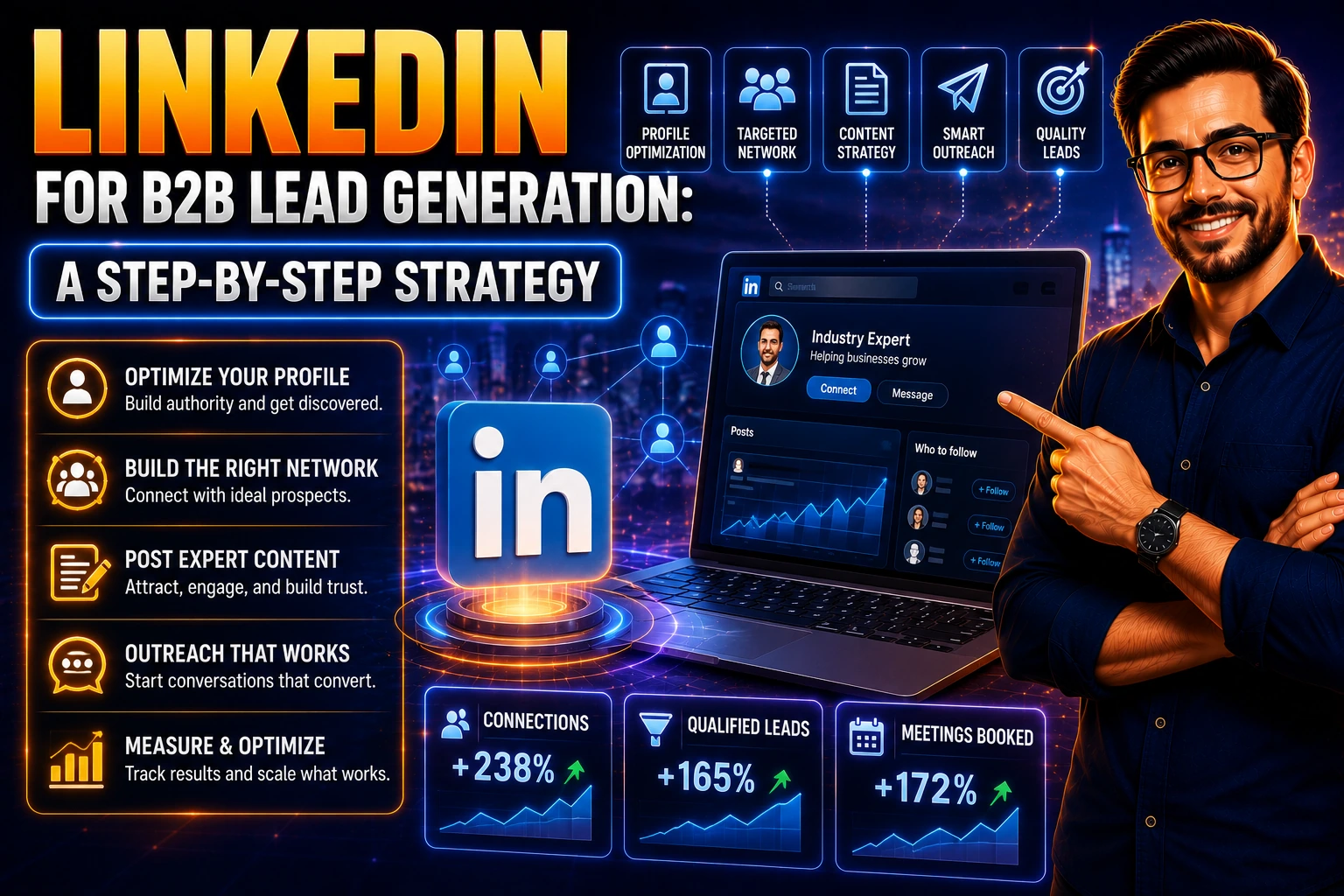
LinkedIn for B2B Lead Generation: A Step-by-Step Strategy
For B2B businesses, LinkedIn is the most concentrated audience of decision-makers, executives, and professionals available on any platform. The people who actually buy your services — the operations directors, the finance leaders, the founders, the practice managers — are on LinkedIn at scale, often professionally engaged in ways they aren't on other platforms. That makes LinkedIn one of the most valuable lead-generation channels available to B2B businesses, if you know how to work it. The catch is that LinkedIn rewards a specific approach — relationship-building, value-led content, and targeted outreach — and punishes the spray-and-pray tactics that work poorly anywhere but especially fail on a professional network.
Published: July 2, 2026 | Reading Time: ~9 minutes | Category: Social
The most common LinkedIn mistake is treating it like Facebook or Twitter — posting generic broadcasts, sending mass cold outreach, and expecting transactional response. LinkedIn doesn't reward that. The B2B businesses that generate real leads from LinkedIn build a presence rooted in genuine professional value: thoughtful content that demonstrates expertise, real engagement with their network, and targeted outreach that respects the recipient's time. It's a longer-term, relationship-driven channel — and when worked that way, it produces the kind of qualified, high-value leads that B2B businesses need.
This guide is the step-by-step strategy for B2B lead generation on LinkedIn: setting up the foundation (your profile and company page), building the network of the right people, the content strategy that demonstrates expertise and builds trust, the outreach approach that respects recipients while generating real conversations, LinkedIn ads where they fit, and the measurement that turns it into a system. For B2B businesses tired of cold outreach that doesn't work and hoping for a more genuine channel, this is the practical playbook.
What You'll Learn
- Setting up the LinkedIn foundation — your personal profile and company page as lead-generation assets
- Building the network of the right people — connection strategy that puts you in front of decision-makers
- The content strategy that demonstrates expertise and builds trust over time
- The outreach approach that respects recipients and generates real conversations (not the spray-and-pray that LinkedIn punishes)
- Where LinkedIn ads fit and when they earn the budget
- How to measure LinkedIn's contribution to B2B lead generation
Setting Up the LinkedIn Foundation
Before content or outreach, the foundation has to be in place — both the personal profile of the person doing the lead generation and the company page that supports it.
The Personal Profile
On LinkedIn, the personal profile is more important than the company page for B2B lead generation. People connect with people, content comes from people, and outreach works through people. The personal profile of the owner, founder, or business-development lead — typically the person actually doing the LinkedIn lead generation — should be optimized to communicate expertise and build immediate credibility with prospects.
- Professional headshot and clean background photo — visual credibility starts before anyone reads a word.
- Headline that communicates who you help and how — not just your job title. 'I help service businesses generate exclusive leads through SEO and paid search' beats 'Founder at Acme Marketing.'
- About section that articulates your perspective, expertise, and the kind of work you do — written for the prospects you want to attract, not just a generic bio.
- Featured content showing your best work — recent posts, case studies, articles, or other proof of expertise.
- Experience and credentials that build credibility for your target audience.
The Company Page
The company page is less critical for direct lead generation than the personal profile, but it matters as a credibility check — prospects who hear of you through a personal connection or content often look at the company page to verify. A complete, professional company page with clear positioning, recent updates, employee presence, and case studies or client work serves as the credibility foundation. It doesn't need to be the lead-generation engine; it needs to support the personal profiles that do the work.
PERSONAL BRAND DRIVES B2B LINKEDIN: On LinkedIn for B2B, the personal brand of the founder or business-development lead drives most of the lead generation, more than the company brand. People connect with people, content from a person engages more than corporate content, and outreach from a person converts better than from a faceless brand. This doesn't mean ignoring the company page — but it does mean recognizing that the personal profile is where the strategy concentrates. The B2B businesses that win on LinkedIn typically have an owner or leader who shows up consistently in their own voice; the businesses that try to do it all through the company page underperform.
Building the Network of the Right People
LinkedIn's value compounds with the quality of your network. A network full of irrelevant connections produces little; a network concentrated in your target audience — the decision-makers who could become clients — produces consistent opportunity.
Connection Strategy
Build your network deliberately, focused on the people who match your ideal customer profile. The decision-makers in your target industries, geographies, and company sizes. Past clients and the network around them. People who engage with your content or attend relevant events. The goal is a network where most of your connections are people who could buy from you or refer you to people who could. Connecting with thousands of random people inflates your numbers but doesn't generate leads.
Sending Connection Requests That Get Accepted
- Personalize the request when you can — a short note referencing why you're connecting (shared interest, mutual connection, recent content of theirs) dramatically improves acceptance rates over the default.
- Connect with people who have a reason to know you — your content engages them, you share a mutual connection, you've interacted at events, you're in the same industry conversation.
- Don't pitch in the connection request — connecting is the first step, not the sale. Save the conversation for after they accept and engagement is established.
- Engage with prospects' content before connecting where it makes sense — meaningful comments on their posts make a subsequent connection request natural rather than cold.
Building the Right Network Over Time
The network builds over months and years through consistent activity — posting content that attracts the right people, engaging with the content of people you want in your network, connecting from genuine professional interactions. The B2B businesses with the most effective LinkedIn lead generation usually have founders or leaders who've built networks of thousands of qualified contacts over years of consistent presence. There's no shortcut, but every relevant connection added compounds the platform's value over time.
The Content Strategy That Builds Expertise and Trust
Content is how you stay in front of your network, demonstrate expertise, and attract the right people without explicit pitching. The B2B businesses that generate LinkedIn leads consistently publish content that genuinely informs and engages their target audience — not generic motivational quotes, not company self-promotion, but substantive perspective and insight.
What to Post
- Industry insights and perspective: your take on trends, developments, and questions in your industry. Demonstrates expertise and invites engagement from people interested in the topic.
- Practical advice and lessons: what you've learned, what works and what doesn't, useful frameworks and approaches. The kind of content prospects bookmark and refer to.
- Case examples and stories: real examples of work, problems solved, lessons learned — within appropriate confidentiality. Stories of outcomes are far more engaging than abstract claims.
- Behind-the-scenes and process content: how you work, why you do things a certain way, the thinking behind your approach. Humanizes the brand and demonstrates depth.
- Original opinion and stance: contrarian or strong-stance content (where genuine and defensible) attracts engagement and signals confidence. Generic content invites generic responses.
How to Post
Consistency matters more than virality — a sustained presence (multiple posts per week, every week) builds compounding visibility and demonstrates active engagement. Each post should add value rather than self-promote — the rule of thumb is that the post should be useful even to people who never buy from you, and the lead generation comes from the right prospects recognizing your expertise over time. Engagement with comments on your posts and on others' posts amplifies your visibility and builds the relationships that lead to opportunities.
PRO TIP: The biggest LinkedIn content mistake is treating it as a broadcast channel for company promotion. Posts that say 'we won this award' or 'check out our latest service' generate little engagement and don't build the expertise positioning that drives B2B leads. Instead, post like a thoughtful person in your industry — insights, perspective, advice, lessons, opinions. The content that builds expertise and attracts leads on LinkedIn is content that genuinely helps and informs the target audience, not content that promotes the business. The lead generation happens as a byproduct of being recognized as a knowledgeable, valuable presence in the industry conversation.
Outreach That Respects Recipients and Generates Real Conversations
LinkedIn outreach (direct messaging with prospects) is where the rubber meets the road in B2B lead generation — and where most businesses fail because they use the same spray-and-pray tactics that fail in cold email and worse. The outreach that works on LinkedIn is targeted, personalized, and value-led; the outreach that fails is mass, generic, and pitch-focused.
What Effective Outreach Looks Like
- Targeted to prospects who fit your ideal customer profile — not blasted to everyone.
- Personalized with genuine reference to the recipient — their company, role, recent activity, or relevant context. Recipients can spot generic templates instantly, and they delete them.
- Value-led: offering something useful (an insight, a resource, a relevant introduction) or asking a thoughtful question — not opening with a pitch.
- Conversational, not transactional: aimed at starting a relationship and exploring whether there's a fit, not at closing on the first message.
- Respectful of the recipient's time and inbox: short, considerate, easy to respond to or ignore without offense.
What Doesn't Work
Mass templates that everyone recognizes immediately. Aggressive pitches in the first message. Connecting and immediately selling. Long, self-focused messages. Following up aggressively when the recipient hasn't responded. All of these tactics burn LinkedIn's value — they damage your reputation, get you reported as spam, and condition your network to ignore you. LinkedIn outreach that scales is outreach that respects the relationship at a smaller volume, not outreach that maximizes volume at the cost of every relationship.
Where LinkedIn Ads Fit
LinkedIn ads are powerful but expensive — typically more expensive than other social platforms because of the precise B2B targeting available. They earn their place in the budget for specific B2B use cases where the targeting precision is worth the cost.
- Reaching specific job titles, industries, and company sizes at scale — when you need to reach a defined target audience that other channels can't reach as precisely.
- Promoting high-value content (gated guides, webinars, reports) to capture leads through content downloads.
- Retargeting website visitors with LinkedIn's audience data layered in.
- Account-based marketing campaigns targeting specific companies you want to reach.
LinkedIn ads work best layered onto an organic LinkedIn presence rather than as the sole channel — the organic content and personal profiles build the credibility, and the ads amplify the reach. Running ads without the organic foundation often produces clicks but few conversions, because prospects who click also check your profile and content and find little to back up the ad. The organic and paid reinforce each other.
Measuring LinkedIn's Contribution to B2B Lead Generation
LinkedIn lead generation often plays a longer-cycle role in the B2B funnel than direct-response channels, which makes measurement tricky but essential.
- Track the leads and conversations LinkedIn directly produces — connection requests that become conversations that become opportunities.
- Track LinkedIn's contribution to the broader funnel — prospects who heard of you on LinkedIn before converting through another channel, the brand awareness that primes other outreach.
- Measure content engagement and audience growth as leading indicators of the relationship building that produces leads later.
- For LinkedIn ads, measure cost per lead and downstream conversion, comparing against the alternatives.
- Accept that LinkedIn often shows up in the funnel before the final conversion — its role in awareness and consideration is meaningful even when last-click attribution doesn't credit it.
The Bottom Line
LinkedIn for B2B lead generation rewards a specific approach — relationship-building, value-led content, targeted respectful outreach — and punishes the spray-and-pray tactics that fail anywhere but especially on a professional network. The B2B businesses that generate real LinkedIn leads build the foundation (optimized personal profile, supporting company page), grow a network concentrated in their target audience, publish content that demonstrates expertise and builds trust over time, conduct outreach that respects recipients and generates real conversations, layer in LinkedIn ads where the precision is worth the cost, and measure the platform's contribution honestly across the longer B2B funnel.
The platform is one of the most valuable lead-generation channels available to B2B businesses precisely because the audience is so concentrated and so professionally engaged. But it's a longer-cycle, relationship-driven channel — not a transactional one — and it produces results for businesses willing to invest in building genuine professional presence over months and years. The owners and leaders who show up consistently with valuable content, build the right network, and conduct outreach that respects recipients turn LinkedIn into a steady source of qualified, high-value B2B leads. The businesses that try to shortcut the work with mass templates and generic broadcasts find LinkedIn doesn't reward those tactics. The relationship-driven approach is the strategy that works.
Key Takeaways
- LinkedIn for B2B is one of the most valuable lead-generation channels because the audience of decision-makers is uniquely concentrated and professionally engaged — but it rewards relationship-driven approaches and punishes spray-and-pray tactics
- The foundation: optimized personal profile (more important than company page on LinkedIn — the owner or business-development lead's profile drives most B2B lead generation) and a supporting company page that serves as credibility check
- Network strategy: build deliberately around your ideal customer profile, personalize connection requests, connect with people who have a reason to know you, and let the network compound over months and years
- Content strategy: industry insights, practical advice, case examples, behind-the-scenes, and original opinion — content that genuinely helps the target audience, not company self-promotion. Consistency beats virality
- Outreach: targeted, personalized, value-led, conversational, and respectful — not mass templates or aggressive pitches. The outreach that scales respects relationships at smaller volume rather than maximizing volume at the cost of every relationship
- LinkedIn ads earn their place for specific B2B use cases (precise targeting by job/industry/company, gated content, retargeting, ABM) — work best layered on organic presence, not as standalone
- Measure LinkedIn's contribution across the longer B2B funnel — direct conversations and opportunities, contribution to the broader funnel, content engagement and audience growth as leading indicators — last-click attribution often understates LinkedIn's real role
READY TO BUILD A LEAD PIPELINE THAT'S YOURS? Astra Results Marketing helps B2B businesses build LinkedIn lead-generation systems — personal profile and company page foundations, network growth strategy, content programs that demonstrate expertise over time, targeted respectful outreach, LinkedIn ads where the precision is worth the cost, and measurement across the longer B2B funnel. Stop blasting LinkedIn with cold templates that don't work. Build the platform's real lead-generation value through the relationship-driven approach that does. Astra Results Marketing · astraresults.com · (+1) 786-643-3036