Rated 5 star on

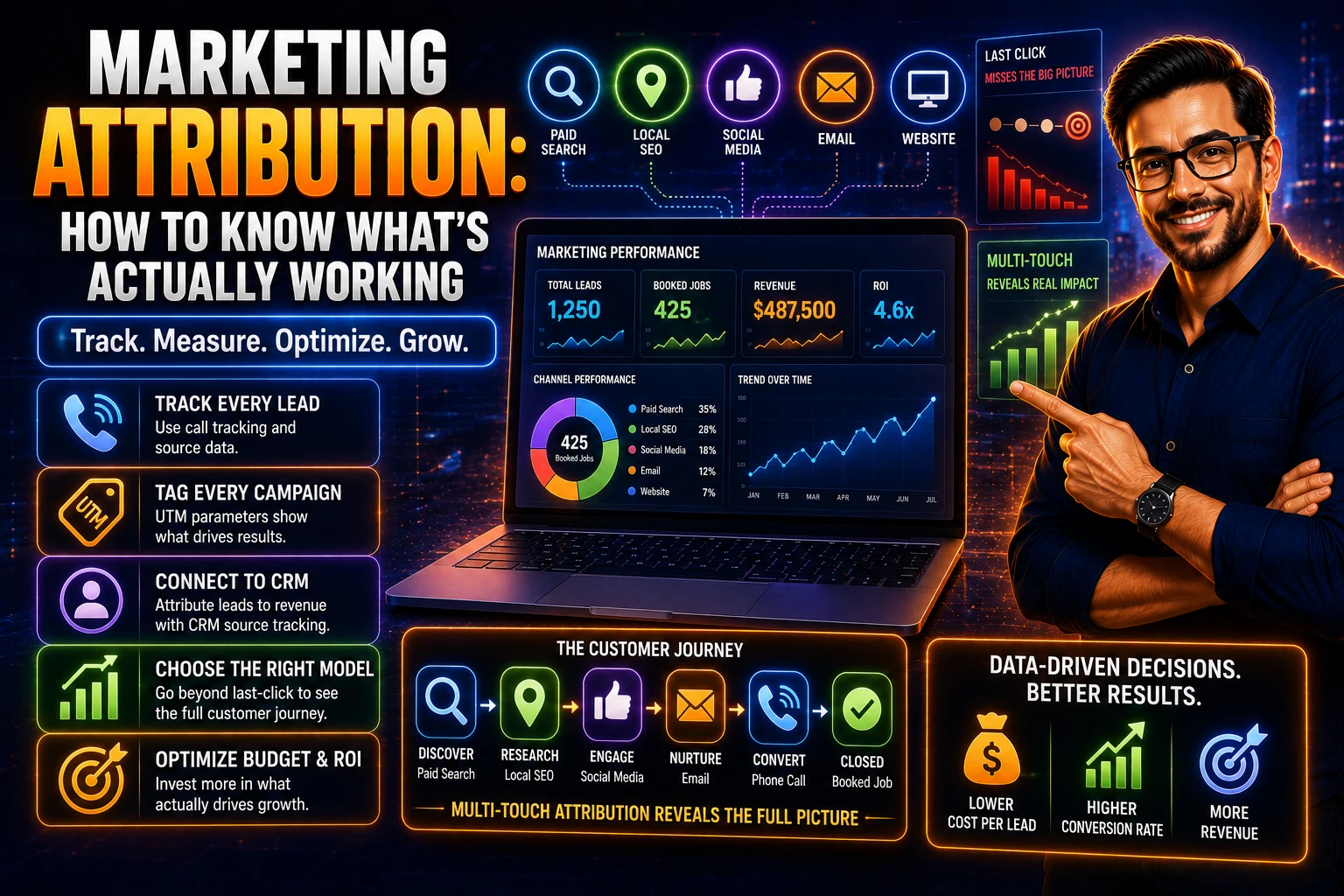
Marketing Attribution: How to Know What's Actually Working
Here's a problem every service-business owner runs into eventually: you're spending money on multiple marketing channels — SEO, Google Ads, Local Services Ads, social, referrals, email — and you can't tell which ones are actually producing the business. You see total leads and total revenue, but when you try to allocate the credit across channels, it gets murky fast. A customer might have first seen you in a Google search, then visited your website, then seen a retargeting ad, then asked a friend who knew you, and finally called from a Google Ads click. Which channel deserves credit for that customer? Which channel would have produced them without the others? These are attribution questions, and they're harder than they look.
Published: July 8, 2026 | Reading Time: ~9 minutes | Category: Strategy
Bad attribution leads to bad budget decisions. Cutting an SEO investment because Google Ads gets all the last-click credit — even though the SEO was building the brand awareness that made the Google Ads work — destroys long-term growth. Doubling down on the channel that 'shows results' while neglecting the channels that feed it produces short-term gains and long-term decline. The businesses that allocate marketing budget well aren't necessarily the ones with the most sophisticated attribution tools — they're the ones who understand the limits of attribution, build the practical measurement they actually need, and use judgment alongside data to allocate budget across the funnel.
This guide covers marketing attribution practically for service businesses: why perfect attribution doesn't exist (and accepting that), the common attribution models and what each gets right and wrong, the practical measurement service businesses can actually implement (call tracking, UTM parameters, how-did-you-hear-about-us, CRM source tracking), the trap of last-click thinking and how to avoid it, the incremental-lift approach that supplements traditional attribution, and how to use attribution data alongside judgment to allocate budget well. Whether you're trying to evaluate which channels are working or making bigger budget decisions, this is the honest framework.
What You'll Learn
- Why perfect attribution doesn't exist (and why accepting that frees you to measure what you can)
- The common attribution models and what each gets right and wrong
- Practical measurement service businesses can actually implement
- The last-click thinking trap and how it systematically undervalues upper-funnel channels
- Incremental lift testing as a supplement to traditional attribution
- How to use attribution data alongside judgment to allocate budget
Why Perfect Attribution Doesn't Exist
Customers don't move through marketing in clean, linear paths that can be perfectly tracked. They see your business in multiple places, often over months, before converting — a search result here, a social post there, a recommendation from a friend, a retargeting ad, a returning visit to your website. By the time they convert, the journey involved touches you can't see and influences you can't measure. Even with perfect tracking technology (which doesn't exist), the influence of brand awareness, word-of-mouth, and indirect touches would still be partially invisible.
Compounding this, the tracking technology itself is increasingly limited. Browser changes have eliminated many cross-site tracking capabilities. Privacy regulations restrict what can be measured. Apple's iOS changes broke many attribution flows. Cookies are unreliable. The tracking that worked five years ago doesn't fully work today, and the trend is toward less tracking, not more. The data we have is noisier and more incomplete than the marketing-attribution dashboards make it look.
ACCEPTING IMPERFECT ATTRIBUTION IS THE FOUNDATION: The most important attribution insight is that perfect attribution doesn't exist and never has. Accepting this isn't a defeat — it's the foundation for measuring what you can, using judgment for what you can't, and avoiding the false confidence that's worse than honest uncertainty. The businesses that allocate marketing budget well aren't the ones with the most expensive attribution tools; they're the ones who understand the limits of what attribution can tell them, measure the things they actually can measure, and use judgment alongside data. Trying to make budget decisions on last-click data as if it were full truth is worse than acknowledging the limits and triangulating from multiple imperfect signals.
The Common Attribution Models
Different attribution models distribute credit across the customer journey in different ways. None is 'right' — each captures part of the picture and misses other parts. Understanding what each model gets right and wrong helps you interpret what attribution dashboards are actually telling you.
- Last-click attribution: 100% of credit to the last touchpoint before conversion. Strengths: simple, easy to track, identifies the channel that closed the conversion. Weaknesses: completely ignores everything that built awareness and consideration before the final click — systematically underrating top-of-funnel investments.
- First-click attribution: 100% of credit to the first touchpoint. Strengths: highlights what's bringing new prospects into the funnel. Weaknesses: ignores everything that moved them through consideration and converted them.
- Linear attribution: credit distributed evenly across all touchpoints. Strengths: acknowledges the multi-touch reality. Weaknesses: weights every touch equally, even ones that probably contributed little.
- Time-decay attribution: more credit to touchpoints closer to conversion. Strengths: weights closer-to-conversion touches more heavily, which often reflects reality. Weaknesses: still systematically underweights early awareness.
- Position-based attribution: more credit to first and last touchpoints, less to middle ones. Strengths: emphasizes the introduction and the closer. Weaknesses: arbitrary weights, undervalues middle-of-funnel consideration.
- Data-driven attribution: credits based on actual modeling of how touches contributed to conversion in your data. Strengths: most empirically grounded. Weaknesses: requires significant conversion volume to work, still subject to all the underlying data limitations.
The honest takeaway: each model is a different lens on the same incomplete data. Sophisticated attribution work usually involves looking at the data through multiple models and seeing where they agree and disagree — convergent signals across models are more trustworthy than results from any single model.
Practical Measurement for Service Businesses
Service businesses don't need enterprise-grade attribution platforms to get useful measurement. Several practical approaches give you most of what you need.
Call Tracking
For service businesses where most leads come through phone calls (which is most of them), call tracking is the foundation of measurement. Call tracking assigns different phone numbers to different marketing channels (or webpages, or campaigns) and tracks which numbers are called. The result: you can see which channels and campaigns actually produced phone leads — the most important conversion type for most service businesses. Without call tracking, you're invisible to the calls your marketing produces, and most of your leads aren't being attributed at all. With call tracking integrated into the rest of your measurement, you see the full picture.
UTM Parameters and Consistent Tagging
UTM parameters are codes appended to URLs that identify the source, medium, and campaign of traffic in your analytics. Used consistently across all your marketing — every email link, every social post link, every ad — they let you see exactly which campaigns produced visits, conversions, and ultimately revenue. The discipline is implementing UTM tagging consistently and avoiding inconsistencies that make the data unusable. With consistent UTM tagging, your analytics shows actually useful campaign-level data.
How Did You Hear About Us
Asking new customers directly how they found you is the most undervalued attribution tool available. A simple field on the contact form or an early-conversation question captures information no tracking technology can — including channels (referrals, word-of-mouth, offline marketing) that don't appear in any analytics. The data is self-reported and imperfect (customers don't always remember accurately), but it captures the influence of channels that are invisible to digital tracking. For service businesses where referrals and brand awareness matter, this data is genuinely valuable.
CRM Source Tracking
Your CRM should track the lead source for every customer — not just the channel attribution from the tracking technology, but the manually-verified source after sales conversations. Combined with call tracking, UTM data, and how-did-you-hear-about-us answers, the CRM becomes the source-of-truth for which channels are actually producing customers and revenue. The trick is consistency: every lead tagged with source, every customer's revenue tied to source, every channel evaluated on the leads and revenue it produces.
PRO TIP: For most service businesses, the highest-leverage attribution improvement is implementing call tracking properly. Most service-business leads come through phone calls, and without call tracking those calls are invisible to your channel measurement — they look like they came from nowhere, leaving SEO, paid search, LSAs, and other channels under-credited. Call tracking with channel-specific numbers (or dynamic number insertion that swaps numbers based on traffic source) attributes phone leads to the channels that produced them. Combined with UTM tagging and CRM source tracking, this captures the substantial majority of where service-business leads actually come from. Start here before investing in more sophisticated attribution tools.
The Last-Click Trap
Most analytics platforms default to last-click attribution, and most business owners look at their data through that lens. The problem: last-click systematically undervalues upper-funnel channels (SEO, content, brand awareness, social) while overvaluing bottom-of-funnel channels (paid search, LSAs) that close conversions already pre-warmed by the upper-funnel work.
The pattern plays out predictably. The business owner looks at the data, sees Google Ads producing 'most' of the leads (in last-click data), and decides to shift more budget from SEO to Google Ads. SEO investment declines. Six months later, organic traffic is down, brand searches are down, the Google Ads cost-per-lead is rising (because there's less brand awareness driving people toward the ads), and total leads are declining. The 'data-driven' decision to cut SEO and invest in Google Ads destroyed the awareness that made the Google Ads work in the first place. This trap is one of the most common reasons marketing performance erodes over time, and last-click thinking is the culprit.
The defense: never make budget decisions based on last-click attribution alone. Always layer in additional signals — brand search volume trends, direct traffic, branded vs non-branded organic, the trend of cost-per-lead in your closer-to-conversion channels (rising costs often indicate upper-funnel decay). The upper-funnel channels that don't get last-click credit are usually the ones whose absence is felt months later in the closer-to-conversion channels' deteriorating performance. Protect the upper-funnel investments even when the last-click data doesn't credit them directly.
Incremental Lift Testing
A different approach to evaluating channels supplements traditional attribution: incremental lift testing. The idea is to measure what a channel actually adds — what would happen without it, compared to what happens with it. This sidesteps the attribution problem by testing causality directly.
- Geographic or audience holdouts: turn off a channel in specific geographies or audience segments and measure what happens to total conversions in those areas vs the rest. If turning off the channel doesn't reduce conversions, the channel may not be adding what attribution credits it with. If conversions drop meaningfully, the channel is producing genuine lift.
- Pause-and-restart tests: pause a channel for a defined period (a few weeks) and measure total conversions during the pause vs before and after. Some channels' contributions become visible only when they're removed.
- Channel-specific landing pages and tracking: route specific campaigns to dedicated landing pages with their own tracking, isolating the channel's contribution from cross-channel interference.
Incremental lift testing is more rigorous than attribution modeling because it tests cause and effect rather than just observing correlations. The catch: it requires the discipline to actually run the tests (which means temporarily reducing spend on potentially-working channels), patience to wait for results, and enough volume to see clear signals. For service businesses willing to run these tests on key channels, the results are often more useful for budget decisions than attribution dashboards.
Using Attribution Data Alongside Judgment
The honest practical approach to attribution combines the imperfect data with business judgment — neither replacing the other. Attribution data tells you what the measurement systems see; judgment fills in what they don't.
- Look at multiple signals: last-click conversions, attributed leads, brand search volume, direct traffic, how-did-you-hear-about-us answers, CRM source data, channel-specific cost-per-lead trends. Convergent signals across multiple measures are more trustworthy than any single number.
- Apply funnel logic: top-of-funnel channels (SEO, content, brand) feed the conversion channels (paid search, LSAs). Even if the conversion channels get last-click credit, sustain the upper-funnel investments that feed them.
- Use incremental tests for big decisions: before cutting a major channel investment based on attribution data, run a pause-and-restart test to see what actually happens without it.
- Trust patterns across customers: if your CRM source data and how-did-you-hear-about-us answers consistently show a channel producing customers, trust the pattern even when last-click attribution misses it.
- Beware of being too 'data-driven': sophisticated-sounding attribution methodologies built on incomplete data can produce confident-sounding wrong answers. Honest uncertainty about an imperfect picture beats false confidence in a precisely wrong one.
The Bottom Line
Marketing attribution is harder than it looks, perfect attribution doesn't exist, and the businesses that allocate budget well don't have magic measurement — they have practical measurement combined with sound judgment about what the data can and can't tell them. For service businesses, the practical foundation is call tracking (the highest-leverage attribution improvement, capturing the phone leads most service businesses depend on), UTM tagging implemented consistently, how-did-you-hear-about-us collection, and CRM source tracking. With these in place, you see most of where leads actually come from — not perfectly, but substantively.
Beyond the measurement, the discipline that matters most is avoiding the last-click trap. Last-click attribution systematically undervalues the upper-funnel channels that feed the conversion channels — and cutting upper-funnel investments based on last-click data is one of the most common ways marketing performance erodes over time. Layer in additional signals (brand search trends, channel cost trends, lift tests on big decisions), respect the funnel logic where upper channels feed lower ones, and apply judgment alongside the data. The businesses that triangulate from multiple imperfect signals make better budget decisions than the businesses that trust a single attribution model. Imperfect measurement combined with sound judgment beats sophisticated-sounding wrong answers every time.
Key Takeaways
- Perfect attribution doesn't exist — customers move through multi-touch journeys you can't fully track, and the tracking technology itself is increasingly limited. Accepting imperfect attribution is the foundation for making better decisions, not a defeat
- Common models (last-click, first-click, linear, time-decay, position-based, data-driven) each capture part of the picture and miss other parts — sophisticated attribution looks at multiple models and trusts convergent signals across them
- Practical measurement for service businesses: call tracking (the foundation, capturing phone leads that are invisible without it), UTM parameters consistently applied, how-did-you-hear-about-us collection (captures channels digital tracking misses), and CRM source tracking
- The highest-leverage attribution improvement for most service businesses is implementing call tracking properly — most service-business leads come through phone calls and without call tracking the channels producing them are dramatically under-credited
- The last-click trap systematically undervalues upper-funnel channels (SEO, content, brand) while overvaluing bottom-of-funnel channels (paid search, LSAs) — cutting upper-funnel investments based on last-click data is a common reason marketing performance erodes over time
- Incremental lift testing (geographic holdouts, pause-and-restart tests, channel-specific landing pages) tests cause and effect directly and is often more useful for big budget decisions than attribution dashboards
- The right approach combines imperfect data with sound judgment — look at multiple signals, apply funnel logic, run lift tests on big decisions, trust patterns across customer data, and beware of false confidence in precisely-wrong sophisticated-sounding attribution
READY TO BUILD A LEAD PIPELINE THAT'S YOURS? Astra Results Marketing builds practical measurement and attribution systems for service businesses — call tracking integrated with campaigns, UTM tagging across all channels, CRM source tracking, how-did-you-hear-about-us workflows, and the funnel-aware analysis that interprets the data without falling into the last-click trap. Stop making budget decisions on incomplete data with false confidence. See what's actually working — and what's feeding what's working. Astra Results Marketing · astraresults.com · (+1) 786-643-3036