Rated 5 star on

The Marketing Funnel: From Cold Traffic to Loyal Customers
Most service businesses think about marketing one tactic at a time. They run Google Ads. They post on social. They send emails. They invest in SEO. Each tactic gets evaluated on whether it's 'working' in isolation — and when something doesn't produce immediate results, it gets cut or replaced. This tactic-by-tactic thinking misses the most important reality of marketing: customers move through stages, and the marketing that produces real growth works at every stage of that journey, not just the conversion moment. The businesses that grow predictably aren't the ones running the most aggressive ads or having the cleverest social posts — they're the ones who've built a marketing system that captures customers at the top of the funnel, moves them through consideration, converts them efficiently, and turns them into loyal customers who refer more business.
Published: July 5, 2026 | Reading Time: ~10 minutes | Category: Strategy
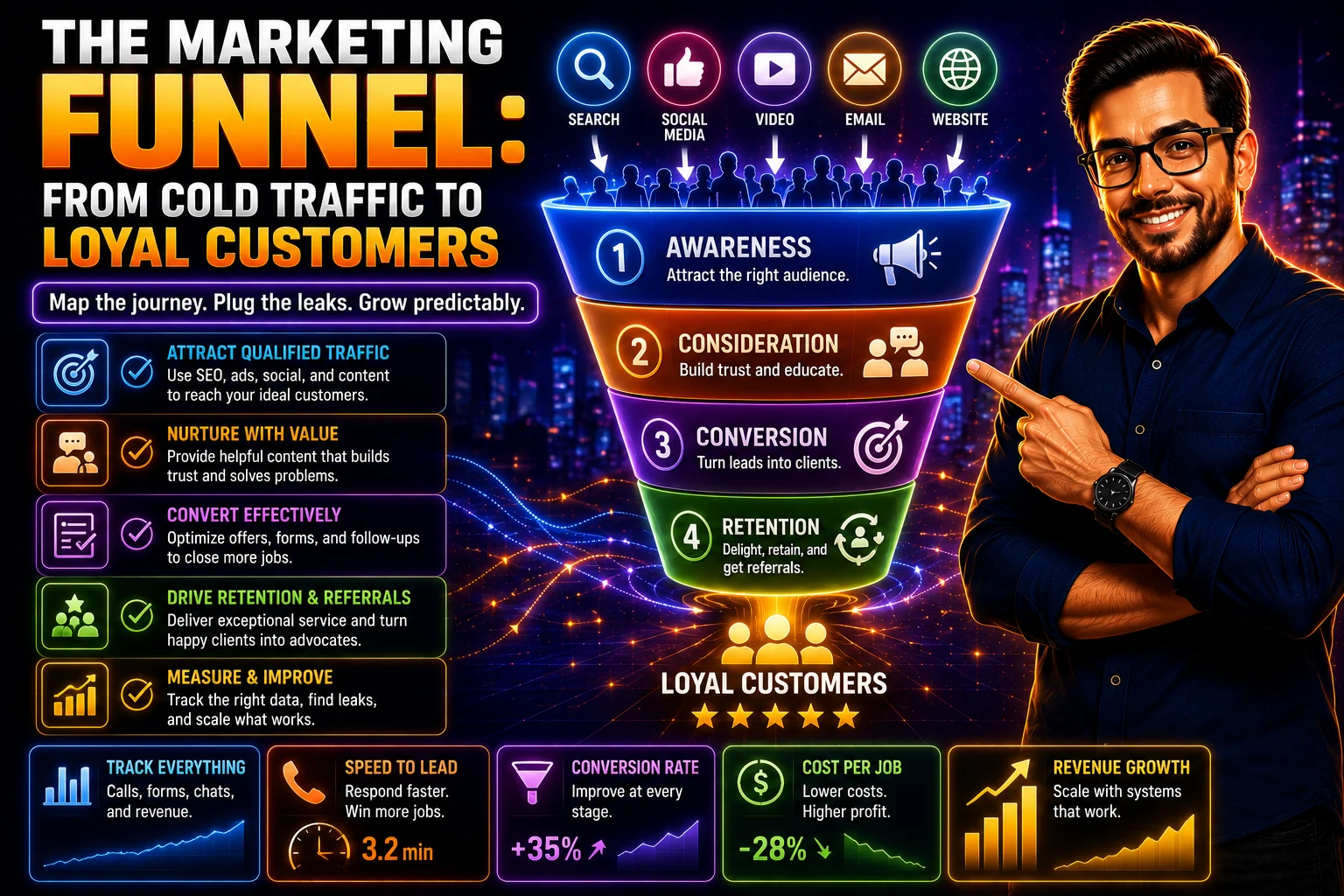
This is the marketing funnel, and it's the framework that turns scattered tactics into a coherent system. The funnel is the customer journey — from the moment someone first hears of you to the moment they become a paying customer to the moment they become a repeat customer and advocate. Each stage of the journey has different goals, different tactics, and different metrics. Marketing that ignores the funnel ends up over-investing in some stages (usually the conversion moment) while neglecting others (usually the top of the funnel where new customers enter and the bottom where they become advocates). Marketing built around the funnel captures customers at every stage and moves them through systematically.
This guide covers the marketing funnel in practical terms for service businesses: the stages of the funnel and what each requires, the channels and tactics that fit each stage, how to map your current marketing against the funnel to find gaps, the leaks that cost conversions at each stage, integration across stages that produces compounding growth, and measurement at each level. Whether your business is established and looking to grow or scaling and trying to systematize, this is the framework that turns scattered tactics into a system.
What You'll Learn
- The marketing funnel — the customer journey from cold traffic to loyal advocate
- The four stages and what each requires: awareness, consideration, conversion, retention/advocacy
- Which channels and tactics fit each stage of the funnel
- How to map your current marketing against the funnel to find gaps
- The leaks that cost conversions at each stage and how to fix them
- How integration across stages produces compounding growth
- How to measure the funnel at each level
What the Marketing Funnel Actually Is
The marketing funnel is a model of the customer journey — the sequence of stages a prospect moves through from never having heard of you to becoming a paying, loyal customer who refers more business. It's called a funnel because the volume decreases at each stage: many people enter the top (awareness), fewer move into consideration, fewer still convert into customers, and a subset of those become advocates who drive more business. Marketing that works addresses each stage, capturing prospects at the top and moving them through systematically.
Different models name the stages differently, but the essential progression is consistent. We'll use four stages because they fit service businesses cleanly: awareness (prospects discover your business exists), consideration (they evaluate whether you're the right choice), conversion (they become a customer), and retention/advocacy (they become a repeat customer who refers others). Each stage requires different things from your marketing — different content, different channels, different metrics — and the businesses that build effective marketing think about each stage deliberately.
WHY FUNNEL THINKING BEATS TACTIC THINKING: Most service businesses evaluate marketing tactic by tactic, asking whether each tactic 'works' in isolation. This produces predictable mistakes: cutting top-of-funnel investments (SEO, content, brand) because they don't immediately produce booked jobs, while over-investing in bottom-of-funnel tactics (paid search, LSAs) that depend on the top-of-funnel they just cut. Funnel thinking reveals that tactics work together — top-of-funnel investments fill the awareness pool that consideration tactics convert that conversion tactics close. Eliminating any stage starves the others. The marketing that grows the business systematically addresses every stage of the funnel, not just the one where customers visibly convert.
The Four Stages of the Service-Business Funnel
Stage 1 — Awareness (Top of Funnel)
Awareness is where new prospects discover your business exists. They might be searching for information, browsing social media, hearing about you through a referral, or encountering you through content or advertising. At this stage, they're not yet evaluating whether to hire you — they're just becoming aware that you're a possibility. The goal is volume and reach: getting your business in front of the right kinds of prospects so they enter the funnel.
Channels that fit awareness: SEO that captures informational searches, content marketing that demonstrates expertise, social media that builds presence, brand-awareness advertising, public relations and community engagement, referral programs that put your name in front of new audiences. The key is that awareness investments build the pipeline of people who could later become customers — they don't usually convert immediately, but they fill the top of the funnel that downstream stages depend on.
Stage 2 — Consideration (Middle of Funnel)
In consideration, prospects who are aware of you evaluate whether you're the right choice. They compare you to competitors, read your reviews, look at your website, consume your content, and decide whether to take the next step. The goal at this stage is to be the obvious choice when they decide to act — building the trust, credibility, and relevance that puts you ahead of competitors.
Channels and tactics that fit consideration: in-depth content that demonstrates expertise (case studies, guides, comparisons), reviews and testimonials that build trust, retargeting that keeps you in front of past visitors, email nurture sequences that build relationships, the website content that prospects find when researching, the Google Business Profile that searchers find when comparing. The consideration stage is where the prospect makes up their mind, and the marketing that wins is the marketing that builds the trust and authority that drives the choice.
Stage 3 — Conversion (Bottom of Funnel)
Conversion is where prospects who've decided to act become customers. They contact you, get a quote, book an appointment, sign a contract. The goal at this stage is to capture the conversion efficiently — making it effortless to contact you, qualifying the lead, following up fast, and closing the sale. This is the stage where most marketing measurement happens because conversions are easy to track.
Channels and tactics that fit conversion: Google Search ads on high-intent queries (someone searching 'plumber near me' is ready to convert), LSAs that capture exclusive leads at the moment of intent, optimized landing pages that convert traffic into leads, instant lead response (the speed-to-lead advantage), AI customer service that captures every call, and the sales process that converts qualified leads into signed customers. The conversion stage is where the prior stages pay off — and where weak execution destroys the value that awareness and consideration created.
Stage 4 — Retention and Advocacy (Beyond the Funnel)
Retention and advocacy are where customers become repeat customers and advocates. They come back when they need service again, they refer friends and family, they leave reviews, they enter maintenance plans or subscriptions. The goal is to maximize the lifetime value of each customer and convert customers into a referral and reputation engine that drives more business.
Channels and tactics that fit retention/advocacy: excellent service delivery (the foundation), systematic post-service review requests, referral programs, maintenance plans and recurring-service offerings (especially powerful for HVAC and other service categories), email and SMS communication that maintains the relationship, loyalty programs where applicable, and the customer experience that turns satisfied customers into advocates. The retention stage is where the customer base becomes a compounding asset rather than a one-time transaction.
Mapping Your Current Marketing Against the Funnel
Most service businesses have marketing that addresses some stages of the funnel and neglects others. The diagnostic exercise: map every marketing tactic you currently run against the funnel stage it serves, and see where the gaps are.
- Awareness: SEO for informational searches, content marketing, social media presence, brand awareness, referral programs. Many service businesses have weak top-of-funnel investment, depending on bottom-of-funnel channels to find new customers — which limits growth because the pipeline of new prospects is constrained.
- Consideration: in-depth content, reviews and ratings, retargeting, email nurture, website content, Google Business Profile. Many businesses have weak consideration-stage tactics, leaving prospects to evaluate them based on whatever they happen to find rather than a deliberate trust-building experience.
- Conversion: high-intent search ads, LSAs, landing pages, lead response, sales process. Most businesses concentrate marketing investment here because it's where conversions are easiest to track — sometimes to the exclusion of the other stages.
- Retention/Advocacy: service delivery quality, review generation, referral programs, maintenance plans, customer communication. Many businesses neglect this stage entirely, treating customers as one-time transactions rather than the compounding asset they could be.
After mapping, the gaps are usually obvious. Most businesses are over-invested in conversion-stage tactics and under-invested in awareness, consideration, or retention. Filling those gaps — particularly awareness (which feeds everything downstream) and retention (which compounds existing customer value) — is usually where the highest-ROI improvements are.
The Leaks That Cost Conversions at Each Stage
The funnel is leaky at every stage — prospects fall out at each transition, and most businesses lose more than they realize. Identifying and fixing the leaks is one of the highest-leverage things you can do to improve overall results.
Awareness Leaks
Awareness leaks are people who could have heard of you but didn't. You're not ranking for the informational searches your prospects use; your content isn't reaching the audience; your social presence is weak; you're invisible in the markets and demographics you should reach. The leak is the gap between the prospects you could have reached and the ones you actually did.
Consideration Leaks
Consideration leaks are people who became aware of you but chose someone else. Your reviews are weak compared to competitors; your website fails to communicate what makes you the right choice; prospects can't find the information they need; competitors are doing a better job of building trust. The leak is the prospects who knew you existed and still chose someone else.
Conversion Leaks
Conversion leaks are people who decided to act but didn't convert with you. They called and couldn't reach anyone; they filled out a form and didn't get a fast response; the landing page didn't convert them; your sales process lost them. The leak is the difference between the leads you could have closed and the ones you actually did.
Retention/Advocacy Leaks
Retention/advocacy leaks are customers you didn't keep or didn't convert into advocates. They had a fine experience but never came back; they didn't leave a review even though they were satisfied; they didn't refer friends because you never asked; they fell out of your customer base over time. The leak is the lifetime value and referral pipeline you didn't capture from customers you already won.
PRO TIP: Audit your funnel for leaks once a year and after any major business change. Walk through each stage as a prospect would — search for the things your customers search for, see if you appear; visit your website as a stranger and see what you find; contact your business and see how the response feels; reflect on what happens (and doesn't happen) after a customer's first service. The leaks become visible when you experience your own funnel from the outside, and most businesses find meaningful leaks they didn't realize existed. Fixing the leaks improves overall results without requiring you to drive more traffic — you're capturing more of the traffic you already have.
Integration Across Stages
The funnel produces compounding growth when the stages reinforce each other rather than operating in isolation. The awareness investments fill the top of the funnel that consideration tactics work on. The consideration tactics build the trust that conversion tactics close. The conversion stage produces customers who feed retention. The retention stage produces referrals that feed back into awareness. Each stage reinforces the others, and the system compounds over time.
This integration is why the funnel matters more than any individual tactic. A business with strong awareness (SEO, content, brand) but weak consideration (no reviews, weak website) wastes the awareness — prospects discover them but choose competitors. A business with strong consideration but weak conversion fails to capture leads it could have closed. A business with strong conversion but weak retention is constantly replacing churned customers rather than compounding their customer base. The whole system needs to work together, and the businesses that grow predictably build that system deliberately rather than running tactics in isolation.
Measuring the Funnel at Each Stage
Each stage of the funnel has its own metrics, and measuring the whole funnel reveals where the leaks and opportunities are.
- Awareness metrics: organic traffic and rankings, brand searches, social reach, referral source diversity — the pipeline of new prospects entering the funnel.
- Consideration metrics: time on site, pages per visit, content engagement, review volume and rating, returning visitors, retargeting engagement — the depth of engagement with prospects who've become aware of you.
- Conversion metrics: lead volume, conversion rate (visitors to leads, leads to customers), cost per lead, cost per booked job, speed-to-lead — the efficiency with which interested prospects become customers.
- Retention/advocacy metrics: customer lifetime value, repeat-customer rate, referral rate, review velocity, maintenance-plan membership (where applicable), churn rate — the value extracted from customers after the first conversion.
Looking at the whole funnel together reveals which stages are working and which aren't, and where the highest-ROI improvements are. A business with weak awareness should invest in top-of-funnel; a business with weak conversion should fix the conversion stage; a business with weak retention should build retention systems. The funnel metrics make the priorities obvious, where tactic-by-tactic measurement often doesn't.
The Bottom Line
The marketing funnel — awareness, consideration, conversion, retention/advocacy — is the framework that turns scattered tactics into a coherent system. Each stage requires different things, but they reinforce each other: awareness fills the pipeline that consideration converts that conversion closes that retention compounds. Service businesses that think tactic-by-tactic instead of funnel-by-funnel predictably under-invest in awareness and retention while over-investing in conversion, missing the system that produces compounding growth. Service businesses that build marketing around the funnel — addressing every stage deliberately, fixing the leaks, integrating across stages — grow predictably and compound their customer base over time.
Map your current marketing against the funnel and find the gaps. Audit each stage for leaks and fix them. Build the awareness, consideration, conversion, and retention infrastructure that the funnel requires. Measure each stage and use the data to direct investment. The funnel isn't a marketing buzzword — it's the framework that separates businesses with scattered marketing tactics from businesses with marketing systems that produce reliable, compounding growth. The shift from tactic thinking to funnel thinking is one of the highest-leverage strategic changes a service business can make.
Key Takeaways
- The marketing funnel — awareness, consideration, conversion, retention/advocacy — is the framework that turns scattered tactics into a coherent system; each stage requires different things and they reinforce each other
- Funnel thinking beats tactic thinking — businesses that evaluate tactics in isolation predictably under-invest in awareness (which feeds everything downstream) and retention (which compounds existing customers) while over-investing in conversion
- Awareness (top of funnel): SEO for informational searches, content marketing, social, brand awareness, referrals — fills the pipeline of new prospects that downstream stages depend on
- Consideration (middle): in-depth content, reviews and ratings, retargeting, email nurture, website, GBP — builds the trust and relevance that drives prospects to choose you over competitors
- Conversion (bottom): high-intent search ads, LSAs, landing pages, fast lead response, AI customer service, sales process — captures the conversion efficiently when prospects decide to act
- Retention/advocacy (beyond): service delivery, review generation, referral programs, maintenance plans, customer communication — turns customers into a compounding asset that drives more business
- Audit your funnel for leaks at each stage, integrate the stages so they reinforce each other, and measure each level — the funnel produces compounding growth when the stages work together, and stalled growth when stages are neglected
READY TO BUILD A LEAD PIPELINE THAT'S YOURS? Astra Results Marketing builds marketing systems around the funnel — awareness infrastructure that fills the pipeline, consideration tactics that build trust, conversion systems that capture leads, and retention engines that turn customers into repeat and referral business. We help service businesses move from scattered tactics to integrated systems that produce compounding growth. Stop running tactics in isolation. Build the funnel that compounds. Astra Results Marketing · astraresults.com · (+1) 786-643-3036