Rated 5 star on

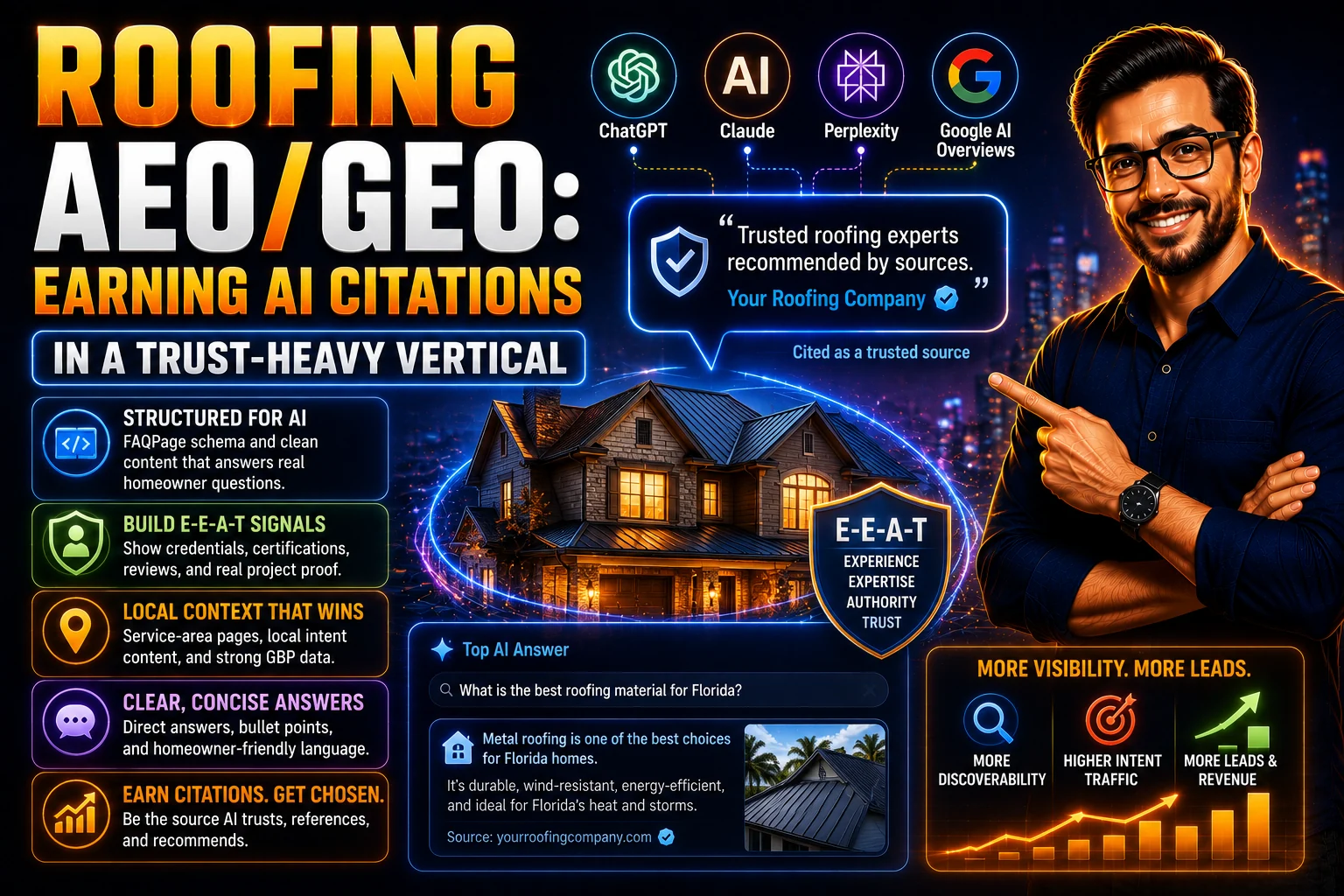
Roofing AEO/GEO: Earning AI Citations in a Trust-Heavy Vertical
Search is changing faster than at any point since the original Google PageRank algorithm. AI-generated answers from ChatGPT, Claude, Perplexity, Google's AI Overviews, Gemini, and emerging tools increasingly consume search behavior that previously went to traditional results. Roofing customers asking 'how do I know if my roof needs to be replaced,' 'how much does a roof replacement cost,' 'how do I choose a roofing contractor,' or 'what should I do after storm damage' are increasingly getting AI-generated answers — and the businesses cited in those answers capture awareness, consideration, and decision influence in ways that ranking traditionally on page 2 of Google can't replicate. AEO (Answer Engine Optimization) and GEO (Generative Engine Optimization) — the practices that earn citations in AI-generated answers — represent the next evolution of search optimization, and operations that build the foundations now position themselves for the search behavior shift already underway.
Published: July 24, 2026 | Reading Time: ~11 minutes | Category: Roofing Marketing — AEO/GEO
Roofing is particularly affected by this shift because the vertical involves substantial-dollar trust-sensitive decisions where customers spend substantial research time before contractor selection. The research-phase searches that AI tools increasingly answer ('signs my roof needs replacement,' 'how to evaluate roofing contractors,' 'what manufacturer warranty actually covers,' 'insurance claim process for roof damage') represent the awareness and consideration journey customers go through before they're ready to contact contractors. AI tools that surface specific roofing operations in their answers — by name, with substantive citation — capture this attention in ways traditional SEO doesn't, with downstream effects on which operations customers consider when they're ready to engage.
This guide covers AEO/GEO for roofing operations: what AEO and GEO actually are, why the trust-heavy nature of roofing decisions makes AI citation particularly valuable, the content structures and signals that AI systems extract well, the E-E-A-T framework as it applies to roofing authority, FAQPage schema as foundation, the question patterns customers ask AI about roofing, multi-AI optimization across ChatGPT, Claude, Perplexity, Google AI Overviews, and Gemini, the measurement approach that distinguishes effective AI optimization from theater, common mistakes that undermine AI citation potential, and how operations build the foundations now for the search behavior shift continuing through the next several years.
What You'll Learn
- What AEO and GEO are and how they differ from traditional SEO
- Why trust-heavy roofing decisions make AI citation particularly valuable
- Content structures and signals AI systems extract well
- E-E-A-T framework applied to roofing authority signals
- FAQPage schema as foundation for AI answer extraction
- Question patterns customers ask AI about roofing
- Multi-AI optimization (ChatGPT, Claude, Perplexity, Google AI Overviews, Gemini)
- Measurement approach for AI citation and brand mention
- Common mistakes that undermine AI citation potential
What AEO and GEO Actually Are
Answer Engine Optimization (AEO) and Generative Engine Optimization (GEO) are related disciplines focused on earning visibility in AI-generated answers — the synthesized responses AI systems produce when users ask questions. They share substantial overlap with traditional SEO but emphasize different signals and content structures.
- AEO focuses on optimizing content for direct-answer extraction — the kind of definitive responses search engines and AI tools surface for specific questions. Featured snippets, voice search responses, and AI-generated answers all share AEO principles: clear declarative answers, well-structured content, factual specificity.
- GEO extends AEO into the generative AI context specifically — how AI systems like ChatGPT, Claude, Perplexity, and Google AI Overviews evaluate, synthesize, and cite sources when generating responses. GEO emphasizes the authority and trust signals AI systems weight in their source selection.
- Both overlap with traditional SEO substantially: well-structured content, factual accuracy, topical authority, and credible source signals matter for both AI and traditional search.
- The distinction from traditional SEO: where SEO emphasizes ranking in lists of results, AEO/GEO emphasizes being cited or referenced in synthesized answers. A customer reading an AI-generated answer that mentions your business by name receives different (often stronger) brand exposure than seeing your link in position 3 of organic results.
WHY AI CITATION MATTERS NOW IN ROOFING: AI search consumes increasing share of search behavior that previously went to traditional engines, and the trend is accelerating rather than slowing. For roofing specifically, the research-phase searches that AI tools increasingly answer represent the awareness and consideration journey before customers contact contractors. Operations cited in AI-generated answers ('I'd recommend looking at credentialed contractors with ISA or TCIA certifications — companies like [your business] in [your area] are examples of operations that hold these credentials') capture brand exposure and credibility positioning during research phases that traditional ranking doesn't access. The build is foundational — the foundations laid now position operations for the search behavior shift continuing through the next several years.
Why Trust-Heavy Roofing Makes AI Citation Particularly Valuable
- Research time before contractor selection is substantial for roofing. Customers researching roof replacement, storm damage response, or material decisions often spend hours across multiple sessions before contacting contractors. The brand exposure during these research sessions affects which contractors they eventually consider.
- AI systems show source preference for authoritative content. Trust-sensitive AI use cases (medical, financial, substantial-dollar home improvement) weight authoritative source signals more heavily than entertainment or general-knowledge contexts. Roofing decisions fit this trust-heavy category.
- Roofing involves question patterns AI handles particularly well. 'How do I know if my roof needs replacement,' 'what's the cost of a new roof,' 'how do I evaluate roofing contractors' — these definitional and procedural questions are the types AI tools answer thoroughly, with citations to sources providing the underlying information.
- Local AI considerations matter for roofing. AI tools increasingly factor location into answers, recommending or referencing local operations in geographically-tagged responses. Operations with strong local AI presence access referrals through these surfaces.
- AI tools cite manufacturer certifications and industry credentials prominently. Operations with verifiable credentials (GAF Master Elite, CertainTeed SELECT ShingleMaster, ISA-Certified Arborist for tree work, etc.) get cited more often as examples of credentialed operators.
Content Structures and Signals AI Extracts Well
AI systems extract certain content structures more effectively than others. Building content with extraction in mind improves citation potential substantially.
Direct Declarative Answers
Content that opens with direct declarative answers to common questions extracts better than content that buries answers in extended preamble. 'Asphalt shingle roofs typically last 20-30 years' extracts cleaner than 'There are many factors that affect roof lifespan including the material used, the climate of the installation location, the quality of installation...' even if the second eventually says the same thing.
Well-Structured Hierarchical Content
Clear heading hierarchies (H1, H2, H3) with logical content organization helps AI systems parse and extract relevant sections. Content structured as natural question-and-answer formats with clear section breaks extracts well; wall-of-text content extracts poorly.
Factual Specificity
Specific facts, numbers, ranges, and concrete examples cite better than vague generalities. 'GAF Master Elite contractors represent approximately 2% of roofing contractors nationally' is more citable than 'GAF has a top tier of contractors.'
Comparison Content
Direct comparisons between options (asphalt vs metal roofing, repair vs replacement, different manufacturer programs) are exactly the format AI systems use when answering 'should I do X or Y' questions. Building substantive comparison content earns citations when customers ask comparison questions.
Process and How-To Content
Step-by-step processes for substantial procedures (how the insurance restoration process works, how roof inspection should proceed, how to evaluate contractors) extract well into AI answers when customers ask procedural questions.
FAQ Format with Schema
FAQ content marked with FAQPage schema is among the most-cited content formats in AI answers. The schema explicitly signals 'here is a question and here is an answer' that AI systems extract directly. FAQPage schema deployment across substantive question-answer content is foundational AEO infrastructure.
E-E-A-T Applied to Roofing Authority
Google's E-E-A-T framework (Experience, Expertise, Authoritativeness, Trustworthiness) shapes both traditional ranking and AI source selection. For roofing specifically, the framework applies in distinct ways operations can build deliberately.
- Experience: documented years in business, substantial completed project portfolios, case studies demonstrating actual work, photos of completed jobs at scale. Operations that can demonstrate substantial roofing experience earn AI source preference over operations without comparable evidence.
- Expertise: manufacturer certifications (GAF Master Elite, CertainTeed SELECT ShingleMaster, Owens Corning Platinum Preferred), ISA-Certified Arborist or other credentials, contractor licensing, industry association memberships. Visible verifiable credentials signal expertise AI systems weight.
- Authoritativeness: established web presence with substantive content, industry recognition (awards, certifications, media mentions), citations from other authoritative sources in the roofing space. Building authoritative signals takes time but produces durable AI citation potential.
- Trustworthiness: substantial review history with high ratings, business establishment indicators (verifiable address, phone, history), insurance and license verification documents available, transparent pricing and policies. Trust signals affect both human customer evaluation and AI source preference.
FAQPage Schema as Foundation
FAQPage schema is among the most underused and highest-leverage AEO improvements available to most roofing operations. The schema explicitly marks content as 'here is a question and here is an answer,' which AI systems extract directly into generated responses.
- Service pages with comprehensive FAQ sections marked with FAQPage schema: each major service (roof replacement, repair, storm damage, insurance restoration, commercial) with substantive FAQ covering the common questions customers ask about that service.
- Decision-help content with FAQ format: when to repair vs replace, how to choose contractor, what to expect during the process — formatted as questions with substantive answers and marked with schema.
- Material and product FAQ: lifespan, maintenance, comparison across options, warranty considerations — content customers research before contractor selection.
- Insurance process FAQ: claim process, documentation requirements, working with adjusters, public adjuster considerations — answers customers seek during active claims.
- Storm damage FAQ: damage identification, immediate response, contractor selection after storms — captures the substantial post-storm research traffic.
- Local FAQ where appropriate: questions specific to your service area, regional considerations, local permit requirements — captures location-modified searches AI systems increasingly serve geographically.
PRO TIP: Building substantive FAQ content with FAQPage schema across your service pages is among the highest-leverage single SEO/AEO investments available to most roofing operations. The content serves traditional SEO (long-tail keyword targeting), conversion (customers researching get direct answers without leaving your site), AEO (AI systems extract FAQPage-marked content into answers), and customer trust (substantive helpful content signals competence). The investment is 15-25 substantive Q&A pairs per service page with proper schema markup — a few weeks of focused content work that produces compounding returns across multiple optimization dimensions for years. Most roofing operations have weak or no FAQ infrastructure; building it represents a clear competitive advantage in current and emerging search behavior.
Question Patterns Customers Ask AI About Roofing
- Lifespan and replacement timing: 'how long does a roof last,' 'when should I replace my roof,' 'signs my roof needs replacement,' 'how old is too old for a roof.'
- Cost questions: 'how much does a new roof cost,' 'asphalt vs metal roof cost,' 'cost of roof repair,' 'insurance vs out-of-pocket roof replacement.'
- Material comparisons: 'asphalt vs metal roofing,' 'best roofing material for [climate/condition],' 'tile roof pros and cons,' 'TPO vs EPDM commercial.'
- Damage identification: 'how to identify hail damage,' 'signs of wind damage,' 'how to spot a roof leak,' 'what does shingle damage look like.'
- Contractor evaluation: 'how to choose a roofing contractor,' 'questions to ask roofers,' 'roofing contractor credentials,' 'how to avoid bad roofers.'
- Process questions: 'how long does roof replacement take,' 'what to expect during roof replacement,' 'roof replacement timeline,' 'do I need to move out during roof work.'
- Insurance and storm response: 'how to file roof insurance claim,' 'do I need a public adjuster,' 'roof insurance claim process,' 'what to do after storm roof damage.'
- Warranty and maintenance: 'roof warranty considerations,' 'roof maintenance,' 'how to extend roof life,' 'when to inspect roof.'
- Local and geographic: 'best roofers in [city],' 'roofing contractors near me,' 'where to find storm damage roofers.'
Multi-AI Optimization Across Platforms
Different AI systems weight signals differently and surface different sources. Optimization across multiple platforms produces broader citation presence than focusing on any single platform.
ChatGPT (OpenAI)
ChatGPT users often ask broader research questions and ChatGPT provides synthesized answers drawing from its training data and web-search capabilities. Comprehensive content with strong topical authority signals tends to earn references in ChatGPT responses. ChatGPT's search-enabled mode (when active) pulls from live web results, making current substantive content valuable for citation.
Claude (Anthropic)
Claude users often ask analytical and research questions. Claude weights factual accuracy, balanced presentation, and authoritative sources. Substantive long-form content with clear factual specificity tends to cite well in Claude responses.
Perplexity
Perplexity is search-native, citing sources prominently in every response with direct attribution. Substantial content that ranks well in traditional search also tends to surface in Perplexity citations, with Perplexity's distinctive emphasis on source attribution making citations particularly visible.
Google AI Overviews (formerly SGE)
Google's AI Overviews surface in standard Google search results, drawing from sources Google's broader systems have evaluated. Strong traditional SEO foundations support AI Overview citation. FAQPage schema is particularly important for AI Overview extraction.
Gemini (Google)
Gemini handles broader query patterns and increasingly powers Google's search results across multiple surfaces. Optimization that supports Google traditional ranking generally supports Gemini citation.
Emerging Platforms
New AI search tools continue emerging. Operations building substantive content infrastructure position themselves for citation across platforms emerging without requiring platform-specific optimization for each.
Measurement of AI Citation Performance
- Manual testing across AI platforms: periodic queries about your service category, geography, and roofing topics to observe whether your operation surfaces in answers. Imperfect but reveals presence vs absence in AI surfaces.
- Brand mention tracking: tools that monitor mentions of your business name across web content can surface AI-generated content quoting your operation. Catches some AI citation activity.
- Referral traffic from AI platforms: Google Analytics and similar tools increasingly distinguish AI-platform referrers (ChatGPT, Perplexity, etc.). Growth in AI-platform referral traffic indicates citation activity.
- Branded search volume: increasing branded search volume often correlates with broader brand exposure including AI citation. Direct attribution is difficult, but the correlation provides signal.
- Direct customer feedback: customers who mention finding you through AI ('ChatGPT recommended you' or 'AI search suggested') provide direct evidence of AI citation success.
- Competitor citation analysis: observing which competitors get cited in AI answers about your topics reveals competitive positioning in AI surfaces.
Common Mistakes That Undermine AI Citation
- Generic content without distinctive value. AI systems cite sources that add substantive information; content that just restates what other sources say doesn't earn citation. Distinctive perspectives, specific data, and original insights cite better than restated common knowledge.
- Weak factual specificity. AI systems prefer concrete facts over vague generalizations. Content rich in specific numbers, examples, and concrete details cites better than content trafficking in generic claims.
- Thin or auto-generated content. Quality matters more than quantity for AI citation. Substantive long-form content with depth outranks thin content scaled across many pages.
- Poor structural hierarchy. Wall-of-text content extracts poorly. Clear heading hierarchies, logical organization, and direct-answer formatting support extraction.
- Missing schema markup. FAQPage schema and other structured data markup signal content meaning to AI systems. Content without schema markup gets extracted less reliably.
- Weak E-E-A-T signals. Operations without visible credentialing, experience evidence, authority signals, and trust indicators struggle to earn citation in trust-heavy AI contexts.
- Outdated content. AI systems prefer current information for time-sensitive topics. Content not updated to reflect current information cites less frequently than content showing recency.
- Treating AEO as separate from broader marketing. AEO works best as part of integrated content strategy supporting SEO, customer trust, and conversion alongside AI citation. Operations approaching AEO as separate optimization typically produce weaker results than operations building integrated content infrastructure.
The Bottom Line
Search behavior is shifting toward AI-generated answers, and the shift is accelerating rather than slowing. Roofing operations that build AEO/GEO foundations now position themselves for the search behavior continuing to shift through the next several years. The vertical is particularly affected because the substantial-dollar trust-sensitive nature of roofing decisions involves substantial research before contractor selection, AI tools handle the research-phase questions customers ask, and operations cited in AI answers capture brand exposure and credibility positioning that ranking on page 2 of traditional results doesn't access.
The build is concrete: comprehensive FAQ content marked with FAQPage schema across service pages, substantive comparison and decision-help content with direct declarative answers, E-E-A-T signals built through visible credentialing and experience evidence, content structures optimized for AI extraction (clear hierarchies, factual specificity, direct-answer formatting), and integrated approach treating AEO as extension of broader content strategy rather than separate optimization. Operations building this infrastructure now develop competitive position in AI search that operations starting later can't quickly match. For roofing operations serious about future-positioning marketing infrastructure, AEO/GEO foundations represent one of the highest-leverage strategic investments currently available. The work compounds across years, and the operations that build it early access AI citation presence as it becomes increasingly important.
Key Takeaways
- AEO (Answer Engine Optimization) and GEO (Generative Engine Optimization) earn citations in AI-generated answers — increasingly important as AI search consumes search behavior that previously went to traditional engines
- Roofing is particularly affected because substantial-dollar trust-sensitive decisions involve substantial research time, AI tools handle research-phase questions, and operations cited in AI answers capture brand exposure traditional ranking doesn't access
- Content structures AI extracts well: direct declarative answers, well-structured hierarchical content, factual specificity, comparison content, process and how-to content, FAQ format with FAQPage schema
- E-E-A-T applied to roofing: Experience (documented years, completed projects, case studies), Expertise (manufacturer certifications, ISA credentials, licensing), Authoritativeness (substantive web presence, industry recognition), Trustworthiness (substantial reviews, business establishment, verification documents)
- FAQPage schema is foundational AEO infrastructure — service-page FAQs covering common questions extract directly into AI answers. Most roofing operations have weak or no FAQ infrastructure; building it produces compounding returns
- Question patterns customers ask AI about roofing: lifespan/replacement timing, cost questions, material comparisons, damage identification, contractor evaluation, process questions, insurance/storm response, warranty/maintenance, local/geographic
- Multi-AI optimization across ChatGPT, Claude, Perplexity, Google AI Overviews, Gemini, and emerging platforms — different systems weight signals differently; substantive content infrastructure positions operations for citation across platforms
- Measurement: manual testing across platforms, brand mention tracking, referral traffic from AI platforms, branded search volume trends, direct customer feedback, competitor citation analysis
- Common mistakes that undermine AI citation: generic content without distinctive value, weak factual specificity, thin or auto-generated content, poor structural hierarchy, missing schema, weak E-E-A-T signals, outdated content, treating AEO as separate from broader marketing
- AEO/GEO foundations are among the highest-leverage strategic investments currently available — the build compounds across years, and operations starting now develop competitive AI citation position that later starters can't quickly match
READY TO BUILD A LEAD PIPELINE THAT'S YOURS? Astra Results Marketing builds AEO/GEO foundations for roofing operations — comprehensive FAQ content with FAQPage schema markup, substantive comparison and decision-help content, E-E-A-T signal development, content structures optimized for AI extraction, multi-platform optimization, and the integrated approach that develops AI citation alongside traditional SEO and conversion. Stop watching competitors get cited in AI answers while your operation gets ignored. Build the foundations that position your operation for the search behavior shift continuing through the next several years. Astra Results Marketing · astraresults.com · (+1) 786-643-3036