Rated 5 star on

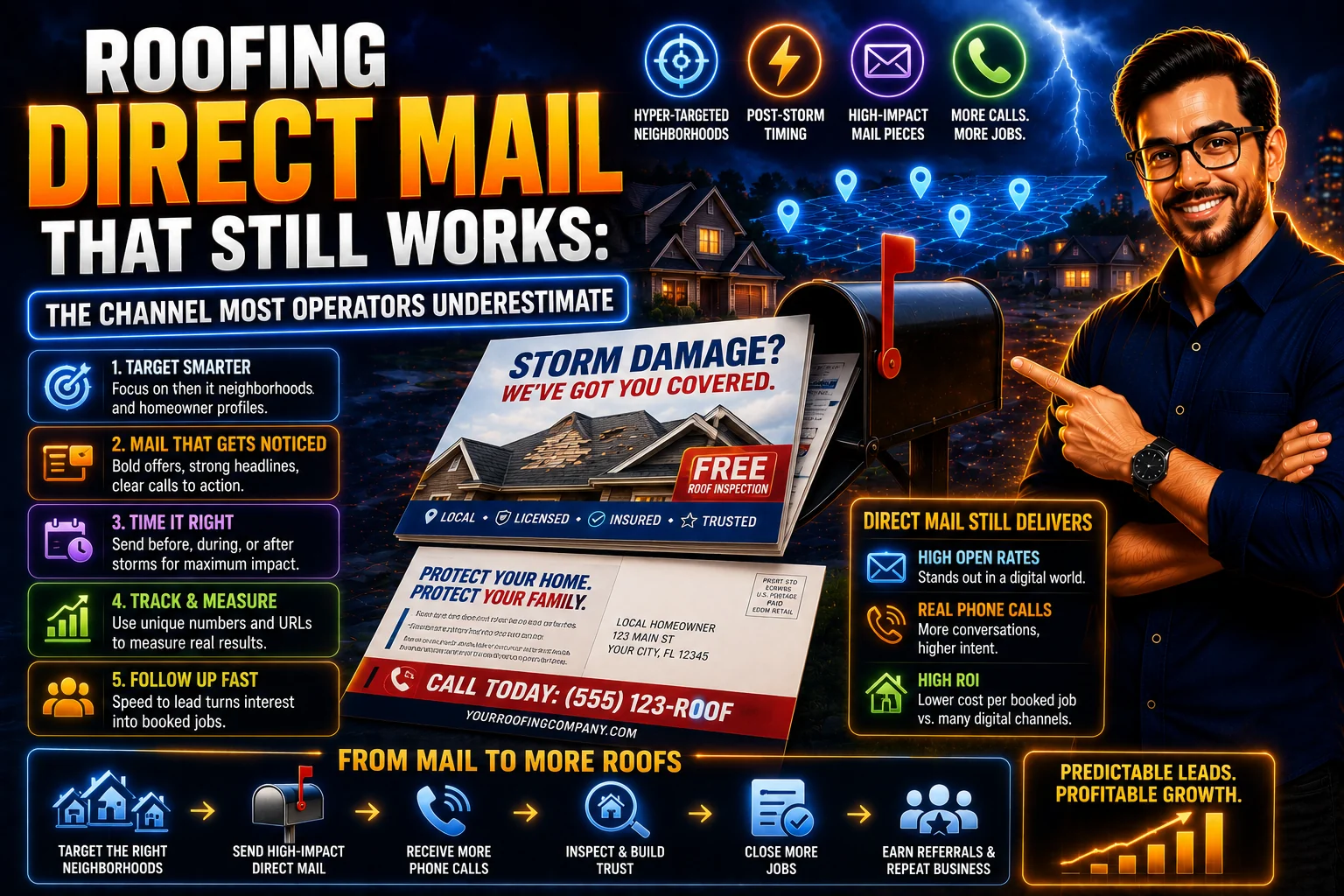
Roofing Direct Mail That Still Works: The Channel Most Operators Underestimate
Direct mail isn't dead in roofing. It's just unfashionable — overshadowed by digital channels that get more conversation in marketing media. The roofing operations running disciplined direct mail programs alongside their digital marketing capture leads that pure-digital competitors miss entirely, at unit economics often outperforming the saturated digital channels everyone else is bidding up. Direct mail works particularly well for roofing because the buying behavior often involves homeowners noticing roof issues over time (visible damage, age, neighborhood replacement patterns) rather than searching urgently, and well-targeted mail catches them when the latent concern becomes active intent. The substantial roof replacement job values justify per-piece mailing costs that lower-ticket categories couldn't sustain.
Published: July 24, 2026 | Reading Time: ~8 minutes | Category: Roofing Marketing — Direct Mail
This guide covers direct mail for roofing operations practically: when direct mail works (and when it doesn't), the targeting that drives response rates, mail formats that perform for roofing specifically, message and offer disciplines that produce booked jobs, timing strategies including the high-leverage storm response window, integration with digital marketing that produces strongest combined performance, A/B testing methodology that improves results over time, commercial direct mail as a distinct application, and measurement that distinguishes working mail from wasted budget. Whether you've never tried direct mail or tried it badly and concluded it doesn't work, this is the practical playbook.
What You'll Learn
- When direct mail works for roofing and when it doesn't
- Targeting that drives response rates (mature-roof neighborhoods, demographic and value filters)
- Mail formats that perform for roofing specifically
- Message and offer disciplines that produce booked jobs
- Timing strategies including high-leverage storm response windows
- Integration with digital marketing for combined performance
- A/B testing methodology that improves results over time
- Commercial direct mail as distinct B2B application
- Measurement that distinguishes working mail from wasted budget
Why Direct Mail Survives in Roofing
- Slow-emerging recognition of need. Homeowners notice roof aging, visible damage, neighborhood replacement patterns over time. Mail catches them at the moment the concern activates, often before they'd search online.
- Substantial job values justify per-piece costs. Roof replacement averaging $10K-$30K+ supports per-piece mailing costs that lower-ticket categories can't sustain.
- Geographic targeting precision possible. ZIP and carrier route targeting reaches specific neighborhoods with mature housing stock where roofing demand concentrates.
- Mature-roof demographics are identifiable. Home age data, owner-occupied filters, and home value indicators identify the households most likely to need roofing work in defined timeframes.
- Storm response opens specific windows. Post-storm direct mail to affected ZIP codes produces particularly high response rates when timed correctly.
- Trust-sensitive substantial-dollar decisions favor substantive communication. Mail format allows substantive trust-building content (credentialing, before/after photos, testimonials) that digital ads can't match.
WHY MOST ROOFING DIRECT MAIL UNDERPERFORMS: Most roofing operations that try direct mail test once with a generic postcard, get weak results, and conclude mail doesn't work. The conclusion is wrong; the test was insufficient. Disciplined mail programs run for 6-12 months minimum with multiple format and message tests, track response and cost-per-booked-job rigorously, refine based on data, and build cumulative brand presence that compounds over time. Mail isn't a one-shot tactic; it's a sustained channel producing meaningful lead flow when run with the same discipline applied to digital channels. Operations testing once and giving up miss what disciplined operations capture sustainably.
Audience Targeting
- Geographic targeting to ZIP codes and carrier routes with mature housing stock — typically established residential neighborhoods with substantial homes 15-30+ years old where roofing demand concentrates.
- Home age filtering: homes built 15-25 years ago are entering the replacement-consideration window for asphalt shingle roofs (typical lifespan); homes 20-30+ years old face more urgent replacement timelines.
- Home value filtering: higher-value homes typically have substantial roofs, justifying contractor pricing structures that match the operation's positioning.
- Owner-occupied filters: owners are decision-makers for roofing; rental properties are typically managed differently (property managers as decision-makers, different sales cycle).
- Seasonal layering: target list adjustments by season (post-winter damage assessment season, pre-summer storm preparation, fall pre-winter maintenance) match seasonal demand patterns.
- Storm-response targeting: rapid deployment to affected ZIP codes within days of storm events captures affected homeowners during decision-making windows.
- Commercial-targeted lists: property managers, HOA boards, commercial real estate contacts compiled from public records and professional directories for B2B mail.
Mail Formats That Perform
Postcards
Lower per-piece cost, broad reach, simple message constraint forcing clarity. Best for awareness, seasonal offers, and simple credibility messages. Effective when designed well; ineffective when designed as visual clutter. Substantial-stock postcards (oversized or premium card stock) outperform standard postcards in roofing because the substantial-dollar nature of the work supports investment in substantial-feeling marketing materials.
Letter-Format Mail
Higher per-piece cost but allows substantial content — credentialing explanation, before-and-after photos, testimonials, specific offer detail. Performs better for considered decisions where the prospect needs to evaluate trust and competence before responding. Often outperforms postcards in cost-per-booked-job even at higher per-piece cost. For roofing specifically (substantial-dollar trust-sensitive decision), letter format is often the superior choice over postcards despite the cost premium.
Self-Mailers and Brochures
Folded formats giving more space than postcards without envelope cost of letters. Useful for visual-heavy content (project galleries, before/after presentations, service overview) and trust-building messaging. Tri-fold and bi-fold formats work well for roofing where visual evidence of completed work carries weight.
Every Door Direct Mail (EDDM)
USPS program for saturated mailings to all addresses on selected carrier routes. Reduces per-piece cost substantially for high-volume geographic targeting. Useful for storm-response markets (saturating affected areas), neighborhood-saturation campaigns, and brand-building in target service areas. The trade-off is reduced targeting precision compared to addressed mail.
Dimensional and Premium Mail
Higher-cost premium formats (dimensional mail, premium card stock, branded packages) for specific use cases — commercial outreach, high-value residential targeting in premium ZIP codes, or post-storm restoration positioning to substantial damage areas. The cost is meaningful but response rates can justify the investment for the right targets.
Message and Offer Disciplines
- Lead with credibility, not pitch: credentialing (manufacturer certifications, years in business, license/insurance verification) communicated visibly. The recipient should immediately see why you're the trustworthy choice.
- Concrete offers beat vague claims: free assessment, seasonal discount, specific service package, financing option — gives the recipient a reason to respond now rather than file the mail away.
- Address the real concern: 'is your roof reaching end of life?' or 'storm damage assessment available' speaks to actual situations the recipient may be in. Generic 'roofing services available' messaging gets ignored.
- Multiple response paths: phone, website URL, QR code, text option. Different recipients prefer different paths.
- Substantial trust signals: before/after photos, brief testimonials, photos of credentialed team, geographic-area service confirmation, license and insurance verification, manufacturer certifications prominent.
- Honest scarcity where applicable: 'limited capacity this storm season' or 'spring scheduling fills by April' creates legitimate urgency when true. False scarcity destroys credibility.
- Visual content that matters: actual completed projects, real team members, equipment imagery that signals capability. Stock photography of generic roofs reduces credibility.
Timing Strategies
Pre-Spring (Late Winter)
Catches homeowners thinking about spring roofing work before the rush. Particularly effective in markets where winter damage becomes visible as snow melts and homeowners assess what needs attention.
Pre-Storm-Season
In storm-prone markets, the months leading into storm season produce homeowners thinking about preparation. Mail addressing roof condition assessment and storm preparation captures this demand.
Post-Storm Recovery
Rapid deployment to affected ZIP codes within days of major storm events captures affected homeowners during their decision-making windows. This use case is particularly high-leverage and underused by most roofing operations. Pre-prepared mail templates and target lists allow within-72-hour deployment after events.
Pre-Fall Cleanup
Late summer and early fall mail addressing pre-winter roof condition assessment and any necessary repairs. Captures homeowners thinking about winter preparation.
Steady Drumbeat Between Peaks
Maintain presence without saturation. Typically every 6-8 weeks for active target areas, building cumulative brand awareness that compounds over time.
PRO TIP: The single most underused direct mail opportunity in roofing is post-storm rapid deployment. Most operations don't have pre-prepared mail pieces ready to deploy within 72 hours of major storm events. Build the mail templates, identify the printer relationships and lists that support rapid deployment, and have the operational discipline to activate within the window where affected homeowners are making contractor decisions. Operations that prepared the rapid-deployment capability before storms hit deploy immediately; operations that didn't can't compete for the post-storm mail-driven demand at all. The pre-storm preparation is the work that creates the in-storm capability.
Integration With Digital
Mail performs better when integrated with the digital presence the recipient will encounter when they look you up. Recipients scan mail, decide whether to take closer look, and frequently search your business online before calling. A strong website, current Google Business Profile, active reviews, and consistent credentialing presence across digital and mail together produce response rates substantially higher than either channel alone. Mail without supporting digital underperforms; mail integrated with strong digital presence performs.
- Vanity URLs and tracked phone numbers on mail pieces enable attribution and create connection points between offline and online customer journeys.
- Landing pages matched to mail piece messaging convert mail-driven traffic at higher rates than mail driving to generic homepage.
- Retargeting digital ads to recipients of recent mail (where audience matching is possible) reinforces the message across channels.
- Email follow-up to mail recipients who provided email addresses extends the touchpoint sequence.
- Social media presence reinforces mail messaging when recipients investigate your operation.
A/B Testing Methodology
Disciplined mail programs improve over time through systematic testing rather than relying on intuition. What to test: format (postcard vs letter vs self-mailer), headline and primary message (credibility-led vs offer-led vs urgency-led), offer specifics (free assessment vs discount vs financing), visual approach (project photos vs team photos vs minimal visuals with strong typography), trust signals emphasized (credentialing vs reviews vs years in business), call-to-action (phone vs QR vs URL emphasis), and timing (seasonal vs event-triggered vs steady drumbeat).
How to test: A/B testing direct mail requires sufficient sample sizes for statistical meaningfulness. For most roofing mail programs, this means split-testing across substantial geographic areas with unique tracking (different phone numbers, URLs, or promo codes for each version) over 4-8 week response windows. Smaller tests produce noisy results leading to wrong conclusions; larger tests with disciplined attribution produce data that actually improves the program.
Commercial Direct Mail as Distinct Application
Commercial mail to property managers, facility managers, and commercial real estate decision-makers follows different rules than residential. Recipients are professional decision-makers receiving substantial volumes of vendor mail; standing out requires more substantive content. Sales cycles are longer — commercial mail typically produces inquiries weeks or months after receipt. And lifetime value of successful commercial contracts justifies higher per-piece investment.
- Higher-quality formats: letter-format mail with substantive content, professional design, credentialing prominence.
- Decision-maker targeting: property manager names from public records, commercial real estate executives from professional directories. Generic 'occupant' mail underperforms.
- Capability-statement enclosures: substantive documents demonstrating credentialing, manufacturer certifications, project portfolios, and references.
- Multi-touch campaigns: three or four pieces spaced 2-3 months apart outperform single high-volume drops in commercial markets.
- Integration with LinkedIn and direct outreach: commercial mail performs best as part of multi-channel sequence including LinkedIn engagement and direct phone or email follow-up.
Measurement
- Track unique phone numbers, URLs, or promo codes by campaign to attribute response.
- Calculate cost-per-call and cost-per-booked-job by campaign and format.
- Track over full response windows — direct mail produces calls over weeks, not just first few days.
- Compare cost-per-booked-job against digital channels to evaluate channel-mix decisions.
- Iterate format, message, and targeting based on data — kill what doesn't work, scale what does.
- Storm-response mail tracking: lead volume, conversion, and cost-per-booked-job from post-storm rapid deployment campaigns specifically.
The Bottom Line
Direct mail in roofing isn't dead — it's underutilized, with most operations either ignoring it entirely or testing it badly and giving up. Operations running disciplined mail programs alongside digital marketing capture leads that pure-digital competitors miss, at unit economics that often compete favorably with saturated digital channels. The disciplines are concrete: geographic and demographic targeting matching mature-roof neighborhoods, format selection appropriate to message and audience, credentialing-forward messaging, seasonal timing including the high-leverage post-storm rapid deployment, integration with digital presence, A/B testing methodology, and sustained execution over 6-12 months minimum rather than one-shot testing.
For roofing operations in storm-prone markets specifically, the post-storm rapid deployment use case represents one of the highest-leverage marketing opportunities available — and one most operations haven't built the infrastructure to capture. Building the templates, lists, printer relationships, and operational discipline that enable within-72-hour deployment after major storm events accesses mail-driven response volume during the critical decision-making windows when affected homeowners are choosing contractors. The opportunity exists precisely because most competitors haven't built the capability; operations that do build it access markets pure-digital operations can't reach effectively.
Key Takeaways
- Direct mail in roofing is underutilized — most operators either ignore it or test it badly and give up, leaving the channel available to disciplined operators willing to run sustained programs
- Works because of slow-emerging recognition of roof issues, substantial job values supporting per-piece costs, geographic targeting precision, identifiable mature-roof demographics, storm response opens specific windows, trust-sensitive decisions favor substantive communication
- Audience targeting: mature-roof neighborhood ZIP/carrier-route targeting, home age 15-25+ years, home value filtering, owner-occupied filters, seasonal layering, storm-response targeting, commercial B2B lists
- Mail formats: postcards (lower cost, broad reach), letter-format (often wins cost-per-booked-job for trust-sensitive substantial-dollar decisions), self-mailers and brochures (visual content), EDDM (saturation), dimensional and premium mail for specific high-value targets
- Message disciplines: lead with credibility, concrete offers beat vague claims, address real concerns, multiple response paths, substantial trust signals (real before/after, real team, real credentialing), honest scarcity, visual content that matters
- Timing strategies: pre-spring, pre-storm-season, post-storm rapid deployment (most underused), pre-fall cleanup, steady drumbeat at 6-8 weeks for active areas
- Post-storm rapid deployment is the highest-leverage underused mail opportunity — pre-prepared templates, lists, printer relationships, and operational discipline enable within-72-hour deployment after events
- Integration with digital: vanity URLs and tracked phone numbers, matched landing pages, retargeting where possible, email follow-up, social media presence reinforcement
- A/B testing methodology: test format, headline/message, offer, visual approach, trust signals, CTA, timing with sufficient sample sizes and disciplined attribution over 4-8 week response windows
- Commercial direct mail: higher-quality formats, decision-maker targeting, capability-statement enclosures, multi-touch campaigns, LinkedIn and direct outreach integration
- Measurement: tracked attribution by campaign, cost-per-call and cost-per-booked-job, full response window tracking, channel-mix comparison, iterative improvement based on data
READY TO BUILD A LEAD PIPELINE THAT'S YOURS? Astra Results Marketing builds direct mail programs for roofing operations integrated with digital marketing — geographic and demographic targeting calibrated to your service profile, format selection and creative production, credentialing-forward messaging, seasonal timing including post-storm rapid deployment capability, integration with digital presence, A/B testing methodology, and measurement that distinguishes working mail from wasted budget. Stop ignoring a channel that still works for roofing operations willing to run it with discipline. Astra Results Marketing · astraresults.com · (+1) 786-643-3036