Rated 5 star on

Google LSAs for Roofers: Position Zero for Storm Demand and Steady-State Leads
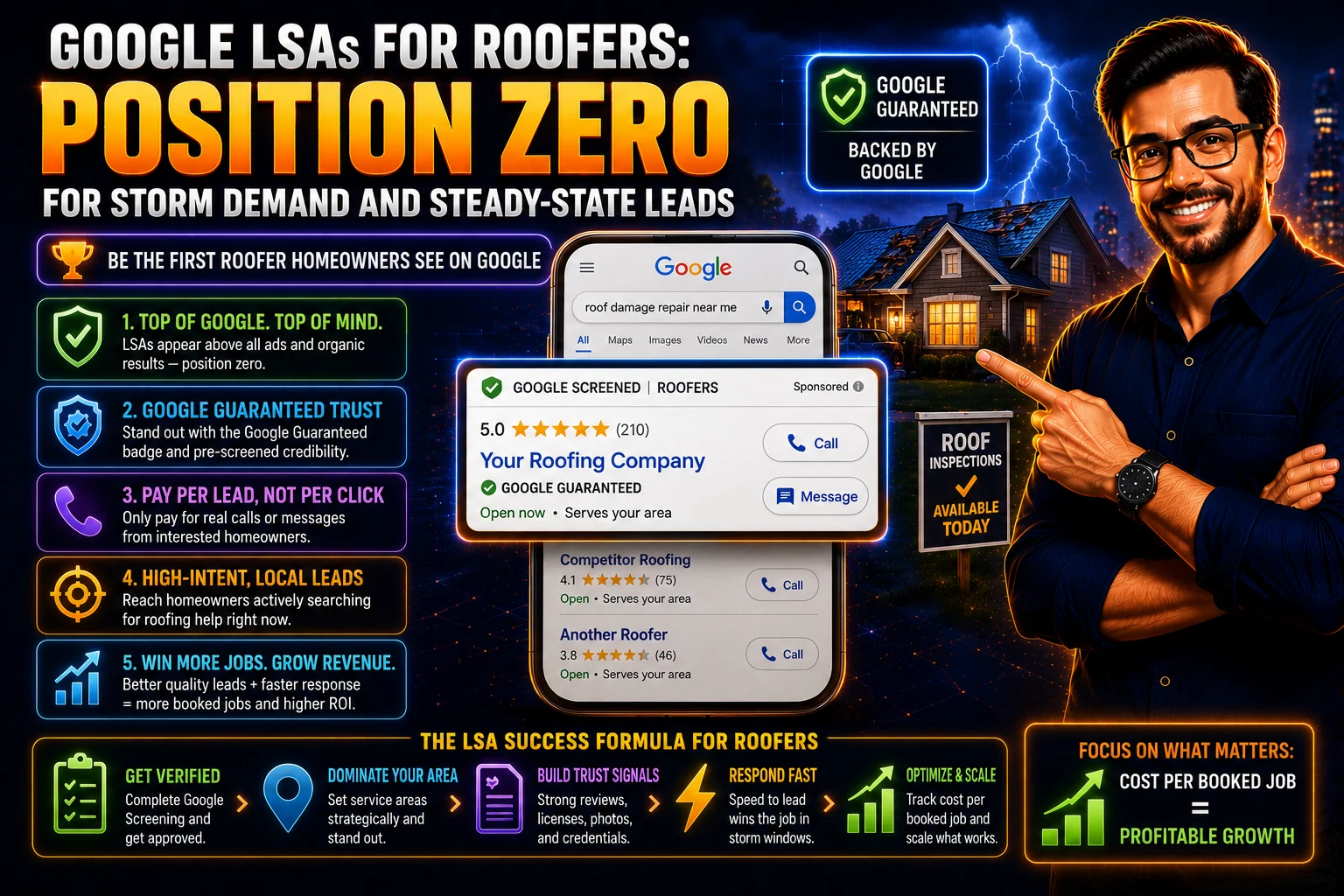
Position zero in Google search results — above the Map Pack, above traditional paid ads, above every organic listing — belongs to Local Services Ads. For roofing operations, that placement is among the most valuable real estate in local search, particularly during storm windows when demand spikes and customers choose from the first results they see. LSAs also operate on pay-per-lead economics that align spend with actual lead acquisition rather than click volume, and carry the Google Guaranteed badge that addresses the trust concerns substantial roofing investments naturally generate. For roofing operators serious about exclusive lead acquisition, LSAs are non-optional infrastructure.
Published: July 17, 2026 | Reading Time: ~8 minutes | Category: Roofing Marketing — Local Services Ads
This guide covers Google LSAs for roofing operations practically: why LSAs are particularly powerful for roofing, the verification process that gates entry, the pay-per-lead economics and how to think about cost-per-booked-job, the ranking factors that determine who gets position-zero placement, the response-rate and review disciplines that drive ranking, the storm-window dynamics specific to roofing, the integration with Map Pack and paid search in an overall local strategy, and the common mistakes that bleed budget. Whether you're considering LSAs for the first time or trying to make existing LSA spend perform better, this is the practical playbook.
What You'll Learn
- Why LSAs are particularly powerful for roofing operations
- The Google Guaranteed badge as trust infrastructure for substantial roofing investments
- The verification process that gates entry to the platform
- Pay-per-lead economics and cost-per-booked-job thinking
- Ranking factors that determine position-zero placement
- Response-rate and review disciplines that drive ranking
- Storm-window dynamics specific to roofing LSAs
- Integration with Map Pack and paid search in an overall local strategy
- Common mistakes that bleed LSA budget
Why LSAs Are Particularly Powerful for Roofing
- Storm-driven demand intensity. Severe weather produces substantial demand spikes within hours, and LSAs at position zero capture the first-look traffic during these windows. Operations with strong LSA presence during storm events capture disproportionate work compared to operations relying only on Map Pack or organic SEO.
- Trust-sensitive substantial-dollar decisions. Roof replacement involves substantial homeowner investment, and the Google Guaranteed badge that comes with LSA verification addresses real customer concerns about contractor quality and recourse. The badge isn't decorative; it represents third-party verification customers genuinely value.
- High job values justify per-lead pricing. LSA per-lead costs can run substantial in competitive roofing markets, but roofing job values (especially for full replacements, storm restoration, and commercial work) easily justify the lead costs when conversion economics are properly managed.
- Pay-per-lead aligns spending with results. Unlike pay-per-click platforms charging regardless of conversion potential, LSAs charge only for qualified leads. The pay structure forces Google's algorithm to deliver leads matching your service area, services, and qualifications — producing structurally better lead quality than equivalent click spending.
- Position above Map Pack. The visual real estate above the Map Pack is dramatically valuable for any local service, particularly in emergency and storm contexts where customers scroll fast and choose from the first results visible.
THE GOOGLE GUARANTEED BADGE IN A TRUST-SENSITIVE VERTICAL: For roofing specifically, the Google Guaranteed badge does work no amount of paid advertising can match. The badge signals: Google verified the business's license and insurance. Google ran background checks on the business owner. Google offers a guarantee on covered work. For a homeowner evaluating substantial roof investment in a vertical where storm-chasers and reactive operators are common, the badge is the proxy for due diligence the customer needs but can't easily perform. This trust infrastructure is part of what makes LSAs particularly powerful for roofing — and why the verification process exists in the first place. The badge means something because Google verifies what it claims to verify.
The Verification Process
Before a roofing operation can run LSAs, it must complete Google's verification process — more substantive than typical paid-ads onboarding.
- Business license verification: documentation of state, county, or municipal contractor licenses required for roofing in your jurisdictions. Roofing licensing varies substantially by state — Florida requires roofing-specific contractor licensing; some states require general contractor licensing; some require less. Google verifies against applicable requirements.
- Insurance verification: documentation of general liability and workers' compensation insurance at the levels Google requires. Roofing insurance requirements are typically higher than other home services due to elevated risk profile.
- Background checks: business owner and sometimes additional personnel undergo background checks. The process can take days to weeks to clear.
- Business verification: confirmation of business registration, legitimacy, and operational existence through public records and other sources.
- Service-area documentation: the geographic areas where the business operates, with appropriate documentation.
Verification typically takes one to several weeks depending on licensing-verification authority responsiveness, background check timing, and any back-and-forth with Google's verification team. Operations should plan for the timeline rather than expect same-day activation. Many operations discover during verification that their licensing or insurance documentation needs updating — corrections that improve overall credentialing position beyond just LSA access.
Pay-Per-Lead Economics: Cost-Per-Booked-Job Thinking
Per-Lead Pricing for Roofing
LSA per-lead costs for roofing vary substantially by geographic market, competition level, and lead category. Less competitive markets see modest per-lead costs; competitive metros during storm windows can see substantially higher costs. The right metric isn't the per-lead price in isolation but the cost-per-booked-job the channel produces.
The Math That Matters
Channel spend divided by booked jobs from that channel produces cost-per-booked-job. A higher per-lead cost producing favorable cost-per-booked-job through strong conversion beats a lower per-lead cost producing poor conversion. Operations tracking cost-per-booked-job make better channel decisions than operations focused only on CPL.
What Drives Cost-Per-Booked-Job Favorably
- Lead-to-booking conversion strength: answering the phone, fast response, scheduling estimates promptly, closing professionally. Operational conversion drives the metric more than per-lead price.
- Lead quality matching: configuring LSA service offerings, geographic areas, and exclusions so leads match work you actually do at the prices you charge.
- Dispute discipline: LSAs sometimes charge for leads that don't qualify (wrong service area, wrong service type, spam). The platform allows disputes; operations that dispute methodically recover cost-per-lead they shouldn't have paid.
- Higher-value job mix: cost-per-booked-job becomes favorable faster when booked jobs are higher-value. Roofing operations targeting full replacements and storm restoration sustain higher cost-per-lead than operations chasing small repair jobs.
Ranking Factors That Determine Position-Zero Placement
- Reviews — volume, recency, and rating. The single most important LSA ranking factor for roofing. Sustained review velocity rather than accumulated count carries the most weight.
- Response rate and time. LSAs explicitly track how often businesses answer calls from LSA leads and how fast they respond. Operations missing calls rank worse; operations with disciplined response rank better.
- Verification completeness and currency. Fully verified businesses with current licenses and insurance outrank those with verification lapses.
- Proximity to the searcher. LSAs prefer to surface businesses near the searcher based on service-area definitions and operating address. Accurate service-area configuration improves ranking.
- Bid preferences (where applicable). LSAs let businesses set bid preferences affecting placement competition. The bid isn't dominant but influences placement among similarly-qualified businesses.
- Business profile completeness. Complete, accurate profile information — services offered, hours, photos, descriptions — supports better ranking than incomplete or stale profiles.
PRO TIP: The two highest-leverage LSA improvements for most roofing operations are response rate discipline and review velocity — and both reward operational behaviors the business should already be doing. Answer every call from an LSA lead, ideally within the first ring. Deploy AI receptionist tools to handle overflow during storm windows or peak times so no LSA lead ever goes to voicemail. Generate reviews from every completed job systematically — request reviews at the moment of customer satisfaction with low-friction direct links. Operations with strong response rates and sustained review velocity rank consistently without competing on bid price; operations missing calls and letting reviews accumulate sporadically find themselves outranked even when bidding aggressively.
Storm-Window LSA Dynamics for Roofing
Roofing LSAs behave differently during storm windows than during steady-state demand. Operations capturing the storm opportunity adjust their LSA management accordingly.
- Lead volume spikes dramatically. Storm-driven emergency demand can produce LSA lead volumes multiples of normal demand for short windows. Intake capacity must scale or the opportunity is missed.
- Per-lead costs may rise. Competition pushes per-lead costs up during storm windows in many markets. The economics still work because storm-window job values run higher and conversion rates from lead to booked work are typically elevated, but expect higher per-lead costs during these periods.
- Response time matters more than usual. During storm windows, the homeowner frustrated by long waits or busy signals at competitors calls whoever answers first. Response-time discipline that's important always becomes critical.
- Service-area and offering configurations may benefit from review. Some operations narrow LSA service-area or service offerings during storm windows to focus on the most profitable storm work, then reopen broader coverage after.
- Post-storm review generation is high-leverage. Reviews from successfully completed storm jobs reinforce LSA ranking for future storm windows — the flywheel where each storm strengthens position for the next.
Integration With Map Pack and Paid Search
LSAs aren't a replacement for Map Pack or paid search; they complement both, occupying their own position and reinforcing integrated local presence.
- The local search stack from top to bottom: LSAs at position zero (3-4 listings with badge, phone, ratings), then Google paid search, then Map Pack (3 local listings with ratings, hours), then organic results. Operations occupying all four layers capture customers across the full range of search behaviors.
- Reviews drive multiple layers. The review velocity that ranks you in Map Pack also factors into LSA ranking. The same review-generation work strengthens both channels.
- Operational excellence shows in multiple places. Fast response, completed-work quality, and customer satisfaction all reinforce LSAs, Map Pack ranking, and the reputation supporting both.
- LSAs and paid search complement rather than duplicate. LSAs target qualified-lead acquisition at position zero with per-lead pricing; traditional paid search targets specific keywords with click pricing. Together they cover different search behaviors and produce more comprehensive capture than either alone.
Common LSA Mistakes That Bleed Budget
- Missing calls from LSA leads. Operations not answering consistently waste both the per-lead cost paid and the ranking impact of low response rates. Every missed LSA call costs twice.
- Slow response to messages. LSAs increasingly route some inquiries through messages. Operations not monitoring and responding quickly miss work and damage LSA ranking simultaneously.
- Not disputing inappropriate charges. LSAs charge for leads that sometimes don't qualify. Operations not disputing systematically pay for leads they shouldn't have been charged for.
- Inadequate review generation. LSA ranking is heavily review-driven. Operations not generating reviews systematically lose ranking position and lead volume.
- Misconfigured service areas or service offerings. Operations receiving leads outside their actual service area or for services they don't perform waste lead spend.
- Verification lapses. Letting licenses or insurance expire creates ranking penalties or pulls the account off the platform.
- Set-and-forget management. The platform performs best with active management — reviewing leads, monitoring response rates, disputing charges, refreshing configurations, adjusting bid strategies.
The Bottom Line
Local Services Ads at position zero represent one of the highest-value placements in local search for roofing operations — particularly valuable because roofing combines storm-driven demand intensity, trust-sensitivity at substantial dollar levels, and high job values that justify per-lead costs in competitive markets. The Google Guaranteed badge addresses real customer concerns about contractor reliability; the pay-per-lead model aligns spending with lead acquisition; the position above Map Pack captures first-look traffic in the moments that matter most.
Operations that succeed at LSAs combine basic discipline (verification completion, accurate configuration, active account management) with operational behaviors LSAs reward (high response rates, systematic review generation, completed-work quality, methodical charge disputing). The same operational excellence that makes LSAs perform also strengthens Map Pack ranking, organic SEO, and the integrated local presence — the discipline isn't LSA-specific but the LSA returns reward it directly. For roofing operations willing to do the verification work and run the platform actively, position zero is available — and the placement value is real.
Key Takeaways
- LSAs at position zero are particularly powerful for roofing: storm-driven demand intensity, trust-sensitivity at substantial dollar levels, Google Guaranteed badge addressing customer concerns, pay-per-lead aligning spending with lead acquisition, position above Map Pack capturing first-look traffic
- The Google Guaranteed badge represents real trust infrastructure: license/insurance verification, background checks, work guarantee — the proxy for due diligence customers need but can't easily perform themselves
- Verification process: business license, insurance, background checks, business verification, service-area documentation — typically days to weeks, often surfacing credentialing improvements the operation should have made anyway
- Think in cost-per-booked-job rather than cost-per-lead — higher per-lead cost with strong conversion can beat lower per-lead cost with poor conversion. Lead-to-booking conversion, lead-quality matching, dispute discipline, and higher-value job mix all drive favorable economics
- Ranking factors: reviews (volume, recency, rating — most important), response rate and time, verification completeness, proximity, bid preferences, business profile completeness
- Two highest-leverage improvements: response rate discipline (answer every call, AI receptionist for overflow) and review velocity (systematic post-job generation) — both reward operational behaviors the business should already be doing
- Storm-window dynamics: lead volume spikes dramatically, per-lead costs rise but conversion rates and job values rise faster, response time matters more, post-storm review generation reinforces future ranking
- Integration with Map Pack and paid search produces comprehensive local presence across all four layers (LSAs, paid, Map Pack, organic) that captures customers across search behaviors
- Common mistakes: missing calls, slow message response, not disputing inappropriate charges, inadequate review generation, misconfigured service areas, verification lapses, set-and-forget management
READY TO BUILD A LEAD PIPELINE THAT'S YOURS? Astra Results Marketing builds and manages roofing LSA programs — verification completion, account configuration calibrated to your service area and offerings, response-rate infrastructure including AI receptionist overflow, systematic review generation, methodical charge disputing, and active account management that produces position-zero placement consistently. Stop letting position zero go to less-prepared competitors. Build the LSA discipline that captures the placement value where customers actually look first. Astra Results Marketing · astraresults.com · (+1) 786-643-3036