Rated 5 star on

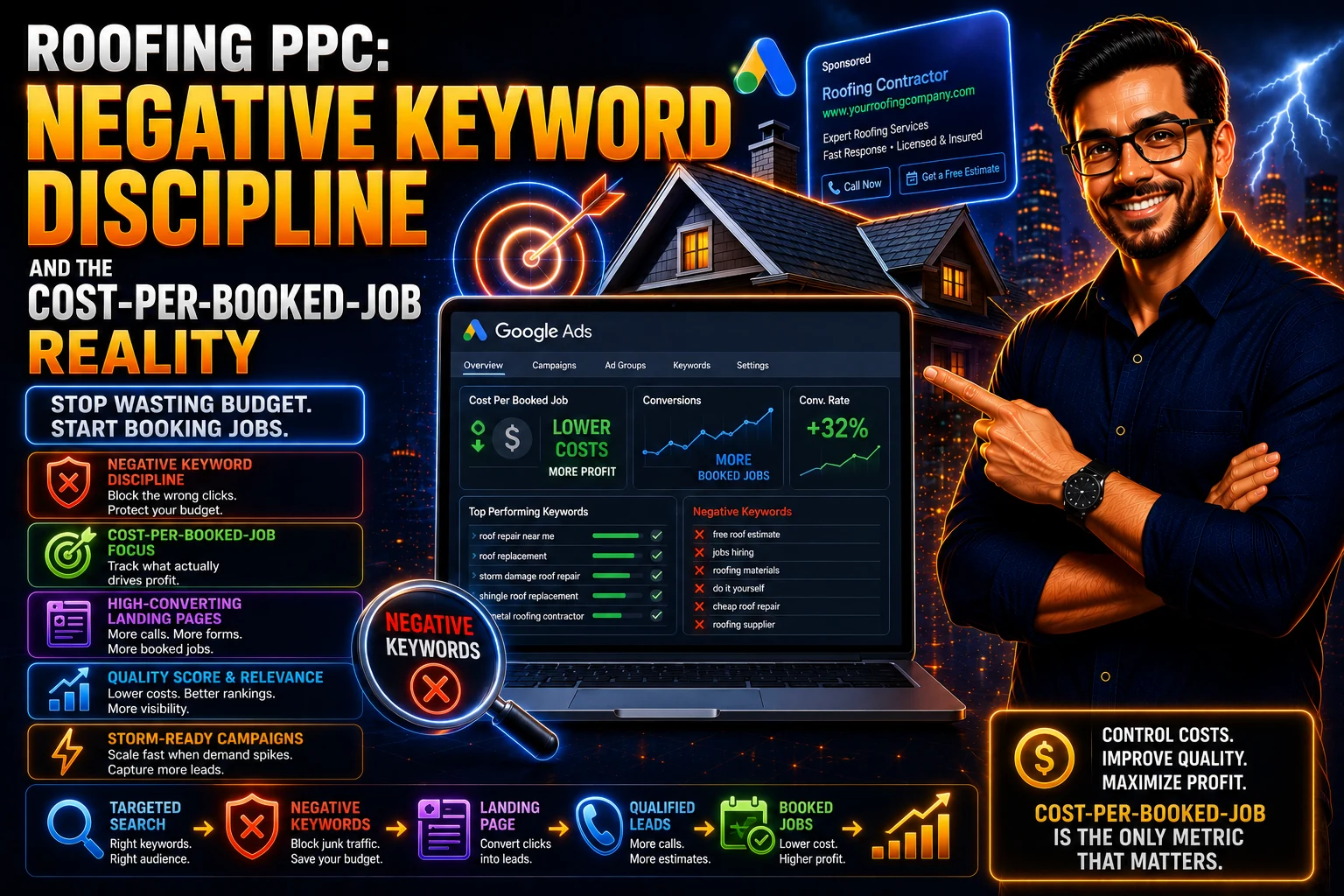
Roofing PPC: Negative Keyword Discipline and the Cost-Per-Booked-Job Reality
Roofing Google Ads is one of the most expensive paid-search categories in home services. Per-click costs run dramatically higher than other verticals, the competition is dominated by aggressive operators and lead aggregators bidding up the auction, and the path from click to booked job involves substantial drop-off that magnifies the cost-per-acquisition. Operations running roofing PPC without disciplined negative keyword management, tight geographic targeting, conversion-focused landing pages, and honest cost-per-booked-job tracking burn budget at rates that destroy unit economics. Operations running roofing PPC well produce favorable lead flow alongside SEO and LSAs, but the discipline required is substantially higher than for less-competitive verticals.
Published: July 18, 2026 | Reading Time: ~8 minutes | Category: Roofing Marketing — PPC
This guide covers roofing PPC for operators trying to make Google Ads work as part of their channel mix. It covers why roofing PPC is structurally expensive and what that means for strategy, the negative keyword discipline that's non-negotiable in this vertical, the cost-per-booked-job framing that distinguishes working PPC from budget hemorrhaging, the match types and intent considerations that affect spend efficiency, the geographic targeting and storm-driven bidding dynamics, the landing-page work that converts the clicks you pay for, the Quality Score factors that affect what you pay per click, and the common mistakes that bleed roofing PPC budget faster than almost any other home-services vertical.
What You'll Learn
- Why roofing PPC is structurally expensive and what that means for strategy
- Negative keyword discipline as non-negotiable foundation
- Cost-per-booked-job framing that distinguishes working PPC from budget hemorrhaging
- Match types and intent considerations for roofing keywords
- Geographic targeting and storm-driven bidding dynamics
- Landing pages that convert the expensive clicks you pay for
- Quality Score factors specific to roofing PPC
- Common mistakes that destroy roofing PPC economics
Why Roofing PPC Is Structurally Expensive
Roofing PPC costs are among the highest in home services for reasons specific to the category.
- High job values support high bids. Roofing operations bid aggressively because successful customer acquisition produces substantial revenue. The bid floor in any competitive roofing market reflects what aggressive operators are willing to pay for leads.
- Lead aggregators bid up the auction. Companies like HomeAdvisor, Angi, Networx, and others bid heavily on roofing keywords because they resell leads to multiple roofing operations. Their economics work on different math than individual contractors and they sustain bidding levels individual operators struggle to match.
- Storm-chaser dynamics inflate spend. After major storms, out-of-state operators and reactive local operators bid aggressively for limited time windows, pushing per-click costs to levels that don't sustain steady-state. Operations bidding into storm windows often pay substantially elevated CPCs.
- Intent ambiguity in head terms. Searches like 'roofing' or 'roofers' include intent ranging from immediate-purchase to information-gathering to research with no near-term purchase. Operations bidding on these head terms pay for substantial click volume that won't convert.
THE COST-PER-CLICK REALITY: Roofing PPC in competitive markets sees per-click costs that would be unsustainable for most other home services — substantial dollars per click on competitive head terms in many metros, with storm-window bidding pushing costs higher still. The economics only work when conversion infrastructure (landing pages, intake, sales process) converts the expensive clicks at favorable rates. Operations running roofing PPC without disciplined negative keywords, tight geographic targeting, conversion-focused landing pages, and honest cost-per-booked-job tracking burn budget at rates that destroy margins. The discipline isn't optional; it's the difference between roofing PPC working and burning cash with nothing to show for it.
Negative Keyword Discipline as Non-Negotiable Foundation
Negative keyword management is more important in roofing PPC than in almost any other vertical. The breadth of related-but-unintended searches that match roofing keywords without proper exclusion produces substantial wasted spend. Operations not running disciplined negative keyword strategies pay for clicks from searches that have essentially zero conversion potential.
Categories of Negatives Worth Managing
- Job-search keywords: 'roofer jobs,' 'roofing jobs near me,' 'roofing employment,' 'roofing salary.' Substantial search volume that's never going to convert to roofing customers. Exclude these systematically.
- DIY and information searches: 'how to roof,' 'DIY roofing,' 'roof repair YouTube,' 'roofing tutorials.' Researchers not buying professional services. Exclude unless the operation explicitly wants to capture some of this for content/awareness purposes (rare and usually unprofitable).
- Material supplier searches: 'roofing supply,' 'roofing materials,' 'shingles for sale,' 'metal roofing supplier.' Searchers looking for materials, not service. Exclude.
- Educational and certification searches: 'roofing school,' 'roofing certification,' 'how to become a roofer,' 'roofing license.' Industry research not customer intent. Exclude.
- Competitor brand terms: brand names of major competitors, when relevant. These can sometimes be appropriate targets (competitor conquest campaigns) but typically waste spend in untargeted match types.
- Wrong-service searches: 'gutter cleaning,' 'siding repair,' 'fence installation,' 'painting' — adjacent home-services searches roofing keywords sometimes match. Exclude if you don't offer the service.
- Geographic exclusions: locations outside your service area that match your broader keywords. Geographic targeting at the campaign level handles most of this, but specific city or state names appearing in queries can require keyword-level exclusions.
- Rental and commercial property type variations the operation doesn't serve. If your operation focuses on residential, exclude commercial-specific terms. If you focus on commercial, exclude residential-specific terms.
Ongoing Negative Keyword Maintenance
Negative keyword management isn't a one-time setup. Search Query Reports should be reviewed weekly during early campaign optimization and monthly thereafter, with new negatives added based on the searches actually triggering your ads. Operations that don't review SQRs miss the negative keywords that emerge over time as search behavior evolves and as new query variations appear.
Cost-Per-Booked-Job Framing
CPL alone is misleading in roofing PPC because conversion rates from lead to booked work vary dramatically by campaign type and lead quality. A $80 lead from a high-intent storm-restoration search that converts to a booked job at 40% produces $200 cost-per-booked-job; a $30 lead from a broad informational search that converts at 3% produces $1,000 cost-per-booked-job. The lower per-lead cost looks better superficially but is dramatically worse economically.
- Track booked-job attribution by campaign and ad group, not just lead-level attribution. The metric that matters is what each campaign produces in completed jobs and revenue, not just what it produces in lead volume.
- Calculate cost-per-booked-job monthly: total channel spend divided by booked jobs from that channel for the period.
- Compare against your other channels (LSAs, SEO, referrals) to understand channel mix economics.
- Make budget decisions based on cost-per-booked-job rather than CPL. The lower CPL channel isn't necessarily the better channel.
Match Types and Intent
- Exact match for the highest-intent core terms (specific service + city, specific service + 'near me,' specific damage-type queries). Tightest control, highest relevance, generally favorable economics when configured well.
- Phrase match for substantial intent terms where reasonable variation is acceptable. Captures relevant variations while maintaining intent control.
- Broad match generally not recommended for roofing without aggressive negative keyword management and tight intent control. Broad match in roofing PPC produces substantial waste in most operations.
- Broad match with smart bidding may work in mature campaigns with substantial conversion data and proven account structure, but requires sophisticated negative keyword discipline and ongoing oversight. New or untrained accounts should not run broad match.
Geographic Targeting and Storm-Driven Bidding
- Tight geographic targeting to actual service areas. Roofing operations are local; targeting outside service areas produces zero conversion potential and wastes budget.
- Zip-code-level granularity where the operation's service area has distinct sub-markets. Different zip codes within a metro may justify different bidding strategies based on demand density and average job values.
- Storm-driven bid adjustments: temporary bid increases in affected zip codes during and immediately after storm events, with adjustments reverting after the storm window passes. Pre-built bid adjustment strategies activated within hours of weather events capture spike demand.
- Bid adjustments by device, time-of-day, and day-of-week based on historical conversion data. Roofing inquiries often peak at specific times; bidding can be optimized accordingly.
- Geographic exclusions of areas outside your service area that match broader geographic targeting — particularly relevant for operations near metro boundaries or in multi-metro markets.
PRO TIP: The single highest-leverage roofing PPC discipline is honest weekly review of search query reports during the first 60-90 days of any campaign, with aggressive negative keyword addition based on what actually triggers your ads. Operations that do this consistently produce dramatically better cost-per-booked-job than operations that set up campaigns and leave them running on autopilot. The negative keyword work during initial optimization compounds for the life of the campaign — every poorly-converting query type excluded means budget redirected to converting queries. Operations that skip this work or do it only sporadically pay for substantial waste that disciplined operations don't.
Landing Pages That Convert
Roofing PPC traffic dropped onto weak landing pages converts at devastating rates. The expensive clicks you pay for need conversion infrastructure designed for the intent driving them.
- Match landing page content to ad and keyword intent: searches for 'storm damage roof repair' should land on a storm-damage-specific page, not a generic 'roofing services' page. Intent-matched landing pages convert at substantially higher rates.
- Page speed and Core Web Vitals: substantial portions of roofing PPC traffic abandon slow-loading pages. Target excellent Core Web Vitals on landing pages specifically.
- Mobile-first design: roofing searches skew mobile, particularly emergency and storm-related. The mobile experience must be fast, easy to navigate, and easy to contact.
- Prominent tap-to-call: emergency and high-intent roofing searchers want to call. The call action should be impossible to miss on mobile, repeated through the page, and tracked for attribution.
- Trust signals visible without scrolling: license, insurance, years in business, certifications, reviews — visible immediately in the first viewport.
- Simple lead capture for form-preferred visitors: minimum-field forms (name, phone, brief description) convert dramatically better than long forms.
- Clear value proposition above the fold: what you offer, why you're the right choice, what to do next.
- Conversion tracking properly implemented: phone calls (with call tracking), form submissions, chat engagement, all tracked back to the ad-and-keyword that produced the click.
Quality Score Factors for Roofing
- Expected click-through rate: how often users searching your keywords click your ad relative to other ads. Strong ad copy matching keyword intent drives this.
- Ad relevance: how closely your ad matches the keyword's intent. Generic ad copy across diverse keywords scores poorly; intent-matched ad copy scores higher.
- Landing page experience: page speed, mobile experience, content relevance to the ad, ease of navigation. Quality Score directly affects both your CPC and your ad position; landing page quality has direct economic consequences.
- Account history: established accounts with conversion history and refined optimization sometimes get Quality Score benefits new accounts don't. The patience to let accounts mature with disciplined optimization pays off.
Common Mistakes That Destroy Roofing PPC Economics
- No negative keyword management. The single most common reason roofing PPC underperforms — running campaigns without disciplined exclusion of non-converting queries.
- Broad match without sophistication. Broad match in roofing PPC produces massive waste without aggressive negative keyword management and ongoing oversight.
- Sending all traffic to the homepage. Generic homepages convert PPC traffic at rates well below intent-matched landing pages. Custom landing pages matched to ad groups are foundational.
- No conversion tracking. Operations running PPC without proper conversion tracking can't optimize because they can't see what's actually producing booked jobs.
- Set-and-forget campaign management. Roofing PPC requires active management — search query review, bid adjustments, ad copy testing, negative keyword updates, landing page optimization.
- Ignoring storm-window dynamics. Operations running steady-state PPC during storm windows pay inflated CPCs without storm-specific landing pages or messaging to convert the elevated-intent traffic.
- Bidding on competitor terms without strategic purpose. Generic competitor bidding usually wastes budget; targeted competitor conquest with specific value propositions can work in mature accounts but requires deliberate strategy.
- Mobile experience neglected. Substantial portions of roofing traffic are mobile; weak mobile experience destroys conversion on the majority of spend.
The Bottom Line
Roofing PPC is among the most expensive paid-search categories in home services, with structural factors (high job values supporting aggressive bidding, lead aggregators inflating auctions, storm-chaser dynamics, intent ambiguity in head terms) producing per-click costs that destroy unit economics without disciplined management. The operations that make roofing PPC work combine aggressive negative keyword discipline, cost-per-booked-job tracking rather than CPL focus, intent-matched landing pages with strong conversion infrastructure, tight geographic targeting, storm-driven bid adjustments, and active ongoing management. The discipline isn't optional in roofing PPC; it's the difference between PPC contributing favorable lead flow and burning budget with nothing to show for it.
For most roofing operations, PPC works best as part of an integrated mix alongside SEO foundations and LSAs rather than as a primary channel. SEO and LSAs produce more durable economics; PPC supplements with high-intent capture and storm-window activation when run disciplined. Operations new to roofing PPC should expect 60-90 days of intensive optimization to reach favorable cost-per-booked-job, with ongoing active management thereafter. Roofing PPC is one of the marketing channels where the difference between disciplined execution and casual management produces dramatically different outcomes — and the discipline is what every successful roofing PPC program shares.
Key Takeaways
- Roofing PPC is structurally expensive — high job values supporting aggressive bidding, lead aggregators inflating auctions, storm-chaser dynamics, and intent ambiguity in head terms all push CPCs to levels that destroy unit economics without disciplined management
- Negative keyword discipline is non-negotiable: exclude job-search, DIY/information, material supplier, educational, competitor (where appropriate), wrong-service, geographic, and property-type-mismatch queries. Review search query reports weekly during optimization, monthly thereafter
- Cost-per-booked-job is the metric that matters, not CPL: a $80 lead at 40% conversion to booked work beats a $30 lead at 3% conversion. Track booked-job attribution by campaign and ad group; make budget decisions based on cost-per-booked-job
- Match types: exact and phrase match for high-intent terms with disciplined coverage; broad match generally not recommended without sophisticated negative keyword management and ongoing oversight
- Geographic targeting tight to service areas; zip-code granularity where sub-markets justify it; storm-driven bid adjustments in affected zip codes activated within hours of events; bid adjustments by device, time, and day-of-week based on conversion data
- Landing pages: intent-matched to ad and keyword, fast loading with excellent Core Web Vitals, mobile-first, prominent tap-to-call, trust signals above the fold, simple lead capture, clear value proposition, proper conversion tracking
- Quality Score factors: expected CTR, ad relevance, landing page experience, account history — Quality Score directly affects CPC and ad position, with real economic consequences
- Common mistakes that destroy roofing PPC economics: no negative keyword management, unsophisticated broad match, traffic sent to generic homepages, no conversion tracking, set-and-forget management, ignoring storm-window dynamics, undisciplined competitor bidding, neglected mobile experience
READY TO BUILD A LEAD PIPELINE THAT'S YOURS? Astra Results Marketing builds and manages roofing PPC programs with the disciplined negative keyword work, cost-per-booked-job tracking, intent-matched landing pages, tight geographic and storm-driven bid management, and active ongoing optimization that produces favorable economics in a vertical where casual PPC management destroys budgets fast. Stop bidding into the aggressive roofing PPC auction without the discipline required to make it work. Build the PPC infrastructure that produces booked jobs at favorable cost-per-acquisition alongside your SEO and LSA channels. Astra Results Marketing · astraresults.com · (+1) 786-643-3036