Rated 5 star on

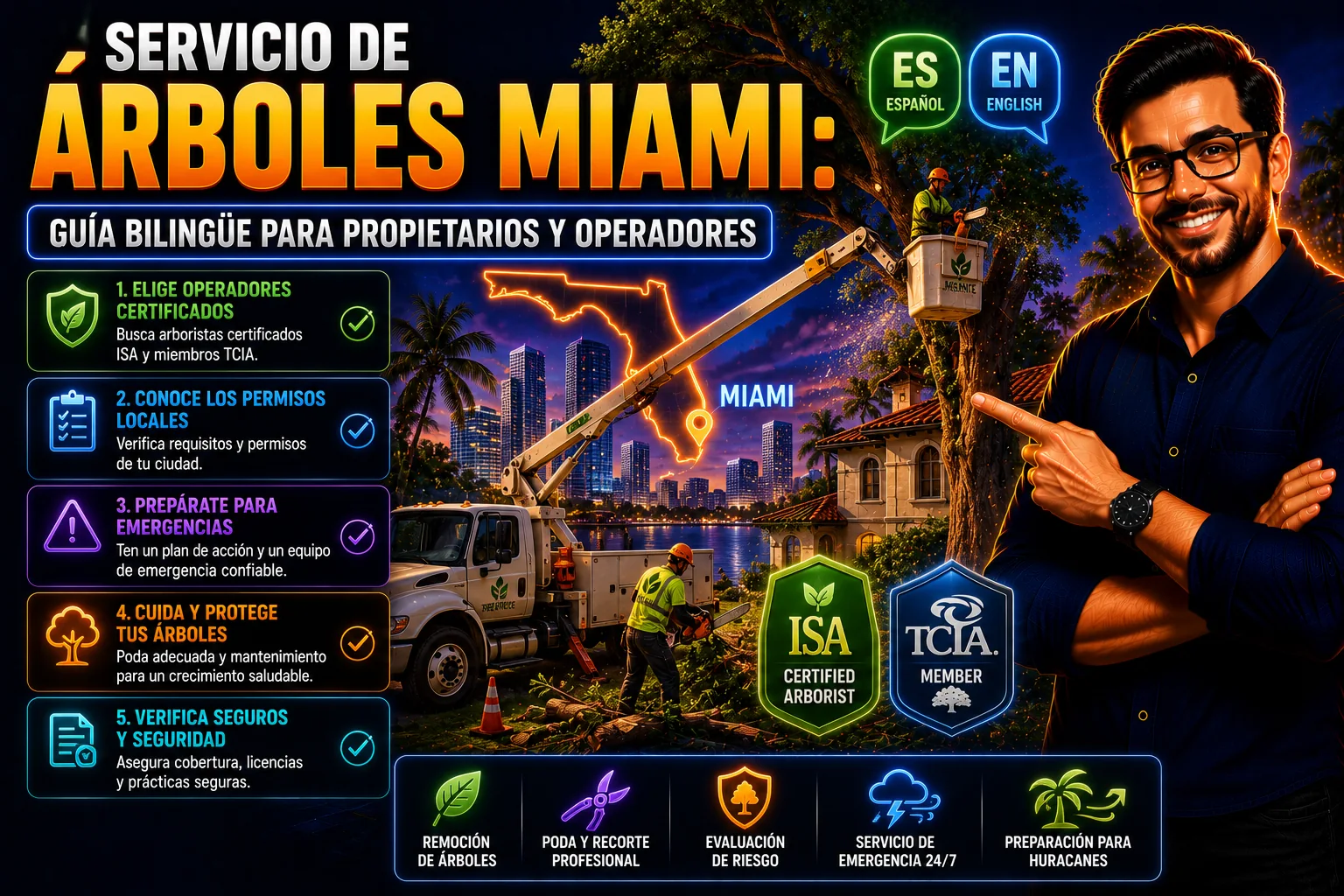
Servicio de Árboles Miami: Guía Bilingüe para Propietarios y Operadores
Miami is a bilingual city, and tree service in Miami is a bilingual industry. Roughly 70% of Miami-Dade County residents speak Spanish at home, and a substantial portion of homeowners and property managers prefer or require Spanish-language communication when navigating tree-service decisions. Operations that serve Miami without bilingual capability lose access to a substantial portion of the market they could otherwise reach; homeowners who need Spanish-language service may struggle to find credentialed operators that can communicate with them effectively. This guide addresses both sides — written in both English and Spanish, with practical information for Spanish-speaking Miami property owners navigating tree-service decisions, and operational guidance for tree-service operations building the bilingual capability the Miami market requires.
Published: July 16, 2026 | Reading Time: ~12 minutes | Category: Tree Service — Bilingual Miami
The bilingual reality affects every part of how tree service actually works in Miami. Phone intake systems need to handle calls in either language without delay or confusion. On-site work involves crews communicating in Spanish among themselves and with property owners. Written estimates, contracts, and documentation often need to be available in either language. Marketing reaches different audiences through different channels, with Spanish-language content reaching customers monolingual English content doesn't reach. ArborCentric Solutions operates as a fully bilingual tree-service operation across Miami-Dade and broader South Florida, and the bilingual capability is foundational rather than supplementary to how the operation functions.
What You'll Learn
- Why bilingual capability is foundational, not supplementary, to Miami tree service
- Practical guidance for Spanish-speaking Miami property owners (in Spanish)
- How to identify credentialed tree-service providers regardless of preferred language
- Emergency response considerations specific to Spanish-speaking property owners
- How tree-service operations build genuine bilingual capability (not just translation)
- The market reach gained through real bilingual operations
- How ArborCentric Solutions operates as a fully bilingual tree-service operation
Guía Práctica para Propietarios de Miami (En Español)
Esta sección está escrita para propietarios de viviendas, gerentes de propiedades, y juntas de asociaciones de propietarios en Miami que prefieren información en español sobre servicios de árboles. Cubre los temas que más importan a la hora de tomar decisiones sobre el cuidado de árboles en sus propiedades.
Cómo Identificar un Operador Profesional Calificado
La diferencia entre un operador profesional y los "jardineros" sin credenciales que abundan en Miami es real, y afecta tanto la calidad del trabajo como su seguridad legal y financiera. Los operadores profesionales que vale la pena contratar comparten ciertas características verificables.
- Arborista certificado por ISA: La Sociedad Internacional de Arboricultura (ISA) certifica arboristas que han demostrado competencia profesional. Se puede verificar el estado de certificación en la base de datos de ISA. El operador debe poder proporcionar el número de certificación si se le pide.
- Acreditación TCIA: La Asociación de la Industria del Cuidado de Árboles (TCIA) acredita compañías que cumplen con estándares de seguridad y prácticas comerciales. Relativamente pocas operaciones tienen esta acreditación, y es una señal fuerte cuando la tienen.
- Licencia de contratista de Florida: Dependiendo del trabajo específico, Florida puede requerir licencias de contratista que se pueden verificar a través del portal del estado.
- Seguro de responsabilidad y compensación de trabajadores: El operador debe poder proporcionar certificados de seguro al ser solicitados. Sin seguro adecuado, usted como propietario asume riesgos legales si hay un accidente en su propiedad.
- Presencia local establecida: Operaciones con dirección de Miami verificable, historia local, y presencia en la comunidad. Los operadores que aparecen solo después de tormentas a menudo no tienen esta historia verificable.
- Reseñas de clientes verificables: Historia sustancial de reseñas en Google y otras plataformas. Las operaciones legítimas con años de servicio tienen esta historia; los operadores no calificados no la tienen.
Qué Hacer en una Emergencia
Si un árbol cae sobre su casa, su vehículo, o crea una situación peligrosa en su propiedad, las decisiones que tome en la primera hora importan.
- Seguridad primero: Manténgase alejado del área afectada hasta que pueda evaluar la situación desde un lugar seguro. Los árboles comprometidos pueden moverse o caerse más. Si hay líneas eléctricas caídas, manténgase muy lejos y llame a la compañía eléctrica (FPL) inmediatamente. Trate todas las líneas caídas como si estuvieran energizadas.
- Atención a heridos: Si alguien está herido, priorice la atención médica antes que las preocupaciones de propiedad.
- Servicios de emergencia: Si la situación involucra colapso estructural o personas en peligro, llame al 911.
- Documentación: Tome fotografías de la situación antes de que comience cualquier trabajo. Estas fotos son importantes para los reclamos de seguro.
- Contacto con la compañía de seguros: Comuníquese con su compañía de seguros lo antes posible. La mayoría de las pólizas requieren notificación rápida, y comenzar el proceso de reclamo temprano facilita el trabajo subsiguiente.
- Verificación del contratista: Verifique las credenciales del operador antes de autorizar trabajo sustancial, incluso en emergencias. Tómese los pocos minutos necesarios para confirmar certificación ISA, seguro, y presencia local.
- Evite los oportunistas: Las operaciones que aparecen en su propiedad sin invitación después de tormentas ofreciendo servicio inmediato a precios cotizados son el clásico patrón del oportunista de tormenta. A menudo cobran precios inflados por trabajo de calidad cuestionable, y desaparecen después sin responsabilidad.
Servicios Comunes de Árboles
- Poda: Trabajo selectivo en árboles para mantener la salud, estructura, y longevidad del árbol. Se realiza según los estándares ANSI A300 que rigen el cuidado profesional de árboles. La poda incluye limpieza de ramas muertas, raleo de copa para reducir resistencia al viento, elevación de copa para liberación, y reducción estructural cuando es necesario.
- Remoción de árboles: Cuando un árbol necesita ser eliminado completamente, ya sea por enfermedad, daño, riesgo estructural, o conflicto con estructuras. Requiere evaluación profesional, técnica adecuada, y atención a la seguridad.
- Remoción de tocones: Eliminación del tocón después de la remoción del árbol. Se puede hacer como complemento al trabajo de remoción (más eficiente) o como servicio independiente para tocones antiguos.
- Servicios de emergencia: Respuesta a árboles caídos, daños por tormenta, situaciones peligrosas. Disponible 24/7 con operadores que mantienen capacidad de respuesta.
- Preparación para huracanes: Trabajo preventivo antes de la temporada de huracanes para reducir el riesgo de daños. Incluye raleo selectivo, eliminación de árboles comprometidos, y preparación estructural.
- Mantenimiento comercial: Contratos recurrentes con asociaciones de propietarios, administradores de propiedades, y propiedades comerciales para cuidado continuo de árboles.
Permisos y Regulaciones Locales
Algunos municipios de Miami-Dade requieren permisos para remoción de árboles, particularmente Coral Gables que tiene ordenanzas sustanciales de preservación de árboles. Antes de realizar trabajo de remoción significativo, es importante verificar los requisitos locales. Los operadores profesionales familiarizados con su área pueden ayudar a navegar el proceso de permisos.
- Coral Gables: Requiere permisos para remoción de árboles sobre cierto diámetro, con requisitos de reemplazo, multas sustanciales por trabajo no autorizado, y consideraciones especiales para especies protegidas.
- Otros municipios: Varían en sus requisitos. Verifique con su municipio o consulte con su operador profesional antes de realizar trabajo sustancial.
- Comunidades con HOA: Asociaciones de propietarios a menudo tienen requisitos adicionales y procesos de aprobación para trabajo de árboles en propiedades privadas.
- Consideraciones de servicios públicos: Trabajo cerca de líneas eléctricas requiere coordinación con FPL.
POR QUÉ LA CAPACIDAD BILINGÜE REALMENTE IMPORTA: Para propietarios hispanohablantes en Miami, la capacidad de comunicarse efectivamente en español con su operador de servicios de árboles no es solo una conveniencia. Es la diferencia entre poder explicar claramente su situación durante una emergencia, entender exactamente lo que se va a hacer en su propiedad, revisar estimaciones y contratos con confianza, y construir la relación de confianza con su proveedor que beneficia tanto el trabajo individual como la atención continua de sus árboles. Las operaciones que sirven a Miami con verdadera capacidad bilingüe — equipos que hablan español, sistemas de intake en español, documentación bilingüe, y la familiaridad cultural que hace que la capacidad bilingüe funcione en la práctica — proporcionan un servicio meaningfully mejor a los propietarios hispanohablantes que las operaciones que solo ofrecen "servicio en español" como nota al pie.
Building Genuine Bilingual Capability (For Operators)
For tree-service operations serving the Miami market, building bilingual capability is foundational infrastructure, not supplementary marketing. Operations that build it properly access the full Miami market; operations that don't operate at a structural disadvantage in this metro. The build involves several distinct components.
Intake Systems
- Phone systems that can handle calls in either language without delay, transfer friction, or language barrier. The first words of the intake should not require the caller to specify language preference or navigate to a Spanish-language line.
- Staff capable of handling Spanish-language intake fluently — not just basic Spanish but the practical capability to gather emergency details, schedule work, discuss pricing, and answer questions in Spanish at the same level of service as English calls.
- AI receptionist tools configured for bilingual operation — both for overflow capacity during peaks and to ensure calls in either language get handled when human capacity is at limits.
- Text and message channels supporting both languages — for customers who prefer text communication or who reach out through web forms.
Field Operations
- Crews with Spanish-speaking members capable of communicating effectively with property owners on-site. Many Miami crews already function in Spanish among themselves; the capability extending to property-owner communication is the operational improvement that matters.
- Crew leaders capable of conducting professional conversations in Spanish — explaining work, discussing options, addressing questions, and handling on-site decision-making at the same standard as English-language interactions.
- Safety communication that works in both languages — important for crews where Spanish may be the primary working language and for ensuring safety protocols are understood consistently.
Documentation and Marketing
- Written estimates and contracts available in either language at the customer's preference. Some customers want documentation in Spanish; others prefer English; bilingual operations provide either.
- Website content available in Spanish for the substantial portion of the market that searches and evaluates providers in Spanish.
- Marketing materials (direct mail, social media, paid search) developed for both language markets — not just translated English content but materials calibrated to how each audience actually searches and evaluates.
- Google Business Profile and review responses handling both languages — engaging with Spanish-language reviews professionally in Spanish.
PRO TIP: The single biggest mistake monolingual operations make when attempting bilingual capability is treating Spanish-language service as 'translation of the English business' rather than as substantive capability on its own. Real bilingual operations don't translate English processes into Spanish; they operate fluently in Spanish from the foundation — intake, field work, documentation, marketing, customer relationships — at the same professional standard they operate in English. The Spanish-speaking Miami customer evaluating providers can tell the difference between operations that genuinely function in Spanish and operations that have a Spanish phone option that connects to limited capability. The investment in genuine bilingual capability pays back through access to the substantial Miami market segment that monolingual operations can't reach.
The Market Reach Gained Through Bilingual Operations
Operations that build genuine bilingual capability access market segments monolingual operations can't reach effectively. The reach extends across several dimensions worth understanding.
- Direct customer access: roughly 70% of Miami-Dade residents speak Spanish at home, with a substantial portion preferring Spanish-language service for considered decisions. Monolingual English operations are structurally limited in reaching this market segment.
- Property manager and HOA relationships: many of the property managers and HOA board members making vendor decisions in Miami operate in Spanish or move comfortably between both languages. Vendor relationships built on bilingual capability reach decision-makers other vendors miss.
- Crew recruitment and retention: bilingual operations recruit from a wider talent pool and retain crew members more effectively. The operational benefits compound the customer-facing benefits.
- Referral networks: customer referrals propagate through language and cultural networks. Spanish-speaking customers refer through their networks; bilingual operations capture this referral flow that monolingual operations miss.
- Community presence: visible community presence in Spanish-speaking Miami communities — at events, in local media, in community engagement — builds the kind of trust that translates to substantial business over time.
FAQ — Preguntas Frecuentes / Common Questions
¿Cuánto cuesta la remoción de un árbol? / How much does tree removal cost?
El costo varía sustancialmente según el tamaño del árbol, la accesibilidad, la complejidad del trabajo (proximidad a estructuras, líneas eléctricas, etc.), y otros factores. Los árboles pequeños pueden costar desde unos cientos de dólares; los árboles grandes en condiciones difíciles pueden costar varios miles. Una evaluación profesional en el sitio determina el costo real.
Cost varies substantially based on tree size, accessibility, work complexity (proximity to structures, power lines), and other factors. Small trees may cost a few hundred dollars; large trees in difficult conditions may run several thousand. Professional on-site assessment determines actual cost.
¿Cuándo es el mejor momento para podar los árboles? / When is the best time to prune trees?
En el clima de Miami, muchas especies se pueden podar en varias temporadas, con consideraciones específicas por especie. El trabajo de preparación para huracanes idealmente se completa en los meses anteriores a la temporada de huracanes. La poda estructural de árboles jóvenes se puede hacer en varias temporadas según la especie. Un arborista calificado familiarizado con las especies de su propiedad puede recomendar el momento óptimo.
In Miami's climate, many species can be pruned across multiple seasons with species-specific considerations. Hurricane preparation work is ideally completed in the months before hurricane season. Structural pruning of young trees can happen across seasons depending on species. A credentialed arborist familiar with your specific tree species can recommend optimal timing.
¿Necesito un permiso para remover un árbol? / Do I need a permit to remove a tree?
Depende de su municipio específico y, en algunos casos, del tamaño y especie del árbol. Coral Gables tiene los requisitos más extensos en Miami-Dade. Otros municipios varían. Verifique con su municipio o consulte con un operador profesional antes del trabajo de remoción sustancial.
Depends on your specific municipality and, in some cases, tree size and species. Coral Gables has the most extensive requirements in Miami-Dade. Other municipalities vary. Check with your municipality or consult a professional operator before substantial removal work.
¿Qué cubre el seguro de hogar? / What does homeowner insurance cover?
Generalmente, los daños por árboles durante tormentas están cubiertos por el seguro de hogar, pero los detalles específicos varían por póliza. El trabajo de mitigación de emergencia generalmente está cubierto o es reembolsable. La remoción de árboles caídos por causas no relacionadas con tormentas a menudo no está cubierta. Verifique los detalles con su compañía de seguros y revise su póliza específica.
Generally, storm-related tree damage is covered by homeowner insurance, but specific details vary by policy. Emergency mitigation work is generally covered or reimbursable. Removal of trees fallen for non-storm reasons often isn't covered. Verify details with your insurance company and review your specific policy.
How ArborCentric Operates as a Bilingual Operation
ArborCentric Solutions operates as a fully bilingual tree-service operation across Miami-Dade and broader South Florida. The bilingual capability runs through every layer of the operation — intake systems handling calls and messages in both languages without delay, ISA-Certified Arborists capable of conducting professional consultations in either language, crews communicating fluently with property owners on-site in their preferred language, written estimates and contracts available in either language at customer preference, marketing materials and web presence reaching both language markets, and the cultural familiarity that makes the bilingual capability function in practice rather than just in theory.
For Spanish-speaking property owners in Miami, this means tree-service access at the same professional standard as English-speaking customers — emergency response that communicates effectively in your language, work explained clearly in your language, documentation in your language for your records and insurance, and the relationship-building that produces long-term tree-care partnerships. For English-speaking property owners in mixed-language households or properties, this means a provider capable of serving every stakeholder regardless of language preference. For property managers and HOA boards serving multilingual properties, this means a vendor relationship that simplifies coordination across the language diversity of the properties they manage.
The bilingual capability is foundational rather than supplementary. ArborCentric was built to operate in Miami's actual bilingual reality from the start, not as an English operation with a Spanish phone option added later. The difference shows in every interaction — from initial contact through completed work, in either language, at the professional standard the Miami market deserves.
The Bottom Line / Conclusión
Miami is a bilingual city, and tree service in Miami is a bilingual industry. For Spanish-speaking property owners, finding a credentialed operator that genuinely communicates in Spanish — through intake, field work, documentation, and ongoing relationship — is the path to professional tree care at the standard your property deserves. The verifiable credentials (ISA-Certified Arborist, TCIA Accreditation, Florida licensing where applicable, substantial insurance, local Miami presence, sustained review history) apply regardless of language preference; the bilingual capability is what makes accessing professional service efficient when you prefer Spanish-language communication.
Miami es una ciudad bilingüe, y el servicio de árboles en Miami es una industria bilingüe. Para propietarios hispanohablantes, encontrar un operador calificado que realmente se comunique en español — a través del intake, el trabajo en sitio, la documentación, y la relación continua — es el camino al cuidado profesional de árboles al estándar que su propiedad merece. Las credenciales verificables (Arborista Certificado por ISA, Acreditación TCIA, licencias de Florida cuando aplican, seguro sustancial, presencia local en Miami, historial sustancial de reseñas) aplican independientemente de la preferencia de idioma; la capacidad bilingüe es lo que hace que acceder al servicio profesional sea eficiente cuando prefiere comunicación en español.
For tree-service operations serving Miami, building genuine bilingual capability is foundational infrastructure that accesses the full market this metro represents. The investment in genuine bilingual operations — not translation of English processes, but substantive capability operating fluently in Spanish from the foundation — pays back through access to the substantial Miami market segment that monolingual operations can't reach effectively. ArborCentric Solutions runs this bilingual capability across South Florida; other operations can build similar capability over time with deliberate investment. The Miami market rewards the operations that meet it on its actual terms, in both languages, at the professional standard the metro deserves.
Key Takeaways
- Miami is a bilingual city — roughly 70% of Miami-Dade residents speak Spanish at home, and a substantial portion of homeowners and property managers prefer Spanish-language communication for tree-service decisions
- For Spanish-speaking property owners: identify credentialed operators (Arborista Certificado por ISA, Acreditación TCIA, licencia de Florida, seguro, presencia local, historial de reseñas) and verify capability before authorizing work, especially during emergencies
- Emergency response steps in any language: safety first (clear of utilities), document with photos, contact insurance early, verify contractor credentialing before authorizing substantial work, avoid storm-chasers appearing unsolicited
- Para propietarios hispanohablantes en Miami: la capacidad bilingüe genuina de su operador hace una diferencia real — comunicación efectiva durante emergencias, entendimiento claro del trabajo, revisión de documentos con confianza, y construcción de relación a largo plazo
- Operations serving Miami need genuine bilingual capability across intake, field work, documentation, and marketing — not 'translation of English business' but substantive Spanish-language capability at the same professional standard
- Genuine bilingual operations access market segments monolingual operations can't reach: direct customer access (~70% Spanish-speaking population), property manager and HOA relationships, broader crew recruitment, referral networks, community presence
- ArborCentric Solutions operates as a fully bilingual tree-service operation across Miami-Dade — bilingual intake, bilingual ISA-Certified Arborists and crews, bilingual documentation, bilingual marketing, and the cultural familiarity that makes the capability function in practice
READY TO BUILD A LEAD PIPELINE THAT'S YOURS? ArborCentric Solutions provides bilingual tree service across Miami-Dade and broader South Florida — Servicio de árboles bilingüe en todo Miami-Dade. Arboristas Certificados por ISA, intake bilingüe 24/7, documentación en ambos idiomas, y la capacidad operacional que el mercado bilingüe de Miami merece. Astra Results Marketing builds bilingual marketing infrastructure for tree-service operations serving Miami's actual language reality. Whether you're a property owner who needs professional tree service in your preferred language, or a tree-service operation building bilingual capability to access the full Miami market, the framework here applies. La capacidad bilingüe genuina no es opcional para operar exitosamente en Miami — es fundamental. Astra Results Marketing · astraresults.com · (+1) 786-643-3036