Rated 5 star on

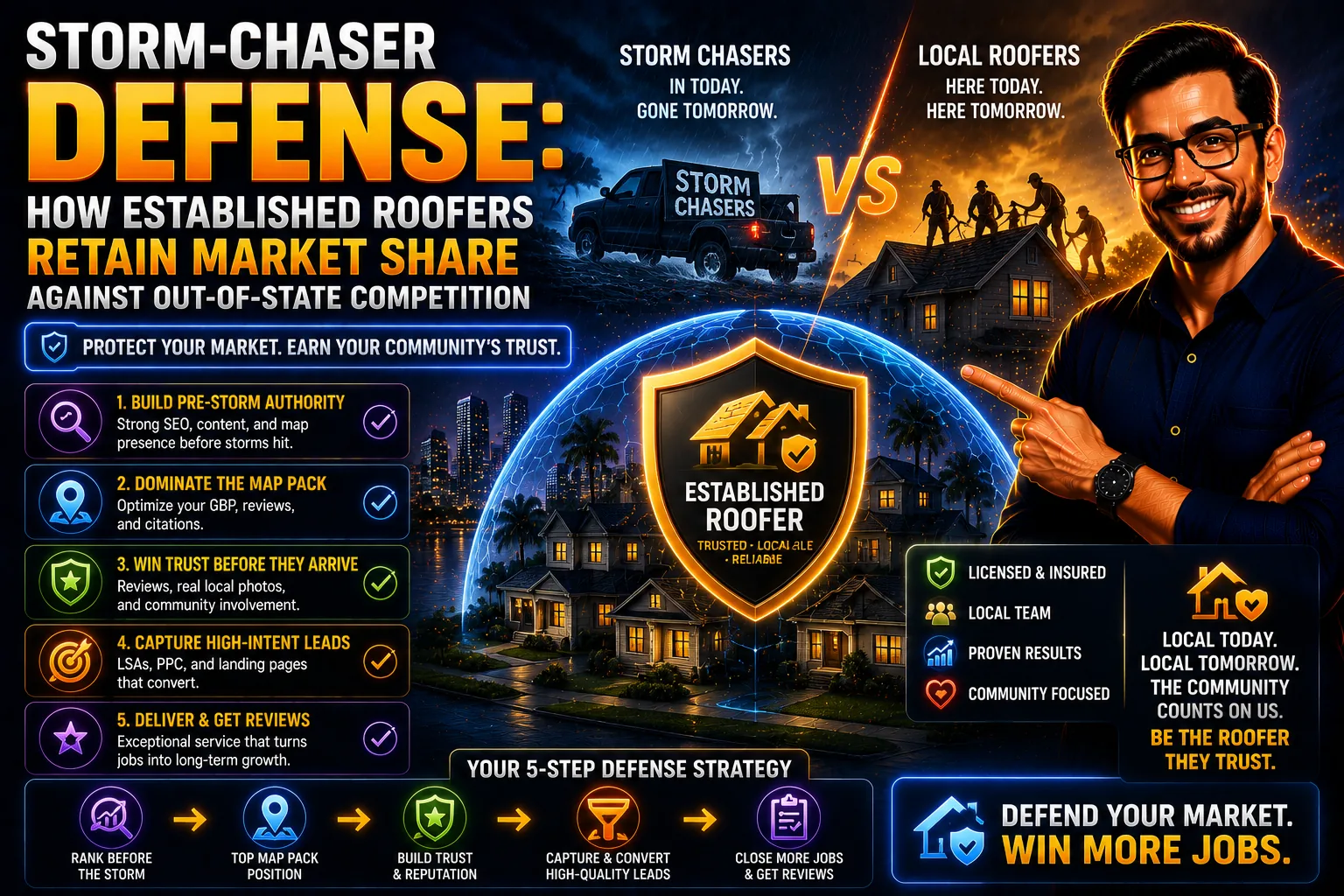
Storm-Chaser Defense: How Established Roofers Retain Market Share Against Out-of-State Competition
After every major storm, the affected market sees an influx of out-of-state roofing operations and reactive local operators racing to capture surge demand. The storm-chaser pattern is well-documented: door-to-door sales pressure, aggressive paid advertising, urgency tactics that exploit homeowner stress, work that's completed quickly but often without proper standards, crews that disappear after the surge with no accountability for subsequent issues. For established local roofers serving the affected market year-round, storm-chaser competition can be substantially damaging — market share captured during the highest-value period of the year by operators who won't be there for warranty work, who underbid sustainable pricing, and who damage the broader market through poor work quality and customer experiences.
Published: July 19, 2026 | Reading Time: ~8 minutes | Category: Roofing Marketing — Storm-Chaser Defense
Storm-chaser defense isn't about waiting for storm-chasers to leave. It's about building the marketing infrastructure that retains your market share during storm windows — pre-storm brand awareness that means customers think of you first, dominant search presence that puts you in front of customers before storm-chasers reach them, trust positioning that makes you the obvious choice when customers compare, and the operational capacity to actually deliver during surge windows. Established roofers with strong marketing defense capture the storm work that should be theirs; established roofers without it watch storm-chasers harvest the highest-margin work of their year.
This guide covers storm-chaser defense for established local roofing operations: understanding the storm-chaser playbook to defend against it, the pre-storm marketing foundation that gives you the first-look advantage, the in-storm marketing tactics that compete for surge demand, the trust positioning that distinguishes you from storm-chasers in the moments when customers compare, the operational capacity that converts the marketing advantage into completed work, and the post-storm reputation work that compounds the advantage across future storm seasons.
What You'll Learn
- Understanding the storm-chaser playbook so you can defend against it
- Pre-storm marketing foundation that produces first-look advantage
- In-storm marketing tactics that compete for surge demand
- Trust positioning that distinguishes established operations from storm-chasers
- Operational capacity that converts marketing advantage into completed work
- Post-storm reputation work that compounds the advantage across future seasons
Understanding the Storm-Chaser Playbook
Storm-chasers operate with specific patterns that, once understood, become defensible. The patterns recur across markets and storm events with consistency that makes defense strategy possible.
- Aggressive door-to-door canvassing in affected neighborhoods within days of storms. Crews go door-to-door pitching free inspections, immediate availability, and urgency around insurance claim filing windows. The in-person sales pressure converts homeowners who haven't researched alternatives.
- Heavy paid advertising during storm windows. Storm-chasers bid up Google Ads, Facebook Ads, and local digital channels during storm windows, often paying CPCs that exceed sustainable rates because their economics are based on quick volume rather than long-term presence.
- Urgency-based sales tactics: 'insurance only covers this if you file within X days,' 'we can only honor this price today,' 'we're leaving the area next week.' These tactics exploit homeowner stress and discourage the comparison shopping that would expose the storm-chaser disadvantages.
- Insurance claim filing assistance presented as service: storm-chasers often help homeowners file insurance claims, position themselves between homeowner and insurer, and structure their compensation around the claim amounts. The dynamic can create conflicts of interest the homeowner doesn't recognize.
- Work completed fast at potentially questionable quality: storm-chasers prioritize volume over substantive workmanship. Roofs are installed quickly with standard materials, often without the substrate inspection, flashing detail, and code compliance that quality work involves.
- Disappearance after the surge: storm-chasers leave the market when surge demand fades, taking their warranties with them. Subsequent issues with their work become the homeowner's problem with no recourse to the original installer.
WHY CUSTOMERS FALL FOR STORM-CHASERS: Storm-chasers succeed because they show up at moments of homeowner stress with confident-seeming solutions, before homeowners have researched local alternatives. The homeowner has just experienced storm damage, is stressed about repair costs and insurance, and a salesperson is at the door offering free inspection and immediate help. The storm-chaser sale closes before the homeowner researches your operation or compares alternatives. Defense isn't about convincing homeowners to choose you over a storm-chaser they've already engaged with — it's about being the first option they think of, the first option they find when searching, and the obvious option when they evaluate alternatives. The defense happens in advance of the comparison, not during it.
Pre-Storm Marketing Foundation
The marketing work that defends against storm-chasers is largely done before storms hit. The brand awareness, search presence, and reputation built during steady-state periods are what produces the first-look advantage when storms arrive.
Sustained Local Brand Awareness
- Consistent presence in local marketing channels year-round: local sponsorships, community involvement, charity work, and visible engagement in the neighborhoods you serve. Storm-chasers can't replicate this; established operations can build it deliberately.
- Direct mail to mature-roof neighborhoods (homes 15+ years old where roof replacement is approaching) building brand recognition before storms hit. The recipient who's seen your mailers for two years remembers your name when their roof gets damaged.
- Local PR and media presence: appearances in local news, contributions to home-improvement content in regional publications, and the kind of presence that establishes you as the recognized local roofer.
- Vehicle wraps and yard signage: branded vehicles working visibly in the neighborhoods you serve, yard signs on every completed job (where permitted), and the cumulative visual presence that means residents recognize your brand.
Search Dominance Before Storms
- Map Pack ranking maintained at full strength: when the storm hits and affected homeowners start searching, your Map Pack listing is already at the top. Storm-chasers can't quickly outrank Map Pack positions built through years of review velocity and GBP optimization.
- LSA position-zero presence with strong Google Guaranteed badge: customers searching during storm windows see your LSA listing first, with the trust signals that distinguish you from unverified alternatives.
- Organic ranking for relevant terms: storm damage, emergency roof repair, insurance restoration — the terms customers search after storms. Ranking organically for these terms before storms hit means you appear when affected customers search.
- Substantive web presence demonstrating credentialing: licensed, insured, established locally, with substantial review history that's been accumulated over years. Storm-chasers can't fabricate this; established operations have it as a permanent advantage.
PRO TIP: Most roofing operations underinvest in pre-storm marketing because the work doesn't produce immediate measurable returns. The brand awareness, search dominance, and reputation built during quiet periods don't produce direct leads in the moment. But during storm windows, the operations that did the pre-storm work capture surge demand at favorable economics while operations that didn't watch storm-chasers capture work that should have been theirs. The economics of pre-storm marketing pay back during storms — measure it across the full annual cycle, not within any single month, and the investment case becomes clear.
In-Storm Marketing Tactics
When storms hit, established operations with strong pre-storm foundations execute in-storm marketing that competes for surge demand against storm-chasers.
- Rapid-deploy paid search activation: pre-built campaigns targeting affected zip codes with storm-specific keywords activated within hours of the event. The operations that prepared these campaigns during quiet periods activate immediately; operations that didn't are still trying to build campaigns while demand surges around them.
- LSA bid adjustment during storm windows: increased bids to maintain position-zero placement as competition intensifies. The strong Google Guaranteed badge and review history support this; new entrants without comparable signals can't match the placement.
- Direct mail deployment to affected areas: pre-prepared mail pieces deployed within days of storms reach homeowners during the decision-making window. The pieces emphasize local establishment, credentialing, and the trust signals that distinguish established operations.
- Email and customer-database activation: existing customer database contacted with storm-response messaging. Past customers and their referral networks represent warm leads storm-chasers can't access.
- Social media presence covering the storm response: documenting work in affected areas, sharing customer stories with permission, and maintaining the visible local presence that storm-chasers can't sustain.
- Local media engagement: established operations often have relationships with local media that surface during storm coverage — interviews about damage patterns, recovery advice, and the kind of expert positioning that storm-chasers can't access.
Trust Positioning That Distinguishes Established Operations
- Years in business prominently communicated: 'serving [region] for 20 years' carries weight storm-chasers can't claim. The years-in-business signal addresses customer concerns about contractor reliability and warranty support.
- Local establishment verifiable: physical office address (not a PO box), local phone number with established history, and the documentation that proves long-term local presence.
- Substantial review history: hundreds of Google reviews accumulated over years, with sustained recent velocity. Storm-chasers might generate a handful of reviews during their surge window but can't match years of accumulated reputation.
- Credentialing visible: license numbers, insurance verification, manufacturer certifications (GAF Master Elite, CertainTeed SELECT ShingleMaster, etc.), industry association memberships displayed prominently.
- Community involvement evidence: sponsorships, charitable work, community presence that demonstrates investment in the area. Storm-chasers have no local stake; established operations can document theirs.
- Warranty backed by sustained presence: the warranty is only as good as the company standing behind it. Established operations stand behind their warranties because they're here next year and the year after; storm-chasers' warranties evaporate when they leave.
- Insurance-restoration competence positioned substantively: established operations often have insurance-adjuster relationships, claim-process expertise, and the documented capability that handles insurance restoration professionally — work that storm-chasers may attempt but execute poorly.
Operational Capacity for Storm Windows
Marketing advantage only matters if operational capacity converts the marketing reach into completed work. Established operations need surge-capable operations to actually serve the storm-window demand their marketing produces.
- Intake capacity that scales: expanded human staff during anticipated and active storm windows, plus AI receptionist capability for overflow. No marketing-generated lead should go unanswered during surges.
- Crew capacity that scales through standing capacity expansion or established subcontractor relationships activating during surges. Operations that contract for surge capacity ahead of storms have it when needed.
- Equipment and materials ready: pre-positioned materials and equipment ready for surge deployment. Supply-chain disruptions during major storms can constrain operations that didn't prepare.
- Scheduling and dispatch systems handling surge volume: scheduling tools, customer communication, and field coordination tested for surge capacity before storms hit.
- Insurance and credentialing current and verifiable: storm windows produce scrutiny; current credentialing prevents complications during the period when smooth execution matters most.
- Cash flow management: storm work often involves insurance-delayed payments while operation costs hit immediately. Cash management plans for storm windows prevent operational strain.
Post-Storm Reputation Work
Each storm window produces reputation effects that compound across future storms. Established operations executing strong storm-window work build the reputation that strengthens defense against future storm-chaser competition.
- Systematic review generation from completed storm jobs: storm customers often leave specific story-driven reviews about the response and the work. These reviews compound LSA and Map Pack ranking for future storm windows.
- Customer database growth: new customer relationships built during storm windows feed steady-state demand and produce referrals for years.
- Case study and content documentation: completed storm work documented becomes marketing content, social media presence, and credibility evidence for future periods.
- Storm-chaser contrast positioning: content addressing the storm-chaser problem, what to look for in a roofing contractor after storms, and how to evaluate alternatives. This content educates future homeowners and positions established operations as the credible alternative.
- Insurance and warranty follow-through: standing behind work performed during storm windows produces the long-term customer relationships that distinguish established operations from storm-chasers who disappeared.
The Bottom Line
Storm-chaser defense for established roofing operations is fundamentally about building the marketing and operational infrastructure that ensures customers think of you first, find you first, and choose you when comparing — before storm-chasers have the chance to engage them. The defense happens primarily in the pre-storm period through sustained local brand awareness, Map Pack and LSA dominance, comprehensive review history, and trust positioning that storm-chasers can't replicate. In-storm tactics execute against the foundation built during quiet periods; post-storm reputation work compounds the advantage across future storm seasons.
The operations that defend against storm-chasers effectively capture the storm-window work that represents some of the highest-value revenue available in roofing — at the economics that established local operations can sustain. The operations that don't defend effectively watch storm-chasers harvest surge demand and leave damaged customer relationships and market reputation in their wake. Investment in storm-chaser defense isn't optional for established roofing operations in storm-prone markets; it's the difference between strengthening your market position during storms and watching it erode. The work is concrete, the framework applies across markets, and the returns compound across storm seasons that established operations are here to serve year after year.
Key Takeaways
- Storm-chaser defense isn't reactive — it's the marketing infrastructure that ensures customers think of you first, find you first, and choose you when comparing, before storm-chasers can engage them
- Storm-chaser playbook: door-to-door canvassing, heavy paid advertising during surges, urgency tactics, insurance claim involvement, fast-but-questionable work, disappearance after surges. Understanding the pattern enables defense
- Pre-storm foundation produces first-look advantage: sustained local brand awareness (sponsorships, mail, PR, vehicle/yard signs), search dominance (Map Pack, LSAs, organic, substantive web presence) built before storms hit
- In-storm tactics: rapid-deploy paid search in affected zip codes, LSA bid adjustments, direct mail to affected areas, customer database activation, social and local media engagement
- Trust positioning that storm-chasers can't replicate: years in business, local establishment verifiable, substantial review history, visible credentialing, community involvement, warranty backed by sustained presence, insurance-restoration competence
- Operational capacity for storm windows: intake capacity that scales (human + AI receptionist), crew capacity through standing or subcontractor relationships, ready materials and equipment, scheduling systems, current credentialing, cash flow management
- Post-storm work compounds across future storms: systematic review generation, customer database growth, case study documentation, storm-chaser contrast content, warranty follow-through that distinguishes from disappeared storm-chasers
- Pre-storm marketing investment doesn't show direct returns in any single month, but during storm windows determines whether established operations capture surge demand or watch storm-chasers harvest the highest-value work of the year
READY TO BUILD A LEAD PIPELINE THAT'S YOURS? Astra Results Marketing builds storm-chaser defense for established roofing operations — pre-storm marketing foundation (local brand awareness, Map Pack and LSA dominance, review velocity systems), in-storm rapid-deploy infrastructure, trust positioning that distinguishes established operations from out-of-state competition, operational capacity for storm windows including AI receptionist overflow, and post-storm reputation work that compounds across seasons. Stop watching storm-chasers harvest the storm work that should be yours. Build the defense that retains your market position when it matters most. Astra Results Marketing · astraresults.com · (+1) 786-643-3036