Rated 5 star on

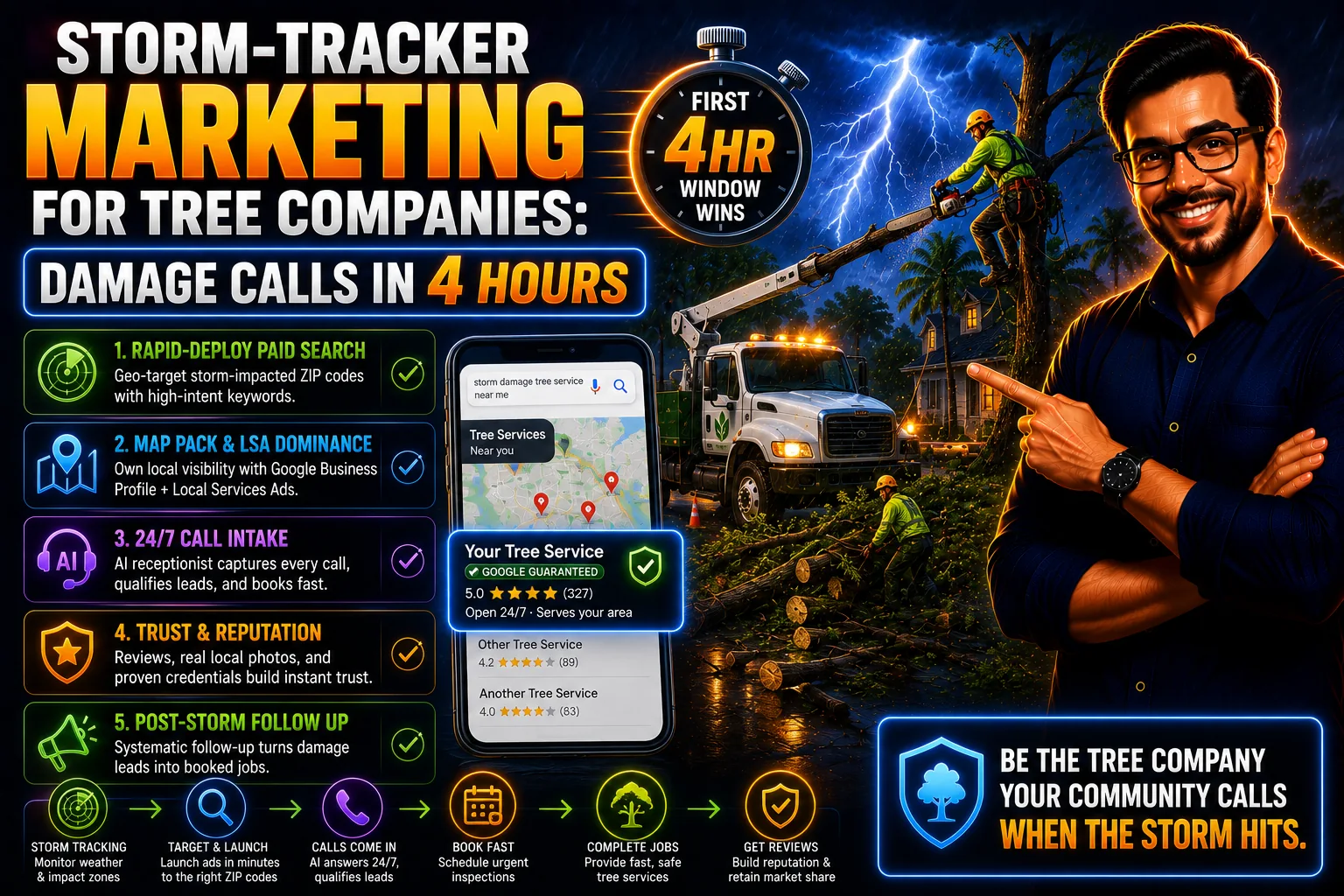
Storm-Tracker Marketing for Tree Companies: Damage Calls in 4 Hours
There's a window after every major storm when tree-service demand spikes and the company that responds first captures the majority of available work. Customers staring at a tree on their roof, a limb through their fence, or a downed trunk blocking the driveway aren't researching contractors for days — they're calling whoever shows up at the top of their search and answers the phone. The crew that gets there first books the job; the crews that arrive later either compete for what's left or get told 'we already have someone coming.' The economics of storm response are decided in those first hours, and most tree-service operators don't have the marketing infrastructure to win that window.
Published: July 10, 2026 | Reading Time: ~10 minutes | Category: Tree Service — Storm Marketing
Storm-tracker marketing is the practice of building the systems that capture this spike — the geographic precision, the rapid-response paid search, the always-on Map Pack and LSA presence, the call-intake capacity, and the field-team coordination that lets a tree-service company turn weather events into booked-job pipeline within hours instead of days. ArborCentric Solutions built this capability over several storm seasons in South Florida, and the difference between their storm-window performance before and after the systems were in place is substantial — moving from being one of many companies fighting for residual work to being the company that consistently captures the high-value emergency calls in the first 4 hours.
This guide covers storm-tracker marketing for tree companies practically: the channels that fire in the first hours, the geographic targeting that focuses spend on actually-affected areas, the call-intake capacity that converts the calls you do generate, the field coordination that turns booked jobs into completed ones, and the post-storm follow-up that compounds reputation and referrals. Whether you operate in a storm-prone market or just want to capture the seasonal weather events your area does have, this is the practical playbook.
What You'll Learn
- Why the first 4 hours after a storm decide the bulk of tree-service demand capture
- The channels that fire in the storm window — Map Pack, LSAs, rapid-deploy paid search
- Geographic targeting precision: focusing spend on actually-affected zip codes
- The call-intake capacity that converts spike-hour calls into booked jobs
- Field coordination that turns booked jobs into completed (and reviewed) work
- Post-storm follow-up that compounds reputation and referrals
- What ArborCentric Solutions built to win the South Florida storm window
Why the First 4 Hours Decide the Storm Window
Storm demand for tree services doesn't distribute evenly across the days following the event. It compresses heavily into the first hours, then tapers as homeowners either get a contractor lined up or accept that they'll have to wait. Understanding this compression is the foundation of storm-tracker strategy.
How the Demand Curve Actually Behaves
In the hours immediately after a storm, affected homeowners check their property, see the damage, and start calling tree-service companies. The first wave — the homeowners with the most acute problems (tree on the house, blocked driveways, downed power lines requiring tree removal before utility crews can work) — calls within the first hour or two and books with whoever responds. The second wave — less urgent but still motivated damage — calls in the following hours. By 24 hours after the event, the high-value emergency work has largely been claimed; what remains is the lower-margin cleanup work that competitors are also chasing.
The crew that captured the first-wave work in the first 4 hours has a fully-booked schedule before competitors are even staffing their phones. The crews that respond slowly are working on the residual demand at less favorable economics. The compression is the strategic reality, and the marketing systems that win in storm markets are built around capturing that early window.
WHY MOST TREE SERVICES MISS THE STORM WINDOW: Most tree-service companies set up their marketing for steady-state demand — moderate ongoing flow of trimming, removal, and maintenance work — and treat storms as bonus volume that arrives whether or not specific marketing fires. This works for capturing some storm demand but misses the first-4-hour compression where the highest-value work is decided. The companies that win storm markets build dedicated systems that activate when weather events happen: pre-built rapid-deploy paid search campaigns that turn on in affected zip codes within hours, always-on Map Pack and LSA presence that dominates baseline local search, expanded call-intake capacity for surge volume, and field-team coordination ready to dispatch fast. The systems take work to build, but they're what separates the operators who capitalize on storms from the operators who get the leftovers.
The Channels That Fire in the Storm Window
Three channel categories dominate storm-window capture, working together to ensure presence wherever affected homeowners search.
Always-On Map Pack and LSAs
Map Pack rankings and Local Services Ads presence are the baseline infrastructure — they're not 'turned on' for storms because they're always on. But their value during storm windows is enormous: when affected homeowners search 'tree service near me' or 'emergency tree removal,' the businesses ranking in the Map Pack and Google Screened in LSAs capture a large share of clicks before the search even reaches paid results below. ArborCentric's investment in Map Pack and LSAs across South Florida service areas paid back substantially during storm events because the always-on presence captured a meaningful share of the spike volume without any storm-specific campaign activation.
Rapid-Deploy Paid Search
Beyond the always-on channels, pre-built paid search campaigns that activate within hours of a storm event capture additional spike demand. The campaigns target storm-specific keywords ('tree on house,' 'emergency tree removal,' 'storm damage tree service'), geo-target the affected zip codes specifically, and use aggressive bids during the window since the cost-per-call economics improve dramatically when call volume and conversion rates spike. The key is having the campaigns built and ready to activate rather than scrambling to launch them after the storm — which loses the very window the campaigns are meant to capture.
Storm-Tracking Geographic Triggers
The most sophisticated storm marketing uses weather tracking to anticipate where damage will occur and stages campaign activation accordingly. National Weather Service watch/warning data, hurricane track projections, and storm-cell radar all provide the geographic intelligence needed to activate marketing in the right areas before the storm hits or immediately after. ArborCentric tied paid search activation to specific weather-event triggers, with campaigns ready to fire for forecasted-affected zip codes the moment damage was likely. The geographic precision concentrated spend on areas where demand would actually spike rather than wasting budget on broader regional targeting.
Geographic Targeting Precision
Storm damage doesn't happen uniformly across a region — it concentrates in specific paths, neighborhoods, and zip codes based on the storm's track and local topography. The marketing that wins concentrates spend where the demand actually is.
- Zip-code-level targeting rather than metro-level: paid search activated for specific zip codes affected by the storm event, not the whole metro area. Affected-area spend captures real demand; unaffected-area spend wastes budget.
- Track-based activation: hurricane and tropical storm tracks are predictable enough days in advance to pre-stage targeting. Tornado and severe-storm events activate after the fact based on damage reports.
- Refining as damage is reported: initial activation based on forecast tracks gets refined within hours as actual damage areas become known. The marketing concentrates further on the highest-damage areas.
- Bilingual coverage in mixed-language markets: in South Florida and similar diverse markets, parallel Spanish-language campaigns capture Hispanic homeowners who search in Spanish during emergencies. The bilingual capability can be the difference in capturing the full demand from a diverse affected area.
ArborCentric refined the geographic-targeting precision over multiple storm seasons, learning which zip codes consistently produced the highest-value calls relative to spend, which storm types produced which patterns of damage, and how quickly the geographic concentration of demand shifted from initial forecast areas to actual damage areas. The data accumulated over seasons produced increasingly precise targeting and substantially better unit economics on storm-window spend.
Call-Intake Capacity for the Surge
Generating the calls is only half the work. Converting those calls into booked jobs requires intake capacity that handles spike volume — and most tree-service operations have intake capacity sized for steady-state demand, dropping a substantial percentage of calls during storm spikes.
- Expanded human capacity during anticipated storm windows: extra staff on phones during the spike hours, with the training to handle emergency-tree-service intake.
- AI receptionist capability for overflow: when human capacity is exceeded, AI receptionist tools capture the calls that would otherwise be missed, gather damage details, and either book directly or hand off to a human callback. The leads that would have been lost to busy signals or unanswered phones become captured leads instead.
- Triage workflows for prioritization: when intake captures more requests than the field team can serve same-day, triage processes (emergency vs urgent vs deferrable) ensure the highest-value or most-urgent work is prioritized while lower-priority work is scheduled for later in the response.
- Honest expectation-setting: telling affected homeowners realistically when service can be provided, rather than overpromising and then disappointing. Honest scheduling builds trust and reduces the cancellations that come from missed promises.
PRO TIP: The single highest-leverage storm-window improvement for most tree services is expanding call-intake capacity to handle the surge — most operations have intake capacity sized for normal demand and drop a meaningful percentage of calls during spike events. AI receptionist tools that capture overflow when humans are at capacity, expanded human staffing during anticipated windows, and clear triage workflows together convert dramatically more of the storm-window demand into booked jobs. ArborCentric layered AI receptionist capability behind their human intake during storm seasons, ensuring that even at peak hours, no incoming damage call went to voicemail or busy signal — capturing the leads that would have been lost to competitors who could answer.
Field Coordination That Turns Bookings Into Completions
Booked jobs that don't get completed in a reasonable timeframe — or that get bumped because better-paying work came in — generate the negative reviews and reputation damage that compound across future storm windows. The field coordination that delivers on the booked work matters as much as the marketing that generates it.
- Crew scheduling matched to demand pattern: highest-value emergency work scheduled first, with routes optimized for geographic clustering of jobs to maximize crew productivity during the window.
- Equipment and crew pre-positioning: during anticipated storm events, crews and equipment positioned near forecasted-affected areas so dispatch is fast when the demand hits.
- Reserve capacity for the surge: maintaining or contracting additional crew capacity available during storm seasons rather than running at steady-state capacity that can't scale to spike demand.
- Communication discipline: keeping booked customers informed about timing, confirming arrivals, and handling the schedule changes that inevitably happen during high-volume windows. Customers tolerate delays when communication is good; they leave bad reviews when communication is poor.
- Quality maintained at volume: storm-window work that's done quickly but badly produces customer complaints and reputation damage. The crews that capture storm demand while maintaining quality build the reputation that compounds across future events; the ones that sacrifice quality for volume undermine their own future business.
Post-Storm Follow-Up That Compounds Reputation
The storm window doesn't end when the immediate work is completed. Post-storm follow-up — review requests from satisfied storm customers, referral generation, and the reputation building from a well-executed response — compounds across future storm events and feeds the always-on marketing presence between events.
- Systematic review requests from storm customers: every successfully completed storm job is a review opportunity. Storm customers are often particularly grateful (they were in a stressful situation and you helped) and the reviews tend to be specific, story-driven, and impactful — exactly the kind of trust signal that drives Map Pack ranking and converts future searchers.
- Referral activation: satisfied storm customers refer friends and neighbors at high rates because storm damage spreads through communities, and word travels fast about which companies actually performed. A referral program that activates after storm seasons captures this word-of-mouth at scale.
- Content from storm response: the storm work itself produces content — photos, videos, before-and-afters — that fuels social media, website credibility, and case studies for future marketing. Document the work systematically.
- Customer database building: every storm customer becomes part of your customer database for ongoing marketing — maintenance plan offerings, future service reminders, reactivation campaigns. The storm-acquired customers feed steady-state demand between events.
- Reputation amplification: a well-executed storm response builds the local reputation that compounds for years. The next storm event finds you with stronger reviews, more referrals, and more trust signals than you had before — and the cycle continues.
What ArborCentric Built — and What It Produced
ArborCentric Solutions built the storm-tracker marketing infrastructure over multiple South Florida storm seasons. The components — always-on Map Pack and LSA dominance across service areas, pre-built rapid-deploy paid search campaigns tied to weather-event triggers, zip-code-level geographic targeting refined across multiple events, AI receptionist capability layered behind human intake to capture overflow, field-coordination workflows that handled the dispatch and scheduling at spike volume, and systematic post-storm review and referral generation — work together as an integrated system rather than disconnected tactics.
The cumulative outcome over multiple storm seasons: ArborCentric consistently captures the high-value emergency work in the first hours of storm events, books their crews to capacity well ahead of competitors who respond more slowly, executes the work at quality levels that generate strong reviews and referrals, and compounds the reputation that makes the next event's capture even more efficient. The unit economics of storm-window work — high-value emergency jobs at favorable per-job revenue, with marketing spend concentrated in proven-effective geographic areas — produce some of the highest-ROI marketing periods for the business. And the steady-state effects between storms — strong Map Pack rankings sustained by storm-generated reviews, a customer database expanding with each event, referral activity continuing well beyond the storm windows themselves — feed ongoing demand even when no specific storm event is active.
The Bottom Line
Storm-window demand for tree services is the highest-value, most-compressed opportunity tree-service operators see — and most operations are set up to capture only a fraction of it because they're not built for the first-4-hour window where the high-value work is decided. Storm-tracker marketing builds the integrated systems that capture that window: always-on Map Pack and LSA presence as the baseline, rapid-deploy paid search activating in actually-affected zip codes within hours, call-intake capacity that handles the surge volume, field coordination that turns booked jobs into completed quality work, and post-storm follow-up that compounds reputation and referrals across future events.
The build takes work and discipline — pre-built paid search campaigns ready to activate, weather-event monitoring tied to marketing triggers, AI receptionist capability for intake overflow, field-team workflows for surge dispatch, and review-and-referral systems that activate after every storm. But the tree-service operators that build it consistently capture the storm window that less-prepared competitors miss, and the cumulative effect across storm seasons is substantial — higher revenue during events, better unit economics on storm-window spend, stronger ongoing reputation between events, and a compounding customer base that produces referrals year-round. Storms come whether or not you're ready for them; the question is whether your marketing turns them into the demand-capture opportunity they could be.
Key Takeaways
- Storm-window demand for tree services compresses heavily into the first 4 hours — affected homeowners call whoever responds first, and the high-value emergency work is decided in those hours, with residual lower-margin cleanup work remaining for slower-responding competitors
- Most tree services miss the storm window because they're set up for steady-state demand, not the first-4-hour compression — the operators who win build dedicated systems that activate when weather events happen
- The channels that fire in the storm window: always-on Map Pack and LSAs (the baseline that captures spike searches without storm-specific activation), pre-built rapid-deploy paid search (activates within hours, geo-targeted to actually-affected zip codes), and storm-tracking geographic triggers (NWS data, hurricane tracks, radar) for precision activation
- Call-intake capacity is the single highest-leverage storm-window improvement — most operations drop a meaningful percentage of calls during spikes. Expanded human capacity plus AI receptionist for overflow plus triage workflows together convert dramatically more demand into booked jobs
- Field coordination turns booked jobs into completions: crew scheduling matched to demand pattern, equipment/crew pre-positioning, reserve capacity for the surge, communication discipline with booked customers, and maintained quality at volume — bookings without completions damage reputation more than missed bookings ever would
- Post-storm follow-up compounds: systematic review requests (storm customers leave specific, story-driven reviews), referral activation while word-of-mouth is hot, content from the response, customer database building, and the reputation amplification that makes the next event easier
- ArborCentric Solutions built the integrated storm-tracker system across multiple South Florida storm seasons — the compounding effects (high-value emergency capture, favorable unit economics, ongoing reputation between events, expanding customer database) make storm windows among the highest-ROI marketing periods for the business
READY TO BUILD A LEAD PIPELINE THAT'S YOURS? Astra Results Marketing builds storm-tracker marketing systems for tree-service operators — always-on Map Pack and LSA presence, pre-built rapid-deploy paid search tied to weather-event triggers, AI receptionist capability for call-intake surge, and the post-storm follow-up that compounds reputation across future events. We worked with ArborCentric Solutions to build this capability across South Florida storm seasons. Stop letting storms produce mediocre demand capture. Build the systems that turn weather events into the highest-ROI marketing periods of your year. Astra Results Marketing · astraresults.com · (+1) 786-643-3036