Rated 5 star on

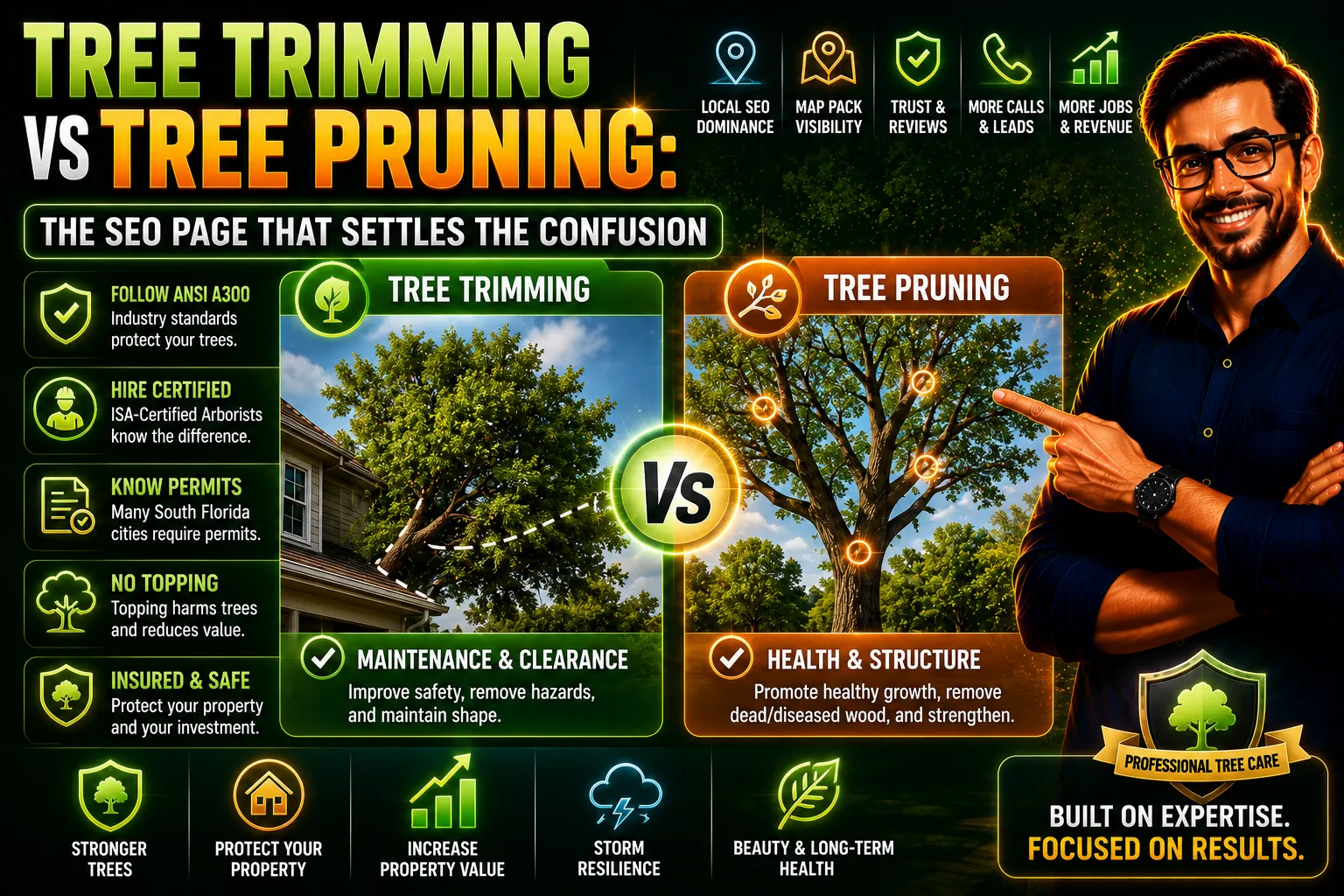
Tree Trimming vs Tree Pruning: The SEO Page That Settles the Confusion
Homeowners use 'tree trimming' and 'tree pruning' interchangeably. Tree-service companies often do too. Search engines return overlapping results for both terms, and most of the content that ranks doesn't actually clarify the distinction — it just uses both words and hopes the reader figures it out. The result is one of the most persistent areas of consumer confusion in tree care: a homeowner who asks for 'trimming' may receive what an arborist would call 'pruning,' or vice versa, with substantial differences in outcome, cost, and impact on the tree. The words actually mean different things, and understanding the difference matters for every homeowner making decisions about their trees.
Published: July 12, 2026 | Reading Time: ~18 minutes | Category: Tree Service — Authority Content
This guide settles the confusion. The technical distinction is well-defined in arboriculture, codified in standards like ANSI A300 that govern professional tree work, and meaningful enough that the work performed under each label is substantially different. Pruning is selective branch removal for tree health, structure, and longevity — the strategic, biology-informed work that ISA-Certified Arborists perform. Trimming is more aesthetic and size-management oriented — shaping for appearance, managing clearance issues, controlling growth into structures or sightlines. Both are legitimate services; both have proper applications; and both can be done well or badly. The homeowner who understands the distinction can ask for what they actually need and evaluate whether they're getting it.
This is the authoritative reference page on the topic — the kind of content built to actually answer the question rather than just rank for it. It covers the real technical distinction between pruning and trimming, the formal standards governing each, the specific types of pruning and trimming work performed in arboriculture, how to know which one your trees need, why the work should be performed by an ISA-Certified Arborist regardless of which it is, the timing and seasonality considerations, the common mistakes that damage trees, and how to evaluate the quality of work after it's done. ArborCentric Solutions performs both pruning and trimming as distinct services in their South Florida operation, and the substantive distinction between them is part of how the company communicates value to homeowners trying to make informed decisions about their trees.
What You'll Learn
- The actual technical distinction between tree pruning and tree trimming in arboriculture
- The formal standards (ANSI A300) that govern professional tree work and what they require
- The specific types of pruning work — crown thinning, raising, reduction, deadwooding, structural pruning
- The specific types of trimming work — shaping, height reduction, clearance, view management
- How to know which your tree actually needs (and why the question is itself diagnostic)
- Why the work should be performed by an ISA-Certified Arborist regardless of which it is
- Timing and seasonality considerations for both pruning and trimming
- Common mistakes — topping, lion-tailing, over-pruning — that damage trees permanently
- How to evaluate the quality of pruning or trimming after the work is done
The Actual Technical Distinction
In professional arboriculture, pruning and trimming refer to different categories of work with different goals, different techniques, and different impacts on the tree. The distinction isn't about formality of language — it's about what the work is actually trying to accomplish.
Pruning — Strategic Work for Tree Health and Structure
Pruning is the selective removal of specific branches, stems, or parts of a tree to achieve a defined objective related to the tree's health, structure, safety, or long-term wellbeing. The objective drives which branches come off, where the cuts are made, and how the work is sequenced. Pruning decisions are informed by tree biology — understanding how trees compartmentalize wounds, how branch architecture affects structural integrity, how the canopy interacts with environmental factors, and how the species responds to different cut types. The arborist performing proper pruning is making strategic decisions branch by branch, with reasoning behind every cut.
Examples of objectives that pruning addresses: removing dead, dying, or diseased branches to prevent decay spread (deadwooding); reducing structural weakness from co-dominant stems or improper branch unions; improving light penetration and air movement through the canopy (crown thinning); raising the lowest branches for clearance under the tree (crown raising); reducing overall canopy size when justified by structural concerns (crown reduction); training young trees toward sound mature structure (structural pruning). Each of these has specific techniques and standards, and each is performed differently depending on tree species, age, condition, and goal.
Trimming — Aesthetic and Size-Management Work
Trimming is the more general work of shaping, managing growth, and addressing aesthetic or practical concerns about a tree's size or appearance. Trimming objectives include shaping the tree for visual appeal, managing growth that's interfering with structures or sightlines, controlling height where size is a concern, clearing branches away from buildings, power lines, or driveways, and maintaining ornamental or landscape forms. Trimming work tends to be more uniform — removing branches based on where they are rather than on a strategic plan for tree health.
This isn't a knock on trimming. Aesthetic and practical concerns are legitimate reasons to work on a tree, and trimming addresses real homeowner needs. The distinction is that trimming optimizes for visible outcomes (size, shape, clearance) while pruning optimizes for tree-biology outcomes (health, structure, longevity). Done well, both are valuable; done badly, both can damage the tree. The difference matters because the work performed under each label, the qualifications required to do it properly, and the typical pricing all differ.
WHY THE WORDS MATTER: The same operation labeled 'tree trimming' might mean very different things depending on who's doing it. A homeowner who calls for 'trimming' might get what an arborist would call structural pruning (high-skill, biology-informed work), or they might get a crew with chainsaws giving the tree a haircut to a uniform shape — work that can permanently damage the tree if it removes too much canopy, makes cuts in the wrong places, or violates basic arboricultural standards. The label 'trimming' covers both. Asking for 'pruning' moves the conversation closer to the strategic, standards-based work that protects tree health — but only if the company being hired actually performs pruning to professional standards rather than calling everything they do by whatever word the customer used. The vocabulary alone isn't a guarantee; what matters is what the company actually does, whether it's standards-compliant, and whether the people performing it have the training to make the strategic decisions pruning requires.
The Formal Standards — ANSI A300
Professional tree care in the United States is governed by a set of standards developed by the American National Standards Institute (ANSI) and published as the A300 series. These standards define the proper techniques and approaches for various categories of tree work, and they're the reference point that distinguishes professional practice from improvisation.
What ANSI A300 Covers
- ANSI A300 (Part 1): Pruning — defines the techniques, types of cuts, and approaches for proper pruning, including the specific objectives different pruning types address and the standards for executing them.
- ANSI A300 (Part 2): Soil Management — covers soil testing, amendment, and management practices for tree health.
- ANSI A300 (Part 3): Supplemental Support Systems — addresses cabling, bracing, and other support installations for trees with structural concerns.
- ANSI A300 (Part 4): Lightning Protection Systems — for protecting valuable trees from lightning damage.
- ANSI A300 (Part 5): Management of Trees and Shrubs During Site Planning, Site Development, and Construction — protecting existing trees during construction projects.
- Additional parts cover specific specialty areas like integrated pest management, root management, and tree assessment.
Why the Standards Matter for Homeowners
Tree-service work that complies with ANSI A300 is, by definition, performed to recognized professional standards. The cuts are made in the proper locations relative to the branch collar, the volume of canopy removed in any single operation is within the standards' guidelines (typically no more than 25% in mature trees), the wounds heal properly because the cuts respect tree biology, and the long-term outcomes for the tree are favorable. Tree-service work that doesn't comply with the standards — work that ignores branch collars, removes too much canopy at once, makes improper cut types, or violates other foundational principles — can damage trees in ways that take years to become apparent but that are essentially permanent once they occur.
Reputable tree-service companies perform work to ANSI A300 standards and can speak knowledgeably about what the standards require. When you're evaluating a tree-service company, asking about their adherence to ANSI A300 and the training their crews receive in proper pruning techniques is one of the most diagnostic questions you can ask. Companies that perform standards-compliant work answer clearly; companies that don't either deflect, change the subject, or reveal that they're not actually familiar with the standards governing their industry.
The Specific Types of Pruning Work
Within pruning, several distinct types of work address different objectives. Understanding the categories helps homeowners ask for and evaluate the right kind of work.
Crown Cleaning (Deadwooding)
Removing dead, dying, diseased, weakly attached, or broken branches from the canopy. This is the most fundamental and lowest-risk type of pruning — the branches removed weren't contributing to the tree's health anyway, and their removal reduces the risk of branches falling, eliminates pathways for disease and pest spread, and improves the tree's overall appearance. Most mature trees benefit from periodic crown cleaning, and it's often a starting point for trees that haven't received regular care.
Crown Thinning
Selectively removing small live branches throughout the canopy to reduce density. The objectives include improving light penetration and air movement through the canopy, reducing wind resistance (relevant in hurricane-prone areas like South Florida), and reducing weight on heavy limbs. Crown thinning is highly technique-dependent — done well, it maintains the natural shape of the tree while improving its health and structure; done badly (most commonly through 'lion-tailing,' where interior branches are stripped and weight is concentrated at branch tips), it weakens the tree structurally and creates problems that often become apparent only later.
Crown Raising
Removing lower branches to raise the height of the tree's canopy above ground level. Common objectives include providing clearance for vehicles, equipment, structures, or sightlines. Crown raising should be performed gradually over multiple years for young or recently raised trees; raising the canopy too aggressively in a single operation can shift the tree's center of gravity in ways that affect long-term stability and remove the lower branches that contribute to trunk taper and structural strength.
Crown Reduction
Reducing the overall size of the canopy when justified by structural concerns, conflicts with structures, or other specific objectives. Crown reduction is performed using proper reduction cuts that respect tree biology — cutting back to a lateral branch large enough to assume the role of the leader. Improper crown reduction, where branches are simply cut back to arbitrary points (often called 'topping'), is one of the most damaging practices in tree care and should never be performed by a competent operation.
Structural Pruning
Strategic pruning of young or developing trees to establish sound mature structure. By identifying and addressing structural issues — co-dominant stems, included bark, poorly attached branches — during the tree's early years, an arborist can dramatically improve the tree's long-term structural integrity. Structural pruning is high-leverage work because the decisions made about young trees affect their structure for decades; well-pruned young trees become structurally sound mature trees that are safer, longer-lived, and require less corrective work later.
Vista or Selective Pruning
Strategically removing specific branches to open views or sightlines while maintaining the tree's overall health and aesthetic. This bridges into trimming territory but, when performed by a qualified arborist with attention to which branches can be safely removed without harming the tree, is legitimate pruning work serving an aesthetic objective through biology-informed cuts.
The Specific Types of Trimming Work
Trimming covers a related but distinct set of work focused on aesthetic and practical management of trees.
Shaping
Cutting a tree to achieve a particular shape — often spherical, conical, or other formal forms. Common in landscape and ornamental contexts, particularly with certain species adapted to maintained forms. Shaping is legitimate practice when applied to appropriate species and done in ways that respect the species' growth pattern; applied indiscriminately to species that don't tolerate it well, it can cause stress, dieback, and chronic structural issues.
Height Reduction
Reducing the height of a tree, typically because it's grown taller than the homeowner wants or because it's interfering with overhead utilities or other constraints. When performed properly using reduction cuts to lateral branches, height reduction is acceptable practice. When performed by simply cutting the top off (topping), it's destructive and creates structural problems that compound for the rest of the tree's life. The same word, 'height reduction,' can describe either practice depending on who's performing it.
Clearance Trimming
Removing branches that are interfering with structures, vehicles, sightlines, walkways, or other functional considerations. Clearance work is common, legitimate, and routine — but should still be performed with attention to proper cut techniques and avoidance of removing too much canopy in any single operation.
Hedge and Ornamental Trimming
Maintaining the formal shape of hedges, topiary, or ornamental forms. Different from tree work in the strictest sense but often performed by tree-service companies as part of their services. The standards and techniques for hedge work are different from those for trees, and the species commonly used for hedging tolerate frequent uniform cutting in ways that most tree species don't.
Vista Maintenance
Ongoing maintenance of view corridors that have been established — keeping the views open over time as the trees grow. Similar to the vista pruning category above but emphasizing the maintenance aspect, often performed at lighter touch and more frequently.
How to Know Which Your Tree Actually Needs
For most homeowners, the honest answer is: you might not know, and that's diagnostic in itself.
If you can articulate the specific issue you're trying to address — 'I want to clear branches over my driveway,' 'the trees are growing into the power lines,' 'I want to shape these ornamental hedges' — you probably want trimming, and the work itself is relatively defined. If you're noticing something more general about your trees — they don't seem healthy, branches are dying, a tree might be unsafe, you're not sure what care they need but you sense they need something — you probably want a proper assessment by an arborist, and the work that follows is likely pruning in one of its forms. The assessment matters more than the label in the second case, because the right work depends on what the assessment finds.
Questions That Indicate Pruning Is Probably the Right Frame
- 'Is this tree healthy?' or 'I'm worried about this tree.' Health assessments lead to pruning work.
- 'There are dead branches I can see, but I'm not sure what else might need to come off.' Crown cleaning combined with broader pruning.
- 'This is a young tree and I want it to grow well.' Structural pruning.
- 'I'm worried about hurricane season and want my trees prepared.' Selective thinning and structural pruning for wind resistance.
- 'A storm or something damaged this tree and I'm not sure what to do.' Damage assessment and corrective pruning.
- 'Something's going wrong with the canopy — branches dying, leaves looking off.' Health diagnosis and corrective work.
Questions That Indicate Trimming Is Probably the Right Frame
- 'I want to clear branches over [structure, vehicle, walkway].' Clearance trimming.
- 'The trees have gotten too tall and I want them shorter.' Height reduction — to be performed properly, not by topping.
- 'I want to open up this view.' Vista pruning or selective clearance.
- 'I want these hedges shaped.' Hedge trimming.
- 'Branches are touching my house and I want them away.' Clearance trimming.
PRO TIP: Here's a useful diagnostic question: 'Are you trying to solve a specific visible problem, or are you worried about the broader health and care of your trees?' The first case fits trimming work — the issue is concrete, the desired outcome is visible, and the work is more about achieving the visible result. The second case fits pruning — the issue isn't fully diagnosed yet, the desired outcome involves the tree's long-term health, and the work that should be performed depends on what an arborist's assessment finds. For the second case, hire an ISA-Certified Arborist to assess the trees and recommend the work; for the first case, you can be more directive about what you want done, but you still want to hire someone who'll perform the work to professional standards rather than just cutting branches off.
Why ISA-Certified Matters for Both
A common assumption is that pruning requires a credentialed arborist while trimming is something any tree-service crew can do. This is wrong on two counts.
First, trimming done badly damages trees just as much as bad pruning. The difference between competent and incompetent trimming is significant — improper height reduction (topping), excessive canopy removal in a single operation, cuts that don't respect branch collar locations, and other foundational errors all damage the tree regardless of whether the work was labeled 'trimming' or 'pruning.' A homeowner who hires an uncredentialed crew to do 'just trimming' can still end up with permanently damaged trees from work that was technically labeled differently.
Second, the boundary between trimming and pruning isn't as clear in practice as it is in textbooks. The same operation might involve some clearance work (clearly trimming), some deadwooding (clearly pruning), and some thinning to reduce wind resistance (also pruning but often grouped with shaping work). A competent ISA-Certified Arborist treats all of it with the appropriate technique for each cut — making decisions branch by branch based on what the tree needs, not what the work was billed as. An uncredentialed crew performing 'trimming' often applies the same uniform approach to all branches, missing the opportunity to do the work properly when individual decisions could have improved the outcome.
The credential matters for both kinds of work because the credential signals the underlying knowledge of tree biology, proper cut technique, ANSI A300 standards compliance, and the ability to make the strategic decisions both pruning and trimming benefit from. Operations led by ISA-Certified Arborists, with credentialed supervisors on the crews performing the work, produce better outcomes across the full range of services they offer — even when the work is labeled by the more colloquial 'trimming' term.
Timing and Seasonality Considerations
The right time of year for pruning and trimming work varies by species, by climate, and by the type of work being performed.
- Late dormant season (late winter, just before spring growth) is generally the best time for major structural pruning of many deciduous species. The tree is dormant, wounds will be exposed to less pathogen pressure before spring growth seals them, and the tree's stored energy reserves will support strong post-pruning growth.
- Summer pruning is appropriate for selected purposes — reducing growth rate, addressing specific issues that emerge, removing dead or damaged branches that appear during the growing season. Major canopy reductions in summer can stress trees more than dormant-season work.
- Avoid pruning during stress periods — drought, immediately after transplant, during disease outbreaks — when the tree's resources are already strained.
- In tropical and subtropical climates (South Florida and similar), the seasonality patterns differ from temperate-zone advice. Native and adapted species often have their own preferred pruning windows that don't follow temperate-zone rules. Local arborists familiar with the species in the area know what's appropriate; generic advice imported from northern climates can be wrong for South Florida trees.
- Hurricane preparation work (selective thinning, structural pruning to reduce wind resistance) should be performed well in advance of storm season — not in the immediate run-up. Last-minute hurricane prep often produces poor work because crews are overcommitted and the time for proper assessment isn't there.
- Clearance trimming (removing branches from structures, etc.) can generally be performed year-round, with proper attention to the species' tolerance and the type of cut being made.
Why Species-Specific Knowledge Matters
Tropical and subtropical species — royal palms, oaks, mahogany, gumbo limbo, ficus, and the many others common to South Florida and similar climates — each have their own optimal pruning windows, sensitivity patterns, and response to different cuts. An arborist familiar with the local species mix performs work at the right times in the right ways for the trees you actually have. A crew without that species-specific knowledge may apply generic practices that aren't right for your particular trees, with outcomes that range from suboptimal to genuinely damaging.
Common Mistakes That Damage Trees Permanently
- Topping. Cutting the top off a tree to a flat or arbitrary height. Topping is condemned by every professional arboricultural body — ISA, TCIA, ANSI standards — because it permanently weakens the tree, creates structurally weak rapid regrowth (water sprouts), exposes the trunk to sunburn and decay, and produces a tree that's both uglier and more dangerous than before. If a tree-service company offers to 'top' your tree, hire someone else.
- Lion-tailing. Stripping the interior branches and foliage from limbs while leaving the canopy concentrated at the branch tips. Lion-tailing produces a 'pom-pom' look that some homeowners find aesthetic but that catastrophically weakens the tree — wind loads on the canopy mass are transferred through a thinned interior to the branch attachments, dramatically increasing breakage risk. Trees that have been lion-tailed often shed limbs in storms that they would have survived intact.
- Excessive removal in a single operation. ANSI standards generally limit single-operation canopy removal to 25% or less of live foliage. Removing more — especially on mature, stressed, or recently-pruned trees — depletes the tree's energy reserves and triggers a stress response that compounds rather than resolves the issues the pruning was meant to address.
- Flush cuts. Cutting branches off flush with the trunk, removing the branch collar that the tree needs to seal the wound properly. Flush cuts leave a wound that doesn't heal properly, providing entry for decay organisms and creating long-term structural damage at the cut site.
- Stub cuts. The opposite mistake — leaving long stubs of branch tissue beyond the branch collar. Stubs die back to the trunk and become decay pathways.
- Inappropriate species treatment. Applying generic pruning practices to species that require different approaches — for example, treating palms (which are not technically trees botanically) as if they were broadleaf trees, or aggressively trimming species that don't tolerate it well.
How to Evaluate the Quality of Work After It's Done
Once the work is complete, several visible indicators distinguish quality work from damaging work.
- Cuts are made just outside the branch collar (the slightly swollen area where the branch meets the trunk or parent branch). Cuts respecting the branch collar will seal naturally; cuts inside the collar (flush cuts) or far outside it (stubs) won't.
- Canopy looks balanced and natural after the work. Quality pruning maintains the tree's natural shape and proportions; it shouldn't look obviously 'cut.' If the tree looks dramatically reshaped, oversized stubs are visible, or large areas of trunk are now exposed that weren't before, the work likely went too far.
- Interior canopy density is preserved. The branches inside the canopy are part of the tree's structural integrity and energy production; quality pruning respects them. A tree that's been lion-tailed will have visible canopy concentrated at the tips with stripped interior — easy to identify after the work.
- Major branches have not been cut back to arbitrary points. Reduction cuts in proper pruning are made to lateral branches large enough to assume the leader role. If you see large branches that have been cut to short stubs with no lateral branch to take over, that's topping or improper reduction.
- No more than approximately a quarter of the live canopy has been removed in a single operation on a mature tree. If significantly more than that has come off, the tree is likely to experience stress symptoms — water sprouts, dieback, vulnerability to pests — in the following growing season.
- Cleanup is thorough. Quality operations clean up the work site, properly dispose of debris, and leave the property in good condition. Sloppy cleanup correlates with sloppy work.
How ArborCentric Approaches Pruning and Trimming
ArborCentric Solutions performs both pruning and trimming as distinct services across South Florida, with the technical distinction informing how the work is performed and how it's communicated to homeowners. The estimate process includes a substantive assessment by an ISA-Certified Arborist who identifies what work the trees actually need — sometimes confirming the homeowner's initial request, sometimes recommending different work, sometimes identifying additional concerns the homeowner hadn't noticed. The work itself is performed to ANSI A300 standards by trained crews under credentialed supervision, with the species-specific knowledge of South Florida trees that local operations need to do the work properly. And the communication with homeowners includes the substantive explanation of what work was performed and why, so the homeowner understands what they paid for and can evaluate it.
The outcome of this approach: better tree-care outcomes for the homeowners who choose ArborCentric, repeat business from homeowners who recognize the quality difference, referrals from satisfied customers who saw the work done right, and the educational content (this page among others) that captures research-phase homeowners trying to make informed decisions. The market for tree-care services in South Florida is full of competing offers — some good, many mediocre, some genuinely damaging. ArborCentric's positioning as the standards-compliant, credentialed, biology-informed option produces the unit economics that lower-quality competitors can't sustain, and the educational content reinforces the positioning by helping homeowners understand what quality work actually looks like before they hire.
The Bottom Line
Tree pruning and tree trimming are distinct work in professional arboriculture, even when the language used in everyday conversation treats them as interchangeable. Pruning is selective, strategic work for tree health and structure, performed to ANSI A300 standards by credentialed arborists making branch-by-branch decisions based on tree biology. Trimming is more aesthetic and size-management oriented, addressing visible concerns about size, shape, clearance, or appearance. Both are legitimate services with proper applications, both can be done well or badly, and both benefit substantially from being performed by ISA-Certified Arborists rather than uncredentialed crews.
For the homeowner trying to figure out what their trees need: if you can describe a specific visible problem you want solved, trimming probably fits, and the conversation is more directive. If you're worried about your trees more generally — health, safety, long-term care — pruning is probably the frame, and the work depends on what an arborist's assessment finds. In either case, the credentialing of the company you hire matters more than the label of the service. Verify ISA-Certified Arborist status, ask about ANSI A300 standards compliance, check insurance and licensing, and read the reviews of past work. The work performed under any label can range from excellent to damaging; the credentialed, standards-compliant company is the one most likely to perform it the way it should be performed — whether the customer called it trimming, pruning, or something else entirely. Your trees are long-term assets on your property; the work performed on them should be done by people who understand what they're doing and care about the outcomes that emerge years after the cuts are made.
Key Takeaways
- Tree pruning and tree trimming refer to distinct categories of work in professional arboriculture: pruning is strategic, biology-informed work for tree health and structure (deadwooding, thinning, raising, reduction, structural pruning), while trimming is more aesthetic and size-management oriented (shaping, height reduction, clearance, vista work)
- The work performed under each label can be substantially different — homeowners using the terms interchangeably may receive very different services depending on the company hired. The vocabulary alone doesn't guarantee anything; what matters is what the company actually performs to what standards
- ANSI A300 is the formal standards series governing professional tree work in the US — covering pruning, soil management, supplemental support, lightning protection, and other specialty areas. Reputable companies perform work to these standards; companies unfamiliar with them often don't
- Pruning types include crown cleaning (deadwooding), crown thinning, crown raising, crown reduction, structural pruning (high-leverage on young trees), and vista pruning — each with specific techniques and applications. Trimming types include shaping, height reduction, clearance, hedge work, and vista maintenance
- If you can describe a specific visible problem (clearance, shape, height), trimming fits and the work can be more directive. If you're worried about tree health, safety, or long-term care generally, pruning fits and the work depends on an arborist's assessment
- ISA-Certified Arborist credentialing matters for both pruning and trimming — bad trimming damages trees as much as bad pruning, the boundary between the two isn't sharp in practice, and credentialed arborists apply proper technique across the full range of work regardless of how it's labeled
- Timing matters and varies by species and climate — South Florida and other tropical/subtropical regions have different optimal windows from temperate-zone advice. Hurricane prep work should be done well in advance, not in the immediate run-up to storm season
- Common damaging mistakes: topping (cutting tops off to arbitrary heights), lion-tailing (stripping interior branches), excessive single-operation removal (>25% of canopy), flush cuts (removing branch collar), stub cuts (leaving long stubs), and inappropriate species treatment
- Quality evaluation indicators: cuts respecting the branch collar, balanced natural-looking canopy, preserved interior density, reduction cuts to lateral branches (not arbitrary stubs), no more than ~25% removed in a single operation, and thorough cleanup
- ArborCentric Solutions performs both pruning and trimming as distinct services in South Florida — ISA-Certified Arborist assessment, ANSI A300-compliant work, species-specific knowledge of local trees, and substantive communication with homeowners about what was done and why
READY TO BUILD A LEAD PIPELINE THAT'S YOURS? Astra Results Marketing builds authoritative educational content and credential-positioned marketing for ISA-certified tree-service operators — the kind of content that captures research-phase homeowners and converts them at credentialing-driven economics. We worked with ArborCentric Solutions to build educational depth across pruning vs trimming, species-specific care, storm preparation, and other topics that homeowners actually research before hiring. Stop competing on price against operators whose work doesn't meet standards. Build the authority positioning that lets credentialed work command the economics it deserves. Astra Results Marketing · astraresults.com · (+1) 786-643-3036