Rated 5 star on

Video Testimonials: How to Get Them and Where to Use Them for Maximum Conversion
In a world flooded with marketing claims, written reviews, and AI-generated content, video testimonials have become one of the most powerful trust signals a service business can show. There's something about seeing a real person on camera talking about their experience — their face, their voice, their unscripted enthusiasm or hesitation — that no amount of written copy can match. A great video testimonial can do in 90 seconds what an entire landing page of written content can't: convince a skeptical prospect that you're worth trusting with their problem.
Published: July 5, 2026 | Reading Time: ~9 minutes | Category: Video
Yet most service businesses underuse video testimonials dramatically. They have happy customers — often customers who would gladly say something on camera if asked — but they never ask, or they ask occasionally and inconsistently, or they collect them and then bury them on a 'Testimonials' page where prospects never see them. The result is that one of the highest-converting trust signals available sits unused while businesses pour budget into less effective tactics. Closing this gap is one of the highest-leverage marketing improvements a service business can make.
This guide covers video testimonials practically: why they convert so well, the kinds of testimonials that work (and the kinds that don't), how to actually get them from satisfied customers, the production approach that keeps them authentic, where to use them throughout your marketing for maximum impact, and how to build a systematic process that keeps producing testimonials over time. Whether you have zero video testimonials currently or a handful you haven't been leveraging, this is the practical playbook for turning satisfied customers into a steady source of conversion-driving social proof.
What You'll Learn
- Why video testimonials convert so much better than written reviews and generic marketing claims
- The kinds of video testimonials that actually work — specific, story-driven, authentic
- How to ask satisfied customers for a video testimonial (and dramatically increase acceptance rates)
- The production approach that keeps testimonials authentic instead of corporate
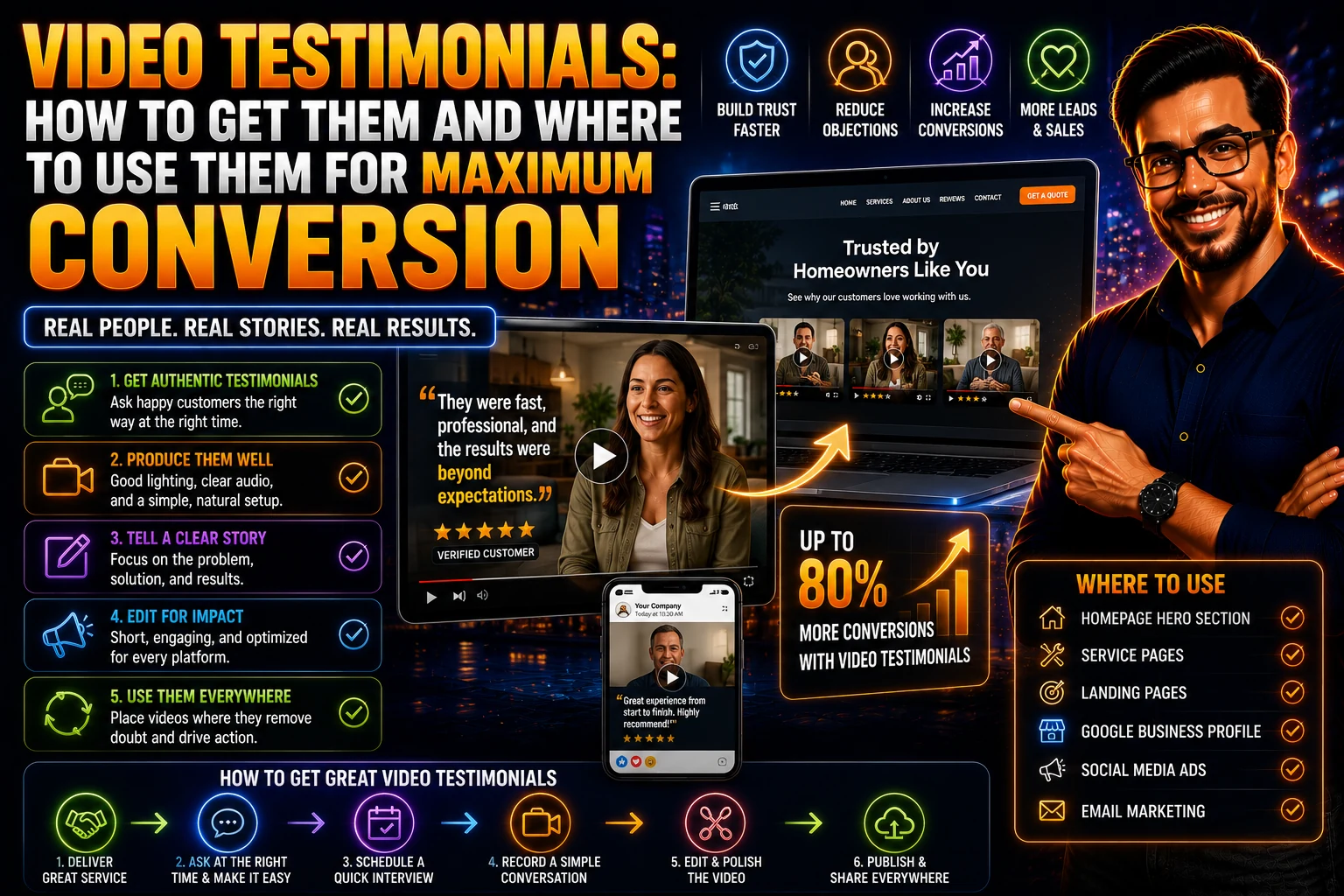
- Where to use video testimonials throughout your marketing for maximum impact
- How to build a systematic process that keeps producing testimonials over time
Why Video Testimonials Convert So Well
Trust signals exist on a hierarchy. At the bottom: claims you make about yourself ('we're the best'), which prospects discount heavily because of course you'd say that. Higher up: written reviews and testimonials from real customers, which carry more weight because they're third-party. Higher still: video testimonials, which carry more weight than written ones because the prospect can see and hear a real person — body language, voice, emotion, and authenticity all come through in ways text simply can't capture. At the top of the hierarchy: video testimonials that are specific, story-driven, and authentic.
The reason video works isn't mysterious. Humans are wired to read other humans — we evaluate trustworthiness from faces, voices, and behavior almost automatically. A real customer on camera, in their own words, talking about a specific experience, activates that natural trust assessment in a way a written paragraph can't. And because video testimonials are harder to fake than written ones (which can be invented entirely), they're more credible by default. The prospect watching a video testimonial isn't just reading a claim — they're meeting the person behind it, and meeting beats reading every time.
THE TRUST HIERARCHY: Marketing claims < Written reviews < Video reviews < Specific, story-driven video testimonials. The further up this hierarchy you operate, the more conversion lift you get per piece of social proof. Most service businesses concentrate at the bottom (claims) and middle (written reviews), where the per-piece conversion lift is real but limited. Investing in the top of the hierarchy — specific, story-driven, authentic video testimonials — produces disproportionate returns because each one carries more trust-weight than dozens of generic reviews. This is why a handful of strong video testimonials often outperforms a long page of written ones.
The Kinds of Video Testimonials That Actually Work
Not every video testimonial converts. The difference between testimonials that move prospects and testimonials that don't comes down to a few characteristics.
- Specific, not generic. 'They were great' is forgettable; 'Our AC failed on the hottest day of the year and they were here in two hours with the part I needed' is memorable and persuasive. Specificity is the single biggest factor in whether a testimonial converts.
- Story-driven, not feature-listing. The best testimonials tell a short story: what the customer's situation was, what concerned them, what happened, and how it turned out. Story carries the prospect through; feature-listing bounces off them.
- Authentic, not scripted. Customers who sound like they're reading lines or repeating talking points lose credibility immediately. Testimonials work when they feel real — even if the customer is a little awkward on camera, the awkwardness reads as authenticity rather than as polish.
- Addresses common concerns. The most powerful testimonials directly address the doubts your prospects have — 'I was worried about being upsold but they actually told me I didn't need to replace the whole system,' 'I'd been burned by other contractors before, and these guys were different.' When the testimonial speaks to the prospect's specific concern, it converts powerfully.
- Right length for the channel. Long-form testimonials (2-3 minutes) for the website and detailed sales contexts; short clips (15-30 seconds) for social media and ads. The same source footage can be edited into both.
How to Actually Get Video Testimonials
Most service businesses don't have many video testimonials because they don't ask — or they ask in ways that produce low acceptance rates. Getting them is a process, and the businesses that systematize the ask collect them steadily.
Ask at the Moment of Satisfaction
The best time to ask is when customer satisfaction is highest — immediately after a successful service, project completion, or significant positive outcome. The customer is happy with you, fresh on the experience, and most willing to do you a favor. A request made two months later — after the satisfaction has faded into the background of their daily life — produces far lower acceptance rates than a request made at the moment of highest satisfaction.
Make the Ask Specific and Easy
Generic 'would you mind doing a testimonial?' is easy to defer. Specific, easy asks convert better. 'We're working on a short video about how we handled your project, and we'd love to include a quick 60-second comment from you about your experience. Could we send a videographer to your location for 20 minutes next week, or would you prefer to record yourself on your phone — we'll send specific questions to make it easy?' The specificity (what, how long, when, what's involved) reduces friction and makes it easy for the customer to say yes.
Provide Light Structure Without Scripting
Give customers a few questions to organize their thoughts — but don't script them. Sample questions: 'What was your situation before you found us?' 'What concerns did you have when deciding?' 'How did the work actually go?' 'What would you tell someone considering us?' The questions guide the customer to the specifics and story that make testimonials work, without dictating the words. Send the questions a day or two ahead so the customer can think — but encourage them to speak naturally rather than read prepared answers.
Show Appreciation
Customers giving a video testimonial are doing you a real favor. Thank them genuinely, send a small thank-you (a gift, a discount on future service, a charitable donation in their name — whatever fits your business and relationship), and follow up to let them know how the testimonial is being used and the impact it's having. Customers who feel appreciated for one testimonial are far more likely to refer others, leave more reviews, and remain advocates.
PRO TIP: The single highest-leverage tactic for getting video testimonials is to make the ask immediately after a positive outcome, with a specific and easy plan attached. The HVAC company that asks the homeowner after the emergency repair on the hottest day of the year. The roofer who asks after the new roof passes inspection. The dentist who asks after the cosmetic case finishes with a happy patient. The window of highest satisfaction is short, and the businesses that systematize the ask at that moment — built into the project-completion or post-service workflow — collect testimonials regularly. The businesses that wait for the right moment to feel right collect them rarely.
Production: Real Over Polished
There's a temptation to over-produce video testimonials — professional lighting, multiple cameras, a polished studio look. For some businesses, that level of production fits the brand. But for most service businesses, over-produced testimonials lose authenticity and underperform simpler, real-feeling productions.
- Decent audio is the floor. Bad audio destroys testimonials regardless of how good the video looks. Use a clip-on lavalier microphone or a phone with good audio; eliminate background noise. Audio matters more than visual polish.
- Adequate but not perfect video. Natural lighting (face the customer toward a window or use a softbox), a simple background that doesn't distract, and stable camera work (a tripod or stabilized phone) are enough. Cinematic production is unnecessary and can hurt authenticity.
- Real environments often beat studios. A customer talking in their own home, business, or in front of the work you did often feels more authentic than the same customer talking against a backdrop in a studio. The environment carries context and credibility.
- Edit lightly. Trim filler, fix obvious stumbles, add titles or context where useful — but don't polish out the authenticity. Cuts and edits that feel like a TV commercial undercut the realness that makes the testimonial work.
- Self-recorded testimonials work. For customers willing but uncomfortable on camera with you present, sending specific questions and asking them to record themselves on their phone often produces excellent results. Less polished, but more authentic — and lower friction.
Where to Use Video Testimonials for Maximum Impact
A great video testimonial used only on a buried 'Testimonials' page produces little. The same testimonial used strategically across multiple touchpoints converts continuously.
- Homepage and key landing pages: feature a strong testimonial prominently on the homepage and conversion-focused landing pages. Prospects evaluating you should encounter video proof immediately rather than hunting for it.
- Service-specific pages: testimonials specific to a service on that service's page (a kitchen-remodel testimonial on the kitchen-remodel page) are particularly powerful because they address the exact concern of the prospect on that page.
- Paid ads (social and YouTube): video testimonials as ad creative — particularly short clips from longer testimonials — convert dramatically better than generic brand ads in many cases. The pre-qualified audience hearing real customer stories works better than generic positioning content.
- Social media: post testimonials regularly on social channels. They earn engagement, demonstrate ongoing customer success, and stay top of mind for your audience.
- Sales process: send relevant testimonials to prospects during the consideration phase — a video testimonial from a similar customer addressing the prospect's specific concerns can move a stalled sales conversation forward.
- Email and nurture sequences: testimonials in email build trust over the course of the nurture, especially when matched to the recipient's likely concerns at each stage.
- Google Business Profile: where allowed, add video content to your GBP — local searchers seeing video proof choose you over competitors with only photos.
Building a Systematic Process
Single testimonials produced occasionally don't compound; a systematic process that produces testimonials steadily does. The businesses that benefit most from video testimonials have built the ask into their workflow.
- Identify the right moments: project completion, post-service follow-up, customer success milestones — the moments of highest satisfaction in your specific business.
- Train the team: whoever is in front of the customer at the right moment needs to be empowered to make the ask. Train them on when to ask, how to ask, and what the next steps are.
- Have the production path ready: a videographer or video producer ready to schedule, a self-record process for customers who prefer it, sample questions and instructions ready to send.
- Set a cadence: aim for a certain number of new testimonials per month or per quarter, depending on volume. Steady production beats sporadic bursts.
- Track and use what you collect: every testimonial used is a conversion asset; testimonials sitting on a hard drive aren't. Track where each is being used and refresh deployment regularly.
- Refresh and rotate: testimonials get stale if the same handful are used forever. Refresh regularly with new ones, retire ones that have run their course, and keep the social proof current.
The Bottom Line
Video testimonials are one of the most powerful trust signals available to service businesses — converting more effectively than written reviews and dramatically more than marketing claims you make about yourself. They work because seeing and hearing a real customer activates the natural trust assessment that text can't reach, and because specific, story-driven, authentic testimonials directly address the doubts prospects have. The businesses that use them well capture conversion lifts that few other tactics can match.
Getting them is a process: ask at the moment of highest satisfaction, with a specific easy plan attached, light structure without scripting, and genuine appreciation for the customer's effort. Produce them with adequate quality but not over-polished — real beats polished for authenticity. Use them across the marketing — homepage, service pages, ads, social, sales process, email, GBP — rather than burying them on a testimonials page. And build a systematic process that produces new testimonials steadily over time. The service businesses that systematize video testimonial collection turn satisfied customers into a compounding marketing asset that drives conversion across every channel they reach. The ones that don't leave one of the highest-converting tactics available unused.
Key Takeaways
- Video testimonials sit at the top of the trust hierarchy (marketing claims < written reviews < video reviews < specific story-driven video testimonials) and produce disproportionate conversion lifts because seeing and hearing a real person activates natural trust assessment that text can't reach
- Testimonials that convert are specific (not generic), story-driven (not feature-listing), authentic (not scripted), address common prospect concerns directly, and are the right length for the channel where they're used
- Get them by asking at the moment of highest satisfaction (immediately after positive outcomes), making the ask specific and easy, providing light structure (sample questions) without scripting, and showing genuine appreciation
- Production: real beats polished — decent audio is the floor, adequate video is enough, real environments often beat studios, edit lightly to preserve authenticity, and self-recorded testimonials from customers on their phones work surprisingly well
- Use them across the marketing: homepage, key landing pages, service-specific pages, paid ads (social/YouTube), social media, sales process, email and nurture, and Google Business Profile — not buried on a testimonials page
- Build a systematic process: identify the right moments in your workflow, train the team to make the ask, have the production path ready, set a cadence, track where each testimonial is deployed, and refresh regularly to keep the social proof current
- The single highest-leverage tactic is making the ask immediately after a positive outcome with a specific easy plan attached — the businesses that systematize the ask at the moment of highest satisfaction collect testimonials steadily while businesses that wait for the right moment to feel right collect them rarely
READY TO BUILD A LEAD PIPELINE THAT'S YOURS? Astra Results Marketing produces video testimonials for service businesses — building the systematic ask process, handling production with the authenticity that drives conversion, editing for use across channels, and integrating testimonials throughout the marketing system where they generate continuous conversion lift. Stop leaving one of the highest-converting tactics available unused. Turn your satisfied customers into a compounding social-proof asset. Astra Results Marketing · astraresults.com · (+1) 786-643-3036