Rated 5 star on

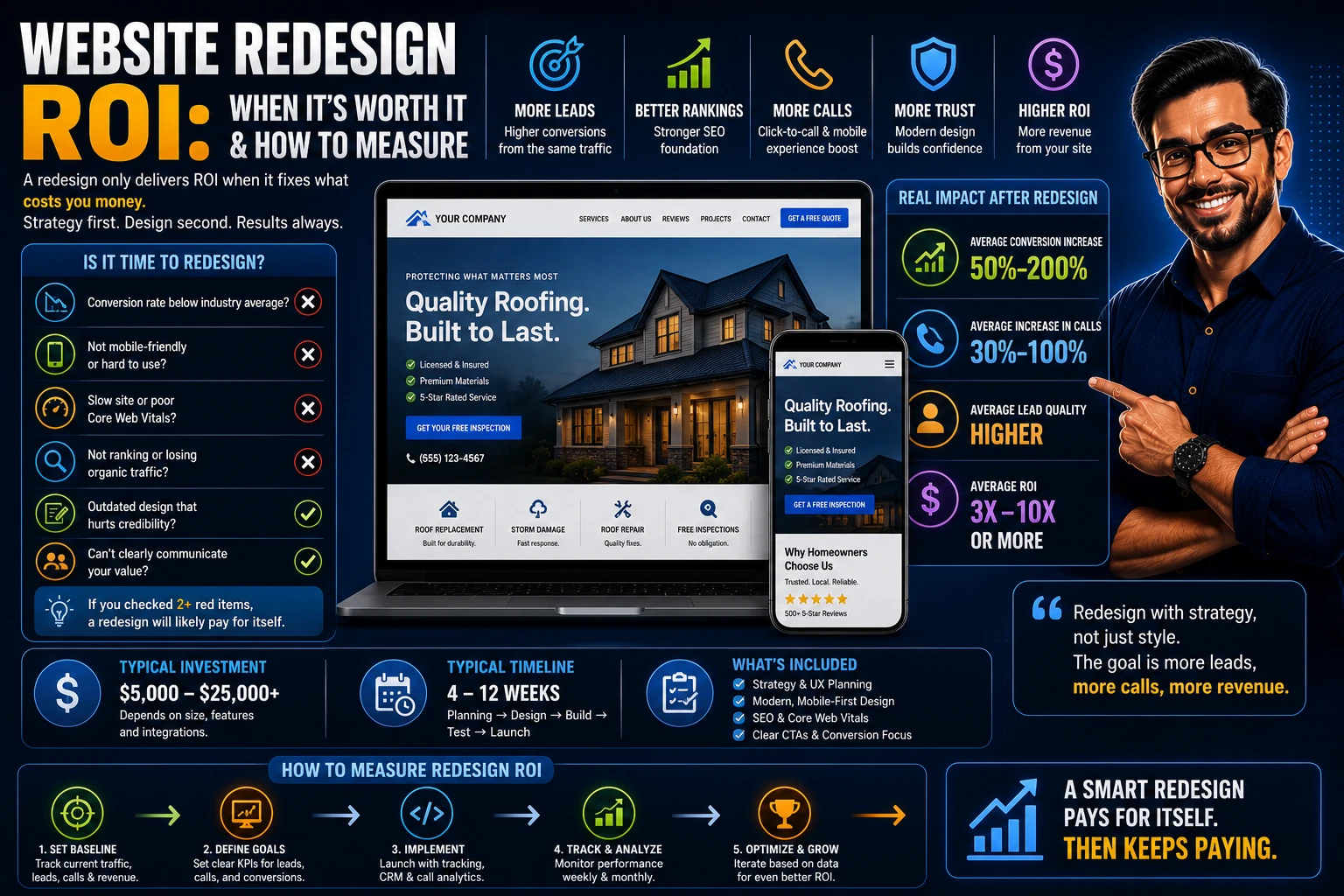
Website Redesign ROI: When It's Worth It and How to Measure
'We need a new website' is one of the most common things business owners say — usually because their current site looks dated, performs poorly, or doesn't reflect where the business is today. But website redesigns are expensive, time-consuming, and frequently disappointing. Many businesses spend tens of thousands of dollars and months of effort on a redesign that looks beautiful but doesn't actually produce more leads or revenue. The question isn't whether your website could be better — it almost certainly could — but whether a redesign is the right investment, and how you'll know if it worked.
Published: July 2, 2026 | Reading Time: ~8 minutes | Category: Web/UX
The honest answer is that redesigns produce real ROI when they fix problems that actually cost the business money — slow loading, poor mobile experience, weak conversion, outdated information, broken SEO foundations — and they waste money when they're driven by aesthetic preferences rather than business outcomes. A redesign that prioritizes the things that drive measurable business outcomes (conversion, SEO, speed, mobile) produces ROI; a redesign that prioritizes how the homepage looks to the owner often doesn't. The difference between the two outcomes is in how you scope the redesign and how you measure it.
This guide covers website redesign ROI specifically: when redesigns are worth it (and when they're not), the costs and timeline to plan for, the elements that actually drive business outcomes, the alternative of iterative improvement versus full redesign, and how to measure whether the redesign actually worked. Whether you're considering a redesign or have one underway, this is the practical guide to making the investment produce real returns.
What You'll Learn
- When a website redesign is worth it — the situations that produce real ROI
- When you're better off with iterative improvements instead of a full redesign
- The realistic costs and timeline for a redesign that delivers results
- The elements that actually drive business outcomes (and the elements that don't)
- How to scope a redesign around business outcomes, not aesthetic preferences
- How to measure whether the redesign actually worked
When a Website Redesign Is Worth It
Some situations clearly justify the investment of a redesign. These are the ones where the existing site is actively costing the business money or limiting growth, and the redesign produces measurable returns.
- The site loads slowly or fails on mobile. Slow loading and poor mobile experience directly hurt both conversions and search rankings. If your site has serious performance or mobile problems, fixing them produces measurable ROI through better conversion and visibility.
- Conversion is weak relative to traffic. If you're getting traffic but few leads, the website is the bottleneck — and a redesign focused on conversion (focus, calls to action, trust signals, friction reduction) can materially lift the conversion rate of the traffic you already have.
- The SEO foundation is broken. Sites with serious technical SEO problems (poor site structure, broken architecture, missing critical pages, content that doesn't match how people search) limit what SEO can accomplish — a redesign with SEO built in fixes the foundation.
- The site no longer reflects the business. If your services, market, or positioning have changed materially and the site doesn't reflect it, the gap costs you in conversion and credibility.
- The platform is genuinely limiting. If your current platform makes it hard or expensive to update content, add functionality, or measure performance, the friction costs you — and migrating to a better platform is often part of a redesign.
When You're Better Off With Iterative Improvements
Many situations don't require a full redesign — they require targeted improvements to a fundamentally sound site. If the foundation is solid and the issues are specific (a few pages that don't convert, a slow page or two, some missing service pages), iterative improvements deliver better ROI than a full redesign because they're cheaper, faster, and don't disrupt the SEO and conversion equity the existing site has built. Don't redesign when you can improve.
AESTHETICS VS OUTCOMES: The most common reason website redesigns fail to produce ROI is that they're scoped around aesthetic preferences rather than business outcomes. The new site looks better, but conversion, traffic, and revenue don't improve — sometimes they get worse, because the new design ignored what was actually working. A redesign that produces ROI is scoped around the business outcomes you want to improve: conversion, organic search performance, mobile experience, page speed. A redesign that's scoped around how the homepage looks to the owner is an aesthetic project, not a business project, and shouldn't be confused with one. Decide first what business outcomes you're trying to improve, then scope the redesign to deliver them.
Realistic Costs and Timeline
Website redesigns vary enormously in cost depending on scope, complexity, and quality of execution, but a few realities apply across most projects.
Cost
Quality redesigns for service businesses typically range from several thousand dollars at the low end (template-based, smaller sites, limited customization) to tens of thousands and up (custom design, larger sites, advanced functionality, integrations). The cheaper end can work for simple sites with modest needs; serious redesigns for established businesses with real traffic and conversion goals usually cost more because they involve more strategic, design, content, development, and SEO work. Beware quotes that seem far below market — they often result in template-based sites that don't deliver the outcomes the business needs, and you end up paying again to redo them.
Timeline
Full redesigns typically take three to six months from kickoff to launch — sometimes longer for complex sites. The timeline includes strategy and discovery, design, content, development, SEO work, testing, and launch. Compressed timelines (a few weeks) usually mean cutting corners on strategy, content, or testing, and the results suffer. Plan for a realistic timeline and resist the pressure to compress it artificially.
Ongoing Investment
The redesign is the project; the website is the asset. Plan for ongoing investment in the site after launch — content updates, SEO optimization, conversion improvements, technical maintenance. A redesign that launches and is then neglected loses value over time; a redesign followed by ongoing investment compounds in value. Budget for the ongoing work, not just the launch.
The Elements That Actually Drive Business Outcomes
Within a redesign, certain elements drive measurable business outcomes and certain elements don't. Focus the investment on the elements that drive returns.
- Page speed and Core Web Vitals: fast loading is a ranking factor and a conversion factor. A fast site outranks and outconverts a slow one of equal quality. Invest in performance.
- Mobile experience: most traffic is mobile, and the mobile experience must be excellent — fast, easy to navigate, easy to contact. Don't treat mobile as an afterthought.
- Conversion-focused design: clear calls to action, prominent contact options, trust signals, focused landing pages, friction reduction in forms and booking. The conversion design is where the lift comes from.
- SEO foundation: site structure, technical SEO (XML sitemap, schema, internal linking, HTTPS), and content architecture that supports rankings. Build the SEO foundation into the redesign, not as an afterthought.
- Content that ranks and converts: service pages, service-area pages, informational content, and trust-building content — the actual content matters as much as the design wrapping it.
- Tracking and measurement: analytics, conversion tracking, call tracking, and the measurement infrastructure that lets you see whether the redesign actually worked.
What Often Doesn't Drive Outcomes
Conversely, several things often consume redesign budget without driving measurable outcomes: aesthetic refinements that don't affect conversion (a more elegant typography that the owner prefers but doesn't improve performance), animations and interactive elements that look impressive but slow the site, brand-storytelling content that doesn't address the searches and decisions of actual customers, and elaborate design systems that exceed what the business actually needs. None of these are wrong in themselves, but they shouldn't be where the budget is concentrated when the goal is business outcomes.
PRO TIP: Before you start a redesign, write down the specific business outcomes you're trying to improve — and make them concrete. 'A better-looking site' isn't an outcome; 'increase the conversion rate of organic traffic from X% to Y%' or 'rank in the top 3 for these specific local searches' or 'cut bounce rate on mobile by 20%' are outcomes. Then scope the redesign to deliver them, prioritize the elements that drive those specific outcomes, and measure against the targets after launch. The redesigns that produce ROI are scoped around concrete business outcomes from the start; the ones that don't are scoped around vague desires for improvement.
The Iterative Improvement Alternative
For many businesses, iterative improvement of the existing site delivers better ROI than a full redesign — particularly when the foundation is sound and the issues are specific.
When Iteration Wins
Iterative improvement wins when your existing site has good bones — solid platform, reasonable SEO foundation, acceptable performance — but specific problems that can be addressed in targeted projects. Improving conversion on a few key pages, adding the service pages you're missing, fixing the slow-loading pages, improving the mobile experience: these are targeted projects that deliver measurable improvement at a fraction of the cost and disruption of a full redesign. They also preserve the SEO and conversion equity the existing site has built, which a full redesign can disrupt if not handled carefully.
What Iterative Improvement Looks Like
- Identify the specific problems: where is conversion weak, what pages are slow, what searches you should rank for but don't, what mobile issues need fixing.
- Prioritize by ROI: which improvements would deliver the most measurable lift for the investment?
- Execute focused projects: one improvement at a time (or a few in parallel), with clear scope, clear measurement, and clear success criteria.
- Measure the results: track whether each project produced the expected lift, and use that data to inform the next project.
- Compound the improvements: small improvements made consistently over time compound into substantial total lift — often more than a single big redesign delivers.
How to Measure Whether the Redesign Actually Worked
This is the part most businesses skip — and it's why so many redesigns end up as expenditures of indeterminate value. To know whether a redesign produced ROI, measure against the specific business outcomes you scoped it to improve.
Baseline Before Launch
Before you launch the redesign, capture the baseline of the metrics you'll measure against — the conversion rate, the rankings, the traffic, the speed metrics, the mobile performance, whatever you scoped the redesign to improve. Without a baseline, you can't know whether the redesign improved anything. Capture the baseline first.
Measure After Launch
- Conversion rate of organic and paid traffic: did conversion lift? By how much?
- Organic search performance: rankings for priority searches, organic traffic, and ultimately leads from organic.
- Page speed and Core Web Vitals: did the technical metrics improve as planned?
- Mobile experience metrics: bounce rate on mobile, mobile conversion, mobile-specific performance.
- Business outcomes: ultimately, did the redesign produce more leads, more revenue, or whatever specific business outcome was the goal?
Measure over enough time to draw real conclusions — a few weeks isn't enough for ranking changes, conversion-rate trends, or seasonal variation. Three to six months post-launch usually reveals the redesign's actual impact. Compare against the baseline, and against the specific targets you set when scoping the project. The honest measurement reveals whether the redesign produced ROI and what to do next — continue the iterative improvements that work, or revisit areas that didn't deliver as planned.
The Bottom Line
Website redesigns produce real ROI when they're scoped around business outcomes — fixing the problems that cost the business money (slow loading, poor mobile, weak conversion, broken SEO foundations, outdated content, limiting platforms) — and measured against the specific outcomes they're meant to improve. Redesigns waste money when they're scoped around aesthetic preferences rather than business outcomes, and when no one measures whether they actually worked. The difference between the two outcomes is entirely in how the redesign is scoped and measured.
For many businesses, iterative improvement of the existing site delivers better ROI than a full redesign — particularly when the foundation is sound and the issues are specific. Targeted projects to fix conversion on key pages, add missing content, improve performance, and address mobile issues compound into substantial lift at a fraction of the cost and disruption of a full redesign. When a full redesign is genuinely needed, scope it around concrete business outcomes, focus the budget on the elements that drive those outcomes, plan for the realistic costs and timeline, and measure rigorously against the targets you set. The redesigns scoped and measured this way produce real returns; the ones that aren't deliver expensive aesthetic upgrades with little to show for it.
Key Takeaways
- Website redesigns produce real ROI when scoped around business outcomes (fixing what costs the business money: slow loading, poor mobile, weak conversion, broken SEO foundations) — and waste money when scoped around aesthetic preferences
- Redesign is worth it when: the site loads slowly or fails on mobile, conversion is weak relative to traffic, the SEO foundation is broken, the site no longer reflects the business, or the platform is genuinely limiting
- Iterative improvement often beats full redesign — when the foundation is sound and the issues are specific, targeted projects (improve conversion on key pages, add missing content, fix performance) deliver better ROI at lower cost and risk
- Realistic costs (thousands to tens of thousands depending on scope) and timeline (3-6 months typically) — beware quotes far below market and compressed timelines that cut corners; plan for ongoing investment after launch
- Elements that drive outcomes: page speed and Core Web Vitals, mobile experience, conversion-focused design, SEO foundation, content that ranks and converts, tracking and measurement
- Before starting, write down the specific business outcomes you're trying to improve (concrete metrics, not 'a better site') — scope the redesign to deliver them, focus budget on the elements that drive them
- Measure rigorously: capture a baseline before launch, measure conversion/SEO/speed/mobile/business outcomes for 3-6 months after, and compare to the targets set at scoping — honest measurement reveals real ROI
READY TO BUILD A LEAD PIPELINE THAT'S YOURS? Astra Results Marketing builds websites and runs website redesigns scoped around business outcomes — conversion, organic search, mobile, and speed — with the SEO foundation, conversion-focused design, and measurement infrastructure that produces real returns. For many businesses, we also recommend targeted iterative improvements instead of a full redesign when that's the higher-ROI path. Stop spending on redesigns that look better but don't perform better. Astra Results Marketing · astraresults.com · (+1) 786-643-3036