Rated 5 star on

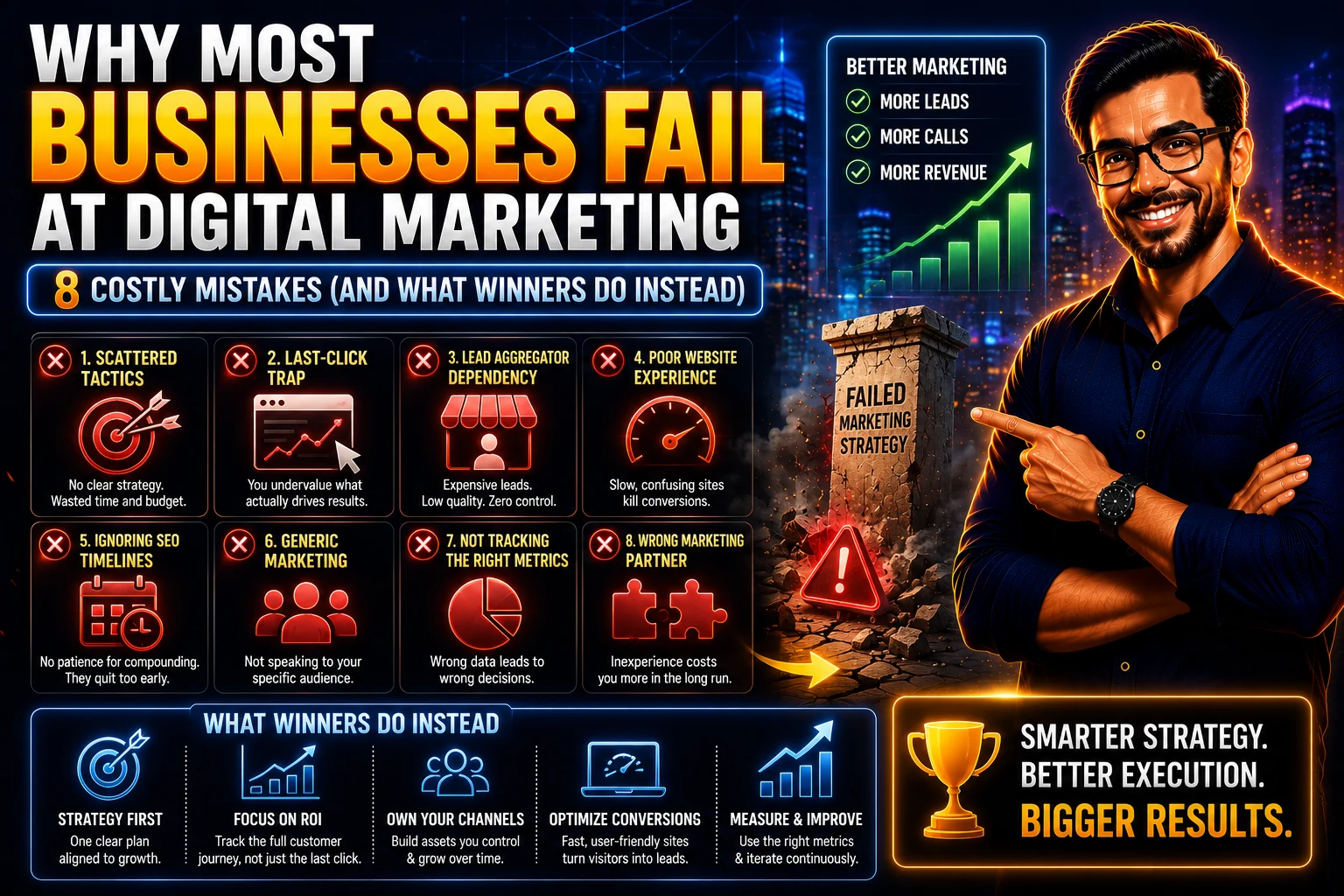
Why Most Businesses Fail at Digital Marketing
Most service businesses don't succeed at digital marketing. They spend money on it — sometimes a lot of it — and yet the results disappoint. Leads trickle in inconsistently. Marketing spend feels like a black hole. They hire and fire agencies, switch tactics, chase the latest trends, and somehow never build the marketing engine that competitors clearly have. The frustrating thing is that the failures usually aren't because digital marketing fundamentally doesn't work — it does, demonstrably, for the businesses that build it well. The failures are because of specific, repeatable mistakes that the businesses making them don't recognize until they've already paid the cost.
Published: July 10, 2026 | Reading Time: ~10 minutes | Category: Strategy
After working with service businesses across plumbing, HVAC, roofing, dental, legal, home improvement, and many other verticals, the failure patterns become predictable. The same mistakes show up across industries — same cost, same outcome — and they're rarely about tactics. They're about how marketing is approached strategically: what gets prioritized, what gets cut, what gets measured, what gets sustained. The businesses that succeed don't have secret tactics; they avoid the strategic mistakes that doom most marketing efforts. The businesses that fail repeat those mistakes consistently.
This is the honest synthesis of why most service businesses fail at digital marketing — the patterns we see repeatedly, the costs each one imposes, and what the businesses that succeed do differently. Read it as a diagnostic: if any of these patterns describe your current marketing, that's a clue about where the gap is. And if you can avoid these specific failures, you'll be ahead of the substantial majority of businesses in your category — most of whom are making these same mistakes right now.
What You'll Learn
- The most common reasons service businesses fail at digital marketing
- Why each failure pattern happens — the underlying mistake driving it
- What each failure costs the business
- What successful businesses do differently
- How to diagnose which patterns describe your current marketing
Failure 1: Treating Marketing as Scattered Tactics Instead of a System
Most failing marketing operations run a collection of disconnected tactics — Google Ads here, a website there, some social posting, occasional email, maybe SEO when remembered — without a unifying system that ties them together. Each tactic gets evaluated on whether it's 'working' in isolation, and when one doesn't produce immediate results, it gets cut. The marketing churns through tactics without ever building a coherent whole.
The cost is enormous. Marketing tactics don't produce returns in isolation — they reinforce each other when integrated and undercut each other when scattered. SEO produces visitors that retargeting converts; reviews drive Map Pack rankings that LSAs reinforce; content awareness primes the paid search that closes the conversion. Cutting any one tactic because it doesn't show immediate isolated ROI usually destroys the value of the others. The marketing fails because it was never built as a system.
What successful businesses do differently: build marketing around the customer funnel — awareness, consideration, conversion, retention — with each stage addressed deliberately and the stages integrated so they reinforce each other. The system compounds; scattered tactics don't.
Failure 2: Falling Into the Last-Click Trap
Last-click attribution gives 100% of credit to whatever channel touched the customer right before they converted — usually paid search, LSAs, or other bottom-of-funnel channels. Looking at last-click data, business owners conclude that the channels getting credit are 'what works' and the channels not getting credit (SEO, content, brand awareness, social) are 'not working.' They shift budget toward the credited channels and cut the others.
Six months later, results have declined. The cost-per-lead in the credited channels is rising because there's less brand awareness driving people toward them. Organic traffic is down. Branded searches are down. The 'data-driven' decision to cut the upper funnel destroyed the awareness that made the bottom funnel work. The business now has worse marketing performance than before, despite optimizing toward the channels that 'showed results.'
What successful businesses do differently: recognize that last-click data systematically undervalues upper-funnel channels. Maintain investment in SEO, content, brand, and reputation even when last-click attribution doesn't credit them. Use multiple signals (brand searches, direct traffic, cost-per-lead trends, lift testing) rather than trusting last-click as truth. Protect the upper funnel that feeds the conversion channels.
Failure 3: Generic Playbooks That Ignore Vertical Dynamics
Most digital marketing advice — and most agencies — apply the same generic playbook to every business. The same approach to SEO, the same paid-search template, the same social strategy. But every vertical has specific dynamics that the generic playbook misses. HVAC has emergency demand, seasonal swings, and a maintenance-plan strategic engine. Roofing has storm-driven demand and storm-chaser competition. Dental is intensely trust-sensitive and proximity-dependent. Legal operates under bar advertising rules and extreme cost-per-click pressure. Home improvement requires negative-keyword discipline that other categories don't.
The business running a generic playbook against vertical-specific competition loses. The HVAC contractor whose marketing ignores the maintenance plan compounds slower than competitors who don't. The roofer who doesn't position against storm chasers gets undercut by them. The dental practice that ignores HIPAA-conscious review responses gets flagged or fails to build trust. Generic playbooks produce generic results — which in competitive verticals means inadequate results.
What successful businesses do differently: build marketing calibrated to their specific vertical's dynamics. Either invest in becoming an expert in their own vertical's marketing realities or work with partners who genuinely understand the vertical — not generic agencies that fit every client into the same template.
WHY MARKETING LOOKS EASIER THAN IT IS: From the outside, digital marketing looks straightforward — run some ads, post some content, watch leads come in. From the inside, the work is much more involved: building integrated systems, navigating vertical-specific dynamics, sustaining work over months for compounding returns, measuring across imperfect attribution, and avoiding the strategic traps that doom most efforts. Most businesses fail at marketing partly because they underestimate what it actually requires. Treating it as simple — when it isn't — leads to the under-investment, impatience, and tactical scattering that produce the failures described in this guide. Respecting the actual complexity is the foundation of doing it well.
Failure 4: Underestimating Timelines and Giving Up Too Soon
Different marketing channels work on different timelines, and most failures involve unrealistic expectations about how fast different work pays off. SEO and Map Pack rankings compound over 6-12 months. Content authority builds over years. Review velocity sustains over the long term. Brand awareness builds gradually. Paid search can produce leads fast, but the best paid search performance depends on the upper-funnel infrastructure that takes longer to build.
Most failures involve business owners who invested in SEO for three months, didn't see immediate results, and quit. Or who tried a new channel for a month and decided it didn't work. Or who switched agencies every 6 months hoping the next one would produce faster results. The compounding work that produces durable marketing performance was abandoned before it had time to compound. The business pays for the early-stage investment without ever reaping the benefits because it didn't sustain the work long enough.
What successful businesses do differently: align timeline expectations to the realistic compound curve of each channel. Sustain investment in slower-compounding channels (SEO, content, brand) while paid channels provide near-term lead flow. Recognize that the businesses winning their categories built their advantages over years of consistent investment — and that abandoning the work before it compounds is one of the most common reasons marketing fails.
Failure 5: Cheap Landing Pages and Conversion Infrastructure That Bleed Expensive Traffic
Many businesses invest substantial budget in driving traffic — paid ads, SEO, content — and then send that expensive traffic to weak websites that don't convert. Slow loading, poor mobile experience, generic landing pages, hidden contact options, too many form fields, no trust signals. The traffic shows up; most of it bounces; the marketing budget produced impressions but few leads.
This is one of the highest-cost failures because it compounds across every other marketing investment. Every dollar spent on traffic is partly wasted when the conversion infrastructure is weak. Improving conversion by 50% effectively improves the ROI of all upstream marketing by 50% — and most service businesses have meaningful room to improve their conversion infrastructure. The leak is invisible because the analytics show traffic; it shows up as the gap between traffic and leads that gets explained away rather than fixed.
What successful businesses do differently: treat conversion infrastructure (landing pages, mobile experience, page speed, contact options, trust signals) as critical investment, not afterthought. Audit conversion rates against benchmarks. Apply UX principles methodically. Test and improve continuously. Make sure every dollar spent on traffic actually converts at a rate that justifies the spend.
Failure 6: Aggregator Dependency They Don't Escape
Many service businesses are deeply dependent on lead aggregators (HomeAdvisor, Angi, Thumbtack, and similar) — paying high per-lead fees for shared leads sold to multiple competitors. The dependency compresses margins (because the leads are expensive and shared) and limits growth (because every job is competing on price with the other businesses who bought the same lead). The business runs hard, generates revenue, and watches margins erode steadily.
The trap is that aggregators provide immediate leads — when alternative channels (Map Pack, LSAs, review-driven SEO, referrals) take 6-12 months to build. Business owners stay dependent on aggregators because cutting them would create a lead gap during the buildup of alternatives. So they never build the alternatives, stay dependent, and never escape the margin compression.
What successful businesses do differently: commit to building exclusive-lead alternatives over time, even while aggregators remain part of the mix initially. Build the Map Pack rankings, LSA presence, review-driven local reputation, and referral systems that produce exclusive leads at favorable economics. Gradually reduce aggregator dependency as alternatives mature. The transformation takes time but produces dramatically better unit economics and a durable competitive position.
Failure 7: Choosing the Wrong Agency or Failing to Direct One Well
Many marketing failures trace back to the agency relationship. Either choosing a weak agency that talks well but executes poorly, or hiring a good agency without providing the direction and accountability the relationship requires. Some businesses cycle through agencies every year or two, never building the cumulative work that compounds. Others sign long contracts with underperforming agencies and stay locked in. Either pattern produces failing marketing.
The cost is substantial: months of underperforming marketing, the rebuilding required after firing a bad agency, the missed opportunities while marketing churns. And the business owner often blames marketing itself for the failure when the real issue was the agency choice or relationship.
What successful businesses do differently: choose agencies carefully (asking the substantive questions that surface real capability vs sales polish), build clear accountability and reporting from the start, provide the direction and decisions the relationship requires, and evaluate based on real business outcomes rather than vanity metrics. Recognize that an agency partnership is a partnership — both sides have responsibilities, and both sides have to deliver.
Failure 8: Chasing Tactics Instead of Building Foundations
The marketing landscape is full of new tactics, new tools, new platforms, and new techniques — and many business owners chase each one in sequence. This year it's TikTok ads; next year it's AI tools; the year after it's whatever new platform launches. Each chase consumes attention, budget, and learning curves — and produces little because the foundational work that makes any tactic pay off was never built.
The businesses that succeed at marketing aren't the ones who jumped on every trend; they're the ones who built durable foundations (content authority, review base, Map Pack rankings, customer relationships, conversion infrastructure) and selectively deployed new tactics that fit their strategy. The foundations compound over years and pay off across multiple tactical futures; chasing every trend produces transient activity without lasting advantage.
What successful businesses do differently: build the foundations first and sustain them. Evaluate every new tactic against whether it builds a durable asset or just produces transient activity. Deploy new tactics selectively, where they actually fit the strategy and complement the foundations. Resist the FOMO that drives most tactic-chasing — most of what feels urgent in marketing media is noise.
What the Successful Businesses Do — The Synthesis
The businesses that succeed at digital marketing don't have secret tactics or special talent. They consistently do a handful of unspectacular things that most failing businesses don't.
- They treat marketing as a system, not scattered tactics — building integrated investments across the awareness, consideration, conversion, and retention stages of the funnel that reinforce each other.
- They sustain investment in slower-compounding channels (SEO, content, brand, reputation) alongside faster-acting ones (paid search, LSAs), avoiding the last-click trap that cuts what feeds what works.
- They calibrate marketing to their specific vertical's dynamics rather than running generic playbooks.
- They respect realistic timelines and sustain the work long enough for compounding to happen.
- They invest in conversion infrastructure (landing pages, UX, mobile, trust signals) so the traffic they pay to attract actually converts.
- They commit to building exclusive-lead alternatives that escape aggregator margin compression, even when it takes 6-12 months.
- They choose agency partners carefully and direct them well, or build internal capability methodically.
- They focus on durable foundations rather than chasing every new tactic, deploying new tools selectively where they fit the strategy.
PRO TIP: The difference between businesses that succeed at digital marketing and businesses that fail isn't tactics, intelligence, or talent. It's systematic execution of the fundamentals — sustained over the time required for compounding to happen. Most failing marketing efforts know what they should do; they just don't do it consistently. They start and stop, switch tactics, lose patience, cut what doesn't immediately work, chase what's new, and never build the cumulative investment that produces real results. The businesses that succeed do the fundamentals consistently for long enough. That sounds simple — and it is — but consistency over time is genuinely difficult, which is why most businesses don't achieve it. The shift from chasing tactics to executing fundamentals consistently is the single most important strategic change most failing marketing operations could make.
The Bottom Line
Most service businesses fail at digital marketing not because the channels don't work — they demonstrably do — but because of specific, repeatable strategic mistakes. Treating marketing as scattered tactics instead of an integrated system. Falling into the last-click trap that destroys upper-funnel investments. Running generic playbooks against vertical-specific competition. Underestimating timelines and abandoning compounding work before it compounds. Sending expensive traffic to weak conversion infrastructure. Staying trapped in aggregator dependency. Choosing the wrong agency or failing to direct one well. Chasing tactics instead of building foundations. Each failure has a clear cost, and each is avoidable.
The businesses that succeed don't have secret tactics. They execute fundamentals consistently — systematic, integrated marketing built around the customer funnel, calibrated to their vertical, sustained long enough for compounding to happen, supported by strong conversion infrastructure, and focused on durable foundations rather than tactic-chasing. If you can avoid the failure patterns this guide describes, you'll be ahead of the substantial majority of businesses in your category. And if you build the systematic execution of fundamentals that successful businesses share, you'll produce the durable marketing engine that drives the kind of growth your competitors clearly have. Most of the businesses in your market are making these mistakes right now. The opportunity is to be one of the few that doesn't.
Key Takeaways
- Most service businesses fail at digital marketing not because the channels don't work but because of specific repeatable strategic mistakes — the same patterns appear across industries with the same costs
- The 8 failure patterns: scattered tactics instead of a system, the last-click trap that destroys upper funnel, generic playbooks ignoring vertical dynamics, underestimating timelines, weak conversion infrastructure bleeding expensive traffic, aggregator dependency that never gets escaped, wrong agency choices or undirected relationships, and chasing tactics instead of building foundations
- Each failure has a clear cost: lost growth, eroded margins, wasted marketing investment, and months or years of underperforming results — but each is avoidable with awareness and discipline
- Successful businesses don't have secret tactics — they execute fundamentals consistently: integrated marketing across the funnel, calibrated to their vertical, sustained over compounding timelines, supported by strong conversion infrastructure, with selective tactic deployment over durable foundations
- The difference between success and failure is systematic execution of fundamentals over time — most failing marketing efforts know what they should do but don't do it consistently. Consistency over time is genuinely difficult, which is why most businesses don't achieve it
- Use this guide as a diagnostic: if any of these failure patterns describe your current marketing, that's a clue about where the gap is — and avoiding the patterns puts you ahead of the substantial majority of businesses in your category
- Marketing looks easier from the outside than it is from the inside — respecting the actual complexity (integrated systems, vertical dynamics, compounding timelines, imperfect attribution, strategic discipline) is the foundation of doing it well
READY TO BUILD A LEAD PIPELINE THAT'S YOURS? Astra Results Marketing helps service businesses avoid the failure patterns most marketing efforts fall into — building integrated systems across the funnel, calibrated to your specific vertical, sustained over the timelines that produce compounding returns, supported by strong conversion infrastructure, and focused on durable foundations rather than tactic-chasing. We work with service businesses that want to build the marketing engine their competitors have rather than churning through tactics that don't add up. Stop making the mistakes most businesses in your category are making right now. Astra Results Marketing · astraresults.com · (+1) 786-643-3036