Rated 5 star on

YouTube SEO: How to Get More Views and Subscribers
YouTube is the world's second-largest search engine after Google itself. Every day, people search YouTube the way they search Google — looking for how-to videos, product comparisons, expert opinions, local services demonstrations, and answers to questions they'd rather watch than read. For service businesses, this means YouTube is a search channel where your potential customers are actively looking for the kind of content you can produce — if you make and optimize it correctly. Most service businesses ignore YouTube entirely or post videos sporadically with no understanding of how the platform works. The few that approach YouTube as a search and authority channel build assets that compound for years.
Published: July 7, 2026 | Reading Time: ~9 minutes | Category: Video
YouTube SEO is different from Google SEO in important ways. The algorithm cares about different signals (watch time and audience retention dominate), the discovery mechanics work differently (browse and recommendations vs search), and the content format requirements are completely different (engaging video vs ranking text). The optimization tactics that work on Google often don't work on YouTube, and vice versa. Understanding what actually drives YouTube performance — beyond the basics of keywords and titles — is what separates channels that grow from channels that produce videos for nobody to watch.
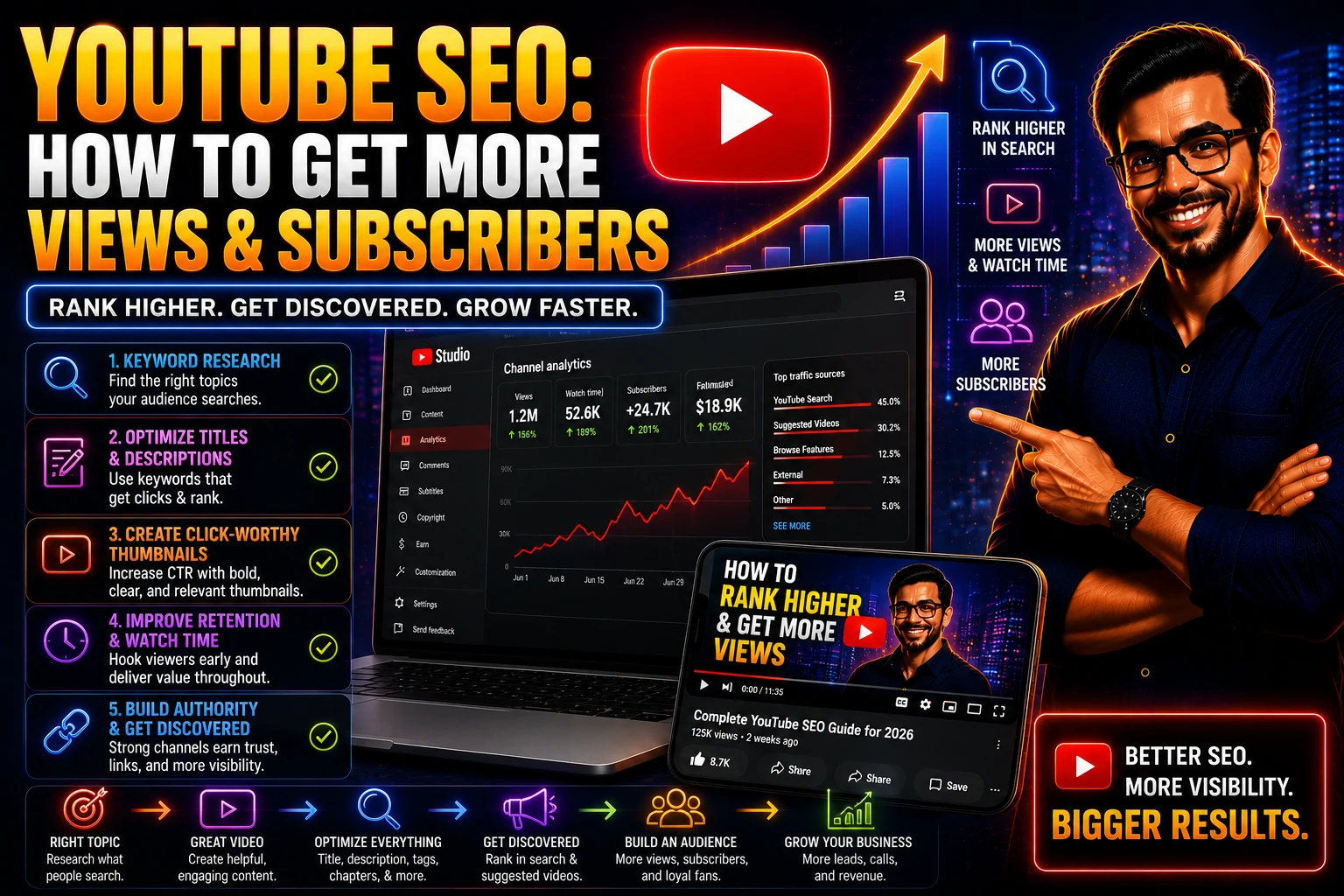
This guide covers YouTube SEO practically: how the algorithm actually works and what it rewards, keyword research that's specific to YouTube (not just Google), the title and thumbnail combination that determines whether anyone clicks, the first 30 seconds that determine whether anyone keeps watching, audience retention as the deciding metric, the description and tag work that supports rankings, channel-level optimization that compounds growth, and the measurement that turns YouTube from a content dumping ground into a strategic channel. For service businesses ready to take YouTube seriously, this is the practical playbook.
What You'll Learn
- How the YouTube algorithm actually works — and why watch time and audience retention dominate
- YouTube keyword research — what's different from Google keyword research
- Title and thumbnail combinations that get clicks (the click-through rate problem)
- The first 30 seconds problem — and why retention starts at the start
- Description, tags, chapters, and end screens that support rankings
- Channel-level optimization that compounds growth across all your videos
- Measurement: the metrics that actually tell you whether YouTube is working
How the YouTube Algorithm Actually Works
YouTube's algorithm has one fundamental goal: keep viewers watching YouTube as long as possible. Every signal it uses, every decision it makes about which videos to surface and recommend, traces back to that goal. Understanding this is the foundation of YouTube SEO — videos that help YouTube keep viewers watching get rewarded with more reach; videos that lose viewers get suppressed.
The Key Signals
- Click-through rate (CTR): when YouTube shows your video to potential viewers, the percentage who actually click on it. CTR is determined primarily by your title and thumbnail combination.
- Audience retention: of viewers who click, what percentage keep watching, and for how long. Retention is the most important signal — videos that hold viewers earn more reach, videos that lose them quickly get suppressed.
- Watch time: the total amount of time viewers spend watching your video. This combines retention with video length — longer videos that hold viewers produce more watch time than short videos that hold them.
- Session time: whether viewers continue watching YouTube (your videos or others') after watching yours. Videos that lead to more YouTube watching get rewarded; videos that end the session get less reach.
- Engagement: likes, comments, shares, subscribers gained — secondary signals that reinforce the primary metrics.
AUDIENCE RETENTION IS THE DECIDING METRIC: Of all the signals YouTube uses, audience retention dominates. A video with average retention of 60% — meaning the average viewer watches 60% of the video — vastly outperforms a video with 30% retention, regardless of how many views the video initially got. YouTube watches retention and decides whether to keep showing the video to more people. High-retention videos get amplified; low-retention videos get throttled. This is why content quality (specifically, the ability to hold attention) matters more on YouTube than on most platforms. The first job of every YouTube video is to be watchable enough to hold the viewer — everything else flows from there.
YouTube Keyword Research
YouTube keyword research is related to but not identical to Google keyword research. The intent behind YouTube searches skews toward video-friendly content — how-to, demonstrations, reviews, explanations, entertainment — and the platform has its own search-volume patterns that don't always match Google.
How to Research YouTube Keywords
- YouTube's own search suggestions: start typing in the YouTube search bar and pay attention to the autocomplete suggestions — these are real queries people are searching.
- Google search results with video carousels: searches where Google surfaces YouTube videos prominently signal that the topic is well-suited to video content. Topics with strong video carousels are good YouTube targets.
- Competitor channel analysis: what topics are competitors and similar channels covering, what's getting views, and what gaps are there in the coverage.
- Customer questions in video form: the questions your customers ask that are best answered with video (visual demonstrations, processes you can show, comparisons that benefit from visuals).
- Trend research with YouTube tools: dedicated YouTube research tools (TubeBuddy, vidIQ, and others) provide YouTube-specific volume and competition data.
What Makes a Good YouTube Keyword
Good YouTube targets are queries with genuine search volume on YouTube specifically, where video is a natural format (demonstrations, how-tos, comparisons, reviews, explanations), where competition isn't insurmountable for a new or small channel, and where the topic matches your expertise. For service businesses, the sweet spot is often educational and how-to content in your domain — explainers, demonstrations, comparisons, and behind-the-scenes content that captures research-phase searches and demonstrates expertise simultaneously.
Title and Thumbnail: The Click-Through Problem
Before retention matters, you need clicks. Title and thumbnail together determine whether YouTube users who see your video in search results, suggestions, or browse recommendations actually click. CTR is the gateway to everything else — videos with low CTR don't get watched, no matter how good the content is.
Titles That Get Clicks
- Specific and curiosity-inducing: 'The 3 Mistakes Most Homeowners Make Hiring a Roofer' beats 'Tips for hiring a roofer.' Specificity (the '3 mistakes') and curiosity (what are they?) drive clicks.
- Promise a clear payoff: tell the viewer what they'll get from watching — a specific benefit, a clear answer, a useful insight.
- Include the target keyword naturally: keywords matter for findability but should fit the title naturally rather than being stuffed in.
- Avoid clickbait that doesn't deliver: titles that overpromise and underdeliver damage retention (viewers leave when the content doesn't match) and channel reputation over time.
Thumbnails That Get Clicks
- Visually distinct and clear: stand out from surrounding thumbnails in the YouTube interface. Bold visual contrast and clear focal points work better than busy, complicated thumbnails.
- Faces and emotion: thumbnails with faces showing clear emotion outperform thumbnails without faces in most categories.
- Text overlay (when it helps): a few words of clear, large text reinforcing the title can boost CTR — but the text must be readable at thumbnail size, not just full-screen.
- Custom designed, not auto-selected: never use YouTube's auto-generated thumbnails. Design custom thumbnails for every video — the difference is dramatic.
- Tested over time: thumbnail performance is testable; learn what works for your channel by comparing CTR across thumbnails and refining the approach.
The First 30 Seconds Problem
Once a viewer clicks, the next critical moment is the first 30 seconds of the video. Audience retention drops more steeply in the opening than at any other point — viewers decide quickly whether the video is worth their time, and they leave fast if it isn't. Videos that hold viewers through the first 30 seconds typically hold most of them for much longer; videos that lose them in the opening collapse retention before the content even gets going.
- Skip the slow intro: long branded intros, lengthy 'hi, welcome to my channel' preambles, and slow setups all kill opening retention. Get into the value fast.
- Hook immediately: the first few seconds should communicate what the viewer will get and why it's worth their time — ideally with a hook (a surprising claim, a question, a visual, a transformation preview) that keeps them watching.
- Deliver value quickly: don't wait until minute 5 to give the viewer something useful. Front-load the value so viewers know early that the rest is worth watching.
- Tease what's coming: brief previews of the most valuable or interesting parts of the video keep viewers watching to see them.
- Don't recap obvious context: viewers who clicked already know roughly what the video is about. Skip the long 'in this video we'll be discussing' and get to the substance.
PRO TIP: The single highest-leverage YouTube optimization is fixing the first 30 seconds of your videos. Most channels lose 30-50% of viewers in the opening — viewers who would have stayed if the opening had been tighter. Tightening the opening (cutting slow intros, leading with the hook, delivering value immediately, teasing what's coming) often produces dramatic retention improvements that cascade into more reach from the algorithm, more views, and more subscribers. Before optimizing anything else, watch your videos' retention graphs and fix the openings — that one change typically produces more YouTube growth than any other single optimization.
Descriptions, Tags, Chapters, and End Screens
Beyond title, thumbnail, and content, several technical elements support discoverability and engagement.
Description
The description is for both YouTube's algorithm and viewers. Lead with a substantive opening (the first 2-3 sentences that appear before 'show more') that includes the target keyword naturally and explains the video. Below the fold, include a longer description with related keywords, links to relevant resources, and any references. The description should genuinely inform — keyword-stuffed descriptions don't help and may hurt.
Tags
Tags carry less weight than they used to, but they still help YouTube understand the video's topic. Use 5-15 relevant tags including the target keyword, variations, and related topics. Don't tag-stuff with irrelevant terms — it doesn't help and can hurt understanding.
Chapters
Chapters (timestamped sections in the video) help viewers navigate and improve engagement signals. They also surface in YouTube's interface and sometimes in Google search results as searchable segments. Add chapters to videos longer than a few minutes — they improve the viewer experience and can boost performance.
End Screens and Cards
End screens (the last 5-20 seconds of the video) and cards (overlays during the video) drive session time by pointing viewers to your next video. Use them to recommend related videos that match the viewer's interest — keeping viewers on your channel rather than letting them drift to other channels. End screens contribute meaningfully to session time, which the algorithm rewards.
Channel-Level Optimization
Beyond individual videos, channel-level optimization compounds growth across everything you post.
- Channel branding: clear channel art, profile photo, and channel description that communicate what the channel is about. Visitors decide whether to subscribe based on whether your channel signals content they'd want more of.
- Playlists: organize related videos into playlists by topic. Playlists improve discoverability, increase session time (viewers watch multiple videos in sequence), and signal channel depth on each topic.
- Consistent posting cadence: regular posting (whatever cadence you can sustain) trains the algorithm and your audience to expect content. Sporadic uploading limits growth.
- Topical focus: channels that develop clear topical focus grow faster than channels covering everything. Find the topical lane your business can own and concentrate content there.
- Community engagement: respond to comments, ask viewers questions in your videos, build the community signals that engaged channels develop. Active community signals reinforce algorithm performance.
Measuring Whether YouTube Is Working
YouTube Studio provides extensive analytics. The metrics that matter most for evaluating progress:
- Click-through rate: are people clicking when YouTube shows them your video? CTR around 4-10% is typical; consistently below 3% signals title/thumbnail problems.
- Average view duration and percentage: how long viewers actually watch — the retention signal. Track this video by video and look for patterns.
- Watch time growth: total watch time across the channel growing over time signals compounding momentum.
- Subscriber growth: net new subscribers per video and overall trend — the long-term audience asset.
- Traffic sources: where views are coming from (search, suggested videos, browse, external) reveals what's working and where you should focus.
- Audience retention graphs: video-by-video retention graphs show exactly where viewers drop off — invaluable for fixing problem spots in your content.
For service businesses specifically, also measure the business outcomes YouTube contributes to — branded search volume increases, leads attributed to YouTube content, conversions from viewers who click through to your website. YouTube is often an upper-funnel channel that contributes to awareness and consideration; the business impact shows up across the funnel, not just in direct conversions.
The Bottom Line
YouTube SEO is the practice of making videos that the algorithm rewards with reach and that viewers actually want to watch. The fundamentals: understand the algorithm prioritizes watch time and audience retention above everything else, research keywords specific to YouTube rather than copying Google research, optimize title and thumbnail for clicks because clicks are the gateway, fix the first 30 seconds where most retention is lost, use descriptions/tags/chapters/end screens to support performance, build channel-level structure (playlists, topical focus, consistent posting) that compounds growth, and measure the metrics that actually predict YouTube success.
For service businesses, YouTube is a long-term play that builds authority, awareness, and trust — and feeds searches across both YouTube itself and Google's video carousels. The businesses that take YouTube seriously, post consistently, and apply the optimization disciplines build channel assets that compound for years. The businesses that post sporadically with no understanding of what the algorithm rewards produce videos that nobody watches. The platform rewards content discipline and platform-specific optimization, and the businesses that bring both turn YouTube into a meaningful authority and search channel.
Key Takeaways
- YouTube is the world's second-largest search engine, and its algorithm has one goal: keep viewers watching YouTube. Every optimization signal — CTR, audience retention, watch time, session time, engagement — traces back to that goal
- Audience retention is the deciding metric: videos that hold viewers get amplified by the algorithm, videos that lose them get suppressed. Retention matters more than any other single signal
- YouTube keyword research differs from Google — use YouTube's autocomplete, watch which Google searches surface video carousels, analyze competitor channels, and prioritize topics where video is a natural format
- Title and thumbnail together determine CTR (the gateway to everything else) — specific curiosity-inducing titles, custom-designed thumbnails with faces/emotion and visual distinctness, no clickbait that doesn't deliver
- The first 30 seconds problem: most channels lose 30-50% of viewers in the opening — tightening the opening (cutting slow intros, leading with the hook, delivering value immediately) is the highest-leverage single optimization
- Supporting elements: substantive descriptions with target keyword in the first sentences, 5-15 relevant tags, chapters for videos over a few minutes, end screens and cards that drive session time to your next video
- Channel-level optimization compounds: clear branding, topic playlists, consistent posting cadence, topical focus, and community engagement build the channel-level signals that reinforce video-level performance
READY TO BUILD A LEAD PIPELINE THAT'S YOURS? Astra Results Marketing produces YouTube content and channel strategy for service businesses — keyword research specific to YouTube, title and thumbnail optimization that drives clicks, content production calibrated to audience retention, channel structure that compounds growth, and the measurement that turns YouTube into a strategic search and authority channel. Stop posting videos for nobody to watch. Build the YouTube channel that compounds for years. Astra Results Marketing · astraresults.com · (+1) 786-643-3036