Rated 5 star on

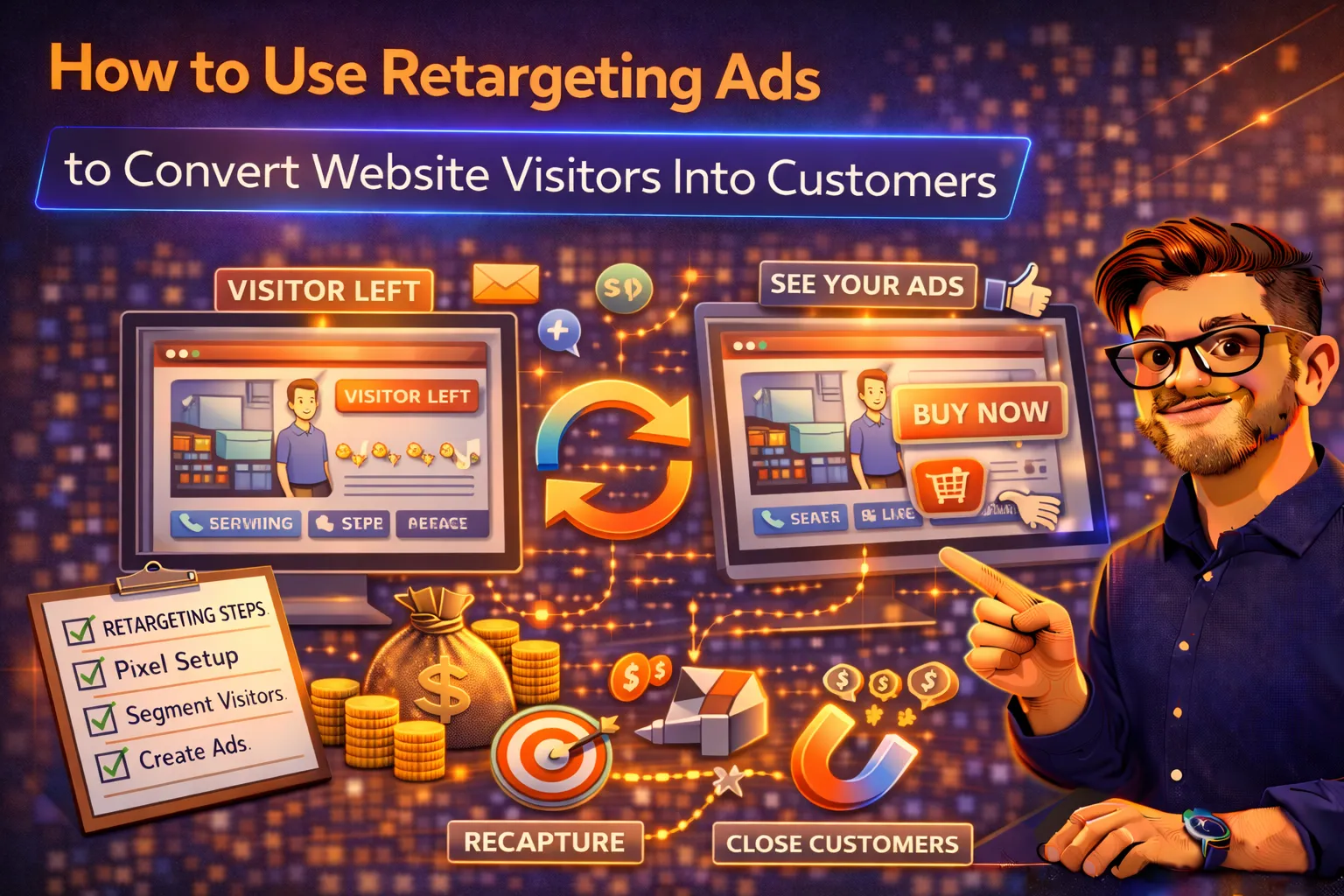
How to Use Retargeting Ads to Convert Website Visitors Into Customers
Quick answer
Ninety-eight percent of website visitors leave without converting, and retargeting exists to bring a portion of them back. It outperforms cold advertising for a simple reason: you are advertising to people who already know you, so the message can assume context and the cost per result falls accordingly. Five strategies suit service businesses.
Why 98% of website visitors leave without converting, how retargeting brings them back, the platform strategies that deliver the highest ROAS, and a step-by-step setup guide for service businesses.
Key Takeaways
- Retargeting (also called remarketing) is a form of online advertising that targets people who have already visited your website or interacted with your business online.
- The reason retargeting outperforms cold advertising is simple: you are targeting people who already know you.
- This is the starting point for every retargeting program.
- Sources: Marketing LTB, Cropink, DemandSage (2025–2026).
- The digital advertising landscape has shifted significantly with the deprecation of third-party cookies.
Published: March 11, 2026 | Reading Time: ~11 minutes | Category: PPC & Paid Media
Approximately 98% of visitors leave your website without taking any action (Marketing LTB/Spiralytics). That is not a rounding error—it is the reality of digital marketing. Your SEO, your Google Ads, your social media campaigns, and your content marketing are all driving visitors to your website, and the vast majority of them leave without filling out a form, making a call, or booking an appointment. They browsed, they considered, and they moved on.
Retargeting changes that equation. It puts your business back in front of those visitors after they leave—on Facebook, Instagram, Google Display, YouTube, and across the web—reminding them of the service they were researching and giving them a reason to come back. The data is compelling: retargeting can increase conversion rates by up to 150% (DemandSage/Cropink), retargeted visitors are 70% more likely to convert than first-time visitors (Invesp), and retargeting ads achieve a click-through rate 10 times higher than standard display ads (DemandSage). For service businesses that are already investing in driving traffic, retargeting is the strategy that turns that investment into revenue.
What Retargeting Is and How It Works
Retargeting (also called remarketing) is a form of online advertising that targets people who have already visited your website or interacted with your business online. When someone visits your website, a small piece of code—a tracking pixel—adds them to a retargeting audience. Later, as they browse Facebook, scroll Instagram, read news sites, watch YouTube, or search Google, they see your ads. These are not random ads to cold audiences; they are targeted messages to people who already know your business exists and have shown interest.
The mechanics are straightforward: install a tracking pixel on your website (Meta Pixel for Facebook/Instagram, Google Ads tag for Google Display/YouTube), the pixel builds an audience of your website visitors, and you create ad campaigns that target that audience with specific messaging designed to bring them back and convert. You can segment your audience by the pages they visited, how long they stayed, and what actions they took—allowing you to show different messages to different levels of intent.
Why does retargeting outperform cold advertising?
| Metric | Performance | Source |
|---|---|---|
| Conversion rate increase | Up to 150% | DemandSage |
| Retargeted visitors vs. first-time visitors | 70% more likely to convert | Invesp |
| Retargeted vs. standard display CTR | 10x higher (0.7% vs. 0.07%) | DemandSage |
| Ad engagement lift | Up to 400% | DemandSage |
| Cart abandonment reduction | 6.5–26% recovery | DemandSage / Skai |
| Brand recall improvement | 57% increase | Cropink |
| CPA vs. cold campaigns | 20–50% lower | Marketing LTB / Cropink |
| Retargeting ROAS (e-commerce avg.) | 8:1 | Marketing LTB |
| Branded search traffic increase | Up to 104% | Marketing LTB |
The reason retargeting outperforms cold advertising is simple: you are targeting people who already know you. They visited your website, looked at your services, and demonstrated intent. Retargeting is not about finding new prospects—it is about converting the prospects you have already paid to attract. That is why the cost per acquisition is dramatically lower and the conversion rates are dramatically higher than cold campaigns.
The Revenue Impact: A service business spending $3,000/month on Google Ads drives 2,000 monthly visitors to its website. At a 2% conversion rate, that is 40 leads. With retargeting recovering even 10% of the 1,960 visitors who left without converting, that is 196 additional opportunities—and at a 5% conversion rate on retargeted visitors, that is 10 additional leads per month from traffic you already paid for. At a $3,000 average job value, that is $30,000 in additional monthly revenue from a retargeting budget of $300–$500.
The Five Retargeting Strategies for Service Businesses
Where does every retargeting program start?
This is the starting point for every retargeting program. Anyone who visits your website gets added to your retargeting audience, and you serve them ads on Facebook, Instagram, and the Google Display Network for a defined period (typically 30–90 days). For service businesses, this means every person who researched your services but did not call or submit a form continues to see your brand as they browse other sites and social media. Your ads should reinforce your value proposition, include a clear call to action (call now, book a free estimate, schedule a consultation), and feature social proof like review counts or customer testimonials.
Which page visits signal the highest intent?
Not all website visitors have the same level of intent. Someone who visited your homepage is less engaged than someone who visited your pricing page, service detail page, or contact page. Page-specific retargeting allows you to create separate audiences based on which pages visitors viewed—and tailor your messaging accordingly. A visitor who viewed your “Emergency Plumbing” page should see an ad about 24/7 availability and fast response times. A visitor who viewed your “Dental Implants” page should see an ad addressing the specific benefits, financing options, and patient testimonials for that procedure. This level of relevance dramatically increases conversion rates.
What do you do about abandoned forms?
A visitor who started filling out your contact form but did not submit it is one of your highest-intent prospects—they were ready to act but something stopped them. Create a dedicated retargeting audience for form abandoners and serve them ads that address common hesitation points: “Still considering? Here’s a free estimate with no obligation,” or “Ready to schedule? Call us directly at [phone number].” This micro-segment typically converts at the highest rate of any retargeting audience because the intent was already there.
Should the message change over time?
People who visited your site yesterday are in a different mindset than people who visited three weeks ago. Sequential retargeting adjusts your message based on time elapsed: in the first 1–3 days, show a direct response ad (book now, call for a free estimate). At days 4–14, shift to educational content and social proof (testimonials, before-and-after project photos, review highlights). At days 15–30+, offer an incentive (limited-time discount, free consultation, seasonal promotion). This graduated approach matches your messaging to the prospect’s decision timeline and prevents ad fatigue.
Can you retarget existing customers?
Retargeting is not only for new customer acquisition. Upload your existing customer email list to Facebook or Google and create a custom audience of past customers. Use these audiences to promote repeat services (annual HVAC maintenance, dental cleanings, follow-up legal consultations), cross-sell related services (a roofing customer who might need gutter installation), and drive referrals with incentive offers. Past customers who already trust your business convert at significantly higher rates than any other audience—and the cost per conversion is the lowest of any retargeting strategy.
Platform-by-Platform Retargeting Guide
| Platform | Best For | Avg. CPC / CPM | Key Advantage |
|---|---|---|---|
| Facebook / Instagram | Visual service businesses, local targeting, testimonial-driven ads | CPC: $0.50–$1.20; conversion lift: 30–80% | Largest retargeting audience; strong demographic and interest targeting |
| Google Display Network | Broad reach across millions of websites; brand reinforcement | CPC: $0.25–$1.50; CPM: $6–10 | Massive reach; used by 65% of advertisers for retargeting |
| YouTube | Video testimonials, before/after work, service demonstrations | CPV: $0.03–$0.12; conversion intent lift: 20–40% | Video builds trust faster than static ads; re-engages for up to 180 days |
| Google Search (RLSA) | Capturing high-intent searchers who previously visited your site | Standard search CPC with higher conversion rates | Bid higher on past visitors searching your keywords—highest intent of any retargeting |
Sources: Marketing LTB, Cropink, DemandSage (2025–2026).
For most service businesses, the highest-impact starting point is Facebook/Instagram retargeting combined with Google Remarketing Lists for Search Ads (RLSA). Facebook provides the visual, social-proof-driven brand reinforcement, while RLSA ensures you bid aggressively when a past visitor returns to Google and searches for your service again—the highest-intent moment in the entire customer journey.
Setting Up Retargeting: Step-by-Step
Step 1: Install Tracking Pixels
- Meta Pixel: Install on every page of your website. This powers Facebook and Instagram retargeting. Set up standard events for key actions: PageView, Lead, Contact, Schedule, and CompleteRegistration.
- Google Ads Tag: Install the global site tag and configure remarketing audiences in Google Ads. This powers Display, YouTube, and RLSA retargeting.
- Verify both pixels are firing correctly using Meta Pixel Helper (Chrome extension) and Google Tag Assistant.
Step 2: Build Your Audiences
- All website visitors (last 30 days)—your foundation audience.
- All website visitors (last 60–90 days)—your extended audience for longer consideration cycles.
- Service page visitors—higher intent; visited specific service pages but did not convert.
- Contact page visitors / form abandoners—highest intent; started the conversion process.
- Past customers (uploaded email list)—for upsell and retention campaigns.
- Exclude converters—always exclude people who have already converted to avoid wasting budget on existing leads.
Step 3: Create Your Ad Creative
- Foundation ads: reinforce your value proposition and include a clear CTA. Feature review ratings, years of experience, and service guarantees.
- Service-specific ads: match the ad to the service page the visitor viewed. Show relevant before-and-after photos, pricing information, or testimonials.
- Urgency and incentive ads: for visitors who have not converted after 14+ days, introduce time-sensitive offers or free consultation messaging.
- Video testimonial ads: short customer testimonials (30–60 seconds) perform exceptionally well in retargeting because they build trust with warm audiences.
Step 4: Set Budget and Frequency
- Start with $10–20 per day for Facebook/Instagram retargeting and $5–15 per day for Google Display retargeting. These are warm audiences—you do not need large budgets to reach them effectively.
- Set frequency caps: limit impressions to 3–5 per person per week on display, and 1–2 per day on social. Overexposure creates ad fatigue and negative brand perception.
- Retargeting budgets typically represent 10–25% of total paid media spend (Marketing LTB)—a relatively small investment for the highest-converting ad channel.
Step 5: Launch, Monitor, and Optimize
- Launch campaigns and monitor daily for the first two weeks.
- Track key metrics: CTR, conversion rate, cost per conversion, and frequency.
- Refresh ad creative every 2–4 weeks to prevent fatigue. Rotate testimonials, offers, and visual styles.
- Review audience performance: which segments convert best? Shift budget toward the highest-performing audiences.
- A/B test ad copy, images, CTAs, and offers continuously. Small improvements compound significantly on retargeting’s already-high conversion rates.
What has privacy change done to retargeting?
The digital advertising landscape has shifted significantly with the deprecation of third-party cookies. Seventy-seven percent of marketers express concern about cookie deprecation, and retargeting effectiveness can decline 25–35% without cookies (Marketing LTB). Here is how smart service businesses are adapting:
Why is first-party data now essential?
Sixty-one percent of companies are shifting toward first-party tracking (Marketing LTB). This means relying on your own data—website pixel data, customer email lists, phone call records, and CRM data—rather than third-party cookies. For service businesses, this is actually an advantage: your customer list, your website visitors, and your lead database are all first-party data you control.
Server-Side Tracking
Server-side tracking (like Meta’s Conversions API and Google’s Enhanced Conversions) sends conversion data directly from your server to the ad platform, bypassing browser restrictions. This improves attribution accuracy by 15–30% (Marketing LTB) and ensures your retargeting audiences remain accurate even as browser-based tracking becomes less reliable.
Email and SMS as Retargeting Channels
Retargeting emails see a 45% open rate—dramatically higher than standard marketing emails (Cropink). SMS follow-ups to website visitors who provided their phone number achieve even higher engagement. As cookie-based retargeting becomes less reliable, these owned channels become increasingly valuable as complementary retargeting strategies.
Common Retargeting Mistakes That Waste Budget
Not Excluding Converters
If you do not exclude people who have already submitted a form, called, or booked an appointment, you are paying to show ads to people who are already your customers. Set up conversion exclusions on every retargeting campaign.
Running the Same Ad for 90 Days
Ad fatigue is the fastest way to turn warm audiences cold. Rotate creative every two to four weeks. If frequency rises above five to six impressions per user without conversion, change the message—the current one is not working for that person.
Targeting Everyone the Same Way
A homepage visitor and a contact-page abandoner should not see the same ad. Segment your audiences by intent level and match messaging accordingly. Generic retargeting wastes the personalization advantage that makes retargeting so effective.
Setting Budgets Too High for Small Audiences
If your website gets 500 visitors per month, you do not need a $50/day retargeting budget. Start small—$5–15/day—and scale based on audience size and performance. Overbudgeting on small audiences leads to excessive frequency that annoys prospects rather than converting them.
Retargeting: The Highest-ROI Paid Channel You Are Probably Underusing
The math behind retargeting is too powerful to ignore. It can increase conversion rates by up to 150% (DemandSage). Retargeted visitors are 70% more likely to convert (Cropink). Retargeting campaigns lower CPA by 20–50% and produce ROAS of 6:1 to 8:1 for e-commerce, with service businesses often seeing even stronger returns because of higher average customer values.
The logic is irrefutable: you are already paying to drive traffic to your website through SEO, PPC, social media, and content marketing. Retargeting ensures that investment does not walk out the door when visitors leave without converting. For service businesses with average customer values of $1,000–10,000+, recovering even a small percentage of lost visitors translates into significant monthly revenue—from a channel that costs a fraction of your primary traffic-driving spend.
Start with the foundation: install your pixels, build your audiences, create service-specific ads with social proof and clear CTAs, and launch with a modest budget. Monitor, optimize, and scale. Retargeting is not optional in 2026—it is the bridge between traffic and revenue.
References
The following sources informed this article:
- Amra & Elma (2025). "Top Retargeting Ad Statistics 2025."
- Cropink (2025). "50+ Retargeting Statistics Marketers Need to Know in 2026."
- DemandSage (2025). "70+ Retargeting Statistics & Trends of 2026."
- Invesp (2024). "Ad Retargeting in Numbers – Statistics and Trends."
- Marketing LTB (2025). "Retargeting Statistics 2025: 97+ Stats & Insights."
- RTB House (2024). "The Retargeting Statistics All Marketers Need to Track."
- Skai (2024). "Retargeting Statistics: Conversion Rates & Marketing Metrics."
- Spiralytics (2024). "Retargeting Statistics Worth Thinking About."
- 99firms (2025). "28 Retargeting Statistics You Need to Know."