Rated 5 star on

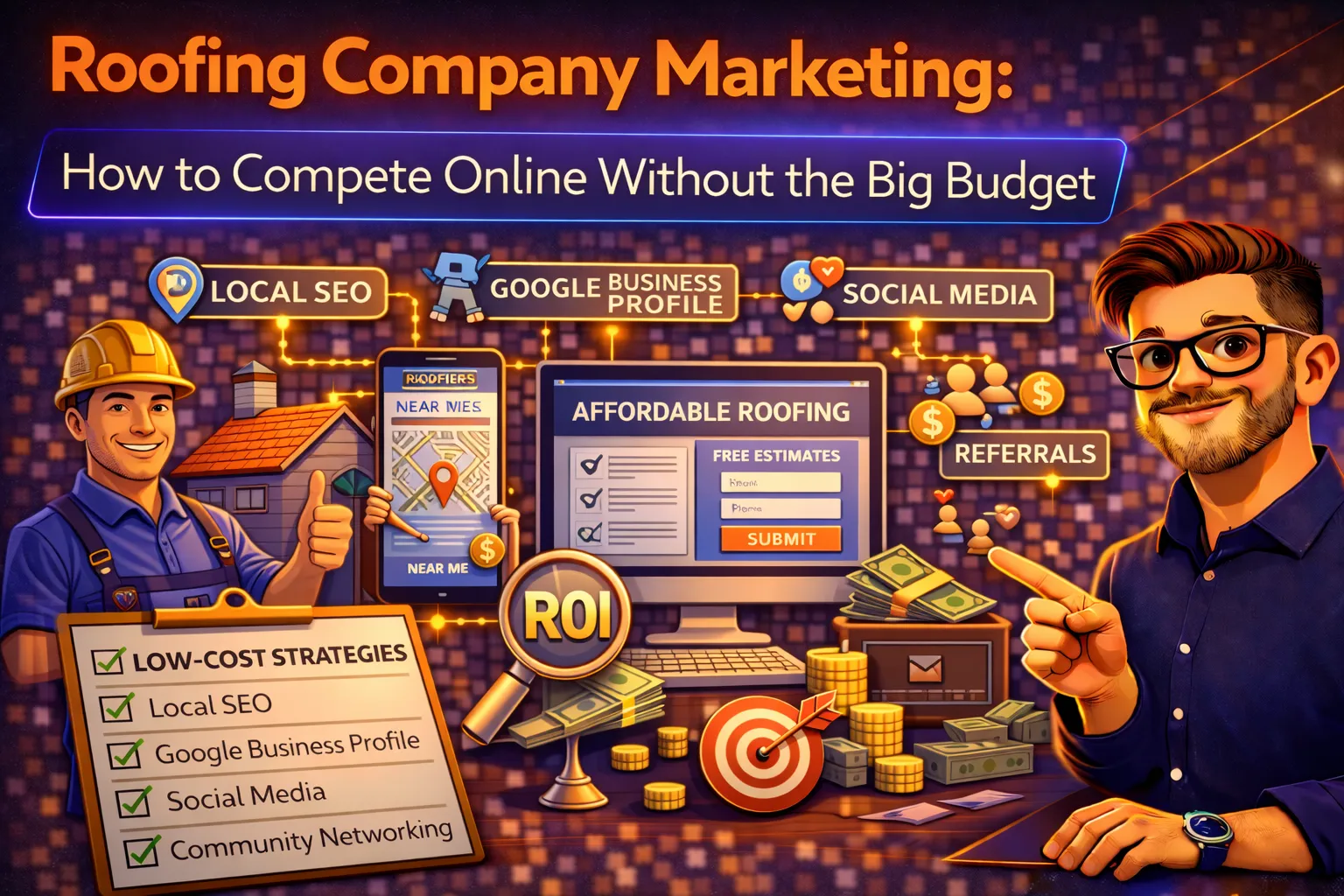
Roofing Company Marketing
Quick answer
A roofing contractor can generate consistent leads and compete with larger companies without spending six figures on advertising. The Google Business Profile is the foundation, because it captures local demand at no cost per click. SEO then compounds over time, which makes it one of the most cost-effective channels available to a smaller operation.
The digital marketing playbook for roofing contractors who want to generate consistent leads, dominate local search, and compete with larger companies—without spending six figures on advertising.
Key Takeaways
- The digital marketing playbook for roofing contractors who want to generate consistent leads, dominate local search, and compete with larger companies—without spending six figures on advertising.
- Google Business Profile (GBP) is the foundation of roofing marketing.
- SEO provides ongoing visibility and compounding returns (Local Roofing SEO), making it one of the most cost-effective marketing channels available.
- While SEO builds over months, Google Ads delivers leads immediately.
- Content marketing generates higher lead volumes at lower costs (Roofing Webmasters).
Published: March 21, 2026 | Reading Time: ~11 minutes | Category: Vertical Marketing – Roofing
The U.S. roofing market reached $47.5 billion in 2025 and is projected to exceed $156 billion globally by 2030 (Comrade Digital / WebFX). The demand is there. The problem for most roofing contractors is not a lack of homeowners who need roofs—it is getting found by those homeowners before the competition does. (Comrade Digital), and (Local Roofing SEO). If your roofing company does not have a strong digital presence, you are invisible to the majority of your potential customers.
Here is the challenge: the top roofing companies making $5 million or more per year dominate search results, run aggressive ad campaigns, and have marketing budgets that smaller contractors cannot match. But budget does not have to be the deciding factor. (WebFX), and (Local Roofing SEO)—both strategies that reward consistency and quality over raw spending.
This guide covers the complete digital marketing playbook for roofing companies that want to compete with bigger players online: local SEO, Google Business Profile optimization, paid advertising, content marketing, reputation management, and social media—all built for contractors who need leads, not vanity metrics.
What competitive dynamics shape roofing marketing?
Before diving into tactics, understand the competitive dynamics shaping roofing marketing this year.
| Market Reality | What It Means for Your Marketing |
|---|---|
| 91% of homeowners search online for roofers | If you are not visible in search, you do not exist to most buyers |
| 58% of new roofing projects start with an online lead | Your website and online profiles are your primary sales channels |
| Referrals still drive 68% of projects | Digital and referral work together—online presence validates word-of-mouth |
| 70% of roofers are unhappy with their SEO provider | Most roofers have been burned by bad marketing—quality stands out |
| 98% of roofing website content gets zero traffic | Content strategy must be targeted, not volume-based |
| 40% of Google searches have local intent | Local SEO is the single highest-leverage channel for roofers |
| Competition is highest in urban residential markets | Consider targeting commercial, emergency, and underserved suburban markets |
| Spring storms and summer peaks drive demand | Marketing spend should align with seasonal search volume spikes |
Sources: Comrade Digital, Local Roofing SEO, Roofing Webmasters, WebFX, ServiceTitan (2025–2026).
Key Insight: Referrals and digital are not competing strategies—they reinforce each other. Sixty-eight percent of roofing projects come from referrals, but when a friend recommends a roofer, the homeowner’s next step is to Google the company name. If your online presence is weak, you lose the referral lead at the validation step.
Why is the Business Profile the highest-return channel?
Google Business Profile (GBP) is the foundation of roofing marketing. Businesses with a complete GBP are twice as likely to be considered reputable than those who do not (Comrade Digital). When a homeowner searches “roofing contractor near me,” the Google Map 3-Pack appears at the top of the page before any paid ads or organic results. If you are not in that 3-Pack, you are losing the highest-intent leads in your market.
How to Optimize Your Google Business Profile
- Complete every section: business name, address, phone number, hours, service area, and categories. Use “Roofing Contractor” as your primary category and add secondary categories like “Roof Repair Service” and “Gutter Cleaning Service”.
- Upload 20+ high-quality photos: completed projects (before and after), your team at work, your trucks and equipment, your office or storefront. Businesses with more photos receive 42% more requests for directions and 35% more website clicks.
- Post weekly updates: share completed projects, seasonal promotions, storm preparedness tips, and team highlights. Regular posting signals to Google that your business is active and engaged.
- Enable messaging and add a booking link: make it as easy as possible for homeowners to contact you directly from your GBP listing.
- Add services and products: list every service you offer with descriptions and pricing ranges. This helps Google match your listing to specific search queries.
- Use the Q&A section proactively: seed your own frequently asked questions with detailed answers about your services, warranties, insurance, and process.
What fuels map pack rankings for roofers?
Reviews are the single most important ranking factor for the Map Pack and the most important trust signal for homeowners choosing between roofers. A roofing company with 150+ Google reviews and a 4.7+ star rating will consistently outrank a competitor with 20 reviews, even if that competitor has better on-page SEO. Build a systematic review collection process: ask every customer for a review at project completion, send a follow-up text or email with a direct link to your Google review page, and respond to every review—positive and negative—within 24 hours. Responding to reviews shows both Google and potential customers that you are engaged and accountable.
Why does local SEO compound over time?
SEO provides ongoing visibility and compounding returns (Local Roofing SEO), making it one of the most cost-effective marketing channels available. Unlike paid ads where leads stop the moment you stop spending, SEO builds cumulative value—every page you optimize, every review you collect, and every backlink you earn continues working for you indefinitely.
How many service area pages do you need?
Create a dedicated page for every city, town, and suburb you serve. Each page should include the service area name in the title tag and H1, unique content about roofing needs specific to that area (weather patterns, common roof types, local building codes), your services available in that area, customer testimonials from that area, and a clear CTA with click-to-call and form submission options. Do not create thin, template pages with only the city name swapped out—Google penalizes duplicate content. Each service area page needs genuinely unique content that demonstrates your knowledge of and commitment to that specific community.
Should each roofing service get its own page?
Build individual pages for each service: roof replacement, roof repair, storm damage restoration, gutter installation, roof inspection, commercial roofing, and any specialty services you offer. Each page targets specific keywords homeowners actually search for: “roof replacement [city],” “storm damage roof repair near me,” “commercial roofing contractor [city].” Include pricing ranges, process explanations, timelines, warranty information, and photos of completed projects for each service.
Where does the hidden roofing traffic come from?
The majority of searches are highly specific terms that do not appear in keyword research tools (Roofing Webmasters). This means the most valuable content strategy for roofers is not chasing high-competition head terms like “roofing company”—it is creating content around specific, real-world topics your customers actually search for. Examples: “How much does a roof replacement cost in [city] in 2026?” “Should I repair or replace my roof after a hailstorm?” “What roofing material lasts longest in [your region’s] climate?” “Does homeowners insurance cover roof replacement?” These long-tail topics attract qualified visitors who are actively in the research and decision-making process.
Technical SEO Essentials for Roofing Websites
- Page load speed under 3 seconds on mobile (compress images, use lazy loading, minimize scripts)
- Mobile-first design with click-to-call buttons on every page
- Schema markup for local business, services, reviews, and FAQ
- Consistent NAP (name, address, phone) across your website, GBP, and all directory listings
- SSL certificate (HTTPS) for security and ranking benefit
- Internal linking between service pages, area pages, and blog content
Which ad formats work for roofing?
While SEO builds over months, Google Ads delivers leads immediately. For roofing companies, three ad formats are particularly effective.
Google Local Services Ads (LSAs)
LSAs appear at the very top of search results—above standard paid ads and organic results. They operate on a pay-per-lead model rather than pay-per-click, which means you only pay when a homeowner contacts you. LSAs display your Google review rating, hours, and a “Google Guaranteed” or “Google Screened” badge that builds immediate trust. For roofing companies, LSAs often deliver the lowest cost per qualified lead of any paid channel because the leads are pre-filtered by service type and location.
Google Search Ads
Target intent-driven keywords that homeowners search when they need a roofer: “roof repair near me,” “roofing contractor [city],” “emergency roof leak repair,” “roof replacement cost [city].” Commercial and emergency roofing clicks typically range from $10 to $30 per click, with higher rates in competitive or storm-affected areas (Local Roofing SEO). Use call-only ads during storm seasons to drive immediate inbound leads when urgency is highest. Include ad extensions for calls, location, sitelinks, and structured snippets.
How should roofing campaigns follow the seasons?
Roofing search volume follows seasonal patterns: spring storms and summer peaks drive the highest demand (WebFX). Align your ad spend accordingly—increase budgets 30–50% during peak storm and summer months, and reduce during winter in most markets. Run ads targeting storm-related keywords immediately after severe weather events when search volume spikes and homeowner urgency is highest. Pre-build storm response ad campaigns so you can activate them within hours of a weather event.
Budget-Smart Approach: If your total monthly marketing budget is under $5,000, prioritize Google LSAs and GBP optimization first. These two channels consistently deliver the lowest cost per qualified lead for roofing companies. Add Google Search Ads only after LSAs are maxing out available lead volume in your area.
Content Marketing: Building Authority Without a Big Budget
Content marketing generates higher lead volumes at lower costs (Roofing Webmasters). For roofing companies, the opportunity is especially strong because most competitors are creating content poorly. Targeted, high-quality content that addresses real homeowner questions will stand out.
High-Impact Content Types for Roofers
| Content Type | Example Topics | Why It Works |
|---|---|---|
| Cost Guides | "Roof Replacement Cost in [City] 2026," "Metal Roof vs. Shingles Cost Comparison" | Captures high-intent buyers researching pricing; attracts long-tail search traffic |
| Before/After Project Showcases | "Complete Roof Replacement in [Neighborhood]," "Storm Damage Restoration: [Address Area]" | Builds trust through visual proof; naturally includes long-tail location keywords |
| Insurance and Claims Guides | "Does Homeowners Insurance Cover Roof Replacement?" "How to File a Roof Damage Claim" | Addresses the #1 concern of storm damage customers; positions you as an expert |
| Material Comparison Guides | "Best Roofing Materials for [Region] Climate," "Asphalt vs. Metal: Which Lasts Longer?" | Helps undecided homeowners make decisions; establishes authority |
| Seasonal Maintenance Tips | "Pre-Hurricane Roof Checklist," "Winter Roof Maintenance for [Region] Homeowners" | Builds audience and email list during off-seasons; creates trust before the sale |
| Local Data Studies | "Average Roof Replacement Cost in [County] 2026," "Most Common Roof Types in [City]" | Earns backlinks from local media and blogs; establishes data authority (Roofing Business Partner) |
Focus on quality over volume. One well-researched, genuinely useful cost guide that ranks on page one will generate more leads than 50 thin blog posts that nobody reads. Remember: 98% of roofing website content gets zero traffic. Do not add to that pile—create content that earns its place.
Reputation Management: The Trust Factor That Closes Deals
For roofing companies, online reputation is not just a marketing metric—it is the deciding factor in whether a homeowner picks up the phone. When someone needs a roof repaired or replaced, they are making a high-stakes, high-cost decision about their home. Trust is everything.
The Review Collection System
- Ask at project completion: train your crew leads and project managers to ask for a review during the final walkthrough when satisfaction is highest.
- Send a follow-up text within 24 hours: include a direct link to your Google review page. SMS requests convert at significantly higher rates than email requests.
- Make it easy: the review link should open directly to the Google review form with your business pre-loaded. Every extra click you require reduces completion rates.
- Respond to every review: thank positive reviewers by name and reference their specific project. Address negative reviews professionally, acknowledge the concern, explain what happened, and offer to resolve the issue.
Managing Negative Reviews
Every roofing company will receive negative reviews. How you respond determines their impact. A professional, empathetic response to a negative review can actually build trust more effectively than the review damages it. Homeowners reading reviews are not looking for perfection—they are looking for a company that is responsive, accountable, and committed to making things right. Never argue, never get defensive, and never ignore a negative review. Acknowledge the experience, apologize for the frustration, and offer to resolve the issue offline.
Social Media for Roofers: Low-Cost Visibility That Builds Trust
With an emphasis on community engagement (Comrade Digital), social media is a trust-building and visibility channel for roofing companies—not a primary lead generation tool. The goal is not viral content; it is consistent presence that builds familiarity and credibility in your local market.
What to Post
- Before-and-after project photos (the highest-engagement content type for roofers)
- Time-lapse videos of roof installations and replacements
- Team spotlights and crew introductions (humanizes your brand)
- Customer testimonials and review highlights
- Seasonal tips: storm preparation, maintenance reminders, energy efficiency advice
- Community involvement: sponsorships, local events, charitable projects
Platform Priorities
Facebook is the primary social platform for residential roofing companies—it has the broadest local audience and the most active community groups. Instagram works well for visual project showcases and before-and-after content. TikTok and YouTube Shorts are growing channels for roofers willing to create short-form video content showing their work in progress. LinkedIn is valuable if you also serve commercial clients and want to connect with property managers and facility directors.
Consistency matters more than polish. Posting three times per week with real photos from actual job sites builds more trust than professionally produced content posted once a month. Homeowners want to see your real work, real team, and real results.
The Budget-Smart Roofing Marketing Stack
You do not need a six-figure budget to compete online. Here is how to allocate your marketing dollars for maximum ROI at different budget levels:
| Budget Level | Monthly Spend | Priority Channels | Expected Results |
|---|---|---|---|
| Starter | $1,000–$2,500/mo | GBP optimization, review generation, basic local SEO, social media | Map Pack visibility, steady review growth, local brand awareness |
| Growth | $2,500–$5,000/mo | All Starter + Google LSAs, service area pages, content marketing | Consistent lead flow from search, organic traffic growth, lower cost per lead over time |
| Competitive | $5,000–$10,000/mo | All Growth + Google Search Ads, Facebook/Instagram ads, email marketing, CRM automation | Multi-channel lead generation, seasonal campaign scaling, competitive market dominance |
| Dominant | $10,000+/mo | All Competitive + video production, retargeting, geofencing, AI search optimization | Full market coverage, brand authority, ability to compete with franchise operations |
The key principle: start with the highest-ROI channels (GBP and local SEO), build a foundation that generates organic leads, then layer paid channels on top to accelerate. Roofers who invest in digital marketing regularly see a 400–800% return on investment because every lead is trackable and targeted (Comrade Digital). The businesses that struggle are the ones that skip the foundation and jump straight to expensive paid campaigns without a converting website, reviews, or local visibility to support them.
Measuring What Matters: Roofing Marketing KPIs
Track these metrics monthly to ensure your marketing investment is producing real business results:
- Total leads per month: how many inbound calls, form submissions, and chat inquiries did your marketing generate?
- Cost per lead by channel: which channels deliver the most affordable qualified leads? Google Business Profile typically delivers the lowest cost per lead for roofers.
- Lead-to-estimate conversion rate: what percentage of leads are converting into on-site estimates?
- Estimate-to-close rate: what percentage of estimates are converting into signed contracts?
- Revenue per marketing dollar: for every $1 spent on marketing, how much revenue is generated?
- Google Map Pack ranking: are you appearing in the top 3 local results for your primary service keywords?
- Organic traffic growth: is your website traffic from search increasing month over month?
- Review count and average rating: are you consistently growing your review count while maintaining a 4.5+ star average?
If you cannot track leads back to specific marketing channels, you cannot optimize your spend. At minimum, use call tracking with dynamic number insertion, GA4 with conversion events, and a CRM that tracks lead source. Marketing that is not measured is marketing that is wasted.
Compete on Strategy, Not Just Budget
The roofing companies dominating their local markets in 2026 are not always the ones with the biggest budgets—they are the ones with the smartest strategies. These are all strategies where consistency, quality, and local expertise matter more than raw spending power.
Start with your Google Business Profile: claim it, optimize every section, upload photos weekly, and build a systematic review collection process. Then build out your local SEO with service area pages and service-specific content. Layer in Google LSAs to capture immediate high-intent leads. And measure everything so you can double down on what works and cut what does not.
The homeowners in your market are searching for a roofer right now. The question is whether they find your company or your competitor’s. A smart digital marketing strategy ensures they find you first—regardless of how big your budget is.
References
The following sources informed this article:
- Comrade Digital Marketing (2025). "Digital Marketing for Roofers: A Complete Guide 2026."
- Local Roofing SEO (2025). "Roofing Industry Statistics You Need to Know in 2026."
- Propellant Media (2025). "Digital Marketing for Roofing Companies: The Ultimate 2025 Blueprint."
- Roofing Business Partner (2026). "2026 Roofing Growth Plan: A 5-Phase AI Marketing Blueprint."
- Roofing Contractor (2025). "2025 Commercial Roofing Trends Report."
- Roofing Webmasters (2025). "Roofing Marketing Statistics (2025 Update)."
- ServiceTitan (2026). "Top 11 Roofing Trends to Know for 2026."
- WebFX (2025). "2026 Roofing Marketing Benchmarks to Build Your Campaigns On."
- WebFX (2025). "6 Roofing Trends for 2026 That You Can’t Ignore."