Rated 5 star on

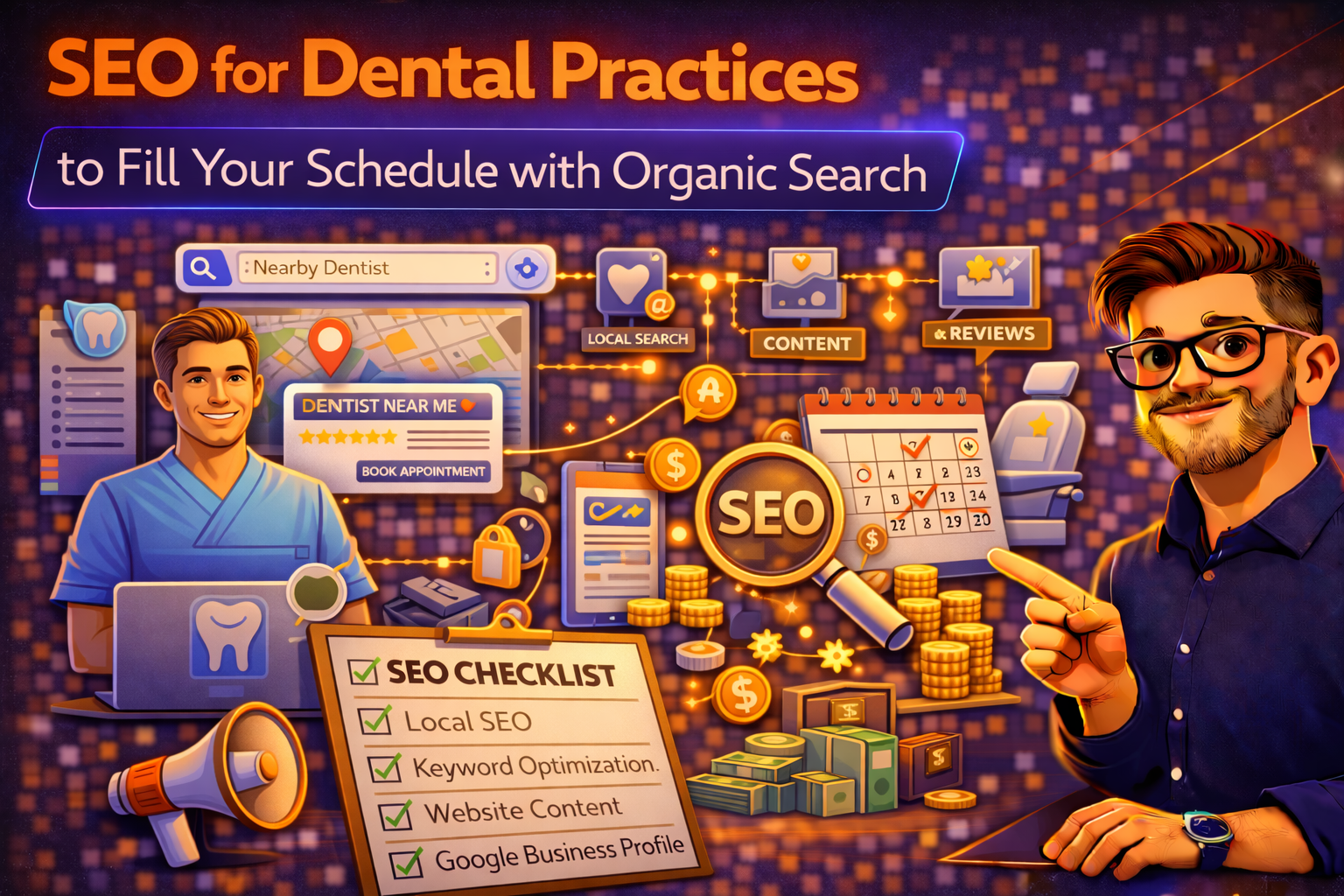
SEO for Dental Practices
Quick answer
Dental SEO is a specialised discipline, and practices that hire general marketing agencies routinely get generic results. Your Google Business Profile is the single most important asset. Beyond it, procedure-specific service pages, neighborhood pages, technical foundations, and disciplined review management are what actually convert organic search into booked new-patient appointments.
The specific SEO strategies that drive new patient appointments—from Google Business Profile optimization and procedure-specific service pages to review management, local authority building, and preparing for AI-driven dental search in 2026.
Key Takeaways
- The specific SEO strategies that drive new patient appointments—from Google Business Profile optimization and procedure-specific service pages to review management, local authority building, and preparing for AI-driven dental search in 2026.
- Dental SEO is a specialized discipline, and practices that hire general marketing agencies often get generic results.
- Your Google Business Profile is the single most important asset in dental SEO.
- A homepage that lists your services as bullet points is not enough.
- All the content in the world will not rank if your website is technically broken.
Published: March 13, 2026 | Reading Time: ~12 minutes | Category: Vertical – Dental
(Sixth City Marketing). With over 200,000 practicing dentists in the United States alone, standing out in local search results requires more than a basic website and a Google listing. The practices that dominate organic search—the ones with a full schedule and a waitlist—are the ones executing a dental-specific SEO strategy built around how patients actually search for, evaluate, and choose their dentist in 2026.
Dental searches are inherently local, high-intent, and trust-driven. Someone searching “dentist near me” or “emergency dentist open now” is not casually browsing—they need care and they are ready to book. (GoMega), and in 2026 many patients will never even click through to your website—they make their decision based entirely on what they see in Google’s Local Pack: your reviews, your photos, your hours, and your services (Roketto). If your practice is not appearing in those top three map results and the first page of organic search for your core procedures and service area, you are losing patients to competitors who are—often to practices that are not clinically better, just more visible online.
This guide covers the complete dental SEO strategy for 2026: Google Business Profile optimization, procedure-specific service pages, review management, technical SEO, content marketing, local authority building, and preparing for AI-driven search—everything a dental practice needs to fill its schedule through organic search.
Why Dental SEO Is Different From General SEO
Dental SEO is a specialized discipline, and practices that hire general marketing agencies often get generic results. The dental vertical has unique characteristics that require specific strategies:
| Dental SEO Factor | Why It Matters |
|---|---|
| Hyperlocal intent | Patients search within a tight radius—5–15 miles. You are competing with 10–50 practices in your immediate area, not nationally. |
| Procedure-specific searches | Patients search for specific treatments: “dental implants,” “Invisalign,” “emergency root canal,” “pediatric dentist.” Each requires a dedicated page. |
| Trust is the conversion factor | Patients are choosing someone who will work inside their mouth. Reviews, credentials, photos, and patient testimonials are not optional—they are the deciding factor. |
| High patient lifetime value | A new patient is worth $800+ in immediate revenue and thousands over their lifetime through cleanings, procedures, and referrals. The ROI on dental SEO compounds. |
| HIPAA and healthcare compliance | Content must be accurate, not misleading, and compliant with healthcare advertising regulations. Before-and-after photos require patient consent. |
| AI is changing discovery | Search impressions are up 49% year-over-year but click-through rates are down 30% as AI Overviews answer basic dental questions directly in search results (DentalScapes). |
Understanding these differences is the foundation. Now let’s build the strategy.
Why is the Business Profile the most important dental asset?
Your Google Business Profile is the single most important asset in dental SEO. In 2026, many patients make their decision entirely from the map pack—without ever visiting your website (Roketto). Your GBP must be complete, accurate, and actively managed.
Categories
Set “Dentist” as your primary category. Add all relevant secondary categories that match services you actually provide: “Cosmetic Dentist,” “Pediatric Dentist,” “Emergency Dental Service,” “Dental Implants Provider,” “Orthodontist” (if applicable). Be specific—each category opens visibility for a different set of patient searches.
How detailed should dental service descriptions be?
Add every service your practice offers with clear, patient-friendly descriptions. Do not leave these generic or empty. Each service should explain what the procedure involves, who it is for, and what the patient experience is like. Google cross-references your GBP services with your website to verify expertise—alignment between the two strengthens your ranking.
Photos and Visual Content
Upload real photos weekly: your office exterior and interior, treatment rooms, your team, your equipment, and before-and-after results (with patient consent). Google’s Vision AI now scans photo content to understand your expertise. A practice that uploads images of dental implant work becomes more likely to rank for implant-related searches. Avoid stock photos—they provide zero SEO value and erode trust.
What breaks the tie between three dental practices?
Reviews are the tiebreaker in dental search. When three practices appear in the map pack, the one with the best review profile usually gets the call. Build a systematic process: ask every patient for a Google review at checkout (text a direct link), respond to every review within 24 hours, and encourage patients to mention specific procedures and your location. A review that says “Dr. Smith did an amazing job on my dental implants in Coral Gables” is significantly more SEO-valuable than “Great dentist!”
Posts and Q&A
Post weekly updates: new patient specials, seasonal promotions (back-to-school cleanings, holiday whitening offers), patient education tips, and team introductions. Seed your Q&A section with the 15–20 most common patient questions—insurance acceptance, emergency availability, sedation options, parking, new patient process. Profiles that go inactive for 30+ days see measurable drops in visibility.
Why is a bulleted services list not enough?
A homepage that lists your services as bullet points is not enough. High-intent patients search for exact treatments like “dental implants in [city]” or “Invisalign provider [neighborhood]” (Prime Dental SEO). Each major procedure or service your practice offers needs its own page on your website.
Essential service pages for most dental practices include:
| High-Value Procedures | Core Services | Specialty / Emerging |
|---|---|---|
| Dental implants | General dentistry / cleanings | Pediatric dentistry |
| Invisalign / clear aligners | Emergency dental care | Sedation dentistry |
| Cosmetic dentistry / veneers | Root canals | Same-day crowns |
| Teeth whitening | Dental crowns and bridges | TMJ / sleep apnea treatment |
Each service page should include: the procedure name in the title tag, H1, and URL; a detailed, patient-friendly description of what the procedure involves; who the ideal candidate is; what the patient experience is like (duration, recovery, pain management); financing and insurance information; FAQs specific to that procedure; patient testimonials mentioning that service; a clear call to action (book a consultation, call our office); and LocalBusiness and MedicalProcedure schema markup.
High-value procedure pages like dental implants and Invisalign deserve the most investment in content depth. These are the searches that generate patients worth five to ten times more than a standard hygiene visit (12AM Agency). A comprehensive implant page that answers every question a patient might ask will outrank a thin competitor page every time.
Step 3: Create Neighborhood and Location Pages
Dental searches are hyperlocal. Patients search for “dentist in [neighborhood],” “pediatric dentist near [suburb],” and “emergency dentist [zip code].” If your practice serves multiple neighborhoods or communities, create a dedicated page for each one. An HVAC contractor or a dental practice targeting Coral Gables, Brickell, Coconut Grove, and Kendall should have a unique, substantive page for each—not a thin doorway page, but genuine content about serving that area: specific directions, parking information, transit accessibility, community involvement, and patient testimonials from that neighborhood.
These hyperlocal pages improve visibility for “near me” searches and voice queries like “Which dentist near Midtown accepts walk-ins?” and “Best pediatric dentist near Westlake” (LocalMighty). They also provide location-specific data that AI systems use when recommending local businesses.
Which technical basics must a dental site get right?
All the content in the world will not rank if your website is technically broken. Dental practices must ensure these technical fundamentals are in place:
- Page speed: Target Largest Contentful Paint under 2.5 seconds on mobile. Fifty percent of consumers expect a site to load in three seconds or less (Sixth City Marketing). Compress images, enable lazy loading, and minify code.
- Mobile-first design: The majority of dental searches happen on smartphones. Your site must be fully responsive with thumb-friendly navigation, click-to-call buttons, and easy appointment booking on every page.
- Schema markup: Implement LocalBusiness, Dentist, MedicalOrganization, and FAQPage schema. This helps search engines and AI systems understand your practice information in structured format.
- NAP consistency: Your practice name, address, and phone number must be identical on your website, GBP, and every directory listing. Even minor inconsistencies weaken your local rankings.
- HTTPS and security: Healthcare websites must be secure. Ensure your SSL certificate is active and all pages load over HTTPS.
- Online booking integration: Seventy-seven percent of patients want a provider that offers online scheduling, but only 26% of practices currently offer it (Sixth City Marketing). Integrating booking directly into your website and GBP removes friction from the patient journey and significantly increases conversions.
Step 5: Content Marketing for Patient Acquisition
Content marketing for dental practices serves two purposes: it drives organic traffic from patients searching for information, and it builds the topical authority that Google and AI systems use to determine which practice deserves the top rankings.
Which blog topics actually book appointments?
Focus on content that matches patient search behavior. The highest-value blog topics for dental practices include: procedure explanations (“What to Expect During a Dental Implant Procedure”), cost and financing guides (“How Much Do Veneers Cost in [City]?”), comparison content (“Invisalign vs. Braces: Which Is Right for You?”), symptom-based content (“Why Does My Tooth Hurt When I Bite Down?”), and patient education (“How Often Should You Really Go to the Dentist?”). Each post should link to the relevant service page, include a call to action, and target long-tail keywords that match how patients actually search.
How do you become the source AI cites?
In 2026, Google’s AI Overviews answer many basic dental questions directly in search results. To be the source AI cites, create comprehensive FAQ sections on your service pages and a dedicated FAQ page covering the questions patients ask most: insurance acceptance, procedure costs, recovery times, sedation options, emergency availability, and new patient processes. Structure these with FAQPage schema so AI systems can easily parse and surface your answers.
Video Content
Video builds trust faster than text—especially in healthcare. Create short videos (60–90 seconds) introducing your dentists, explaining common procedures, giving office tours, and sharing patient testimonials. Embed these on your service pages and upload to YouTube with optimized titles and descriptions targeting dental keywords in your area. Video content on service pages increases time-on-page, which is a positive engagement signal for rankings.
Step 6: Build Local Authority
Link signals and citations remain critical ranking factors for dental practices. Build authority through:
- Healthcare-specific directories: Healthgrades, WebMD, Zocdoc, Vitals, RateMDs, and your state dental association directory. Ensure NAP consistency across all listings.
- Local directories and citations: Yelp, Apple Maps, Bing Places, Facebook, and the major data aggregators (Neustar/Localeze, Data Axle, Foursquare).
- Community involvement: Sponsor local events, school dental health programs, youth sports teams, and community organizations. These generate local backlinks and brand mentions that strengthen your local authority.
- Local press and content features: Pitch dental health tips to local news outlets, participate in community health fairs, and contribute expert commentary on oral health topics. Each feature generates a high-quality local backlink.
- Referral partner relationships: Build relationships with pediatricians, orthodontists, oral surgeons, and general physicians who refer patients. Cross-linking between practice websites and mutual professional references strengthen your entity authority.
Step 7: Prepare for AI-Driven Dental Search
The way patients discover dentists is changing. Search impressions for dental queries are up 49% year-over-year, but click-through rates are down 30% as AI Overviews handle basic questions directly in results (DentalScapes). Patients are also using ChatGPT, Google’s AI Mode, and other AI platforms to ask questions like “Which dentist near me accepts Delta Dental and has Saturday hours?”
To position your practice for AI-driven discovery:
- Maintain complete, consistent information across all platforms. AI systems verify business data across multiple sources before making recommendations—inconsistencies reduce your chances of being surfaced.
- Write service descriptions and FAQs in clear, conversational language that directly answers specific questions. AI favors declarative, structured information over marketing copy.
- Implement comprehensive schema markup so AI can read your practice data in structured format.
- Generate detailed reviews that mention specific procedures, insurance plans, and locations. AI reads review text to understand what your practice actually does and uses it to match patient queries.
- Publish authoritative, original content that demonstrates expertise. AI prioritizes the most complete, credible source for a given dental topic. Practices with deep, well-organized content libraries are more likely to be cited in AI responses.
Measuring Dental SEO ROI
Unlike e-commerce, dental practices do not sell products online—they sell trust and clinical outcomes. Measure dental SEO success by tracking metrics that connect directly to patient acquisition:
| Metric | How to Track | Benchmark |
|---|---|---|
| Organic new patient calls | Call tracking with dynamic number insertion (CallRail or similar) | Track calls >2 minutes as likely bookings |
| Online appointment bookings | Track form submissions and booking widget completions in GA4 | Avg. landing page conversion rate ~10% for dental (Sixth City) |
| Google Map Pack position | Track rankings for core keywords (dentist near me, dental implants [city]) | Top 3 positions for primary services |
| New patient acquisition cost | Monthly SEO investment ÷ new patients from organic search | If SEO costs $2,000/mo and brings 10 patients = $200 CAC |
| Patient lifetime value | Average first-visit spend + projected visits over 5–10 years | $800 first visit; $5,000–15,000+ lifetime (12AM Agency) |
The ROI Math: If your dental SEO costs $2,000 per month and generates 10 new patients, your cost per acquisition is $200. If the average new patient spends $800 on their first visit, that is $8,000 in immediate revenue—a 300% return in month one, before factoring in the years of cleanings, procedures, and referrals that follow. At a conservative $5,000 lifetime patient value, those 10 patients represent $50,000 in long-term revenue from a $2,000 monthly investment. This is why dental SEO compounds: every new patient acquired today generates value for years to come.
Your 90-Day Dental SEO Playbook
Days 1–30: Foundation
- Claim and fully optimize your Google Business Profile: complete every field, set precise categories (Dentist + all relevant specialty categories), upload 25+ real photos, add all services with detailed descriptions, and seed Q&A with 15–20 common questions.
- Audit your website for technical SEO: page speed, mobile responsiveness, HTTPS, NAP consistency, and schema markup.
- Create or optimize dedicated service pages for your top five procedures (start with highest-value: implants, Invisalign, cosmetic, emergency, general).
- Install call tracking and configure GA4 conversion events for form submissions, booking completions, and click-to-call actions.
- Launch a systematic review generation process—ask every patient starting this week.
Days 31–60: Content and Authority
- Build neighborhood-specific landing pages for the three to five communities you serve.
- Publish your first four blog posts targeting high-value, long-tail dental keywords.
- Claim and optimize listings across healthcare directories (Healthgrades, Zocdoc, WebMD) and local directories (Yelp, Apple Maps, Bing Places).
- Begin weekly GBP posting: patient tips, seasonal promotions, team spotlights, and procedure highlights.
- Respond to all existing reviews and commit to 24-hour response time going forward.
Days 61–90: Optimization and Scaling
- Analyze GBP Insights: which searches trigger your profile, how many calls and direction requests you receive, and where visibility is strongest.
- Review call tracking data: which keywords and pages drive the most patient calls? Double down on content that converts.
- Add FAQ sections to all service pages, optimized for AI Overviews with FAQPage schema.
- Create two to three short videos: doctor introduction, office tour, and a top procedure explanation. Embed on service pages and upload to YouTube.
- Establish a monthly SEO review cadence: track map pack rankings, organic traffic, new patient calls, booking conversions, and review velocity.
SEO: The Most Durable Patient Channel for Dental Practices
Paid ads stop generating leads the moment you stop paying. Referrals are valuable but unpredictable. SEO builds a compounding asset: every service page you create, every review you earn, every piece of content you publish, and every local link you build strengthens your visibility permanently. The practices that invest consistently in dental SEO for 12+ months create a competitive moat that new entrants and undisciplined competitors cannot easily overcome.
. . (Sixth City Marketing). The patients are searching. The question is whether they find you or the practice down the street. Start with the foundation—optimize your GBP, build your service pages, generate reviews, and publish content that demonstrates your expertise. Do it consistently, measure the results, and your schedule will fill itself.
References
The following sources informed this article:
- 12AM Agency (2026). "How to Measure SEO ROI for Your Dental Practice in 2026."
- Dental Marketing BFF (2025). "Future Trends in Dental SEO for 2026 and Beyond."
- DentalScapes (2025). "SEO for Dentists in 2025: Adapting to AI in Search."
- GoMega (2026). "AI SEO for Dentists: Rank Higher and Get More Patients."
- LocalMighty (2026). "Local SEO for Dentists: The Complete 2026 Local SEO Guide."
- Prime Dental SEO (2026). "Dental SEO in 2026: The Complete Guide for Dentists."
- Roketto (2026). "Top 15 Dental SEO Services in 2026."
- Rosemont Media (2025). "Best SEO Strategies for My Dental Practice in 2026."
- Sixth City Marketing (2025). "60+ Statistics on Dental Marketing Strategies for 2026."