Rated 5 star on

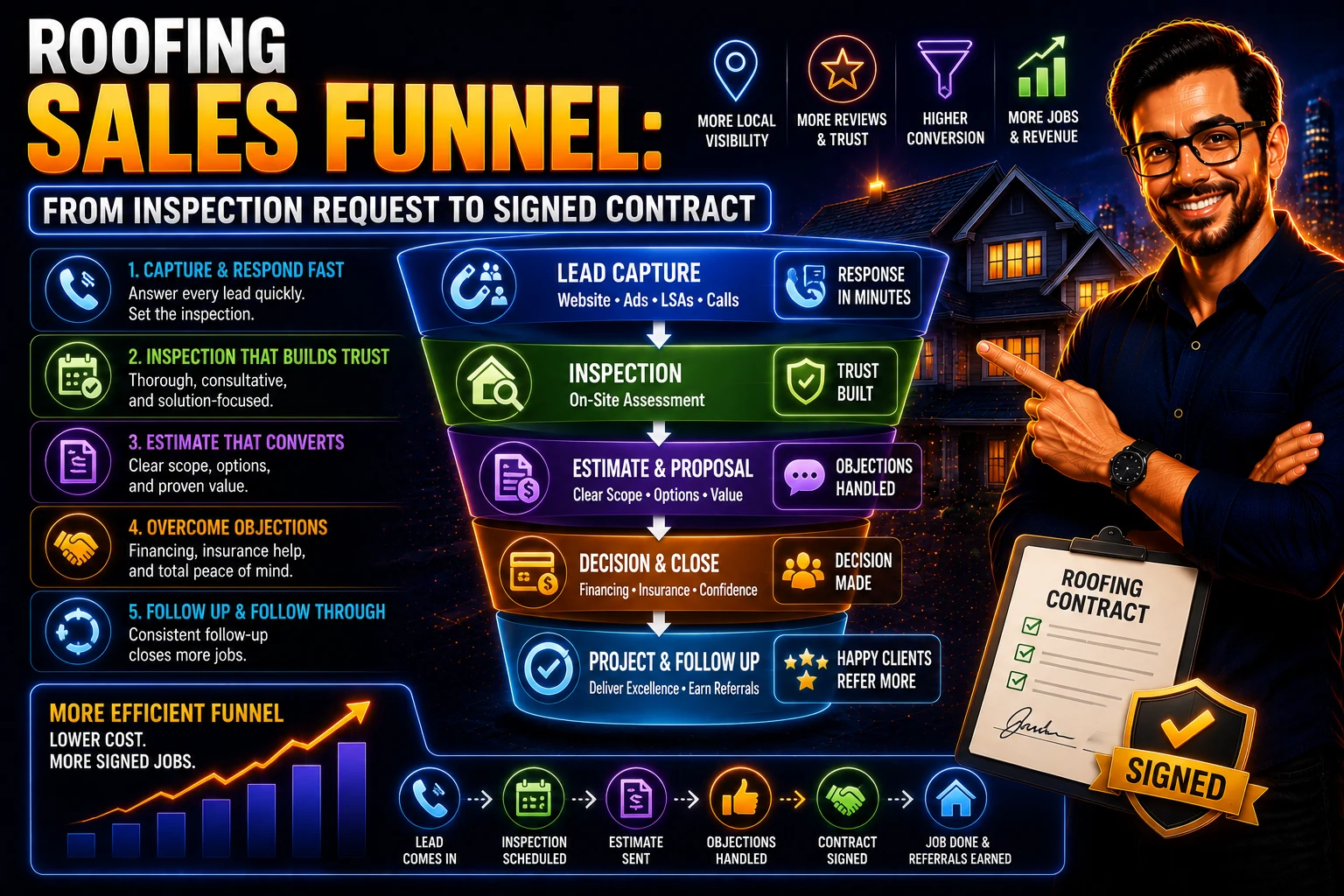
Roofing Sales Funnel: From Inspection Request to Signed Contract
Quick answer
Marketing produces leads; the sales funnel converts them into booked work across four stages. The costliest leak is lead-to-inspection, where operations paying for Local Services Ads, map-pack calls, and paid clicks lose the very leads they bought. Fixing that stage recovers more revenue than any additional traffic will.
Marketing produces leads. The sales funnel converts leads into booked work. Most roofing operations focus marketing investment heavily and sales process discipline lightly — accepting whatever conversion rate happens to emerge from undisciplined process rather than systematically optimizing each stage. The result: substantial marketing investment producing leads that drop off through preventable friction at each funnel stage, with operations attributing the lost conversion to 'price-shopping customers' or 'tough market' when the actual cause is sales process gaps the operation could close.
Key Takeaways
- Marketing produces leads. The sales funnel converts leads into booked work.
- Lead arrives (phone call, form submission, message), sales process converts to scheduled inspection appointment.
- Operations paying for LSA leads, Map Pack-driven calls, and paid search clicks then losing them at the lead-to-inspection stage waste the marketing investment that produced the lead in the first place.
- The on-site inspection isn't just a fact-gathering exercise; it's the central trust-building and qualification event in the roofing sales process.
- The estimate-to-contract stage is where credentialed operations differ most from commodity competitors.
Published: July 25, 2026 | Reading Time: ~8 minutes | Category: Roofing Marketing — Sales Funnel
The roofing sales funnel has distinct stages, each with its own conversion problem: lead-to-inspection (do leads turn into booked inspections?), inspection-to-estimate (do inspections produce written estimates?), estimate-to-contract (do estimates become signed contracts?), and follow-up (do slow deciders eventually return?). Each stage has its own drivers and its own friction. Shops that measure and fix each stage far outperform shops that treat the funnel as one blur.
This guide covers the roofing sales funnel plainly: the stages and their typical conversion rates, where most shops lose customers and how to fix it, the real on-site inspection that sets a credentialed process apart from cheap bidding, insurance-restoration selling, financing as a conversion lever, follow-up that recovers leads others write off, tying sales to marketing for compounding gains, and the CRM and pipeline that make the discipline real instead of wishful.
What You'll Learn
- The four roofing sales funnel stages and typical conversion rates
- Lead-to-inspection conversion: where most operations lose leads they paid to acquire
- Inspection-to-estimate conversion: the substantive on-site assessment that wins
- Estimate-to-contract conversion: the close that distinguishes credentialed from commodity
- Insurance-restoration sales considerations specific to this channel
- Financing options as conversion lever for substantial-dollar decisions
- Follow-up discipline that recovers leads other operations write off
- Sales process integration with marketing for compounding effects
- CRM and pipeline management that operationalizes the discipline
The Four Sales Funnel Stages
What converts a lead into a booked inspection?
A lead arrives (call, form, message), and your process turns it into a booked inspection. With a strong process, 40 to 70% convert; shops with weak intake and slow follow-up convert far less.
What happens between inspection and estimate?
The inspection happens, you assess the roof, and you produce and deliver a written estimate. With a strong process, 70 to 90% convert; shops with weak inspection discipline lose more to no-shows, cancellations, or scope calls that stall.
What closes the estimate into a signed contract?
You deliver the estimate, the homeowner decides, and a contract gets signed. Conversion varies widely (15 to 50%-plus) on credentials, sales discipline, follow-up, and competition. This is where shops differ most.
How much revenue does follow-up actually recover?
Slow deciders return weeks or months later when they're ready. Often 10 to 25% of estimates that don't close right away convert through steady follow-up. Shops without follow-up write off that revenue entirely.
THE COMPOUNDING EFFECT OF STAGE-BY-STAGE OPTIMIZATION: Funnel conversion compounds across stages. Take a shop with 100 leads. At 50% lead-to-inspection, 75% inspection-to-estimate, 30% estimate-to-contract, plus 15% follow-up: that's 50 inspections, 38 estimates, 11 immediate contracts, 4 follow-up contracts — 15 total from 100 leads, or 15% overall. Lift each stage by 10 points (60%, 85%, 40%, 25%): 60 inspections, 51 estimates, 20 immediate contracts, 8 follow-up contracts — 28 total, or 28% overall. That nearly doubles conversion through stage discipline, not more leads. Fixing the funnel usually pays off more than buying more traffic.
Where do roofers lose the leads they paid for?
Shops paying for LSA leads, map-pack calls, and paid clicks and then losing them at lead-to-inspection waste the marketing that made the lead. This stage often holds the biggest gain.
- Answer rate matters most. Calls going to voicemail convert dramatically worse than calls answered immediately. AI receptionist tools handling overflow ensure no inbound calls go unanswered.
- Response time on form submissions: substantial portions of inquiries go elsewhere within minutes if not responded to. Operations responding within 5 minutes convert dramatically better than operations responding hours later.
- Inspection scheduling friction: requiring customers to wait for callbacks, navigate complex scheduling, or hold for available slots loses conversion. AI receptionist or scheduling tools that book directly from initial conversation eliminate this friction.
- Information gathering during initial contact: getting damage details, urgency level, and contact information during the initial call enables better preparation for the inspection and signals professional process.
- Confirmation and reminders: sending appointment confirmations and day-of-inspection reminders reduces no-show rates substantially.
- Inspection cancellation recovery: when inspections cancel, immediate follow-up to reschedule recovers substantial portions of would-be lost conversion.
Inspection-to-Estimate: The Substantive On-Site Assessment
The on-site inspection isn't just fact-gathering; it's the main trust-building and qualifying moment of the sale. Shops that run real, professional inspections convert far better than shops that treat the visit as a quick price quote.
- Comprehensive roof assessment: actual inspection of roof condition, identification of issues, documentation of findings with photos. Customers see professional thoroughness rather than five-minute walk-around.
- Educational explanation: the inspector explains what's being observed, what it means, what options exist. Customers learn from the inspection and develop trust in the inspector's expertise.
- Material and process explanation: discussing what work would involve, what materials would be appropriate, what the process would look like. Substantive explanation distinguishes from commodity bidding.
- Credentialing and trust-signal communication: the inspector mentions manufacturer certifications, license and insurance, the company's experience and history. The on-site interaction is where trust signals translate into customer perception.
- Estimate delivered while on-site or within 24 hours: same-day or next-day written estimates dramatically outperform estimates delivered days later. Customer interest and decision urgency decline rapidly after the inspection.
- Documentation provided to customer: inspection findings, photos, written observations supporting the estimate. The documentation builds credibility and supports the customer's evaluation.
Estimate-to-Contract: The Close
Estimate-to-contract is where credentialed shops pull away from cheap rivals. The same estimate at the same price converts at very different rates depending on how the conversation handles trust signals, decision support, financing, and follow-up.
- Trust signals throughout the conversation: credentialing, manufacturer certifications, license/insurance, references, completed-job examples. The conversation reinforces the trust that converts estimates.
- Substantive estimate document: written estimate with detailed scope, material specifications, timeline, warranty information, and professional presentation. Substantial estimates convert better than verbal quotes or thin emails.
- Decision support without pressure: helping the customer make a good decision rather than pressuring them into immediate signature. Customers respond to consultative approaches; high-pressure tactics often lose substantial-dollar-decision customers.
- Addressing concerns directly: customers often have specific concerns about price, materials, timeline, or process. Operations that address concerns substantively close better than operations that dismiss or deflect.
- Financing options as conversion lever: many roofing customers benefit from financing options that spread substantial costs over time. Operations offering financing convert customers who couldn't immediately fund the work but can manage financed payments.
- Clear next-steps and contract terms: the customer should understand exactly what happens after signing — scheduling, deposit, work timeline, payment terms, warranty registration. Clarity supports the decision.
- Insurance restoration considerations: for insurance-restoration work, the sales conversation involves the claim process and how the operation works through it. Substantive insurance restoration competence converts insurance customers better than generic roofing positioning.
PRO TIP: The single biggest estimate-to-contract win for most roofers is offering financing that fits a big-dollar decision. Many homeowners who can't pay for a full replacement up front can handle financed payments. Shops without financing lose these customers entirely; shops with it convert them. Financing partnerships (with Synchrony, Mosaic, GreenSky, or roofing-specific partners) are simple to set up and often pay back many times over within months. Building financing is one of the most-overlooked sales wins available.
Insurance-Restoration Sales Considerations
Insurance-restoration selling works differently from out-of-pocket sales. The customer is the policyholder but doesn't bear the main cost, the adjuster shapes the outcome, and the conversation involves both the homeowner and the claim process.
- Insurance process explanation: helping homeowners understand the claim process they're navigating reduces friction and builds trust. Operations that explain the process substantively help customers feel confident in their choices.
- Adjuster coordination: working professionally with adjusters during inspections and scope discussions positions the operation favorably for both this claim and future claims with the same adjuster.
- Public adjuster relationships where applicable: customers represented by public adjusters often follow public adjuster recommendations on contractor selection.
- Documentation discipline: insurance work requires substantial documentation that supports the claim and any subsequent disputes. Operations with strong documentation systems convert insurance customers more reliably than operations without.
- Deductible and out-of-pocket clarity: customers need to understand what insurance covers, what the deductible is, and what (if anything) they pay out of pocket. Clarity supports the decision.
- Code upgrade work: insurance often covers code-upgrade work required during repair. Operations that identify and properly document code upgrades produce better claim outcomes and stronger customer experiences.
Follow-Up Discipline That Recovers Lost Leads
A big share of estimates don't close right away. Some customers are still researching, some need to talk it over, some haven't reached the decision. Shops without follow-up write these off; shops with follow-up capture them weeks or months later.
- Initial follow-up within 24-48 hours: brief check-in confirming the customer received the estimate and answering any questions that emerged.
- Second follow-up at week 1: when customers haven't responded, brief touch-base offering to answer questions or discuss further.
- Monthly check-in for 3-6 months: substantial roofing decisions can take months. Periodic professional touch maintains presence without pressure.
- Seasonal triggers: pre-winter, pre-storm-season, or post-storm activation of customers who hadn't proceeded earlier.
- Educational follow-up content: occasional educational content (newsletter, seasonal tips) maintains relationship without sales pressure.
- Tracking and CRM discipline: the follow-up only works if it's systematically tracked. Operations relying on memory or hope miss the opportunity; operations with CRM-tracked follow-up sequences capture it.
Sales Process Integration With Marketing
- Marketing-driven leads need appropriate sales process. The leads from different channels have different characteristics; sales process calibrated to the lead source converts better than uniform sales approach across all leads.
- LSA leads: typically high-intent, customer expecting fast response, often emergency or near-emergency. Sales process emphasizes speed and credentialing.
- Map Pack and organic leads: research-phase customers comparing options. Sales process emphasizes substantive consultation and trust building.
- Paid search leads: varies by keyword intent. Emergency keywords behave like LSAs; research keywords behave like Map Pack.
- Direct mail leads: often informed by mail content, sometimes already comparing alternatives. Sales process matches the mail messaging.
- Referral leads: warmest leads, often already pre-sold. Sales process focuses on confirmation and execution rather than persuasion.
- Insurance restoration leads: claim-driven, often emotionally charged from storm damage experience. Sales process emphasizes process competence and emotional support.
CRM and Pipeline Management
The funnel discipline only works when it's systematized. A CRM and pipeline make it real instead of leaving it to whether a project manager remembers to follow up.
- Lead source attribution captured for every lead. The attribution enables channel performance analysis and supports calibrated sales process.
- Pipeline stages tracked: lead, inspection scheduled, inspection completed, estimate delivered, decision pending, contract signed, work completed.
- Stage durations measured: average time at each stage by lead source. Long pipeline times indicate process bottlenecks.
- Follow-up sequences automated where possible: pre-built follow-up workflows triggering based on stage entry/exit reduce reliance on individual memory.
- Win/loss analysis: tracking why estimates close and why they don't reveals systematic patterns to address.
- Cohort analysis: tracking how groups of leads from specific periods or channels actually perform across the full funnel reveals which marketing investments produce favorable economics.
The Bottom Line
The roofing sales funnel turns the leads marketing produces into booked work. Shops that focus on marketing without sales discipline waste much of what they paid for, losing leads to friction at each stage. Shops that measure and fix each stage — lead-to-inspection, inspection-to-estimate, estimate-to-contract, and follow-up — far outperform shops that treat the funnel as one blur. Fixing the funnel usually pays off more than buying more leads, especially once your marketing already produces real volume.
The work is concrete: fast response including an AI receptionist for surges, real on-site inspections that build trust and qualify estimates, credentials-forward conversations, financing that fits big decisions, insurance-restoration skill for that channel, steady follow-up that captures slow deciders, sales calibrated to lead source, and a CRM and pipeline that make it all real. Shops that run this convert far more of their paid leads than shops that leave the sale to chance. The funnel is where marketing becomes booked work — and the discipline that makes it work is one of the highest-return investments a roofer can make.
Key Takeaways
- Four sales funnel stages: lead-to-inspection (40-70%), inspection-to-estimate (70-90%), estimate-to-contract (15-50%+), follow-up conversion (10-25% of non-immediate decisions)
- Compounding effect of stage optimization: improving each stage by 10 points can nearly double overall conversion (15% → 28% in the example math) — leverage typically exceeds additional marketing spend
- Lead-to-inspection improvements: answer rate (AI receptionist for overflow), fast form response (<5 min), low scheduling friction, information gathering, confirmation/reminders, cancellation recovery
- Inspection-to-estimate: substantive on-site assessment with comprehensive roof inspection, educational explanation, material/process discussion, credentialing communication, same-day or 24-hour estimate delivery, documentation provided
- Estimate-to-contract: trust signals throughout, substantive estimate document, decision support without pressure, addressing concerns directly, financing options as conversion lever, clear next steps, insurance restoration competence where applicable
- Financing options often produce highest-leverage estimate-to-contract improvement — partnerships with Synchrony, Mosaic, GreenSky, or roofing-specific financing converts customers who couldn't immediately fund but can manage financed payments
- Insurance restoration sales: process explanation, adjuster coordination, public adjuster relationships, documentation discipline, deductible clarity, code upgrade identification
- Follow-up discipline recovers substantial conversion: initial 24-48 hour check-in, week-1 second follow-up, monthly touches for 3-6 months, seasonal triggers, educational content, CRM-tracked sequences
- Sales process calibration by lead source: LSAs (speed + credentialing), Map Pack/organic (consultation + trust), paid search (varies by intent), direct mail (matches mail messaging), referrals (confirmation), insurance restoration (process competence + emotional support)
- CRM and pipeline management operationalizes the discipline: lead source attribution, pipeline stage tracking, stage durations, automated follow-up sequences, win/loss analysis, cohort analysis
READY TO BUILD A LEAD PIPELINE THAT'S YOURS? Astra Results Marketing builds sales-funnel systems for roofers — AI receptionist intake, real on-site inspection process, credentials-forward sales training, financing partnerships, insurance-restoration selling, steady follow-up sequences, sales calibrated by lead source, and a CRM and pipeline that make the discipline real. Stop wasting marketing on funnel gaps. Build the sales process that turns your leads into booked work. Astra Results Marketing · astraresults.com · (+1) 786-321-2866