Rated 5 star on


Coral Gables Financial Planning & RIA Marketing
Quick answer
An independent Coral Gables RIA should explain its structure instead of claiming virtues. Plain descriptions of compensation, fees and standard of care convert best. A firm built for a defined client type beats bigger generalists. Content covers process and the first year, never performance. CPAs and attorneys are the key channel. Astra measures client tenure.
An independent registered investment advisor in Coral Gables competes against national brands with advertising budgets larger than her firm's entire revenue, wirehouse offices two blocks away, and a market where every competitor uses the same four words: trusted, personalized, comprehensive, independent. She cannot outspend them and she cannot out-claim them.
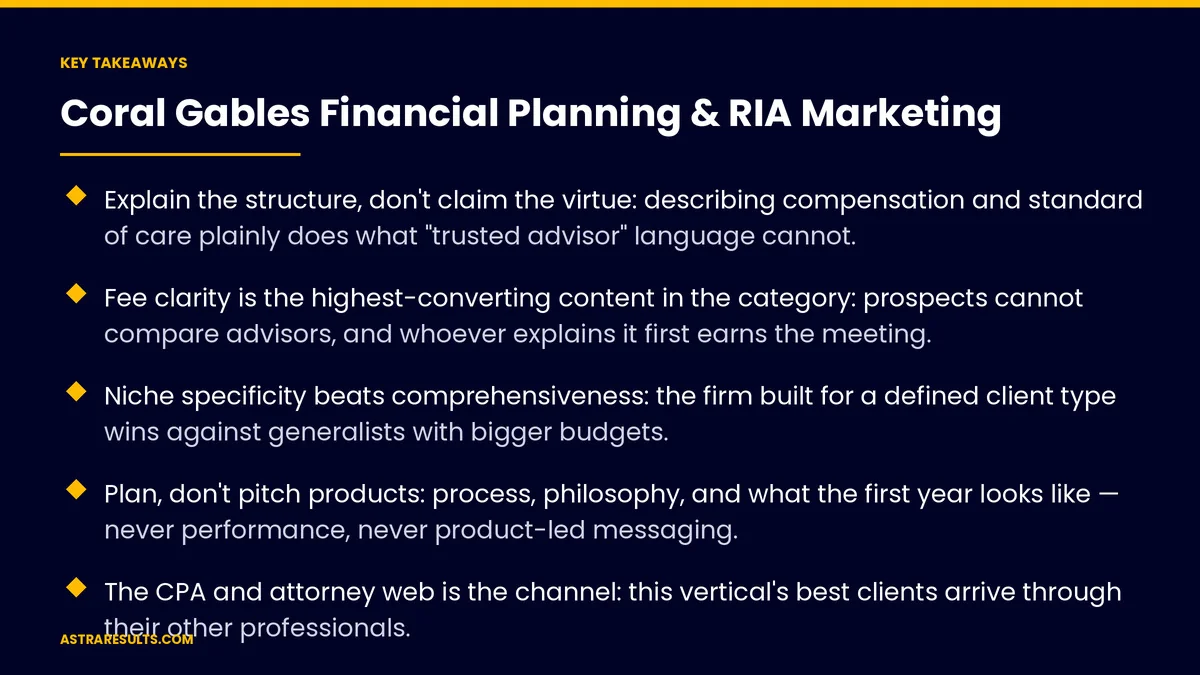
Key Takeaways
- Explain the structure, don't claim the virtue: describing compensation and standard of care plainly does what "trusted advisor" language cannot.
- Fee clarity is the highest-converting content in the category: prospects cannot compare advisors, and whoever explains it first earns the meeting.
- Niche specificity beats comprehensiveness: the firm built for a defined client type wins against generalists with bigger budgets.
- Plan, don't pitch products: process, philosophy, and what the first year looks like — never performance, never product-led messaging.
- The CPA and attorney web is the channel: this vertical's best clients arrive through their other professionals.
- Measure tenure and qualified conversations: this is a decades-long relationship business, and lead counts are the wrong instrument entirely.
Published: October 8, 2026 | Reading Time: ~11 minutes | Category: Financial Services · Coral Gables
What she can do is say plainly the things a brokerage-affiliated competitor structurally cannot, and let a sophisticated market draw the obvious conclusion. The kicker names the whole strategy: fiduciary, plainly explained.
This is the Brickell cross-border playbook's counterpart, built for a different practice shape: where that piece addressed the international-family and cross-border advisory market, this one addresses the independent planning firm serving established local households, professionals, business owners, retirees, and multigenerational Gables families.
The differentiators are structural rather than promotional: how the firm is compensated, what standard governs its advice, who it is built to serve, and what a client's actual experience will be. Nothing here is investment, tax, or legal advice. Nothing here is a recommendation about any security or strategy.
Marketing for investment advisers is governed by SEC, state, and, for some activities, extra regulatory requirements, including specific rules on testimonials, endorsements, performance, and recordkeeping that only your compliance and legal counsel can apply to your registrations. Every asset requires compliance review and archiving before publication.
In This Playbook
- Explain the Structure, Don't Claim the Virtue
- Fee Clarity as the Conversion Engine
- Niche Specificity
- Plan, Don't Pitch
- The Professional Web
- Channels and the Compliance Layer
- What should a Coral Gables RIA measure?
- A 90-Day Build
Explain the Structure, Don't Claim the Virtue
The move that resolves the differentiation problem.
The market's failure. Every firm in the corridor claims trust, personalization, and independence. That means those words carry no information, the saturated-claim problem Astra documents in every premium vertical.
What differentiates. The structural facts a prospect can verify and compare. How the firm is compensated and what that structure incentivizes. What standard of care applies to its advice, described accurately for the firm's specific registrations rather than in slogans. Whether it holds custody or uses a third-party custodian, and why that matters to a client.
What conflicts exist and how they're managed: because every model has some. The firm that names its own is the one believed about everything else, per the steelman discipline Astra applies everywhere.
Why the competitor can't match it. An advisor operating under a different model cannot describe her structure in the same plain terms without inviting exactly the comparison she'd rather avoid. So the independent firm's structural transparency is an asymmetric advantage rather than a marketing choice.
The compliance requirement. All of it stated accurately for your actual registrations and activities, reviewed before publication, because overstating a standard of care is a regulatory matter rather than a positioning error.
Fee Clarity as the Conversion Engine
The single highest-value content asset in this vertical.
The prospect's real problem. She cannot compare advisors. Fee-only, fee-based, commission, wrap, hourly, retainer, assets-under-management percentages, and the products layered beneath them produce a landscape where the plain consumer question, "what will this cost me and how does my advisor get paid?", has no available answer.
The move. Publish the firm's own structure concretely, explain the common models and their trade-offs at educational level, and state what a prospective client should ask any advisor including this one, the comparison-framework play Astra has proven in every high-consideration market, applied to the question this category deliberately obscures.
Why it converts. The prospect who learned to evaluate advisors from your page evaluates every competitor with your framework, and arrives at the meeting already trusting the source.
The AI-answer dividend. These are exactly the questions people now ask assistants first. The answer layer cites pages that answer them, which almost nobody in this vertical publishes.
The plain constraint. Fee descriptions must match your disclosure documents. Any comparison content must be fair rather than a competitor attack.
Niche Specificity
The strategy that lets a small firm beat a large one.
The principle. A firm built for a defined client type (physicians approaching partnership decisions, business owners planning exits, families managing an inheritance, professionals with concentrated equity positions, retirees managing distribution sequencing, or cross-border households) can speak with a specificity no generalist can match, and that specificity outperforms budget.
The content it enables. The questions that client type asks, the mistakes that cohort commonly makes, the coordination their situation requires with other professionals, and the planning sequence appropriate to their stage, real expertise rather than category-average reassurance.
The Gables-specific cohorts. Established multigenerational families where succession and estate coordination dominate, professional practice owners, and the high-net-worth households this corridor concentrates.
The plain exclusion. Stating who the firm is not built for, which raises credibility with the target cohort and reduces the mismatched inquiries that consume a small firm's capacity.
The bilingual dimension. This corridor's Spanish-speaking established families are a real cohort. The chain rule applies with the compliance-review-in-every-language layer this vertical requires.
Plan, Don't Pitch
The tone that keeps the firm out of trouble and in the conversation.
What's marketable. The planning process itself: what discovery involves, how goals become a plan, what the first ninety days look like, what reporting a client receives, how often the firm meets clients, what happens when markets fall, and who the client talks to.
What isn't. Performance in any form, product-led messaging, market predictions positioned as differentiators, and urgency creative of any kind, the honest-urgency line applying with force in a category where fear-of-missing-out marketing is both regulated and corrosive.
The philosophy layer. The principal's own thinking about risk, time horizon, diversification, and the trade-offs she will and won't make, under named-authority authorship, because in an advisory relationship the person is the product.
The behavioral candor. Saying plainly that a large part of the job is helping clients not act on impulse during volatility is both true and differentiating, and it sets expectations that make the relationship durable.
The education cadence. Steady, calm, non-promotional client education is this vertical's most compounding asset. It is also, marketing that must be reviewed and archived like any other.
The Professional Web
The channel that carries this vertical, per the professional-web discipline.
The relationships. CPAs and tax professionals above all, estate and business attorneys, family-law counsel at asset-division moments, insurance specialists, and business brokers at transaction moments.
What earns a place. Responsiveness on the other professional's timeline, work product that makes them look good to a shared client, communication back within the client's authorization, lanes respected absolutely, and candid reciprocal routing, the routing-as-trust-investment logic that returns as future introductions.
The forwardable asset. The plain-language piece a CPA hands a client at a decision point (the fee-model explainer, the exit-planning sequence, the inheritance-coordination checklist) per the forwardable economics Astra keeps proving.
The compensation cleanliness question. Referral arrangements in this industry carry specific disclosure and regulatory requirements, so the firm's public description of how referrals work must be accurate and reviewable. In a corridor this networked, ambiguity here ends relationships faster than competition does.
Client referrals. Warmly asked, never incentivized in ways that create disclosure obligations or convert a relationship into a sales channel.
Channels and the Compliance Layer
Content and search. The fee-clarity library, the structure-and-standard explainers, the niche-cohort content, the planning-process walkthrough, and the principal's philosophy: all under named authorship, all compliance-reviewed and archived, earning the AI citations this market's prospects now generate ("fee-only vs fee-based," "questions to ask a financial advisor," "¿cómo se le paga a un asesor financiero?") through the entity work our AI SEO service builds.
Events and education. The corridor's real channel (client-education seminars, professional-association programs, and business-owner roundtables) with every presentation treated as a reviewable marketing communication.
Testimonials and reviews. Governed by specific regulatory requirements your compliance counsel must map, which in this vertical differ materially from other industries: when in doubt, don't, and compete instead on education and structural transparency, which carry no equivalent constraints.
Paid, narrow. Behind the negatives fortress with DIY-investing, trading-platform, crypto-speculation, and get-rich traffic excluded wholesale, and no performance or urgency creative anywhere.
The local layer. The profile accurate, the corridor page candid, and the discretion register intact, no implied client identities, ever.
What should a Coral Gables RIA measure?
The dashboard, tuned to a decades-long relationship business:
- Qualified-conversation volume and quality rather than lead counts, since an unqualified inquiry costs a small firm more than it returns
- The professional-web ledger by relationship — cultivated, tracked, reciprocated — as the firm's real growth plan
- Forwardable distribution and pull-through, because a CPA who hands your explainer to a client is doing the marketing that matters
- Client tenure and multi-year retention as the flagship metric, with acquisition cost only meaningful against it
- Niche-fit rate — what share of new clients match the firm's stated target cohort, which diagnoses whether the positioning is working
- Language cohorts read separately
- Compliance-governance metrics as first-class KPIs (review completion, archiving completeness, cross-language accuracy)
- Cost per qualified relationship on the ledger standard, read on tenure years
A 90-Day Build
Days 1–30: Structure and niche
- The structural transparency content drafted (compensation, standard of care as it applies, custody, conflicts and their management) with compliance review
- The target-cohort definition decided including who the firm doesn't serve
- The fee-clarity page and the questions-to-ask-any-advisor framework drafted
- The review-and-archiving workflow documented
- Measurement instrumented for qualified conversations, web ledger, niche-fit, and tenure
Days 31–60: Publish the honest version
Fee clarity, structure, and planning-process content live under named authorship in English and native Spanish with each version separately reviewed and archived; the principal's philosophy published in her own voice. Niche-cohort content live for the defined target; the forwardable explainers built as products.
Days 61–90: Web and reads
- The CPA and attorney web engaged with the forwardables and communication-back running
- The education-seminar calendar set with review workflow applied to every presentation
- Narrow paid live behind the fortress
- AI-answer accuracy checked in both languages
- The first governance audit completed
- First clear reads — qualified-conversation quality, web ledger, forwardable pull-through, niche-fit rate — and next quarter set on tenure years
How Astra Builds Independent Advisory Firms
Astra Results Marketing builds RIA and financial-planning marketing on structural transparency rather than claimed virtue.
Compensation and standard of care explained plainly, fee clarity published as the conversion engine it is, niche specificity chosen over comprehensiveness, planning marketed instead of products, and the CPA-and-attorney web cultivated as the channel it is, measured on qualified conversations, the web ledger, and tenure years. Engagements begin with a positioning, fee-clarity, and referral audit through our business consulting team.
Related reading
Frequently asked questions
How do we differentiate when every firm claims to be trusted and independent?
Stop claiming and start describing: how you're compensated, what standard applies to your advice for your actual registrations, whether a third party holds custody. What conflicts exist and how you manage them. Those are verifiable structural facts, and a competitor operating under a different model can't state hers in the same plain terms without inviting the comparison she'd rather avoid. That asymmetry is your advantage.
Should we really publish our fee structure?
It's the highest-converting content in the category, because prospects cannot compare advisors. The vocabulary is designed to prevent it. Publish your own structure concretely, explain the common models and their trade-offs, and give prospects the questions to ask any advisor including you. Make sure it matches your disclosure documents and passes compliance review; then let the prospect who learned to evaluate advisors from your page arrive already trusting the source.
Isn't niching down risky for a small firm?
The opposite: generalist positioning puts you in direct comparison with brands that outspend you on every dimension, while a firm built for a defined cohort (practice owners planning exits, families managing inheritances, professionals with concentrated equity) speaks with specificity budget can't buy. Say who you're not built for too. It raises credibility with your target and reduces the mismatched inquiries that consume small-firm capacity.
What can we actually publish if performance is off the table?
The relationship: discovery, how goals become a plan, what the first ninety days look like, the reporting cadence, how often you meet, who the client talks to, and what happens when markets fall, plus your own philosophy about risk and trade-offs, under your name. Add the behavioral candor that much of the job is helping clients not act on impulse. It's true, differentiating, and it sets the expectations that make relationships durable.
Should we use client testimonials?
Only after your compliance counsel maps the specific requirements applicable to your registrations, because testimonial and endorsement rules in this industry carry disclosure, oversight, and recordkeeping obligations that differ substantially from other verticals. When there's real doubt, don't. Compete instead on education and structural transparency, which persuade this clientele more anyway and carry no equivalent constraints.
Where should a small firm concentrate its marketing effort?
The CPA and attorney web. This vertical's best clients arrive through their other professionals, and being useful to those professionals (responsive on their timelines, forwardable explainers they can hand a client at a decision point, communication back within authorization, candid reciprocal routing) compounds in a way advertising doesn't. Track the web ledger by relationship; that document is your actual growth plan.
Ready to Compete on Structure Instead of Slogans? Astra Results Marketing builds independent advisory marketing on structural transparency, fee clarity published, niche specificity, planning-not-products content, and the professional web. Measured on qualified conversations and tenure years. Start with a positioning, fee-clarity, and referral audit for your firm. ▸ CALL (786) 321-2866 · ▸ REQUEST YOUR CONSULTATION