Rated 5 star on

Houston Industrial & Refinery Injury Attorney Marketing
Quick answer
A Houston industrial-injury firm should make ethics its brand and never advertise on a plant incident. The flagship content explains that Texas employers may opt out of workers' compensation. Third-party claims and maritime questions get plain, hedged explanations. The voice respects workers in multiple languages, and intake routes out-of-scope cases elsewhere.
The corridor along the Houston Ship Channel (refineries, chemical plants, terminals, and the port complex) employs one of the largest concentrated industrial workforces in America. It produces the most serious injury work in Astra's map, and the vertical where marketing ethics are the entire brand.
Key Takeaways
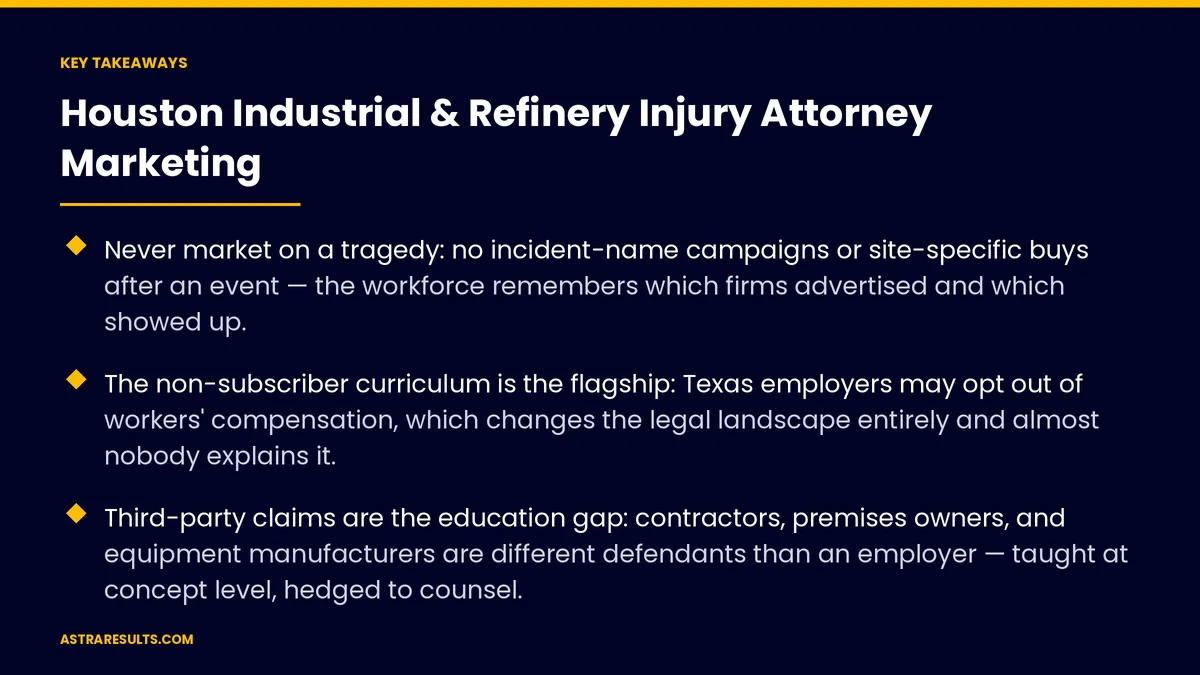
- Never market on a tragedy: no incident-name campaigns or site-specific buys after an event — the workforce remembers which firms advertised and which showed up.
- The non-subscriber curriculum is the flagship: Texas employers may opt out of workers' compensation, which changes the legal landscape entirely and almost nobody explains it.
- Third-party claims are the education gap: contractors, premises owners, and equipment manufacturers are different defendants than an employer — taught at concept level, hedged to counsel.
- The port adds maritime law: Jones Act and longshore questions live at the water's edge and belong to a specialist lane, named plainly.
- The worker-dignity tone is the whole voice: plain language, multiple languages, zero condescension, and the status-safe promise attached.
- Measure the lane plainly: routing referrals out is a trust investment worth logging, and signed cases by lane and language carry the ledger.
Published: October 12, 2026 | Reading Time: ~11 minutes | Category: Legal · Industrial Injury
When something goes wrong at a plant, it is often catastrophic, public, and named. The firms that descend on that name are remembered by the workforce for a generation. This playbook's first rule is therefore its kicker and its non-negotiable: never market on a tragedy.
No incident-name campaigns, no site-specific ad buys in the hours after a release, no scraping a news event for keywords: not because it wouldn't work in the short term. But because this workforce talks, the unions and contractor crews have long memories.
The firm that showed up as an advertiser will never again be the firm that shows up as counsel.
What replaces it is what Astra builds everywhere: protective education, published before anyone needs it. Industrial workers and their families face a confusing legal landscape (workers' compensation, Texas's distinctive non-subscriber employers, third-party claims against contractors and premises owners, and maritime law at the water's edge). Almost nobody explains it in plain language, in the languages this workforce speaks.
The tone runs the cluster's spine: out-teach, don't out-shout. Calm as the credibility. The status-safe promise for a workforce that includes many who fear that calling a lawyer risks their status. And clean hands stated proudly, which in Texas means the barratry line drawn in public. Marketing guidance for licensed attorneys only. Nothing here is legal advice.
Every rule, deadline, and category below is general information with exceptions only counsel can apply: employer status, contract structures, and applicable law vary case by case. Texas attorney advertising and solicitation rules govern every asset.
In This Playbook
- The Ethics Are the Brand
- The Non-Subscriber Curriculum
- Third-Party Claims
- The Port and Maritime Overlap
- The Worker-Dignity Register
- Occupational Illness and the Long Clock
- Intake Built for This Work
- Channels
- How should a Houston refinery injury firm measure results?
- A 90-Day Build
The Ethics Are the Brand
The rule stated first because it governs everything after.
What's banned, in writing. Campaigns keyed to a named incident or facility, ad buys triggered by breaking news of a plant event, content built around a specific tragedy's details, and any outreach that resembles solicitation of identified victims, with Texas's barratry and solicitation rules making several of these matters of professional discipline, not just taste.
Why it's also strategy. Plant workforces are tight, unionized in many facilities, and generationally connected, a firm's conduct after an incident becomes workforce knowledge within days, and the community-memory dynamic Astra observes in every worker market operates here at maximum intensity.
What replaces it. The standing library (published before events, useful during them, and never keyed to anyone's worst day) plus the clean-hands page stating the firm's refusal of runner and case-buying arrangements plainly, because this workforce knows that ecosystem exists and remembers who declined.
The Non-Subscriber Curriculum
The flagship education, and Texas's real distinctive.
The rule, plainly. Texas is unusual in not requiring most private employers to carry workers' compensation. Employers that opt out are commonly called non-subscribers. The legal landscape for an injured worker at a non-subscriber employer differs fundamentally from the comp system most people assume applies.
Why it's the flagship. Injured workers frequently don't know their employer's status, are handed paperwork in the first days that assumes they do, and make decisions that matter before anyone explains the difference.
So the content that teaches the question ("do you know whether your employer subscribes?") and the general consequences is protective education at its highest value, per the economics this library proves.
The comp side, served plainly too. Where comp applies, the system's structure, benefits, and limits get explained at general level with the note that comp questions may belong with counsel who practice in that system, the scope honesty Astra requires, with referrals made cheerfully.
The hedge, standing. Employer status, plan documents, and contract structures are fact-specific; counsel reviews them. Nothing on a webpage settles yours.
Third-Party Claims
The education gap that defines this practice.
The concept. An injured worker's employer is one party. But plants run on layered relationships (owners, operators, general contractors, subcontractors, staffing agencies, equipment manufacturers, and maintenance vendors). Claims against parties other than the employer follow different rules than employer claims.
Taught as categories, hedged entirely. Premises liability concepts for contractor injuries on an owner's property, product and equipment claims, and the contractual-relationship questions that determine who owes what duty, explained at educational level with every application belonging to counsel and the plain statement that these analyses are document-intensive.
Why it converts. This is the single most valuable thing a worker's family can learn early, and the firm that explains it without hype becomes the one they call. The protective-conversion pattern this cluster keeps proving.
The turnaround-and-shutdown layer. Plant turnarounds bring thousands of contract workers into facilities on compressed schedules, a real risk period this content can address as safety-adjacent education without a syllable of opportunism.
The Port and Maritime Overlap
Where the corridor meets the water. Terminals, docks, vessels, and offshore support work bring maritime law into the same geography as land-based industrial work: Jones Act questions for seamen, longshore and harbor-worker frameworks for dock and terminal employees, and the vessel-versus-shore distinctions that determine which body of law applies.
The plain treatment. Named as its own specialist lane with its own page, taught at concept level ("which law applies depends on your role, your employer, and where you were working. And it changes everything"), and referred cheerfully where the matter belongs with maritime counsel.
The tone. This is a workforce that knows its work better than any marketer does. Content that gets the vocabulary right earns credibility instantly while content that guesses loses it permanently.
The Worker-Dignity Register
The voice this vertical requires.
Plain language, zero condescension. Skilled trades read marketing critically and dislike being talked down to. So the content explains law rather than defining wrenches, respects the reader's expertise about their own job, and never implies that an injured worker did something wrong.
Multiple languages, genuinely. This workforce speaks Spanish at enormous scale and includes Vietnamese, West African, and other communities. The chain rule applies with the staff-it discipline absolute, because a worker reading a safety-and-rights explainer in his second language deserves it written natively rather than machine-translated. The status-safe promise, per the cluster's architecture.
Injured workers can pursue claims, conversations are confidential, no documents are required to begin, stated plainly, hedged to counsel, delivered in this metro's own tones, and framed as protective information rather than a recruitment lever.
The family layer. Catastrophic injuries make the household the client unit: spouses and adult children navigating benefits, medical decisions. Paperwork deserve content addressed to them, per the household-unit thinking Astra applies everywhere.
Occupational Illness and the Long Clock
The lane most firms skip. Chemical exposure and occupational illness matters run on different timelines than acute injuries: latency periods, discovery questions, and the documentation problems that come with conditions diagnosed years after exposure.
The content. Exposure-documentation guidance (records, employment history, monitoring data where available), the general concept that discovery rules can affect limitations analysis, and the plain statement that these matters are among the most complex in the field and require counsel early.
The tone. Calm, factual, and never fear-forward. An exposure explainer that frightens a workforce into calling has failed the calm standard this cluster holds. This is precisely the topic where that temptation is strongest.
Intake Built for This Work
The war clocks with an industrial triage.
Calls arrive from hospitals, from family members, and from co-workers (so intake answers 24/7 in multiple languages per the never-voicemail rule, and captures what counsel needs early: employer and its subscriber status if known, the site and its operator, the caller's role and employment relationship, whether contract or direct, and whether the work was land-based or on the water) the five facts that determine which body of law and which defendants a case involves.
Family callers are handled with the register a household in crisis deserves. The configuration our AI Inbound service builds carries capture, language routing, and escalation to humans always.
Channels
Search carries the curriculum.
The non-subscriber flagship, the third-party explainer, the maritime lane, the occupational-illness pages, and the turnaround-safety education under named-attorney authorship, earning the AI citations on the questions this workforce asks ("what if my employer has no workers comp in Texas," "can I sue the plant owner if I work for a contractor," "¿qué pasa si mi patrón no tiene seguro de trabajo?") through the entity work our AI SEO service builds.
Paid runs narrow behind the negatives fortress, and this vertical's fortress has a special entry: no incident-name or facility-name keyword buying, ever, plus comp-only searches routed correctly, job-seeker and safety-training traffic excluded, and OSHA-complaint intent routed to the right resources.
Community presence runs participation-over-promotion: safety-adjacent education where invited, union and community events attended as a neighbor, nothing sold from a folding table. Spanish runs native throughout; further languages on the staff-it rule. Reviews run never-gated with privacy sacred. No one is asked to narrate an injury.
How should a Houston refinery injury firm measure results?
The ledger, per the cost-per-case standard:
- Signed cases by lane (non-subscriber, third-party, maritime, occupational illness), source, and language
- The non-subscriber curriculum's entrances and conversion as the flagship's proof
- Routing referrals out, logged as the trust investment they are. Comp matters and maritime cases sent where they belong, because in this workforce the plain referral returns as three calls later
- The status-safe funnel's health at the privacy standard (cohorts, never identities)
- Intake-clock compliance with the five-fact capture audited in call reviews
- The family-caller share as the household tone's read
- The ethics audit — every asset and campaign reviewed against the no-tragedy-marketing rule on calendar, as a first-class KPI
- Cost per signed case by channel
A 90-Day Build
Days 1–30: Ethics and curriculum
- The no-tragedy-marketing rule written into policy with the campaign-review checklist and the negatives entry that enforces it
- The non-subscriber flagship and third-party explainer drafted with attorney review
- The status-safe promise written Spanish-first with counsel's sign-off
- Intake rebuilt with the five-fact industrial capture
- The clean-hands page committed
- Measurement instrumented for lanes, routing, and the ethics audit
Days 31–60: The library live
- The curriculum published in English and native Spanish under attorney authorship
- The maritime lane live with clear scope and referral paths
- The occupational-illness pages up in the calm tone
- The turnaround-safety education published ahead of season
- Paid live behind the fortress with the incident-keyword prohibition enforced
Days 61–90: Community and reads
- Safety-adjacent community presence begun under participation rules
- Union and contractor-community relationships engaged as a neighbor
- Extra-language capability assessed on the evidence before any page claims it
- AI-answer accuracy checked on the subscriber and third-party questions
- The first ethics audit completed
- First clear reads — lane volumes, curriculum conversion, routing log, family-caller share — and next quarter set on the ledger this workforce keeps: who taught them something before they needed it
How Astra Builds Industrial Injury Practices
Astra Results Marketing builds Houston industrial and refinery injury marketing on the ethics that are the brand.
Never marketing on a tragedy, the non-subscriber curriculum taught where the confusion is greatest, third-party claims explained without hype, the maritime lane named plainly, and the worker-dignity tone delivered natively in the languages this workforce speaks, measured on lane volumes, the routing log, and the ethics audit.
Engagements begin with an ethics, curriculum, and intake audit through our business consulting team.
Related reading
Frequently asked questions
A major plant incident just happened. What should our firm do?
Nothing that looks like advertising on it. No incident-name campaigns, no facility-keyword buys, no content keyed to the event's details, and no outreach resembling solicitation of identified victims, with Texas's solicitation and barratry rules making several of those professional-discipline matters rather than judgment calls. Be findable through the library you published months earlier, answer the phone in every language, and let conduct do the marketing. This workforce compares notes within days.
Why make non-subscriber status the flagship topic?
Because it's the fact that changes everything and almost nobody explains it. Texas is unusual in not requiring most private employers to carry workers' compensation. An injured worker at a non-subscriber employer faces a fundamentally different landscape than the comp system he assumes applies, while signing paperwork in the first days that assumes otherwise. Teach the question, teach the general consequences, hedge every specific to counsel, and you own the market's most consequential unknown.
How do we explain third-party claims without over-promising?
As categories with the analysis reserved. Plants run on layered relationships (owners, operators, general contractors, subs, staffing agencies, equipment makers) and claims against non-employer parties follow different rules, which are document-intensive and fact-specific. Explain the concept plainly, say clearly that determining who owed what duty requires counsel reviewing contracts and records, and let the education do the converting. Hype is what this workforce screens out fastest.
Should we handle maritime cases or refer them?
Say plainly what you do. Jones Act, longshore, and vessel-versus-shore questions determine which law applies and change outcomes substantially, so either practice the lane or name it and refer cheerfully. Either answer earns credibility. Blurring it does not. In this corridor, the plain referral comes back as future calls, which the routing log is built to show you.
How should we approach occupational illness marketing?
Calmly and factually, which is hardest exactly here: exposure and latency questions are complex, documentation matters enormously, and discovery rules can affect limitations analysis. So the content teaches records-gathering and the need for early counsel without a syllable of fear-forward framing. An exposure page that frightens a workforce into calling has failed the tone this cluster holds. One that helps a family organize its history has earned the call.
Which languages does this practice really need?
The ones the workforce speaks, natively: Spanish at enormous scale first, then Vietnamese and other community languages as the chain can run, content, intake, counsel conversations, and document review. Machine-translated safety-and-rights content in a crisis vertical fails people at the worst moment. The staff-it-or-don't-say-it rule applies with full force, and a worker reading his rights in his own language remembers who wrote them that way.
Ready to Build the Practice This Workforce Trusts? Astra Results Marketing builds industrial and refinery injury marketing on ethics as the brand. Never marketing on a tragedy, the non-subscriber curriculum, third-party education without hype, and the worker-dignity tone in every language served. Start with an ethics, curriculum, and intake audit for your firm. ▸ CALL (786) 321-2866 · ▸ REQUEST YOUR CONSULTATION