Rated 5 star on

Houston 18-Wheeler & Car Accident Attorney Marketing
Quick answer
A Houston trucking-crash firm should lead with evidence preservation, not case results. Logs, engine data, dashcam video and maintenance records can become unavailable quickly. Commercial cases involve more parties, each with its own insurer. Content should also explain UM/UIM coverage and the 51% fault bar plainly. The firm never advertises on a specific crash.
This is the auto-specific deep dive behind the Houston injury doctrine: where that playbook taught the market's three rules (the two-year window, the six-month government notice, and the 51% bar) this one teaches the crash. And in a metro that functions as one of America's great freight capitals, the crash that defines this practice is the commercial one.
Key Takeaways
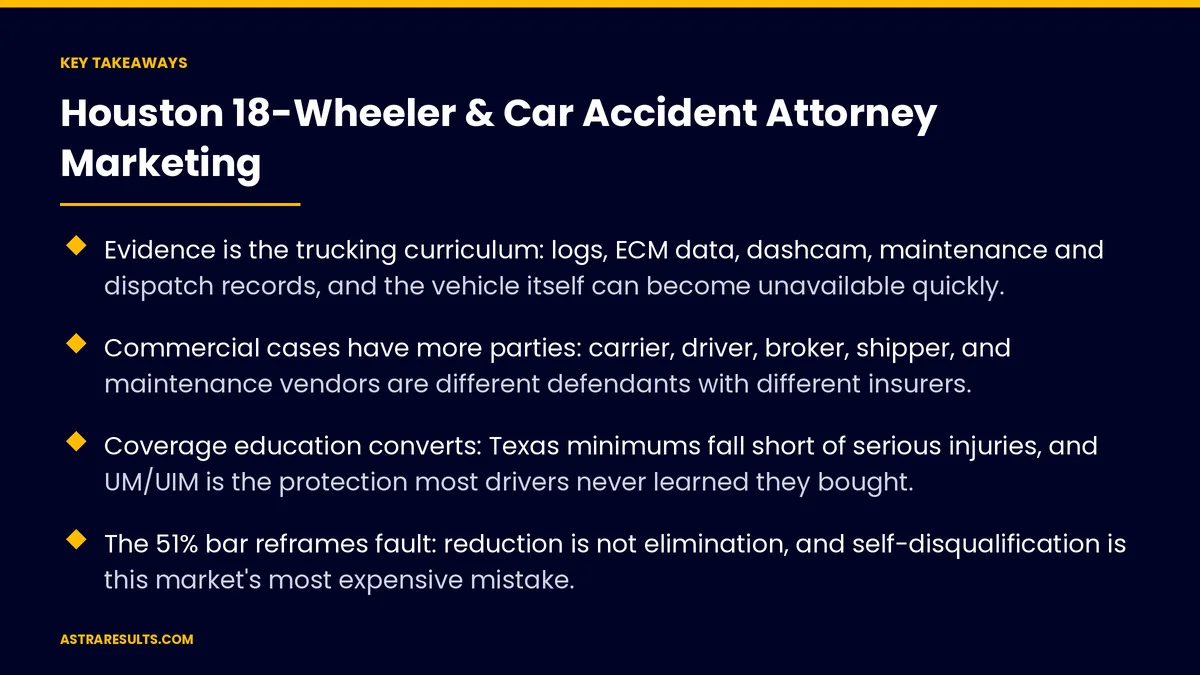
- Evidence is the trucking curriculum: logs, ECM data, dashcam, maintenance and dispatch records, and the vehicle itself can become unavailable quickly.
- Commercial cases have more parties: carrier, driver, broker, shipper, and maintenance vendors are different defendants with different insurers.
- Coverage education converts: Texas minimums fall short of serious injuries, and UM/UIM is the protection most drivers never learned they bought.
- The 51% bar reframes fault: reduction is not elimination, and self-disqualification is this market's most expensive mistake.
- Flood and storm driving is a real lane: high-water incidents, evacuation-traffic crashes, and post-storm road conditions taught protectively.
- Measure the saves: preservation-letter matters, UM-case share, fault consultations, and signed cases by lane and language on the ledger.
Published: October 5, 2026 | Reading Time: ~11 minutes | Category: Legal · Houston
Houston's port, interstate corridors, and industrial base put an enormous number of heavy trucks on the same roads as everyone else, and commercial-vehicle cases turn on something ordinary car cases rarely do: evidence that can disappear within days.
Driver logs, electronic control module data, dashcam footage, maintenance records, dispatch communications, and the truck itself are controlled by parties with counsel and procedures of their own. That is why the kicker names the curriculum: evidence moves fast.
The tone carries the cluster's spine in this arc's plainspoken frequency: out-teach rather than out-shout in a heavily advertised market; calm as the credibility. Real urgency taught, manufactured panic never.
The status-safe promise delivered natively. Clean hands stated proudly with Texas's barratry line drawn in public. And the no-tragedy-marketing absolute this arc established, which applies to multi-fatality highway crashes exactly as it applies to plant incidents. Marketing guidance for licensed attorneys only. Nothing here is legal advice.
Every coverage, deadline, evidence, and liability statement is general information with exceptions counsel must assess. Policies differ, facts govern, and federal and state rules carry nuances no blog should settle. Texas attorney advertising rules govern every asset.
In This Playbook
- The Evidence Curriculum
- More Parties Than a Car Case
- Coverage and Fault
- Flood, Storms, and the Freeway Map
- The First 72 Hours
- Channels
- How should a Houston trucking accident firm measure cases?
- A 90-Day Build
The Evidence Curriculum
The flagship, and the reason early counsel matters more in trucking than anywhere.
What exists and what can go. Modern commercial vehicles generate driver logs, electronic control module and telematics data, dashcam and forward-facing video, dispatch and messaging records, maintenance and inspection histories, and driver qualification files: and while carriers have retention obligations under federal rules, retention periods vary by record type and the practical reality is that data ages, vehicles get repaired or sold, and footage cycles.
The preservation concept, taught plainly. Counsel can act to request that relevant evidence be preserved, and doing so early matters: explained at educational level with the plain hedge that what applies and what's obtainable depends on the case, the parties, and the law, all of which counsel assesses.
Why this converts plainly. It is urgent without being manufactured urgency. The calm-but-real distinction this cluster holds, and the page that explains it is the most useful thing a trucking-crash family can read on day two.
The scene layer. What to photograph if able, why the police report is a starting point rather than a conclusion. How commercial-vehicle scenes differ from ordinary crash scenes.
More Parties Than a Car Case
The structural difference, taught as the fluency signal it is.
The chain. A single commercial crash can involve the driver, the motor carrier, a separate truck or trailer owner, a freight broker, a shipper or receiver, a maintenance vendor, and a manufacturer, each potentially with its own insurer and its own counsel from the first hours.
What that means for the injured family. Multiple adjusters calling, statements requested early, and settlement conversations that begin before anyone understands the full picture, which is exactly why the adjuster-caution page belongs prominently in this vertical too.
The regulatory layer, named plainly. Interstate trucking operates under federal safety regulations covering hours of service, maintenance, driver qualification, and drug-and-alcohol testing, described at general educational level as the framework that often matters in these cases, with every application belonging to counsel.
The scope candor. Firms that don't handle commercial cases should say so and refer, per the routing standard this arc set, and in a freight market, the plain referral returns as future calls.
Coverage and Fault
The two rules that decide the ordinary crash.
Coverage is curriculum. Texas is at-fault, minimum liability limits fall well short of what a serious injury costs. UM/UIM coverage is the part of your own policy that answers when the other driver has nothing or not enough, taught as pure service with the check-your-declarations-page guide, because most drivers decided about this coverage once and never revisited it.
The hit-and-run tie belongs here too. "A hit-and-run doesn't have to mean you're on your own," hedged to counsel and policy terms.
Commercial coverage, by contrast. Commercial policies typically carry much higher limits than personal auto, a fact that changes the practical stakes and explains why carriers and their insurers respond so quickly, stated factually rather than as an invitation.
The 51% bar per the doctrine piece: recovery reduced by the claimant's share of responsibility and barred above 50%, taught in both directions, rescuing the self-disqualifier without promising anyone an apportionment.
Flood, Storms, and the Freeway Map
Houston's driving realities, built as lanes.
High water and flooding. This metro floods, and flood-adjacent crashes, stalled-vehicle incidents, and post-storm road conditions generate real cases, served with safety-first content ("turn around, don't drown" is public-safety guidance the firm can amplify plainly) and the calm register, never disaster opportunism.
Evacuation and hurricane-season traffic. Mass-movement events create their own crash patterns and their own coverage questions, addressed as preparation content published before the season.
The freeway map. I-45, I-10, the Beltway, the Grand Parkway, and 610 carry both freight and commuters, producing this metro's high-severity multi-vehicle work, with each corridor's realities named plainly.
The vulnerable-road-user lane. A car-first metro's pedestrian and cyclist cases served with the gravity they deserve. Rideshare and delivery per the coverage-period framework.
The First 72 Hours
Crisis content that serves before it converts, per the crisis-page disciplines.
The crash-moment layer. The photo checklist, exchange-information basics, witness contacts, and report guidance: mobile-first, skimmable from a shoulder in August heat, in both languages.
The commercial-crash addendum. For truck cases, the extra items worth capturing where safely possible (the carrier name and USDOT number visible on the cab, trailer markings, the number of vehicles involved), practical, not investigative.
The property-damage candor. The family's first panic is often the vehicle, so the firm publishes useful PD guidance (total-loss valuation basics, rental realities, storage-fee traps) and states its role plainly, we handle the injury claim. Here's real help on the vehicle either way, the service-first capture that meets the funnel early.
The treatment-gap truth. Gaps in care hurt both health and cases, delivered as health counsel with see-a-doctor-first leading.
Intake at crash speed. The war clocks absolute (24/7, bilingual, never voicemail) with the commercial-vehicle flag and the date-and-entity triage from the doctrine piece built into the first three minutes.
Channels
The stack runs the doctrine piece's architecture: LSAs with dispute hygiene, search behind the fortress, the Spanish-first chain with Vietnamese on the staff-it rule, attorney video and never-gated reviews.
The auto-and-freight layer adds a negatives fortress built for this market:
- Exclude car-shopping and repair intent wholesale
- Exclude insurance-quote comparison
- Route traffic-ticket and DUI-defense confusion to the right lanes
- Exclude CDL-jobs and trucking-employment traffic, a large waste category in a freight market
- Route property-insurance and flood-claim intent correctly
- No crash-event or carrier-name keyword buying, ever, per the no-tragedy absolute
The AI-answer layer carries the curriculum ("what evidence matters in a truck accident," "what does UM coverage do in Texas," "¿quién paga si el camión tenía la culpa?") and the firm whose evidence, coverage, and fault pages exist in both languages is the one cited, through the entity work our AI SEO service builds under named-attorney authorship.
County-level geo pages run plainly across a multi-county metro. Capture runs 24/7 via the configuration our AI Inbound service builds, human-escalated always.
How should a Houston trucking accident firm measure cases?
The ledger, per the cost-per-case standard:
- Signed cases by crash type, source, and language
- Commercial-case share and the preservation-action rate — matters where early evidence steps were taken, as the flagship curriculum's proof
- The UM-case share as the coverage education's ledger
- Fault-consultation volume as the 51% teaching's read
- Flood-and-storm lane seasonality against the publishing calendar
- Routing candor logged where commercial matters are referred out
- The adjuster-caution and PD-guidance pages' assist roles per the assist logic
- Intake-clock compliance with the commercial flag audited in call reviews
- The ethics audit against the no-event-marketing rule
- Cost per signed case by channel
A 90-Day Build
Days 1–30: Curriculum and ethics
- The evidence-preservation flagship drafted with attorney review
- The parties-and-regulation explainer written at general level
- The coverage and fault pages built in both languages
- The no-event-marketing rule and its negatives entry enforced
- Intake rebuilt with the commercial flag and five-fact capture
- Measurement instrumented for commercial share, preservation actions, and the ethics audit
Days 31–60: Lanes live
- The crash taxonomy published under named-attorney authorship (freeway corridors, vulnerable road users, rideshare and delivery, flood-adjacent)
- The first-72-hours layer live with the commercial addendum and PD guidance
- The flood-and-evacuation content staged ahead of hurricane season
- LSAs and search live behind the fortress
- Attorney video begun on evidence and coverage
Days 61–90: Reads and refinement
- Vietnamese capability assessed on the evidence before any page claims it
- AI-answer accuracy checked on the evidence, coverage, and fault questions in both languages
- The clean-hands and case-size pages live
- The first ethics audit completed
- First clear reads — commercial share, preservation rate, UM share, fault consults, signed cases by lane and language — and next quarter set on the ledger
How Astra Builds Houston Auto and Trucking Practices
Astra Results Marketing builds Houston auto and commercial-vehicle marketing on the curriculum that decides these cases. Evidence preservation taught with real urgency and no theater, the multi-party structure explained as the fluency signal it is, coverage and fault taught in both directions, the flood-and-storm lanes served protectively.
The no-event-marketing absolute held, measured on commercial share, preservation actions, and the ethics audit. Engagements begin with a curriculum, taxonomy, and intake audit through our business consulting team.
Related reading
Frequently asked questions
Why lead with evidence rather than case results?
Because it's the urgent, useful thing. Commercial-vehicle cases turn on logs, control-module data, video, and maintenance records that age, cycle, or become unavailable while a family is still in the hospital. Counsel acting early can seek preservation. Explain that plainly with the hedges intact, and you've written the most valuable page a trucking-crash family reads on day two. Results advertising can't compete with usefulness at that moment.
How do we explain that a truck case has more parties?
As the structural fact it is. The driver, the carrier, separate trailer owners, brokers, shippers, and maintenance vendors can each be involved, each with its own insurer and counsel from the first hours. That is why multiple adjusters call early and why statements get requested before anyone understands the picture. Pair it with the adjuster-caution page and the federal-framework overview at general level. The fluency is the differentiator, and the hedge keeps it candid.
A major highway crash with fatalities just happened. What do we do?
Nothing that resembles advertising on it. No crash-event or carrier-name keyword buys, no content keyed to the incident, no outreach resembling solicitation, with Texas's solicitation rules making several of those disciplinary matters. Be findable through the library you published months ago, answer in every language you serve, and let the ethics audit prove your conduct. In this market, families and workforces compare notes about which firms appeared.
Should we buy keywords for trucking company names?
No, carrier-name and crash-event keyword buying is exactly what the no-tragedy rule forbids. It reads to the market as what it is. Build the evidence, coverage, and parties curriculum instead. It earns the searches and AI citations from families researching what to do rather than from an ad chasing a headline. It's the only version that survives an ethics audit or a conversation with a referral source.
How do we handle flood-related crash content?
Safety-first and calm: amplify public-safety guidance about high water plainly, address stalled-vehicle and post-storm road conditions, publish evacuation-season preparation before hurricane season, and route property and flood-insurance questions to the right resources. A community recovering from a storm remembers who helped and who chased; this lane converts precisely because it isn't trying to.
Which languages does this practice need?
Spanish natively, at this metro's scale (the coverage guide, the evidence page, and the crash-moment checklist all read differently when they're written rather than translated) plus Vietnamese where the chain can run. In a crisis vertical, a half-served language fails people at the worst possible moment, so build one completely before claiming the next.
Ready to Teach the Curriculum That Decides Freight-Capital Cases? Astra Results Marketing builds Houston auto and trucking marketing on evidence preservation, the multi-party structure, coverage and fault taught plainly, and the flood-and-storm lanes served protectively. Measured on commercial share, preservation actions, and the ethics audit. Start with a curriculum, taxonomy, and intake audit for your firm. ▸ CALL (786) 321-2866 · ▸ REQUEST YOUR CONSULTATION