Rated 5 star on


Instagram & Reels Strategy for Aesthetic Practices
Quick answer
An aesthetic practice should use Instagram and Reels to educate, not to bait engagement. Education draws fewer views but better consultations. Every clip needs specific video consent. Hooks should spark curiosity without insecurity. The feed introduces patients to an owned library, DMs follow scripted rails, and success is measured by saves, sends and kept consults.
Short-form video has become the aesthetic patient's research library. Before she searches, before she reads a single page, she has watched dozens of practitioners explain, show, and, far too often, perform. The account she ends up trusting is rarely the one with the most views.
Key Takeaways
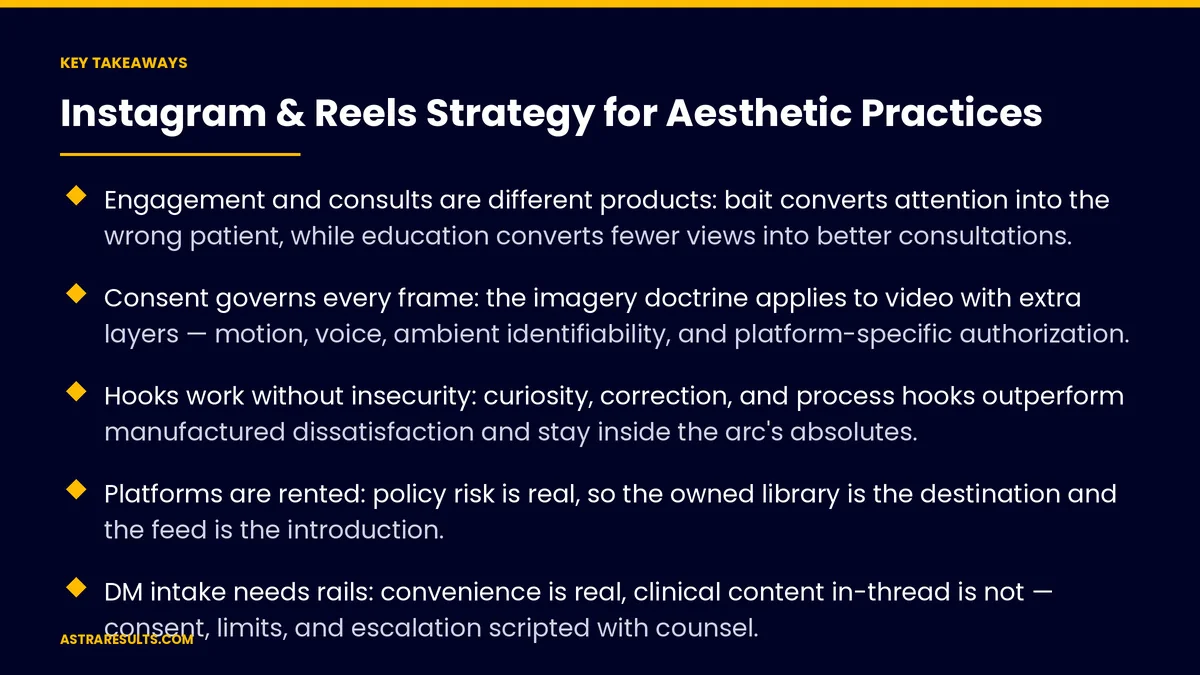
- Engagement and consults are different products: bait converts attention into the wrong patient, while education converts fewer views into better consultations.
- Consent governs every frame: the imagery doctrine applies to video with extra layers — motion, voice, ambient identifiability, and platform-specific authorization.
- Hooks work without insecurity: curiosity, correction, and process hooks outperform manufactured dissatisfaction and stay inside the arc's absolutes.
- Platforms are rented: policy risk is real, so the owned library is the destination and the feed is the introduction.
- DM intake needs rails: convenience is real, clinical content in-thread is not — consent, limits, and escalation scripted with counsel.
- Measure what predicts consults: saves, sends, profile-to-site movement, and DM-to-kept-consult — not likes.
Published: October 9, 2026 | Reading Time: ~13 minutes | Category: Social Media · National
Astra has been building toward this playbook across the entire aesthetic arc: the restraint strategy that outlasts performance in saturated markets, the imagery doctrine that governs every consented case, the no-insecurity absolute that bans manufactured dissatisfaction, and the owned-first posture that treats rented platforms as attention channels rather than assets.
This piece assembles them into a complete short-form manual, and its thesis is the kicker: teach, don't tease.
The strategic case is simple and unfashionable.
Engagement and consults are different products. Transformation bait, shock cuts, and insecurity hooks reliably generate views and reliably attract the wrong patient: the deal-seeker, the unrealistic expectation, the person who arrives having already decided what she needs. Provider-led education attracts fewer views and more of the patient a serious practice wants: informed, realistic, and ready to have a real consultation.
The measurement section makes this legible rather than aspirational, because the whole argument collapses if the practice can't prove it. Marketing guidance for licensed practices only. Nothing here is medical advice. Candidacy, treatment selection, imagery decisions, and every clinical claim belong to your medical providers. Platform policies and advertising rules change frequently and must be checked against current documentation.
Compliance review precedes publication of every asset.
In This Playbook
- Engagement Is Not the Product
- Consent Governs Every Frame
- Hooks Without Insecurity
- Trends, Audio, and Formats
- Platforms Are Rented
- Comments and DMs, With Rails
- Staff, Creators, and Governance
- What should Miami aesthetic practices measure on Reels?
- A 90-Day Short-Form Build
Engagement Is Not the Product
The strategic frame, stated before any tactic.
What bait buys. Hook-driven transformation content, reveal edits, and insecurity framing generate views because they exploit the same reflexes every attention platform rewards: and the audience they assemble skews toward price shopping, unrealistic expectations, and treatment-shopping rather than problem-solving.
What education buys. Fewer views, better conversations. The informed patient who arrives with a real question, understands that candidacy is a clinical determination, and has already absorbed the practice's candor before the consult begins, which is the consult-is-the-product economics Astra builds everywhere.
The saturation argument. In every capital Astra has mapped, restraint stands out precisely because everyone else performs. Short-form is the most saturated surface in the category.
The plain admission. This strategy grows slower on vanity metrics. That is why the practice must instrument the funnel below before adopting it, not after.
Consent Governs Every Frame
The imagery doctrine extended to video, where it gets harder.
Video-specific layers. Motion reveals more than a still, voice identifies, and ambient details (a visible tattoo, a distinctive room, a reflection, a background conversation) can identify a patient who consented to a photograph but never to a fifteen-second clip of her chair.
Authorization must be medium-specific and platform-specific. Consent for video, consent for short-form distribution, and the plain disclosure that platform content can be downloaded, re-shared, and duplicated beyond the practice's control, per the consent-infrastructure standard Astra holds, with a real revocation workflow and a stated takedown clock.
The absolutes carry. Unretouched and unfiltered treatment content, timeline labels where results are shown, no minors ever, no other patients visible in any frame, and no AI-simulated outcomes.
The practical rule. If the practice cannot state on request exactly which consent covers a given clip, the clip should not be posted.
Hooks Without Insecurity
The craft problem this playbook exists to solve.
What's banned. Manufactured dissatisfaction ("things you didn't know were aging you"), body-part callouts, fear framing, and the before-and-after reveal edit built for gasp rather than understanding. All violations of the standing absolute this arc holds.
What works instead, and does. Five hooks carry the category:
- The correction hook: a common myth stated and then dismantled, the highest-retention educational format in the category
- The process hook: what happens during a treatment, narrated calmly
- The decision hook: how candidacy is really assessed, and what makes someone a poor candidate
- The cost-candor hook: framework pricing and what drives it, per the transparency standard
- The "you don't need this yet" hook: the down-scope content that reliably outperforms its own modesty, because nothing else on the platform sounds like it
The provider on camera. The on-camera system Astra built applies. The clinician's authority is the format's whole advantage, and delegating it to an editor's instincts is how practices end up with content their compliance officer discovers later.
Trends, Audio, and Formats
The tactical layer, governed.
Trend participation with a filter. A format is usable only if the underlying claim survives the practice's own candor standards. A trend built on ranking bodies, mocking a concern, or implying a universal result is unusable regardless of reach.
Audio and music. Platform-licensed audio is a rights question and a brand question. Commercial use rules differ from personal use, checked against current platform documentation rather than assumed, per the standing IP caution Astra applies to borrowed material.
The format mix that works. Provider explainers, myth corrections, process walkthroughs, consented case stories with realistic timelines, patient-question answers, and the practice's own standards (photo rules, consent policy, supervision transparency) explained plainly, which doubles as the verification layer sophisticated patients check.
Captions and accessibility. Most viewing is sound-off, so captions are function rather than polish. In multilingual markets, in-language captions follow the staff-it rule like everything else.
Platforms Are Rented
The structural posture.
Policy risk is real. Aesthetic and medical content sits in a restricted category on every major platform, enforcement is inconsistent, reach can be limited without notice. Accounts can be actioned for content that seemed compliant, which is why the owned-first rule governs. The case library and the education library live on the practice's own site, and the feed introduces them.
The archive discipline. Every published clip retained with its consent record and its approval trail. So a takedown or account issue is an inconvenience rather than a loss.
The distribution reality. Content repurposed across surfaces, with the owned page as the destination for anything that matters, because attention rented today is a channel. The search-and-AI layer built on owned pages is the asset that compounds.
Comments and DMs, With Rails
Where social becomes clinical, and where most practices are exposed.
Comment moderation as tone. Questions answered with the same candor the content promises, specific medical advice declined publicly and redirected to consultation, speculation about anyone's appearance never engaged. The society-line discipline extended to every thread, one careless reply about a public figure's face undoes an account's credibility.
DM intake, engineered. Patients now expect to book by message, and the convenience is real.
So the rails are set with counsel per the messaging-rails standard: documented consent for the channel, strict limits on clinical content in-thread (no diagnosis, no candidacy determinations, no photo review beyond what policy permits), defined records handling, and scripted escalation to secure channels and to a human.
Response-time reality. The funnel standard applies, a DM answered in twelve hours is a lost consult in a category where three other accounts replied in twenty minutes, with the configuration our AI Inbound service builds handling capture and routing with human escalation always.
The identifiability trap. Patients send photos unprompted. Policy must cover what happens to them.
Staff, Creators, and Governance
The people problem, solved before it happens.
Staff-generated content. Injectors and aestheticians filming in the practice is often the best content available and the largest uncontrolled risk, governed by written policy (what may be filmed and where, no other patients in frame ever, clinical claims approved before posting, whose accounts may post practice content, and what happens to that content when someone leaves).
Personal-brand tension, addressed plainly. A provider building a personal following is an asset and a succession question. The policy should say who owns what, in writing, before it matters. Creator collaborations per the creator-policy standard: disclosure per advertising rules, honest-experience requirements, clinical-accuracy review, and the recognition that a collab that misleads is the practice's claim wearing someone else's face.
The approval workflow. A documented path from idea to posted clip with a clinical reviewer in it, the governance habit Astra installs wherever claims can drift.
What should Miami aesthetic practices measure on Reels?
The instrumentation that makes this strategy defensible.
The leading indicators, in order. saves and sends (the two behaviors that signal a viewer is treating content as a resource rather than entertainment), profile visits and profile-to-site movement, DM-initiated inquiries, and DM-to-booked-to-kept consult per the four-stage funnel Astra established, because the only number that matters is the kept consultation.
The lagging indicators. Consults attributed to social by source-of-truth intake questions, gallery entrances from social, and cost per kept consult by channel on the ledger standard.
The diagnostic pair. View-to-save ratio (is this content useful or merely watched?) and the down-scope rate among social-sourced consults. The trust metric Astra keeps proving, and the clearest evidence that education is attracting the right patient.
The vanity trap named. Follower count and view count belong in a footnote, because a practice optimizing them will eventually produce content its compliance officer, its providers, and its best patients all dislike.
The governance metrics. Consent-record completeness, approval-workflow adherence, and DM-policy compliance audited on calendar as first-class KPIs.
A 90-Day Short-Form Build
Days 1–30: Policy and pipeline
- The consent structure extended to video (medium- and platform-specific authorization, revocation workflow, takedown clock)
- The content standards written (banned hooks, approved hook library, claim-review requirement)
- Staff, personal-brand, and creator policies documented
- DM rails set with counsel
- The approval workflow built with a clinical reviewer
- Measurement instrumented for saves, sends, profile-to-site, and DM-to-kept-consult
Days 31–60: Publishing rhythm
- The provider-led library launched (myth corrections, process walkthroughs, decision and cost candor, the practice's own standards explained)
- Consented case content published under the full doctrine with realistic timelines
- Captions standard, in-language where the chain is real
- Owned destination pages live for every recurring topic
- Comment moderation trained to tone
Days 61–90: Reads and refinement
- DM response times audited against the funnel standard
- The first governance audit run (consent completeness, approval adherence, DM compliance)
- AI-answer and search performance checked on the owned pages the feed feeds
- First clear reads — save-and-send rates, profile-to-site movement, DM-to-kept consults, down-scope rate among social consults — and the next quarter's content plan built from what produced consultations rather than what produced views
How Astra Builds Short-Form for Aesthetic Practices
Astra Results Marketing builds aesthetic short-form on the teach-don't-tease thesis: consent governing every frame, hooks that work without insecurity, trends filtered through the practice's own candor standards, platforms treated as rented and the owned library as the asset, DMs and comments run with real rails, staff and creator content governed in writing.
Everything measured on saves, sends, and kept consultations rather than views. Engagements begin with a consent, content-standards, and funnel audit through our business consulting team.
Related reading
Frequently asked questions
Our competitors' transformation reels get ten times our views. Why avoid them?
Because views and consultations are different products. Bait reliably attracts price shoppers and unrealistic expectations while education reliably attracts the informed patient who converts and stays. Instrument the funnel before you change strategy (saves, sends, profile-to-site movement, and DM-to-kept consults) and let the comparison be empirical rather than aspirational. Most practices that measure plainly find their best consultations came from their least viral content.
What consent do we need for video that we don't need for photos?
More, and it must be specific: video consent as its own authorization, short-form distribution as its own permission, and disclosure that platform content can be downloaded and re-shared beyond the practice's control, plus attention to what video uniquely reveals, including voice, motion, and ambient identifiers like tattoos, reflections, or a distinctive room. The working rule: if you can't state which consent covers a clip, don't post it.
What hooks actually work without violating the no-insecurity rule?
Correction, process, decision, cost, and restraint. Dismantle a common myth, narrate what happens during a treatment, explain how candidacy is assessed, publish framework pricing and its drivers, and say "you don't need this yet" out loud. That last one outperforms its own modesty because nothing else in the feed sounds like it. It attracts exactly the patient who will trust the consult.
Should we let our injectors build personal followings?
Usually yes, with the ownership question settled in writing first: who may post practice content, what may be filmed, whose accounts carry what, how clinical claims get approved. What happens to content and audience when someone leaves. A provider's personal brand is a real asset and a real succession risk. The policy costs an afternoon now and prevents a dispute later.
How should we handle patients who DM us clinical questions and photos?
With rails set by counsel: documented channel consent, strict limits on clinical content in-thread (no diagnosis, no candidacy determinations, no photo review beyond policy), defined handling for images patients send unprompted, and scripted escalation to secure channels and to a human. Then answer fast, in this category a DM answered in twelve hours is a lost consult, because the convenience is real and the obligations are too.
What metrics should we report to the practice owners?
Saves, sends, profile-to-site movement, DM-initiated inquiries, and DM-to-booked-to-kept consultations, plus cost per kept consult and the down-scope rate among social-sourced patients, with follower and view counts in a footnote. A practice that reports vanity metrics will eventually be managed toward content its providers and its best patients dislike. A practice that reports kept consults can defend restraint with numbers.
Ready to Build a Feed That Produces Consultations? Astra Results Marketing builds aesthetic short-form on teach-don't-tease. Consent governing every frame, hooks without insecurity, owned-first distribution, and DM rails that hold — measured on saves, sends, and kept consults rather than views. Start with a consent, content-standards, and funnel audit for your practice. ▸ CALL (786) 321-2866 · ▸ REQUEST YOUR CONSULTATION