Rated 5 star on

Social Media Marketing for Businesses: The Guide
Quick answer
Organic reach collapsed years ago, so organic social now serves proof and community rather than distribution: it is where a buyer checks whether the business is real. Paid social is a distribution channel with targeting and measurement, and should be judged like one. Confusing the two wastes both, and community management is a sales function.
Social media is the channel businesses spend the most anxiety on and understand the least. Someone posts because the account looks dead otherwise. The follower count is reported monthly. Nobody can say what any of it produced, and nobody wants to be the one who says stop.
Key Takeaways
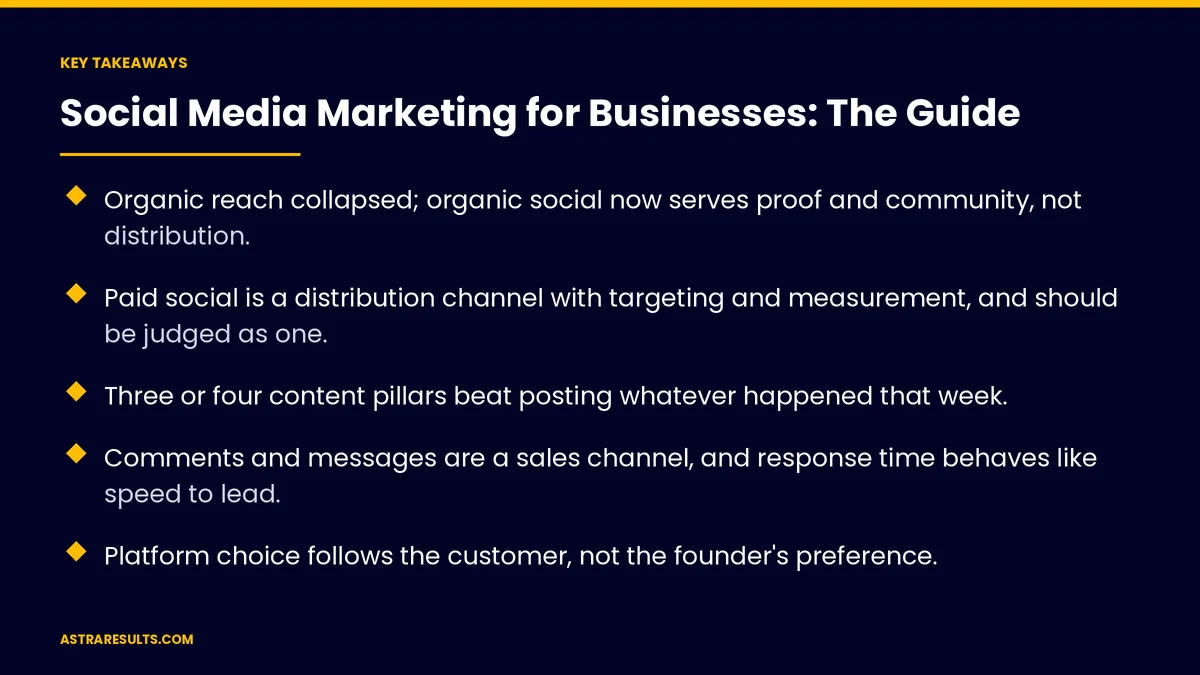
- Organic reach collapsed; organic social now serves proof and community, not distribution.
- Paid social is a distribution channel with targeting and measurement, and should be judged as one.
- Three or four content pillars beat posting whatever happened that week.
- Comments and messages are a sales channel, and response time behaves like speed to lead.
- Platform choice follows the customer, not the founder's preference.
- Measure booked customers and assisted conversions, not followers.
Published: September 23, 2026 | Reading Time: ~14 minutes | Category: Social Media
The plain version is more useful. Organic social does two specific jobs well and several jobs badly. Paid social does something different and is measurable. Community management is a sales function that most businesses staff as an afterthought. This guide separates those, so the effort goes where it pays. The takeaway that matters: organic social builds belief; paid social buys attention. Confusing them wastes both.
Guidance for owners and operators. Nothing here is legal advice. Advertising rules, disclosure requirements for endorsements, and restrictions on claims vary by industry and jurisdiction and should be reviewed with counsel.
In This Playbook
- What organic social does now
- Content pillars beat calendars
- Paid social: a different product
- Choosing platforms
- Community management is a sales function
- Video, because the platforms decided
- Influencers and partnerships, briefly
- Measuring social
- Where social budgets get wasted
- Three months, step by step
- Astra's part in it
What organic social does now
Reach is not what it was, and pretending otherwise causes most of the waste.
- What it does well. Proof, when someone who found the business elsewhere checks whether it is real and active. Recognition, for an audience that already knows the brand. Community, where customers gather and talk. Recruiting, which is underrated.
- What it does badly. Reaching strangers at scale. That job moved to paid and to search.
- The check-the-profile moment. Someone gets a referral, sees an ad or hears the name, and looks at the account before contacting. A dead account or a stale one costs the business a customer it had already earned.
- What that implies for effort. An account that looks alive, shows real work and answers people beats a high-volume calendar of forgettable posts.
- The honest budget question. If organic social is doing proof and community, staff it for that, and put distribution money into paid and search, the case for which sits in inputs versus outputs.
Content pillars beat calendars
Three or four recurring themes, each with a job.
- Proof of work. The thing the business did: the finished project, the process, the before and after, the team on site. The most credible content any business has and the least used.
- Expertise. The question customers ask, answered plainly. Short, specific, useful without the company in the frame.
- People. Who works here. Customers buy from people, and this is the pillar that makes a business feel real.
- Customers. Reviews, testimonials and stories, with permission, in their words.
- Optional fourth. Community or industry, where the business participates rather than promotes.
- Why pillars work. They remove the weekly question of what to post, make the account coherent, and ensure the credible content gets made rather than skipped.
- What to cut. Holiday posts, motivational quotes, stock imagery, and anything a competitor could post unchanged.
Paid social: a different product
Paid social is not boosting posts. It is a distribution channel with its own structure.
- What it is good at. Reaching people who do not know they need the service yet. Retargeting people who visited but did not contact. Reaching a defined audience in a defined area at low cost.
- What it is bad at. Capturing urgent demand. Someone with a burst pipe searches; they do not scroll.
- The structure. Prospecting to cold audiences, retargeting to site visitors and engagers, and a customer audience for retention and referral offers. Each with its own budget and its own judgment.
- Creative is the targeting now. Platforms optimize delivery well; what stops the scroll and who it appeals to is decided by the creative, not the audience settings.
- Volume of creative. Paid social consumes creative faster than any other channel. A campaign with three assets fatigues in weeks.
- Measurement honesty. Platform-reported conversions overstate. Judge with the business's own numbers, the case for which sits in attribution by channel.
Choosing platforms
Follow the customer, not the founder.
- The question to answer. Where do the people who buy this actually spend time? For a home services business, that is different from a B2B software company or a restaurant.
- The cost of being everywhere. Five platforms half-served look worse than two served properly. Each has its own format, rhythm and audience expectation.
- The B2B reality. Professional networks work for some categories and are dead for others. Test before committing.
- The bilingual dimension. In markets with a large Spanish-speaking population, WhatsApp and Spanish-language content are not an add-on, explored in Spanish as a channel.
- The recruiting angle. Sometimes the most valuable platform for a business is the one where its future employees are, not its customers.
Community management is a sales function
The most undervalued part of social, and the easiest to fix.
- What arrives. Questions in comments. Direct messages asking price and availability. Complaints in public. Tags from customers.
- How it is usually handled. Whenever someone remembers to check, which may be days.
- Why that costs money. A message asking "do you do this and how much" is a lead. Response time behaves exactly like speed to lead, according to the intake standard.
- The fix. Messages routed into the same intake system as calls and forms, answered in minutes, with AI covering the hours nobody is watching.
- Public complaints. Answered publicly, briefly, with the resolution moved to private. What other people read is the response, not the complaint.
- The tone. A business, not a brand persona. Manufactured personality reads as manufactured.
Video, because the platforms decided
Every major platform now prioritizes video, which is a format decision the business does not get to make.
- What works. Short, specific, shot where the work happens. The technician explaining. The kitchen at six. The install, sped up.
- Production value. Lower than people fear for social. Phone footage of real work outperforms polished generic video.
- The multiplier. One shoot produces a dozen pieces across formats and platforms, which is the only way the volume is sustainable.
- Captions always. Most viewing is silent.
- The honest constraint. If nobody will appear on camera, this pillar will underperform, and that is a business decision to make consciously rather than discover.
Influencers and partnerships, briefly
- Where it works. Local creators with real audiences in the business's actual market, and complementary businesses serving the same customer.
- Where it fails. Follower counts bought rather than earned, audiences in the wrong geography, and one-off posts with no follow-through.
- The disclosure requirement. Paid relationships must be disclosed, and the rules are specific in many jurisdictions. Counsel confirms the requirements before the first partnership.
- What to track. A tracked link or code, or the partnership is unmeasurable and therefore unjudgeable.
Measuring social
- Booked customers with social as first contact, from the intake source question.
- Messages and comments that became leads, with response time.
- Assisted conversions, where social was seen before a search or a direct visit — imperfect, directionally useful.
- Paid social cost per booked customer, compared to search and every other channel.
- Branded search lift after awareness campaigns.
- Content performance by pillar, to decide what to make more of.
- Followers, in the appendix, as a weak proxy for nothing in particular.
Where social budgets get wasted
- Posting to look busy. Volume without pillars, forgettable and expensive in time.
- Boosting posts instead of structured campaigns.
- Buying followers or engagement. Visible, worthless, and damaging to trust.
- Ignoring messages while paying to drive people to the profile.
- Five platforms, none properly.
- Judging by followers, which keeps the whole channel unaccountable.
Three months, step by step
Days 1–30: audit and pillars
Platforms assessed against where customers are, and the list cut. Three or four pillars defined. Messages and comments routed into the intake system with a response-time standard. The intake source question updated to capture social.
Days 31–60: produce and structure
The first content batch shot in one session and cut into a month of assets. Paid social structured into prospecting, retargeting and customer audiences with separate budgets. Creative volume planned for fatigue.
Days 61–90: measure and prune
Booked customers from social measured against the baseline. Cost per booked customer compared to other channels. Pillars and platforms that produced nothing cut, with the effort moved to the ones that did.
Astra's part in it
Astra Results Marketing separates the two jobs: organic social staffed for proof, community and recruiting, and paid social run as a measurable distribution channel with prospecting, retargeting and customer audiences budgeted separately. Content is built on three or four pillars drawn from the work the business actually does, produced in batches so the volume is sustainable.
Comments and messages are routed into the same intake system as calls and forms, because a message asking price is a lead. Reporting leads with booked customers and cost per booked customer, with followers in the appendix. Engagements begin with a platform and pillar audit through our social media marketing team.
Related reading
Frequently asked questions
What does organic social do for a business now?
Proof and community, not distribution. Reach collapsed, so organic no longer reaches strangers at scale — that job moved to paid and search. What it does well is the check-the-profile moment, when someone who got a referral or saw an ad looks at the account before contacting. A dead or stale account costs a customer the business had already earned.
What content should a business post?
Three or four pillars rather than a calendar: proof of the work done, which is the most credible content any business has and the least used; expertise answering the questions customers ask; the people who work there; and customers in their own words with permission. Cut holiday posts, motivational quotes, stock imagery and anything a competitor could post unchanged.
How is paid social different from organic?
It is a distribution channel with targeting and measurement, structured into prospecting, retargeting and customer audiences with separate budgets. It reaches people who do not yet know they need the service and re-reaches visitors who did not contact. It is bad at capturing urgent demand, because someone with a burst pipe searches rather than scrolls. Creative is effectively the targeting, and it fatigues fast.
Why is community management a sales function?
Because a direct message asking "do you do this and how much" is a lead, and response time behaves exactly like speed to lead. Most businesses check messages whenever someone remembers, which may be days, while paying to drive people to the profile. The fix is routing messages into the same intake system as calls and forms, answered in minutes, with coverage for the hours nobody is watching.
How should platforms be chosen?
By where the people who buy spend time, not by the founder's preference. Five platforms half-served look worse than two served properly, since each has its own format and rhythm. Professional networks work for some B2B categories and are dead for others, so test before committing. And sometimes the most valuable platform is the one where future employees are rather than customers.
What should be measured?
Booked customers with social as first contact from the intake source question, messages and comments that became leads with their response time, assisted conversions as a directional signal, paid social cost per booked customer compared against every other channel, branded search lift after awareness campaigns, and content performance by pillar. Followers belong in the appendix.
READY TO MAKE SOCIAL ACCOUNTABLE? Astra Results Marketing staffs organic for proof and community, runs paid as a measured distribution channel, routes messages into intake, and reports booked customers rather than followers. Astra Results Marketing · 1101 Brickell Ave, Miami, FL 33131 · +1 (786) 321-2866 · [email protected] Find us on Google · Yelp ▸ CALL (786) 321-2866 · ▸ REQUEST YOUR CONSULTATION