Rated 5 star on


Why Aesthetic Practice Marketing Fails
Quick answer
Aesthetic practice marketing usually fails after the ad, not in it. Unanswered phones, missing consult follow-up and poor scheduling waste most of the spend. Discounting attracts patients who do not stay. Attention metrics hide falling consults. Astra fixes the diagnosis with one ledger of kept consults and patient value by source.
Most aesthetic practices that describe their marketing as broken are wrong about where the break is. The campaign is rarely the problem. Across every market Astra has mapped, the failures repeat, and they cluster almost entirely downstream of the ad and upstream of the ledger.
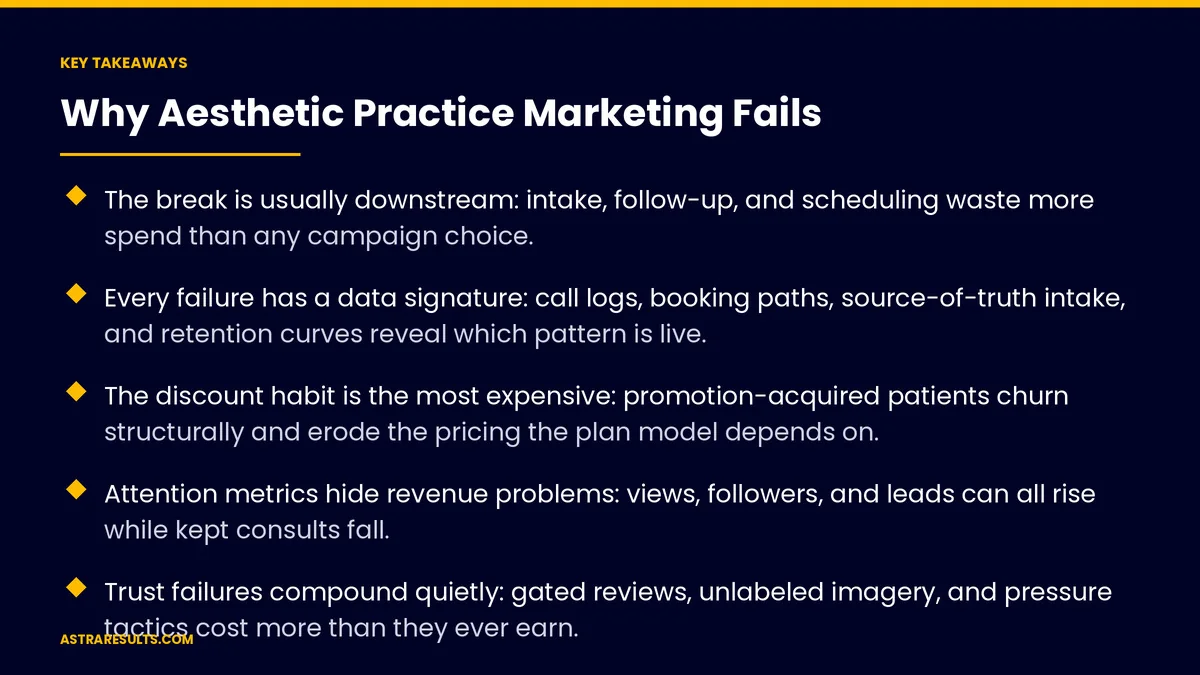
Key Takeaways
- The break is usually downstream: intake, follow-up, and scheduling waste more spend than any campaign choice.
- Every failure has a data signature: call logs, booking paths, source-of-truth intake, and retention curves reveal which pattern is live.
- The discount habit is the most expensive: promotion-acquired patients churn structurally and erode the pricing the plan model depends on.
- Attention metrics hide revenue problems: views, followers, and leads can all rise while kept consults fall.
- Trust failures compound quietly: gated reviews, unlabeled imagery, and pressure tactics cost more than they ever earn.
- One ledger fixes the diagnosis: kept consults, retention, and annual client value by source make every other argument empirical.
Published: October 31, 2026 | Reading Time: ~13 minutes | Category: Diagnostics · National
That map covers five metros, dozens of corridors, and the full range from single-provider med spas to surgical capitals.
An unanswered phone, a consult nobody followed up, a discount habit that trained the wrong patient, a metric that measured attention instead of revenue. This piece is the diagnostic companion to the rest of the library: ten failure patterns, how each one shows up in a practice's own numbers, and what replaces it.
The kicker names the frame: ten failures, one ledger.
The organizing insight is that these failures are detectable rather than debatable. Each pattern below has a signature in data a practice already has (call logs, booking records, source-of-truth intake answers, retention curves) which is why the diagnostic section of each pattern matters more than the description.
A practice that instruments the four-stage funnel and the cost-per-kept-consult ledger can find its own break in a week. A practice that reports impressions will keep buying more of the wrong thing. Marketing guidance for licensed practices only. Nothing here is medical advice. Candidacy and clinical decisions belong to your providers. Compliance review precedes publication of every asset.
In This Playbook
- What happens when an aesthetic practice's phones go unanswered?
- Why do aesthetic consults stall without a follow-up system?
- Failure 3: The Discount Habit
- Failure 4: Attention Mistaken for Demand
- Failure 5: Wrong-Patient Targeting
- Failure 6: The Trust Shortcuts
- Failure 7: The Insecurity Reflex
- Failure 8: Provider-Brand Fragility
- Failure 9: Renting Instead of Owning
- Failure 10: No Ledger
- The Pattern Behind the Patterns
- A 90-Day Diagnostic
What happens when an aesthetic practice's phones go unanswered?
The pattern. Spend generates calls. Calls go unanswered, reach voicemail, or land outside staffed hours. The practice concludes the channel didn't work. This is the single most common and most expensive failure in the category, and it is invisible in ad reporting.
The diagnostic. Pull call logs against ad-schedule hours and count answer rate, abandonment, and after-hours volume; then listen to ten recordings. If answer rate is below the high nineties during spend hours, the campaign was never the variable.
The fix. The never-voicemail standard with staffing matched to spend, the two-rails rule so booking exists without a phone call, and after-hours capture with human escalation via the configuration our AI Inbound service builds.
Why do aesthetic consults stall without a follow-up system?
The pattern. Consultations happen, patients say they'll think about it. Nothing happens afterward, because follow-up is improvised rather than designed. In every high-consideration market Astra has mapped, the return-after-comparison visit is the real conversion event, and practices without a cadence forfeit it.
The diagnostic. Measure consult-to-treatment conversion, then measure it again at 30, 60, and 90 days, if the delta is near zero, no follow-up structure exists.
The fix. A documented, non-pressuring cadence per the funnel standard: decision support, realistic timelines, and the explicit right to think, which is also the anti-close posture that converts best in premium markets.
Failure 3: The Discount Habit
The pattern. Revenue dips, a promotion fixes it, the promotion works. The practice runs another, until price becomes the brand and the patient base is composed of people who came for a deal.
The diagnostic. Cohort retention by acquisition source. Promotion-acquired patients versus full-price and plan-enrolled patients, compared at 12 and 24 months on the annual-client-value ledger. The gap is usually decisive and usually unexamined.
The fix. The plan model over promotion cycles, framework pricing published per the transparency standard, and the anti-deal posture held long enough for the ledger to prove it.
Failure 4: Attention Mistaken for Demand
The pattern. Followers grow, views climb, "leads" increase, and kept consultations don't. The metrics that are easiest to report are the ones least connected to revenue. A practice managed toward them drifts toward content and offers that attract the wrong patient, per the engagement-is-not-the-product argument.
The diagnostic. Build the four-stage funnel (inquiry, booked, kept, treatment-started) and watch whether stage-one growth reaches stage three.
The fix. Report saves, sends, profile-to-site movement, and cost per kept consult by source; put follower and view counts in a footnote where they belong.
Failure 5: Wrong-Patient Targeting
The pattern. Campaigns aimed at treatments rather than concerns, or at price rather than problem, filling the calendar with people who wanted something the practice shouldn't sell them.
The diagnostic. The down-scope rate and the decline rate. If providers are frequently talking patients out of what marketing sold them, the targeting is misaligned; if nobody is ever declined, something worse is happening.
The fix. Concern-led content per the one-intent architecture, a negatives fortress that excludes deal and DIY intent, and candidacy candor published early so self-selection happens before the appointment.
Failure 6: The Trust Shortcuts
The pattern. Gated reviews, unlabeled or filtered before-and-afters, borrowed stock results, vague credentials, "call for pricing" walls, and urgency that isn't real. Each buys a little short-term lift and costs credibility with exactly the researched patient who converts best.
The diagnostic. Audit the site and feed against Astra's standing rules: never-gate reviews, imagery under the full doctrine with consent records complete, credentials stated exactly, and no manufactured deadlines per the honest-urgency line. Then check review velocity and sentiment for the pattern that gating always eventually produces.
The fix. Remove the shortcuts and publish the standards. The photo rules and consent policy explained plainly are themselves conversion assets.
Failure 7: The Insecurity Reflex
The pattern. Copy and creative that sell dissatisfaction (body-part callouts, aging-anxiety hooks, "fix" language) because it demonstrably drives response. It also builds a patient base that arrives dissatisfied and leaves dissatisfied, and it fails the no-insecurity absolute Astra holds without exception.
The diagnostic. Read six months of creative aloud and count how many pieces name a flaw versus explain an option; then compare consult quality and complaint patterns across those cohorts.
The fix. The approved hook library (correction, process, decision, cost, and the down-scope hook) which performs while staying inside the ethics.
Failure 8: Provider-Brand Fragility
The pattern. The practice's marketing rests entirely on one provider's personal following, with no written policy on ownership, content, or departure. So a resignation takes the audience with it.
The diagnostic. What percentage of inquiries name a specific provider. Is there a signed policy covering accounts, content, and audience?
The fix. The staff-and-creator governance Astra requires: ownership settled in writing, practice-brand equity built alongside provider brands, and provider continuity marketed as the relationship it is without making it the only asset.
Failure 9: Renting Instead of Owning
The pattern. Everything lives on platforms (the gallery, the education, the audience) so a policy change, a reach shift, or an account action erases years of work.
The diagnostic. Inventory where the practice's proof lives, and ask what survives losing an account tomorrow.
The fix. The owned-first posture, the case library and education on the practice's own site earning search and AI-answer presence, with platforms as introductions and every published asset archived with its consent record.
Failure 10: No Ledger
The pattern. The practice cannot say what a patient costs to acquire, what she's worth over two years, or which source produced her. So every marketing argument is settled by opinion and every cut is made blind. This failure enables all nine above.
The diagnostic. Try to answer three questions in one sitting: cost per kept consult by source, 24-month value by acquisition cohort, and retention by provider and plan status. If the answers require a project, the ledger doesn't exist.
The fix. Source-of-truth intake questions asked every time, the four-stage funnel instrumented. The cost-per-kept-consult ledger reported monthly, the one build that turns the other nine from arguments into observations.
The Pattern Behind the Patterns
Read together, the ten share a structure worth naming. Nine of them are operational, not creative: which is why agencies that only touch campaigns so often deliver traffic without revenue, and why the operations-as-marketing insight recurs in every corridor Astra maps: the scheduling grace, the answered phone, the plain photo standard, and the follow-up cadence are the marketing.
They compound in both directions. A practice with no ledger runs discounts to fix an intake problem, then buys more attention to fix the discount problem, while a practice that fixes intake first often discovers its "failing" campaigns were working all along.
And they resolve on the same clocks Astra keeps returning to. Retention years, household depth, kept consultations, and the plain cost of acquiring a patient worth keeping.
A 90-Day Diagnostic
Days 1–30: Instrument and observe
- Source-of-truth intake questions deployed
- The four-stage funnel built
- Call-log answer rates pulled against spend hours with ten recordings reviewed
- Cohort retention by acquisition source assembled at 12 and 24 months
- The trust audit run against the standing rules
- No strategy changes yet, because the diagnosis comes first
Days 31–60: Fix downstream first
Intake staffing matched to spend with after-hours capture live; the follow-up cadence documented and running; booking-first shipped beside the phone rail. The trust shortcuts removed and the standards published; the negatives fortress rebuilt around concern-led targeting.
Days 61–90: Rebuild the economics
- The plan model launched with framework pricing published
- The discount calendar retired against the cohort data
- Provider-brand and content governance signed
- The owned library prioritized over platform-only assets
- The ledger reported monthly — cost per kept consult, 24-month cohort value, retention by plan status — with the next quarter's spend allocated from it rather than from opinion
How Astra Diagnoses Practice Marketing
Astra Results Marketing starts every aesthetic engagement with the diagnosis rather than the campaign: the answered-phone audit, the follow-up gap, the discount cohort comparison, the trust-shortcut review, and the ledger that makes all of it visible, because in this category the campaign is rarely the break, and the practices that find their real one stop buying more of the wrong thing.
Engagements begin with a funnel, trust, and ledger audit through our business consulting team.
Related reading
Frequently asked questions
Our ads generate plenty of leads but few patients. Where do we look first?
The phone and the follow-up, in that order. Pull call logs against your ad-schedule hours and check answer rate, abandonment, and after-hours volume, then listen to ten recordings, and separately, measure consult-to-treatment conversion at 30, 60, and 90 days to see whether any follow-up structure exists. In this category those two checks explain most "the ads don't work" complaints, and neither is visible in ad reporting.
How do we know if our discount habit is actually hurting us?
Compare cohorts rather than months: retention and 24-month value for promotion-acquired patients versus full-price and plan-enrolled patients. Promotion cohorts almost always show structurally worse retention and lower lifetime value while also depressing the pricing your plan model depends on. The comparison ends the internal debate faster than any argument, because it's arithmetic rather than philosophy.
Isn't some urgency and some insecurity just how aesthetics marketing works?
It's how a lot of it works, and it's why so much of it produces dissatisfied patients and thin retention. Manufactured deadlines and flaw-naming copy drive response and select for exactly the patient who arrives with unrealistic expectations. The approved hook library (correction, process, decision, cost, and "you don't need this yet") performs while attracting the informed patient. The down-scope rate is how you prove it.
What single metric would improve our decisions most?
Cost per kept consult by source, with 24-month cohort value beside it. Inquiries and bookings both flatter channels that produce no-shows and price shoppers. The kept consultation is the first point at which a practice's marketing has delivered something clinical, and pairing it with cohort value tells you which sources produce patients worth keeping rather than merely counting.
We rely heavily on one injector's Instagram following. Is that a problem?
It's an asset with an unmanaged risk: if a resignation would take your audience and inquiry flow with it, the practice has no brand equity of its own. Settle ownership of accounts, content, and audience in writing now, build practice-level education and case libraries alongside the provider's personal presence, and track what share of inquiries name an individual, that number is your concentration risk.
How long before fixing these shows up in revenue?
Downstream fixes show fastest, answered phones and follow-up cadences often move conversion within a single month, while the economics repairs run on retention clocks and take two to four quarters to read plainly. That's precisely why the ledger comes first. Without it, a practice abandons a working change at week six and returns to the discount cycle that created the problem.
Ready to Find Your Actual Break? Astra Results Marketing diagnoses before it campaigns. The answered-phone audit, the follow-up gap, the discount cohort comparison, the trust review, and the ledger that makes every argument empirical. Start with a funnel, trust, and ledger audit for your practice. ▸ CALL (786) 321-2866 · ▸ REQUEST YOUR CONSULTATION